Formoterol
JFDA label: Oxis Turbohaler
- Asthma-related death:
- Pediatric and adolescent patients:
Mechanism of Action
Relaxes bronchial smooth muscle by selective action on beta2 receptors with little effect on heart rate. Formoterol has a long-acting effect.
Indications
Approved
- Asthma
- COPD
- Canadian labeling
- Chronic obstructive pulmonary disease (COPD)
- Exercise-induced bronchospasm
- US labeling
Contraindications
Source: Lexicomp
- Additional contraindications (not in US labeling): Presence of tachyarrhythmias Absolute
- Hypersensitivity to formoterol or any component of the formulation (Foradil Aerolizer only) Absolute
- monotherapy in the treatment of asthma without use of a concomitant long-term asthma control medication Documentation of allergenic cross-reactivity for sympathomimetics is limited. However, because of similarities in chemical structure and/or pharmacologic actions, the possibility of cross-sensitivity cannot be ruled out with certainty Absolute
- treatment of status asthmaticus or other acute episodes of asthma or COPD (Foradil Aerolizer only) Absolute
Adverse Reactions
Cardiac disorders (1)
Common Chest pain
Nervous system disorders (5)
Common Anxiety · dizziness · headache · insomnia · voice disorder
Gastrointestinal disorders (7)
Common abdominal pain · Diarrhea · dyspepsia · gastroenteritis · nausea · vomiting · xerostomia
Skin and subcutaneous tissue disorders (2)
Common Pruritus · skin rash
Musculoskeletal and connective tissue disorders (2)
Common Muscle cramps · tremor
Respiratory, thoracic and mediastinal disorders (2)
Common exacerbation of asthma · Respiratory tract infection
Dosing
Source: Lexicomp
Warnings & Precautions
Source: Lexicomp
Asthma-related deaths
Long-acting beta2-agonists (LABAs) increase the risk of asthma-related deaths. Formoterol should only be used in asthma patients as adjuvant therapy in patients who are currently receiving but are not adequately controlled on a long-term asthma control medication (ie, an inhaled corticosteroid). Monotherapy with an LABA is contraindicated in the treatment of asthma. In a large, randomized, placebo-controlled US clinical trial (SMART 2006), salmeterol was associated with an increase in asthma-related deaths (when added to usual asthma therapy); risk is considered a class effect among all LABAs. Data are not available to determine if the addition of an inhaled corticosteroid lessens this increased risk of death associated with LABA use; however, current guidelines recommend the use of an inhaled corticosteroid before adding a LABA (GINA 2015; NIH/NHLBI 2007). Assess patients at regular intervals once asthma control is maintained on combination therapy to determine if step-down therapy is appropriate and the LABA can be discontinued (without loss of asthma control), and the patient can be maintained on an inhaled corticosteroid. LABAs are not appropriate in patients whose asthma is adequately controlled on low- or medium-dose inhaled corticosteroids. In a more recent multicenter, randomized, double-blinded trial, the use of salmeterol and an inhaled corticosteroid (ie, fluticasone) combined in a single inhaler in a large number of children, adolescent, and adult patients with pe
Bronchospasm
Paradoxical bronchospasm that may be life-threatening and may occur with use of inhaled bronchodilating agents; this reaction should be distinguished from inadequate response. Discontinue immediately if paradoxical bronchospasm occurs and institute alternative therapy.
Hypersensitivity reactions
Immediate hypersensitivity reactions (urticaria, angioedema, rash, bronchospasm) have been reported.
Serious effects/fatalities
Do not exceed recommended dose or frequency or use with other medications containing LABAs; serious adverse events, including fatalities, have been associated with excessive use of inhaled sympathomimetics. Disease-related concerns:
Asthma
Appropriate use: - Foradil Aerolizer: Do not use for acute bronchospasm. Short-acting beta2-agonist (eg, albuterol) should be used for acute symptoms and symptoms occurring between treatments. Do not initiate in patients with significantly worsening or acutely deteriorating asthma; reports of severe (sometimes fatal) respiratory events have been reported when formoterol has been initiated in this situation. Corticosteroids should not be stopped or reduced when formoterol is initiated. Formoterol is not a substitute for inhaled or systemic corticosteroids and should not be used as monotherapy. During initiation, watch for signs of worsening asthma. - Perforomist: Not FDA approved for the treatment of asthma; safety and efficacy in asthma patients have not been established.
Cardiovascular disease
Use with caution in patients with cardiovascular disease (arrhythmia, coronary insufficiency, hypertension, HF, or aneurysm); beta-agonists may cause elevation in blood pressure and heart rate and result in CNS stimulation/excitation. Beta2-agonists have been reported to produce ECG changes, such as flattening of the T wave, prolongation of the QTc interval, and ST segment depression.
Chronic obstructive pulmonary disease
Do not use for acute episodes of chronic obstructive pulmonary disease (COPD). Do not initiate in patients with significantly worsening or acutely deteriorating COPD. Data are not available to determine if LABA use increases the risk of death in patients with COPD.
Diabetes
Use with caution in patients with diabetes mellitus; beta2-agonists may increase serum glucose; the effect is usually transient.
Exercise-induced bronchospasm
Because LABAs may disguise poorly controlled persistent asthma, frequent or chronic use of LABAs for exercise-induced bronchospasm is discouraged by the NIH Asthma Guidelines (NIH, 2007).
Hyperthyroidism
Use with caution in hyperthyroidism; may stimulate thyroid activity.
Hypokalemia
Use with caution in patients with hypokalemia; beta2-agonists may decrease serum potassium; the effect is usually transient.
Pheochromocytoma
Use with caution in patients with pheochromocytoma; may worsen symptoms.
Seizures
Use with caution in patients with seizure disorders; beta-agonists may result in CNS stimulation/excitation. Concurrent drug therapy issues:
Drug-drug interactions
Potentially significant interactions may exist, requiring dose or frequency adjustment, additional monitoring, and/or selection of alternative therapy. Consult drug interactions database for more detailed information. Special populations:
Pediatric
Foradil Aerolizer: [US Boxed Warning]: LABAs may increase the risk of asthma-related hospitalization in pediatric and adolescent patients. In general, a combination product containing a LABA and an inhaled corticosteroid is preferred in patients Dosage form specific issues:
Foradil Aerolizer
The contents of the capsules are for inhalation only via the Aerolizer device. There have been reports of incorrect administration (swallowing of the capsules).
Lactose
Powder for oral inhalation contains lactose; very rare anaphylactic reactions have been reported in patients with severe milk protein allergy. Other warnings/precautions:
Patient information
Patients using inhaled, short-acting beta2-agonists should be instructed to discontinue routine use of these medications prior to beginning treatment; short-acting agents should still be provided to patients; however, use should be reserved for symptomatic relief of acute symptoms. Patients must be instructed to seek medical attention in cases where acute symptoms are not relieved or a previous level of response is diminished. The need to increase frequency of use of short-acting beta2-agonists may indicate deterioration of asthma or COPD, and medical evaluation must not be delayed.
Tolerance/Tachyphylaxis
Tolerance to the bronchodilator effect, measured by FEV1, has been observed in studies.
Pregnancy & Lactation
Pregnancy
Adverse events were observed in some animal reproduction studies. Beta-agonists may interfere with uterine contractility if administered during labor.
Lactation
It is not known if formoterol is present in breast milk. According to the manufacturer, the decision to continue or discontinue breastfeeding during therapy should take into account the risk of infant exposure, the benefits of breastfeeding to the infant, and benefits of treatment to the mother.
Monitoring
| Clinical pearl | FEV1, peak flow, and/or other pulmonary function tests; shortness of breath; blood pressure, heart rate; CNS stimulation; serum glucose, serum potassium |
|---|
Chemistry & Properties
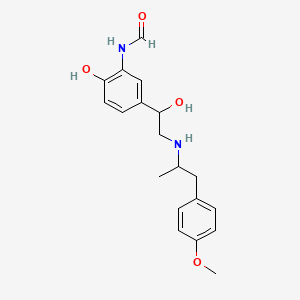
| Formula | C19H24N2O4 |
|---|---|
| Molecular weight | 344.41 g/mol |
| IUPAC name | N-[2-hydroxy-5-[1-hydroxy-2-[1-(4-methoxyphenyl)propan-2-ylamino]ethyl]phenyl]formamide |
| CAS | 73573-87-2 |
| PubChem CID | 3410 |
| InChIKey | BPZSYCZIITTYBL-UHFFFAOYSA-N |
| logP | 2.22 (XLogP 1.8) |
| Polar surface area | 90.82 Ų |
| H-bond acceptors / donors | 5 / 4 |
| Drug-likeness (QED) | 0.41 |
| Lipinski violations | 0 |
SMILES
COc1ccc(CC(C)NCC(O)c2ccc(O)c(NC=O)c2)cc1Biology & Pharmacokinetics
Pharmacokinetics
| BBB penetrant | No |
|---|
Enzyme interactions
| Enzyme | Role | Detail |
|---|---|---|
| CYP1A2 | Inhibitor | — |
| CYP1A2 | Substrate | — |
| CYP2C19 | Inhibitor | — |
| CYP2C19 | Substrate | — |
| CYP2C8 | Inhibitor | — |
| CYP2C9 | Substrate | — |
| CYP2D6 | Inhibitor | — |
| CYP2D6 | Substrate | — |
| CYP3A4 | Inhibitor | — |
Receptor binding (top 4)
| Target | Action | Affinity |
|---|---|---|
| β1-adrenoceptor (ADRB1) | Agonist | pEC50 8.3 |
| adrenergic Beta2 (ADRB2) | Binding | pKi 7.1 |
| adrenergic Beta1 (ADRB1) | Binding | pKi 7.0 |
| adrenergic Beta3 (ADRB3) | Binding | pKi 6.7 |
Transporters
BCRP (Inhibitor)BSEP (Inhibitor)BSEP (Inhibitor)MRP1 (Inhibitor)MRP2 (Inhibitor)MRP3 (Inhibitor)MRP4 (Inhibitor)OATP1B1 (Inhibitor)OATP1B3 (Inhibitor)OCT3 (Inhibitor)P-gp (Inhibitor)MATE1 (Substrate)MATE2 (Substrate)OCT1 (Substrate)OCT2 (Substrate)OCT3 (Substrate)OCTN1 (Substrate)OCTN2 (Substrate)P-gp (Substrate)
Drug–drug interactions (100+, DDInter)
| Interacting drug | Severity | Management |
|---|---|---|
| Carteolol | major | |
| Carteolol (ophthalmic) | major | |
| Carvedilol | major | |
| Cocaine (nasal) | major | |
| Cocaine (topical) | major | |
| Labetalol | major | |
| Levobunolol (ophthalmic) | major | |
| Macimorelin | major | |
| Metipranolol (ophthalmic) | major | |
| Nadolol | major | |
| Ozanimod | major | |
| Penbutolol | major | |
| Pindolol | major | |
| Propranolol | major | |
| Ribociclib | major | |
| Sotalol | major | |
| Timolol | major | |
| Timolol (ophthalmic) | major | |
| Abarelix | moderate | |
| Abiraterone | moderate | |
| Acarbose | moderate | |
| Acebutolol | moderate | |
| Acetazolamide | moderate | |
| Albiglutide | moderate | |
| Alfuzosin | moderate | |
| Alimemazine | moderate | |
| Alogliptin | moderate | |
| Aminophylline | moderate | |
| Amiodarone | moderate | |
| Amisulpride | moderate | |
| Amitriptyline | moderate | |
| Amoxapine | moderate | |
| Amphetamine | moderate | |
| Anagrelide | moderate | |
| Apalutamide | moderate | |
| Apomorphine | moderate | |
| Arformoterol | moderate | |
| Aripiprazole | moderate | |
| Armodafinil | moderate | |
| Arsenic trioxide | moderate |
Showing 40 of 100+.
Registered Products (15)
| Brand | Form / strength | Pack | Agent | Citizen (JOD) |
|---|---|---|---|---|
| Foradil Cap | Capsule 12 mcg | 30 Dry Powder Caps + 1 Inhaler | Nabulsi Drug Store | 10.300 |
| Formagal | Tablet 12 mcg | 60 tab | Salam Drug Store | 13.110 |
| Oxis Turbohaler | Inhaler Dihydrate 9 mcg | 60 Dose | Shawi & Rushedat Drug Store | 18.170 |
| Bufomix Easyhalar | Inhaler 160 mcg, 4.5 mcg | 60 Dose pack varies | Hikma Pharmaceuticals Co.Ltd/Jordan | 18.850 |
| Atimos | Inhaler 12 mcg/dose | 100 Dose | Kurdi Drug Store | 19.090 |
| Symbicort Turbuhaler | Inhaler 160 mcg/dose, Dihydrate 4.5 mcg/dose | 60 dose pack varies | Shawi & Rushedat Drug Store | 19.090 |
| Flutiform | Inhaler 50 mcg, 5 mcg | 1 X 120 Actuations | Sukhtian Group | 20.500 |
| Foster | Tablet 100 mcg, 6 mcg | 1 Can X 120 dose | Kurdi Drug Store | 22.300 |
| Bufomix Easyhalar | Inhaler 320 mcg, 9 mcg | 60 Dose | Hikma Pharmaceuticals Co.Ltd/Jordan | 30.160 |
| Symbicort Turbuhaler 320 mcg/9mcg | Inhaler 320 mcg/dose, 9 mcg/dose | 60 Doses | Shawi & Rushedat Drug Store | 30.180 |
| Flutiform | Tablet 125 mcg, 5 mcg | 1X120 actuation | Sukhtian Group | 30.280 |
| Bufomix Easyhalar | Inhaler 160 mcg, 4.5 mcg | 120 Dose pack varies | Hikma Pharmaceuticals Co.Ltd/Jordan | 35.820 |
| Symbicort Turbuhaler | Inhaler 160 mcg/dose, Dihydrate 4.5 mcg/dose | 120 Dose pack varies | Shawi & Rushedat Drug Store | 36.370 |
| Breztri Aerosphere pressurised inhalation, suspension | Suspension 160 mcg, 5 mcg, 7.2 mcg | 120 Actuations | Shawi & Rushedat Drug Store | 51.610 |
| Flutiform | Tablet 250 mcg, 10 mcg | 1 Canister X 120 Dose | Sukhtian Group | 52.350 |