Acetazolamide
JFDA label: Acetazolamide 250 mg tab
Mechanism of Action
Inhibitor of Carbonic anhydrase 1 — Carbonic anhydrase I inhibitor; Inhibitor of Carbonic anhydrase 2 — Carbonic anhydrase II inhibitor; Inhibitor of Carbonic anhydrase 12 — Carbonic anhydrase XII inhibitor; Inhibitor of Carbonic anhydrase 4 — Carbonic anhydrase IV inhibitor
| Target | Action | Gene / class |
|---|---|---|
| Carbonic anhydrase 1 efficacy | INHIBITOR | CA1 |
| Carbonic anhydrase 12 efficacy | INHIBITOR | CA12 |
| Carbonic anhydrase 2 efficacy | INHIBITOR | CA2 |
| Carbonic anhydrase 4 efficacy | INHIBITOR | CA4 |
Indications
Off-label
- Familial periodic paralysis
- Hydrocephalus, normal-pressure
- Metabolic alkalosis
- Prevention of cystine renal calculi (adjunctive therapy)
- Respiratory stimulant in stable hypercapnic COPD
Contraindications
Source: Lexicomp
- Hypersensitivity to acetazolamide, sulfonamides, or any component of the formulation Absolute
- adrenocortical insufficiency Absolute
- decreased sodium and/or potassium levels Absolute
- hyperchloremic acidosis Absolute
- long-term use in noncongestive angle-closure glaucoma Note: Although the FDA approved product labeling states this medication is contraindicated with other sulfonamide-containing drug classes, the scientific basis of this statement has been challenged. See “Warnings/Precautions” for more detail Absolute
- marked hepatic disease or insufficiency Absolute
- severe renal disease or dysfunction Absolute
Adverse Reactions
Cardiac disorders (1)
Not Known Flushing
Nervous system disorders (12)
Not Known Ataxia · confusion · convulsions · depression · dizziness · drowsiness · excitement · fatigue · flaccid paralysis · headache · malaise · paresthesia
Hepatobiliary disorders (4)
Not Known Abnormal hepatic function tests · cholestatic jaundice · fulminant hepatic necrosis · hepatic insufficiency
Renal and urinary disorders (4)
Not Known Crystalluria · hematuria · Polyuria · renal failure
Blood and lymphatic system disorders (5)
Not Known Agranulocytosis · aplastic anemia · leukopenia · thrombocytopenia · thrombocytopenic purpura
Immune system disorders (1)
Not Known Anaphylaxis
Metabolism and nutrition disorders (7)
Not Known Electrolyte imbalance · growth retardation (children) · hyperglycemia · hypoglycemia · hypokalemia · hyponatremia · metabolic acidosis
Gastrointestinal disorders (7)
Not Known Decreased appetite · diarrhea · dysgeusia · glycosuria · melena · nausea · vomiting
Skin and subcutaneous tissue disorders (5)
Not Known Allergic skin reaction · skin photosensitivity · Stevens-Johnson syndrome · toxic epidermal necrolysis · urticaria
Eye disorders (1)
Not Known Myopia
Ear and labyrinth disorders (2)
Not Known Auditory disturbance · tinnitus
General disorders and administration site conditions (2)
Not Known Fever · Pain at injection site
Dosing
Source: Lexicomp
Warnings & Precautions
Source: Lexicomp
CNS effects
Impairment of mental alertness and/or physical coordination may occur.
Sulfonamide (“sulfa”) allergy
The FDA-approved product labeling for many medications containing a sulfonamide chemical group includes a broad contraindication in patients with a prior allergic reaction to sulfonamides. There is a potential for cross-reactivity between members of a specific class (eg, two antibiotic sulfonamides). However, concerns for cross-reactivity have previously extended to all compounds containing the sulfonamide structure (SO2NH2). An expanded understanding of allergic mechanisms indicates cross-reactivity between antibiotic sulfonamides and nonantibiotic sulfonamides may not occur or at the very least this potential is extremely low (Brackett 2004; Johnson 2005; Slatore 2004; Tornero 2004). In particular, mechanisms of cross-reaction due to antibody production (anaphylaxis) are unlikely to occur with nonantibiotic sulfonamides. T-cell-mediated (type IV) reactions (eg, maculopapular rash) are less well understood and it is not possible to completely exclude this potential based on current insights. In cases where prior reactions were severe (Stevens-Johnson syndrome/TEN), some clinicians choose to avoid exposure to these classes. Disease-related concerns:
Diabetes
Use with caution in patients with prediabetes or diabetes mellitus; may see a change in glucose control.
Hepatic impairment
Use with caution in patients with hepatic dysfunction; in cirrhosis, avoid electrolyte and acid/base imbalances that might lead to hepatic encephalopathy.
Respiratory acidosis
Use with caution in patients with respiratory acidosis; may worsen acidosis. Concurrent drug therapy issues:
Aspirin (high dose)
Use with caution or avoid in patients taking high-dose aspirin concurrently; may lead to severe adverse effects including tachypnea, anorexia, lethargy, coma, and death. Special populations:
Elderly
Use with caution in the elderly; may be more sensitive to side effects. Other warnings/precautions:
Appropriate use
Increasing the dose does not increase diuresis and may increase the incidence of drowsiness and/or paresthesia; often results in a reduction of diuresis.
IM administration
Painful because of the alkaline pH of the drug; use by this route is not recommended.
Pregnancy & Lactation
Pregnancy
Adverse events have been observed in animal reproduction studies. Limited data is available following the use of acetazolamide in pregnant women for the treatment of idiopathic intracranial hypertension (Falardeau 2013; Kesler 2013). Pregnant women exposed to acetazolamide during pregnancy for the treatment of seizure disorders are encouraged to enroll themselves into the AED Pregnancy Registry by calling 1-888-233-2334. Additional information is available at aedpregnancyregistry.org
Lactation
Acetazolamide is excreted into breast milk. In a case report, low concentrations of acetazolamide were detected in the breast milk and the infant serum following a maternal dose of acetazolamide 500 mg twice daily. Acetazolamide concentrations in the breast milk were 1.3 to 2.1 mcg/mL, 1 to 9 hours after the dose. Acetazolamide concentrations in the infant serum were 0.2 to 0.6 mcg/mL, 2 to 12 hours after nursing. Maternal plasma concentrations were 5.2 to 6.4 mcg/mL, 1 to 7 hours after the dose
Monitoring
| Clinical pearl | Intraocular pressure; serum electrolytes, periodic CBC with differential; monitor growth in pediatric patients |
|---|
Chemistry & Properties
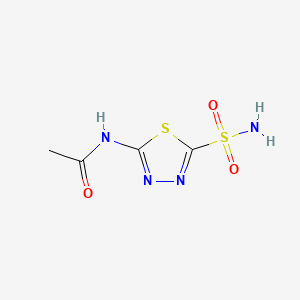
| Formula | C4H6N4O3S2 |
|---|---|
| Molecular weight | 222.25 g/mol |
| IUPAC name | N-(5-sulfamoyl-1,3,4-thiadiazol-2-yl)acetamide |
| CAS | 59-66-5 |
| PubChem CID | 1986 |
| InChIKey | BZKPWHYZMXOIDC-UHFFFAOYSA-N |
| logP | -0.86 (XLogP -0.3) |
| Polar surface area | 115.04 Ų |
| H-bond acceptors / donors | 6 / 2 |
| Drug-likeness (QED) | 0.63 |
| Lipinski violations | 0 |
SMILES
CC(=O)Nc1nnc(S(N)(=O)=O)s1Biology & Pharmacokinetics
Pharmacokinetics
| BBB penetrant | Yes (logBB -0.52) |
|---|
Enzyme interactions
| Enzyme | Role | Detail |
|---|---|---|
| CYP3A4 | Substrate | — |
Receptor binding (top 6)
| Target | Action | Affinity |
|---|---|---|
| carbonic anhydrase 7 (CA7) | Inhibitor | pKi 8.6 |
| carbonic anhydrase 12 (CA12) | Inhibitor | pKi 8.2 |
| Carbonic Anhydrase Isozymes, CA II | Binding | pKi 7.9 |
| Carbonic Anhydrase Isozymes, CA IX | Binding | pKi 7.6 |
| Carbonic Anhydrase Isozymes, CA I | Binding | pKi 6.6 |
| carbonic anhydrase 1 (CA1) | Inhibitor | pKi 6.6 |
Transporters
BCRP (Inhibitor)BSEP (Inhibitor)BSEP (Inhibitor)MRP1 (Inhibitor)MRP2 (Inhibitor)MRP3 (Inhibitor)MRP4 (Inhibitor)OAT1 (Inhibitor)OAT2 (Inhibitor)OAT3 (Inhibitor)OAT4 (Inhibitor)OATP1B1 (Inhibitor)OATP1B3 (Inhibitor)OATP1B3 (Inhibitor)P-gp (Inhibitor)MDR1 (Substrate)OAT (Substrate)OAT2 (Substrate)P-gp (Substrate)
Drug–drug interactions (100+, DDInter)
| Interacting drug | Severity | Management |
|---|---|---|
| Acetylsalicylic acid | major | |
| Aminolevulinic acid | major | |
| Arsenic trioxide | major | |
| Cisapride | major | |
| Metformin | major | |
| Salicylic acid (sodium) | major | |
| Acarbose | moderate | |
| Acetohexamide | moderate | |
| Albiglutide | moderate | |
| Aldesleukin | moderate | |
| Alogliptin | moderate | |
| Aminolevulinic acid (topical) | moderate | |
| Amphotericin B | moderate | |
| Amphotericin B (cholesteryl sulfate) | moderate | |
| Amphotericin B (lipid complex) | moderate | |
| Amphotericin B (liposomal) | moderate | |
| Beclomethasone dipropionate | moderate | |
| Betamethasone | moderate | |
| Bisacodyl | moderate | |
| Canagliflozin | moderate | |
| Castor oil | moderate | |
| Chloroquine | moderate | |
| Chlorpropamide | moderate | |
| Corticotropin | moderate | |
| Cyclosporine | moderate | |
| Dapagliflozin | moderate | |
| Deflazacort | moderate | |
| Dexamethasone | moderate | |
| Diatrizoate | moderate | |
| Dulaglutide | moderate | |
| Empagliflozin | moderate | |
| Epoprostenol | moderate | |
| Ertugliflozin | moderate | |
| Exenatide | moderate | |
| Fludrocortisone | moderate | |
| Formoterol | moderate | |
| Glimepiride | moderate | |
| Glipizide | moderate | |
| Glyburide | moderate | |
| Glycerin | moderate |
Showing 40 of 100+.
Registered Products (1)
| Brand | Form / strength | Pack | Agent | Citizen (JOD) |
|---|---|---|---|---|
| Acetazolamide | Tablet 250 mg | 30 tab | JAWEDA INT. DRUD STORE | 4.190 |