Atropine
JFDA label: Minims Atropine Sulphate 1% e/d
Mechanism of Action
Antagonist of Muscarinic acetylcholine receptor M3 — Muscarinic acetylcholine receptor M3 antagonist; Antagonist of Muscarinic acetylcholine receptor M1 — Muscarinic acetylcholine receptor M1 antagonist; Antagonist of Muscarinic acetylcholine receptor M2 — Muscarinic acetylcholine receptor M2 antagonist
| Target | Action | Gene / class |
|---|---|---|
| Muscarinic acetylcholine receptor M1 efficacy | ANTAGONIST | CHRM1 |
| Muscarinic acetylcholine receptor M2 efficacy | ANTAGONIST | CHRM2 |
| Muscarinic acetylcholine receptor M3 efficacy | ANTAGONIST | CHRM3 |
Indications
Approved
- Digestive System Diseases — gastrointestinal disease
- Mydriasis — Mydriasis
- Poisoning — poisoning
Off-label
- Amblyopia
- Amyotrophic Lateral Sclerosis
- Anisometropia
- Blood Coagulation Disorders
- Bradycardia
- Breast Neoplasms
- Dwarfism, Pituitary
- Headache
- Heart Arrest
- Hemorrhage
- Hypospadias
- Myopia
- Myopia, Degenerative
- Organophosphate Poisoning
- Pain
- Pneumonia, Ventilator-Associated
- Rhinitis, Allergic, Seasonal
- Strabismus
Contraindications
Source: openFDA
- None. None. ( 4 ) Absolute
Dosing
Source: openFDA
Warnings & Precautions
Source: openFDA
Warnings & Precautions
Hypersensitivity ( 5.1 ) Worsening of Ischemic Heart Disease ( 5.2 ) Acute Glaucoma ( 5.3 ) Pyloric obstruction ( 5.4 ) Complete urinary retention ( 5.5 ) Viscid plugs ( 5.6 )
Hypersensitivity Atropine may cause anaphylaxis
Hypersensitivity Atropine may cause anaphylaxis.
Worsening of Ischemic Heart Disease In patients with ischemic heart di
Worsening of Ischemic Heart Disease In patients with ischemic heart disease, the total dose should be restricted to 2 to 3 mg (maximum 0.03 to 0.04 mg/kg) to avoid atropine-induced tachycardia, increased myocardial oxygen demand and the potential for worsening cardiac ischemia or increasing infarction size.
Acute Glaucoma Atropine may precipitate acute glaucoma
Acute Glaucoma Atropine may precipitate acute glaucoma.
Pyloric Obstruction Atropine may convert partial organic pyloric steno
Pyloric Obstruction Atropine may convert partial organic pyloric stenosis into complete obstruction.
Complete Urinary Retention Atropine may lead to complete urinary reten
Complete Urinary Retention Atropine may lead to complete urinary retention in patients with prostatic hypertrophy.
Viscid Plugs Atropine may cause thickening of bronchial secretions and
Viscid Plugs Atropine may cause thickening of bronchial secretions and formation of viscid plugs in patients with chronic lung disease.
Benzyl Alcohol The preservative benzyl alcohol has been associated wit
Benzyl Alcohol The preservative benzyl alcohol has been associated with serious adverse events and death in neonates. The “gasping syndrome” (characterized by central nervous system depression, metabolic acidosis, gasping respirations, and high levels of benzyl alcohol and its metabolites found in the blood and urine) has been associated with benzyl alcohol dosages >99 mg/kg/day in neonates and low-birth weight infants. Additional symptoms may include gradual neurological deterioration, seizures, intracranial hemorrhage, hematologic abnormalities, skin breakdown, hepatic and renal failure, hypotension, bradycardia, and cardiovascular collapse. Although normal therapeutic doses of this product deliver amounts of benzyl alcohol that are substantially lower than those reported in association with the “gasping syndrome”, the minimum amount of benzyl alcohol at which toxicity may occur is not known. Premature and low-birth weight infants may be more likely to develop toxicity. Practitioners administering this and other medications containing benzyl alcohol should consider the combined daily metabolic load of benzyl alcohol from all sources.
Pregnancy & Lactation
Pregnancy
Lactation
During long-term use, observe for signs of decreased lactation (e.g., infant insatiety, poor weight gain).
Chemistry & Properties
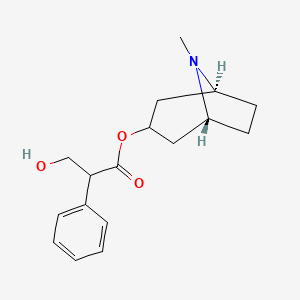
| Formula | C17H23NO3 |
|---|---|
| Molecular weight | 289.38 g/mol |
| IUPAC name | [(1S,5R)-8-methyl-8-azabicyclo[3.2.1]octan-3-yl] 3-hydroxy-2-phenylpropanoate |
| CAS | 51-55-8 |
| PubChem CID | 174174 |
| InChIKey | RKUNBYITZUJHSG-SPUOUPEWSA-N |
| logP | 1.93 (XLogP 1.8) |
| Polar surface area | 49.77 Ų |
| H-bond acceptors / donors | 4 / 1 |
| Drug-likeness (QED) | 0.86 |
| Lipinski violations | 0 |
SMILES
CN1[C@@H]2CC[C@H]1C[C@@H](OC(=O)C(CO)c1ccccc1)C2Biology & Pharmacokinetics
Pharmacokinetics
| BBB penetrant | Yes (logBB -0.06) |
|---|
Enzyme interactions
| Enzyme | Role | Detail |
|---|---|---|
| CYP2C19 | Substrate | — |
| CYP2C9 | Substrate | — |
| CYP3A4 | Substrate | — |
Receptor binding (top 9)
| Target | Action | Affinity |
|---|---|---|
| Cholinergic, muscarinic M3 (CHRM3) | Binding | pKi 9.5 |
| Cholinergic, muscarinic M4 (CHRM4) | Binding | pKi 9.4 |
| Cholinergic, muscarinic M1 (CHRM1) | Binding | pKi 9.3 |
| Cholinergic, muscarinic M5 (CHRM5) | Binding | pKi 9.3 |
| Cholinergic, muscarinic M2 (CHRM2) | Binding | pKi 9.0 |
| Cholinergic, muscarinic | Binding | pKi 8.9 |
| Muscarinic Acetylcholine Receptor | Binding | pKi 8.6 |
| HISTAMINE H1 (HRH1) | Binding | pKi 5.9 |
| 5-HT2A (HTR2A) | Binding | pKi 5.2 |
Transporters
ASBT (Inhibitor)BCRP (Inhibitor)BCRP (Inhibitor)BSEP (Inhibitor)BSEP (Inhibitor)MRP1 (Inhibitor)MRP2 (Inhibitor)MRP3 (Inhibitor)MRP4 (Inhibitor)OATP1B1 (Inhibitor)OATP1B3 (Inhibitor)OCT1 (Inhibitor)OCT2 (Inhibitor)OCT3 (Inhibitor)P-gp (Inhibitor)OCT1 (Substrate)P-gp (Substrate)
Drug–drug interactions (100+, DDInter)
| Interacting drug | Severity | Management |
|---|---|---|
| Potassium chloride | major | |
| Potassium citrate | major | |
| Topiramate | major | |
| Zonisamide | major | |
| Acebutolol | moderate | |
| Acetylcholine | moderate | |
| Aclidinium | moderate | |
| Acrivastine | moderate | |
| Alfentanil | moderate | |
| Alimemazine | moderate | |
| Aluminum hydroxide | moderate | |
| Amantadine | moderate | |
| Ambenonium | moderate | |
| Amitriptyline | moderate | |
| Amoxapine | moderate | |
| Arbutamine | moderate | |
| Aripiprazole | moderate | |
| Asenapine | moderate | |
| Atenolol | moderate | |
| Azatadine | moderate | |
| Belladonna | moderate | |
| Benzatropine | moderate | |
| Benzhydrocodone | moderate | |
| Betaxolol | moderate | |
| Bethanechol | moderate | |
| Biperiden | moderate | |
| Bisoprolol | moderate | |
| Botulinum Toxin Type B | moderate | |
| Botulinum toxin type A | moderate | |
| Brexanolone | moderate | |
| Brexpiprazole | moderate | |
| Brompheniramine | moderate | |
| Buprenorphine | moderate | |
| Butorphanol | moderate | |
| Calcium carbonate | moderate | |
| Carbamoylcholine (ophthalmic) | moderate | |
| Carbinoxamine | moderate | |
| Cariprazine | moderate | |
| Carteolol | moderate | |
| Carvedilol | moderate |
Showing 40 of 100+.
Registered Products (3)
| Brand | Form / strength | Pack | Agent | Citizen (JOD) |
|---|---|---|---|---|
| Apitropin 0.5% eye drops | Ophthalmic Solution 0.5 % | 10 ml | Amman Pharmaceutical Indusries | 0.870 |
| Apitropin 1.0% eye drops | Ophthalmic Solution 1 % | 10 ml | Amman Pharmaceutical Indusries | 0.960 |
| Minims Atropine Sulphate 1% e/d | Ophthalmic Solution 1 % | 0.5 ml | Petra Drug Store | 3.700 |