Betaxolol
JFDA label: Apixol eye drops
Indications
Approved
- Cardiovascular Diseases — cardiovascular disease
- Glaucoma — glaucoma
Off-label
- Glaucoma, Open-Angle
- Ocular Hypertension
Contraindications
Source: openFDA
- Betaxolol tablets, USP is contraindicated in patients with known hypersensitivity to the drug. Betaxolol tablets, USP is contraindicated in patients with sinus bradycardia, heart block greater than first degree, cardiogenic shock, and overt cardiac failure (see Warnings ). Absolute
Adverse Reactions
Cardiac disorders (7)
Very Common Bradycardia
Common Palpitations
Rare Arrhythmia · Atrioventricular block · Cardiac disorder · Cardiac failure · Tachycardia
Vascular disorders (1)
Rare Hypotension
Nervous system disorders (5)
Very Common Dizziness · Headache
Common Paraesthesia
Rare Loss of consciousness · Syncope
Immune system disorders (2)
Rare Hypersensitivity · Immune system disorder
Endocrine disorders (1)
Rare Hyperthyroidism
Metabolism and nutrition disorders (1)
Rare Hypoglycaemia
Gastrointestinal disorders (5)
Common Diarrhoea · Dyspepsia · Nausea
Rare Gastrointestinal disorder · Vomiting
Skin and subcutaneous tissue disorders (6)
Common Dermatitis · Rash
Rare Alopecia · Erythema of eyelid · Eye pruritus · Skin disorder
Musculoskeletal and connective tissue disorders (3)
Common Arthralgia · Musculoskeletal discomfort · Myalgia
Psychiatric disorders (11)
Common Abnormal dreams · Depression · Insomnia
Rare Anxiety · Confusional state · Hallucination · Libido decreased · Mental disorder · Nightmare · Photophobia · Sleep disorder
Eye disorders (17)
Rare Abnormal sensation in eye · Conjunctivitis · Dry eye · Endophthalmitis · Eye discharge · Eye disorder · Eye irritation · Eye pain · Eyelid margin crusting · Foreign body sensation in eyes · Lacrimation increased · Ocular discomfort · Ocular hyperaemia · Panophthalmitis · Vision blurred · Visual acuity reduced · Visual impairment
Reproductive system and breast disorders (2)
Common Erectile dysfunction
Rare Breast disorder
Infections and infestations (7)
Common Rhinitis · Upper respiratory tract infection
Rare Bronchitis · Infection · Influenza · Nasopharyngitis · Sinusitis
Investigations (1)
Rare Feeling abnormal
General disorders and administration site conditions (27)
Very Common Asthenia · Fatigue
Common Chest pain · Lethargy · Nervousness · Oedema · Peripheral coldness · Tension
Rare Angiopathy · Asthenopia · Blepharitis · Blepharospasm · Cataract · Conjunctival disorder · Conjunctival oedema · Disturbance in sexual arousal · Dysgeusia · Infestation · Intermittent claudication · Keratitis · Mediastinal disorder · Nervous system disorder · Periorbital oedema · Psychotic disorder · Punctate keratitis · Refraction disorder · Shock
Respiratory, thoracic and mediastinal disorders (5)
Common Dyspnoea
Rare Asthma · Bronchospasm · Cough · Rhinorrhoea
Dosing
Source: openFDA
Warnings & Precautions
Source: openFDA
Warnings & Precautions
Cardiac Failure: Sympathetic stimulation may be a vital component supporting circulatory function in congestive heart failure, and beta-adrenergic receptor blockade carries the potential hazard of further depressing myocardial contractility and precipitating more severe heart failure. In hypertensive patients who have congestive heart failure controlled by digitalis and diuretics, beta-blockers should be administered cautiously. Both digitalis and beta-adrenergic receptor blocking agents slow AV conduction. In Patients Without a History of Cardiac Failure: Continued depression of the myocardium with beta-blocking agents over a period of time can, in some cases, lead to cardiac failure. Therefore, at the first sign or symptom of cardiac failure, discontinuation of betaxolol tablets, USP should be considered. In some cases beta-blocker therapy can be continued while cardiac failure is treated with cardiac glycosides, diuretics, and other agents, as appropriate. Exacerbation of Angina Pectoris Upon Withdrawal: Abrupt cessation of therapy with certain beta-blocking agents in patients with coronary artery disease has been followed by exacerbations of angina pectoris and, in some cases, myocardial infarction has been reported. Therefore such patients should be warned against interruption of therapy without the physician’s advice. Even in the absence of overt angina pectoris, when discontinuation of betaxolol tablets, USP is planned, the patient should be carefully observed and therapy should be reinstituted, at least temporarily, if withdrawal symptoms occur. Bronchospastic diseases: PATIENTS WITH BRONCHOSPASTIC DISEASE SHOULD NOT IN GENERAL RECEIVE BETA-BLOCKERS. Because of its relative ß 1 selectivity (cardioselectivity), low doses of betaxolol tablets, USP may be used with caution in patients with bronchospastic disease who do not respond to or cannot tolerate alternative treatment. Since ß 1 selectivity is not absolute and is inversely related to dose, the lowest possible dose of betaxolol tablets, USP should be used (5 to 10 mg once daily) and a bronchodilator should be made available. If dosage must be increased, divided dosage should be considered to avoid the higher peak blood levels associated with once-daily dosing. Major Surgery: Chronically administered beta-blocking therapy should not be routinely withdrawn prior to major surgery, however the impaired ability of the heart to respond to reflex adrenergic stimuli may augment the risks of general anest
Pregnancy & Lactation
Pregnancy
Lactation
Because of its relatively extensive excretion into breastmilk and minimal reported experience during breastfeeding, other beta-blocking agents may be preferred for systemic use, especially while nursing a newborn or preterm infant.
Chemistry & Properties
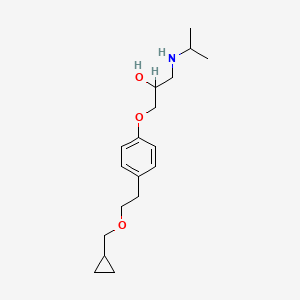
| Formula | C18H29NO3 |
|---|---|
| Molecular weight | 307.43 g/mol |
| IUPAC name | 1-[4-[2-(cyclopropylmethoxy)ethyl]phenoxy]-3-(propan-2-ylamino)propan-2-ol |
| CAS | 63659-18-7 |
| PubChem CID | 2369 |
| InChIKey | NWIUTZDMDHAVTP-UHFFFAOYSA-N |
| logP | 2.39 (XLogP 2.8) |
| Polar surface area | 50.72 Ų |
| H-bond acceptors / donors | 4 / 2 |
| Drug-likeness (QED) | 0.62 |
| Lipinski violations | 0 |
SMILES
CC(C)NCC(O)COc1ccc(CCOCC2CC2)cc1Biology & Pharmacokinetics
Pharmacokinetics
| BBB penetrant | Yes (logBB 0.39) |
|---|
Enzyme interactions
| Enzyme | Role | Detail |
|---|---|---|
| CYP1A2 | Substrate | — |
| CYP2C19 | Substrate | — |
| CYP2D6 | Inhibitor | IC₅₀ 65.99999999999994 µM |
| CYP2D6 | Substrate | — |
| CYP3A4 | Substrate | — |
Transporters
BCRP (Inhibitor)BSEP (Inhibitor)MRP1 (Inhibitor)OATP1B1 (Inhibitor)OATP1B3 (Inhibitor)P-gp (Inhibitor)P-gp (Substrate)
Drug–drug interactions (100+, DDInter)
| Interacting drug | Severity | Management |
|---|---|---|
| Aminophylline | major | |
| Ceritinib | major | |
| Dolasetron | major | |
| Dyphylline | major | |
| Fingolimod | major | |
| Methacholine | major | |
| Oxtriphylline | major | |
| Siponimod | major | |
| Theophylline | major | |
| Acetohexamide | moderate | |
| Aldesleukin | moderate | |
| Alectinib | moderate | |
| Alimemazine | moderate | |
| Amifostine | moderate | |
| Atropine | moderate | |
| Betamethasone | moderate | |
| Brigatinib | moderate | |
| Brimonidine (ophthalmic) | moderate | |
| Brimonidine (topical) | moderate | |
| Budesonide | moderate | |
| Bupropion | moderate | |
| Calcium Phosphate | moderate | |
| Calcium acetate | moderate | |
| Calcium carbonate | moderate | |
| Calcium citrate | moderate | |
| Calcium glubionate anhydrous | moderate | |
| Calcium gluconate | moderate | |
| Calcium lactate | moderate | |
| Canagliflozin | moderate | |
| Celecoxib | moderate | |
| Chlorphenesin | moderate | |
| Chlorpropamide | moderate | |
| Cimetidine | moderate | |
| Clidinium | moderate | |
| Codeine | moderate | |
| Corticotropin | moderate | |
| Crizotinib | moderate | |
| Dapagliflozin | moderate | |
| Deflazacort | moderate | |
| Dexamethasone | moderate |
Showing 40 of 100+.
Registered Products (2)
| Brand | Form / strength | Pack | Agent | Citizen (JOD) |
|---|---|---|---|---|
| Apixol eye drops | Ophthalmic Solution as Hcl 0.5 % | 5 ml | Amman Pharmaceutical Indusries | 3.640 |
| Betac | Tablet 20 mg | 30 tab | Al Hilal Drug Store | 4.400 |