Epinephrine
JFDA label: ADRENALINE AMP
Mechanism of Action
Agonist of Adrenergic receptor — Adrenergic receptor agonist
| Target | Action | Gene / class |
|---|---|---|
| Adrenergic receptor efficacy | AGONIST |
Indications
Approved
- Angioedema — angioedema
- Asthma — asthma
- Bronchial Spasm — asthma
- Cardiovascular Diseases — cardiovascular disease
- Glaucoma — glaucoma
- Heart Arrest — sudden cardiac arrest
- Hemorrhage — hemorrhage
- Hypersensitivity — allergic disease
- Lung Diseases, Obstructive — Airway obstruction
- Muscle Cramp — muscle cramp
- Mydriasis — Mydriasis
- Nasal Obstruction — Nasal congestion
- Rhinitis, Allergic, Seasonal — seasonal allergic rhinitis
- Serum Sickness — type III hypersensitivity reaction disease
- Shock, Septic — septic shock
- Sinusitis — sinusitis
- Urticaria — urticaria
Off-label
- Acute Lung Injury
- Appendicitis
- Breast Neoplasms
- Bronchiolitis
- Carcinoma, Non-Small-Cell Lung
- Cognitive Dysfunction
- Death, Sudden, Cardiac
- Epistaxis
- Fractures, Bone
- Gastrointestinal Hemorrhage
- Genital Neoplasms, Male
- Heart Failure
- Hemoptysis
- Hypospadias
- Hypotension
- Leukemia, Hairy Cell
- Lung Neoplasms
- Musculoskeletal Diseases
- Myoma
- Osteoarthritis, Knee
- Pain
- Pulpitis
- Rhinitis, Allergic, Perennial
- Rotator Cuff Injuries
- Sepsis
- Shock
- Stomach Neoplasms
- Stroke
- Tachycardia, Ventricular
- Ventricular Fibrillation
- Wounds and Injuries
Contraindications
Source: openFDA
- None. None. ( 4 ) Absolute
Adverse Reactions
Cardiac disorders (5)
Not Known Myocardial Infarction · Myocardial Ischemia · Supraventricular Tachycardia · Tachycardia · Ventricular Arrhythmias
Nervous system disorders (3)
Not Known Headache · Paresthesia · Tremor
Metabolism and nutrition disorders (1)
Not Known Extravasation Metabolic Hypoglycemia
Gastrointestinal disorders (1)
Not Known Pulmonary Edema Gastrointestinal Disorders Nausea
General disorders and administration site conditions (9)
Not Known Hype · Limb Ischemia · Nervousness · Pallor · Piloerection · Rales Skin And Subcutaneous Tissue Disorders Diaphoresis · Skin Blanching · Skin Necrosi · Stroke
Dosing
Source: openFDA
Warnings & Precautions
Source: openFDA
Warnings & Precautions
• Monitor patient for acute severe hypertension. ( 5.1 ) • Avoid extravasation into tissues, which can cause local necrosis. ( 5.2 ) • Do not inject into buttocks, digits, hands, or feet. ( 5.3 ) • Potential for pulmonary edema, which may be fatal. ( 5.4 ) • May constrict renal blood vessels and decrease urine formation. ( 5.5 ) • May induce potentially serious cardiac arrhythmias or aggravate angina pectoris, particularly in patients with underlying heart disease. ( 5.6 )
Hypertension When Epinephrine Injection is administered intravenously,
Hypertension When Epinephrine Injection is administered intravenously, titrate the infusion while monitoring vital signs . Invasive arterial blood pressure monitoring and central venous pressure monitoring are recommended. Because of varying response to epinephrine, dangerously high blood pressure may occur [see Drug Interactions (7) ] .
Extravasation and Tissue Necrosis with Intravenous Infusion When Epine
Extravasation and Tissue Necrosis with Intravenous Infusion When Epinephrine Injection is administered intravenously, the infusion site should be checked frequently for free flow. Avoid extravasation of epinephrine into the tissues, to prevent local necrosis. Blanching along the course of the infused vein, sometimes without obvious extravasation, may be attributed to vasa vasorum constriction with increased permeability of the vein wall, permitting some leakage. This also may progress on rare occasions to superficial slough. Hence, if blanching occurs, consider changing the infusion site at intervals to allow the effects of local vasoconstriction to subside. Antidote for Extravasation Ischemia: To prevent sloughing and necrosis in areas in which extravasation has taken place, infiltrate the area with 10 mL to 15 mL of saline solution containing from 5 mg to 10 mg of phentolamine , an adrenergic blocking agent. Use a syringe with a fine hypodermic needle, with the solution being infiltrated liberally throughout the area, which is easily identified by its cold, hard, and pallid appearance. Sympathetic blockade with phentolamine causes immediate and conspicuous local hyperemic changes if the area is infiltrated within 12 hours.
Incorrect Locations of Injection for Anaphylaxis When Epinephrine Inje
Incorrect Locations of Injection for Anaphylaxis When Epinephrine Injection is used for the treatment of anaphylaxis, the most appropriate location for administration is into the anterolateral aspect of the thigh (vastus lateralis muscle) because of its location, size, and available blood flow. Injection into (or near) smaller muscles, such as in the deltoid, is not recommended due to possible differences in absorption associated with this use. Do not administer repeated injections of epinephrine at the same site, as the resulting vasoconstriction may cause tissue necrosis. Do not inject into buttock. Injection into the buttock may not provide effective treatment of anaphylaxis and has been associated with the development of Clostridial infections (gas gangrene). Cleansing with alcohol does not kill bacterial spores, and therefore, does not lower this risk. Do not inject into digits, hands, or feet. Epinephrine is a strong vasoconstrictor. Accidental injection into the digits, hands or feet may result in loss of blood flow to the affected area and has been associated with tissue necrosis.
Pulmonary Edema When Epinephrine Injection is administered intravenous
Pulmonary Edema When Epinephrine Injection is administered intravenously, there is risk of pulmonary edema because of the peripheral constriction and cardiac stimulation produced. Treatment of pulmonary edema consists of a rapidly acting alpha-adrenergic blocking drug (such as phentolamine mesylate) and respiratory support.
Renal Impairment Intravenously administered epinephrine initially may
Renal Impairment Intravenously administered epinephrine initially may produce constriction of renal blood vessels and decrease urine formation.
Cardiac Arrhythmias and Ischemia Epinephrine may induce cardiac arrhyt
Cardiac Arrhythmias and Ischemia Epinephrine may induce cardiac arrhythmias and angina pectoris in patients, especially patients suffering from coronary artery disease, organic heart disease, cerebrovascular disease, hypertension, or patients who are receiving drugs that sensitize the myocardium [see Adverse Reactions (6) and Drug Interactions (7) ] . Treatment of arrhythmias consists of administration of a beta-adrenergic blocking drug (such as propranolol).
Injury with Undiluted Intraocular Solution Epinephrine must be diluted
Injury with Undiluted Intraocular Solution Epinephrine must be diluted before intraocular use. Other epinephrine products that contain sodium bisulfite have been associated with corneal endothelial damage when used in the eye at undiluted concentrations (1 mg/mL). Although this Epinephrine product contains no sulfites or preservatives, warning is still advised [see Dosage and Administration (2.4) ] .
Serious Infections at the Injection Site Rare cases of serious skin an
Serious Infections at the Injection Site Rare cases of serious skin and soft tissue infections, including necrotizing fasciitis and myonecrosis caused by Clostridia (gas gangrene), have been reported at the injection site following epinephrine injection for anaphylaxis. Clostridium spores can be present on the skin and introduced into the deep tissue with subcutaneous or intramuscular injection. While cleansing with alcohol may reduce presence of bacteria on the skin, alcohol cleansing does not kill Clostridium spores. To decrease the risk of Clostridium infection, do not inject Epinephrine Injection into the buttock [see Warnings and Precautions (5.3) ] . Advise patients to seek medical care if they develop signs or symptoms of infection, such as persistent redness, warmth, swelling, or tenderness, at the epinephrine injection site.
Other Disease Interactions Epinephrine should be administered with cau
Other Disease Interactions Epinephrine should be administered with caution to patients with hyperthyroidism, Parkinson’s disease, diabetes mellitus, pheochromocytoma, elderly individuals, and pregnant women. Patients with Parkinson’s disease may experience psychomotor agitation or notice a temporary worsening of symptoms. Diabetic patients may experience transient increases in blood sugar. Despite these concerns, the presence of these conditions is not a contraindication to epinephrine administration in an acute, life-threatening situation.
Pregnancy & Lactation
Pregnancy
Lactation
Epinephrine is the first line-medication of choice for treatment of anaphylaxis; it should be used in the same manner in breastfeeding and non-breastfeeding patients.
Chemistry & Properties
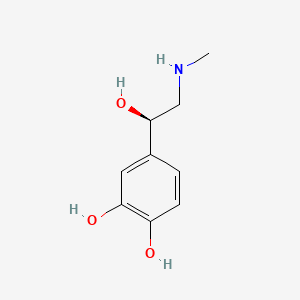
| Formula | C9H13NO3 |
|---|---|
| Molecular weight | 183.21 g/mol |
| IUPAC name | 4-[(1R)-1-hydroxy-2-(methylamino)ethyl]benzene-1,2-diol |
| CAS | 51-43-4 |
| PubChem CID | 5816 |
| InChIKey | UCTWMZQNUQWSLP-VIFPVBQESA-N |
| logP | 0.35 (XLogP -1.4) |
| Polar surface area | 72.72 Ų |
| H-bond acceptors / donors | 4 / 4 |
| Drug-likeness (QED) | 0.51 |
| Lipinski violations | 0 |
SMILES
CNC[C@H](O)c1ccc(O)c(O)c1Biology & Pharmacokinetics
Pharmacokinetics
| BBB penetrant | No |
|---|
Receptor binding (top 17)
| Target | Action | Affinity |
|---|---|---|
| α2A-adrenoceptor (ADRA2A) | Agonist | pEC50 8.0 |
| β2-adrenoceptor (ADRB2) | Agonist | pEC50 7.9 |
| α2B-adrenoceptor (ADRA2B) | Agonist | pIC50 7.6 |
| α2C-adrenoceptor (ADRA2C) | Agonist | pEC50 7.6 |
| β1-adrenoceptor (ADRB1) | Agonist | pEC50 7.6 |
| α2B-adrenoceptor (ADRA2B) | Agonist | pEC50 7.5 |
| α2C-adrenoceptor (ADRA2C) | Agonist | pIC50 6.7 |
| α2A-adrenoceptor (ADRA2A) | Agonist | pIC50 6.5 |
| β3-adrenoceptor (ADRB3) | Agonist | pEC50 6.5 |
| adrenergic Alpha1 | Binding | pKi 6.1 |
| adrenergic Alpha2B (ADRA2B) | Binding | pKi 5.9 |
| adrenergic Alpha2A (ADRA2A) | Binding | pKi 5.8 |
| adrenergic Alpha2C (ADRA2C) | Binding | pKi 5.8 |
| adrenergic Beta2 (ADRB2) | Binding | pKi 5.8 |
| adrenergic Alpha1C | Binding | pKi 5.6 |
Transporters
BCRP (Inhibitor)BSEP (Inhibitor)BSEP (Inhibitor)MRP1 (Inhibitor)OATP1B1 (Inhibitor)OATP1B3 (Inhibitor)OCT1 (Inhibitor)P-gp (Inhibitor)OCT(unspecified) (Substrate)OCT1 (Substrate)OCT2 (Substrate)OCT3 (Substrate)P-gp (Substrate)
Drug–drug interactions (100+, DDInter)
| Interacting drug | Severity | Management |
|---|---|---|
| Amitriptyline | major | |
| Amoxapine | major | |
| Carteolol | major | |
| Carteolol (ophthalmic) | major | |
| Carvedilol | major | |
| Clomipramine | major | |
| Cocaine (nasal) | major | |
| Cocaine (topical) | major | |
| Desflurane | major | |
| Desipramine | major | |
| Dihydroergotamine | major | |
| Doxepin | major | |
| Enflurane | major | |
| Ergometrine | major | |
| Ergotamine | major | |
| Halothane | major | |
| Imipramine | major | |
| Isoflurane | major | |
| Labetalol | major | |
| Levobunolol (ophthalmic) | major | |
| Linezolid | major | |
| Methoxyflurane | major | |
| Methylergometrine | major | |
| Methysergide | major | |
| Metipranolol (ophthalmic) | major | |
| Nadolol | major | |
| Nortriptyline | major | |
| Penbutolol | major | |
| Pindolol | major | |
| Propranolol | major | |
| Protriptyline | major | |
| Sevoflurane | major | |
| Sotalol | major | |
| Timolol | major | |
| Timolol (ophthalmic) | major | |
| Trimipramine | major | |
| Acarbose | moderate | |
| Acebutolol | moderate | |
| Acetohexamide | moderate | |
| Albiglutide | moderate |
Showing 40 of 100+.
Registered Products (23)
| Brand | Form / strength | Pack | Agent | Citizen (JOD) |
|---|---|---|---|---|
| ADRENALINE AMP | Ampoule 1 mg/1 ml | 50 amp pack varies | Al Hilal Drug Store | — |
| ADRENALINE AMP | Ampoule 1 mg/1 ml | 20 amp pack varies | Al Hilal Drug Store | — |
| ARTICAINE MEDIS ADRENALINE 1/100 000 | Cartridge 1 ml/100000 ml | 50 CTG/1 BOX | Professional Drug Store | — |
| Adrecaine-Dental Cartridge | Cartridge 0.0225 mg/1.8 ml, 36 mg/1.8 ml | 1.8 ml | Al Saleem Drug Store | — |
| Adrenaline INJ | Powder for Injection 0.1 % | 10 amp | AL Razi Drug Store | — |
| Adrenamax | Injection 1 mg/ml | 1 ml | Sahar Drug Store | — |
| Alexadricaine 1:100000 | Tablet 68 mg, 0.03306 mg/1.7 ml | 50 Catridge (BOX) | AL-Faiasel Drug Store | — |
| Alexadricaine 1:200000 | Tablet 68 mg, 0.0153 mg/1.7 ml | 50 Catridge (BOX) | AL-Faiasel Drug Store | — |
| Artinibsa 4% with Epinephrine 1:100000 | Cartridge 72 mg/1.8 ml, 32.4 mcg/1.8 ml | 1.8 MILLILITER/50 CARTRIDGE | Burqan Drug Store | — |
| Artinibsa 4% with Epinephrine 1:200000 | Cartridge 72 mg/1.8 ml, 16.2 mcg/1.8 ml | 50 Cart | Burqan Drug Store | — |
| Medicaine with Adrenaline Cart. | Cartridge 36 mg/1.8 ml, 0.032 mg/1.8 ml | 1.8 ml | Professional Drug Store | — |
| Octocaine 100 | Cartridge 0.01 mg/ml, 20 mg/ml | 1.8 ml | Ajyal Al Ghad Al Jadeed Drug Store | — |
| Orabloc 1:100,000 | Cartridge (as Bitartrate) 0.01 mg/ml, 40 mg/ml | 1.8 ml | Almutanabbe Drug Store | — |
| Orabloc 1:200,000 | Cartridge 0.005 mg/ml, 40 mg/ml | 1.8 ml | Almutanabbe Drug Store | — |
| Posicaine 100 | Injection 0.010 mg/ml, 40 mg/ml | 50 vial | Ajyal Al Ghad Al Jadeed Drug Store | — |
| Posicaine 200 Solution for Injection | Injection 0.005 mg/ml, 40 mg/ml | 50 vial | Ajyal Al Ghad Al Jadeed Drug Store | — |
| Surgicaine | Injection 0.5 %, 0.0091 mg/ml | 50 Catrridges | Ajyal Al Ghad Al Jadeed Drug Store | — |
| Ubistesin Forte | Injection 40 mg/ml, 0.012 mg/ml | 1.7 ml | Khoury Drug Store | — |
| Ubistesin Inj. Sol. | Injection 40 mg/ml, 0.006 mg/ml | 1.7 ml | Khoury Drug Store | — |
| XYLESTESIN A CART | Cartridge 20 mg, 0.015 mg | 1.7 ml | Khoury Drug Store | — |
| Xilonibsa | Cartridge 0.0125 mg/ml, 20 mg/ml | 1.8 MILLILITER/50 CARTRIDGE | Burqan Drug Store | — |
| septanest with adrenaline 1/100,000 | Cartridge 0.01 mg/ml, 40 mg/ml | 1.8 ml | Ibn Rushd Drug Store | — |
| septanest with adrenaline 1/200,000 | Cartridge 40 mg, 0.005 mg | 1.8 ml | Ibn Rushd Drug Store | — |