Sevoflurane
JFDA label: Sevoflurane 100%
Mechanism of Action
Positive Modulator of Glycine receptor (alpha-1/beta) — Glycine receptor (alpha-1/beta) positive modulator; Positive Allosteric Modulator of GABA-A receptor; anion channel — GABA-A receptor; anion channel positive allosteric modulator; Opener of Potassium channel subfamily K member 10 — Potassium channel subfamily K member 10 opener; Opener of Potassium channel subfamily K member 18 — Potassium channel subfamily K member 18 opener; Opener of Potassium channel subfamily K member 3 — Potassium channel subfamily K member 3 opener; Opener of Potassium channel subfamily K member 9 — Potassium channel subfamily K member 9 opener; Opener of Potassium channel subfamily K member 2 — Potassium channel subfamily K member 2 opener
| Target | Action | Gene / class |
|---|---|---|
| GABA-A receptor; anion channel efficacy | POSITIVE ALLOSTERIC MODULATOR | |
| Glycine receptor (alpha-1/beta) efficacy | POSITIVE MODULATOR | |
| Potassium channel subfamily K member 10 efficacy | OPENER | KCNK10 |
| Potassium channel subfamily K member 18 efficacy | OPENER | KCNK18 |
| Potassium channel subfamily K member 2 efficacy | OPENER | KCNK2 |
| Potassium channel subfamily K member 3 efficacy | OPENER | KCNK3 |
| Potassium channel subfamily K member 9 efficacy | OPENER | KCNK9 |
Indications
Approved
- Anesthesia
Contraindications
Source: Lexicomp
- Additional contraindications (not in US labeling): Occurrence of liver dysfunction, jaundice or unexplained fever, leukocytosis, or eosinophilia after previous halogenated anesthetic administration Absolute
- Hypersensitivity to sevoflurane, other halogenated anesthetics, or any component of the formulation Absolute
- known or suspected susceptibility to malignant hyperthermia Absolute
- when general anesthesia is contraindicated Absolute
Adverse Reactions
Cardiac disorders (4)
Very Common Hypotension
Common bradycardia · hypertension · Tachycardia
Nervous system disorders (8)
Very Common Agitation
Common delirium (emergence) · dizziness · Drowsiness · headache · hypothermia · myoclonus · shivering
Gastrointestinal disorders (3)
Very Common Nausea · vomiting
Common Sialorrhea
General disorders and administration site conditions (1)
Common Fever
Respiratory, thoracic and mediastinal disorders (5)
Very Common Cough
Common Airway obstruction · apnea · breath-holding · laryngospasm
Dosing
Source: Lexicomp
Warnings & Precautions
Source: Lexicomp
Agitation/delirium
Monitor for emergence agitation or delirium (Stachnik 2006).
Hepatic effects
Postoperative hepatitis or hepatic dysfunction with or without jaundice has rarely been reported; prior exposure to halogenated hydrocarbon anesthetics may increase this risk.
Hyperkalemia
Use of inhaled anesthetics has been associated with rare cases of perioperative hyperkalemia in pediatric patients; concomitant use of succinylcholine was associated with most of the reported cases, but not all. Patients with latent and overt neuromuscular disease (eg, Duchenne muscular dystrophy) are the most vulnerable. Other abnormalities may include elevation in CPK and myoglobinuria. Monitor closely for arrhythmias. Aggressively identify and treat hyperkalemia and resistant arrhythmias.
Hypotension
Sevoflurane produces a dose-dependent reduction in blood pressure during maintenance of anesthesia and may occur more rapidly compared to other inhaled anesthetics.
Increased intracranial pressure
May dilate the cerebral vasculature and may, in certain conditions, increase intracranial pressure (Stachnik 2006).
Malignant hyperthermia
May trigger malignant hyperthermia; some reported cases have been fatal. Use is contraindicated in patients susceptible to malignant hyperthermia such as those with certain inherited ryanodine receptor mutations.
QT prolongation
Cases of QT prolongation in association with torsade de pointes (some fatal) have been reported with sevoflurane use; use caution when administering to patients at risk of QT prolongation (eg, concurrent use of drugs that can prolong the QT interval such as class Ia and III antiarrhythmic drugs, elderly patients, congenital QT prolongation) (Han 2010; Kang 2006; Nakao 2010).
Respiratory depression
Causes dose-dependent respiratory depression and blunted ventilatory response to hypoxia and hypercapnia (Golembiewski 2004). Hypoxic pulmonary vasoconstriction is blunted which may lead to increased pulmonary shunt (Miller 2010). Disease-related concerns:
Heart failure
In a scientific statement from the American Heart Association, sevoflurane has been determined to be an agent that may exacerbate underlying myocardial dysfunction (magnitude: major) (AHA [Page 2016]).
Hepatic impairment
Use with caution in patients with hepatic impairment; safety with severe impairment has not been established.
Renal impairment
Use with caution in patients with renal impairment (ie, creatinine >1.5 mg/dL); safety with severe impairment has not been established.
Seizure disorder
Use with caution in patients at risk for seizures; seizures have been reported in children and young adults. Concurrent drug therapy issues:
Drug-drug interactions
Potentially significant interactions may exist, requiring dose or frequency adjustment, additional monitoring, and/or selection of alternative therapy. Consult drug interactions database for more detailed information. Special populations:
Pediatric neurotoxicity
In pediatric and neonatal patients Special handling:
Occupational caution
There is no specific work exposure limit established for sevoflurane. However, the National Institute for Occupational Safety and Health (NIOSH) has recommended an 8 hour time-weighted average limit of 2 ppm for halogenated anesthetic agents in general (0.5 ppm when coupled with exposure to N2O). Other warnings/precautions:
Desiccated absorbents
Reaction of sevoflurane with CO2 absorbents that become desiccated within circle breathing equipment can lead to formation of formaldehyde (causing respiratory irritation) and carbon monoxide; maintain fresh absorbent as per manufacturer guidelines regardless of state of colorimetric indicator. An exothermic reaction occurs when sevoflurane is exposed to CO2 absorbents; this reaction is increased when the CO2 absorbent becomes desiccated. Rare cases of extreme heat, smoke, and/or fire within breathing circuit have been reported. This reaction also leads to formation of a fluorinated byproduct, compound A, which has been reported to cause mild and reversible renal injury in animal studies (Gentz 2001). The theoretical risk of compound A-induced nephrotoxicity in humans may be dose- and exposure time-dependent; minimize exposure risk by not exceeding 2 MAC hours and using fresh flow rates of 1 to 2 absorbents) should be incorporated into routine practice (Miller 2010).
Pregnancy & Lactation
Pregnancy
Adverse events have been observed in animal reproduction studies. Based on animal data, repeated or prolonged use of general anesthetic and sedation medications that block N-methyl-D- aspartate (NMDA) receptors and/or potentiate gamma-aminobutyric acid (GABA) activity, may affect brain development. Human fetuses may be most vulnerable during the third trimester. Until additional information is available, the benefits and risks of maternal treatment with sevoflurane during pregnancy should be evaluated, especially for procedures lasting more than 3 hours. The ACOG recommends that pregnant women should not be denied medically indicated surgery or procedures, regardless of trimester. If the procedure is elective, it should be delayed until after delivery (ACOG 2011).
Lactation
Due to rapid washout, sevoflurane levels in breast milk have no clinical importance 24 hours after anesthesia.
Monitoring
| Clinical pearl | Blood pressure, temperature, heart rate and rhythm, oxygen saturation, end-tidal CO2 and end-tidal sevoflurane concentrations should be monitored prior to and throughout anesthesia; temperature of CO2 absorbent canister |
|---|
Chemistry & Properties
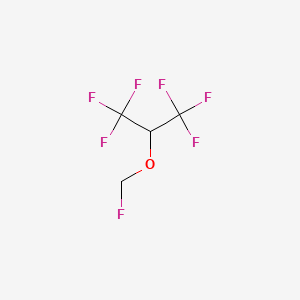
| Formula | C4H3F7O |
|---|---|
| Molecular weight | 200.05 g/mol |
| IUPAC name | 1,1,1,3,3,3-hexafluoro-2-(fluoromethoxy)propane |
| CAS | 28523-86-6 |
| PubChem CID | 5206 |
| InChIKey | DFEYYRMXOJXZRJ-UHFFFAOYSA-N |
| logP | 2.42 (XLogP 2.8) |
| Polar surface area | 9.23 Ų |
| H-bond acceptors / donors | 1 / 0 |
| Drug-likeness (QED) | 0.62 |
| Lipinski violations | 0 |
SMILES
FCOC(C(F)(F)F)C(F)(F)FBiology & Pharmacokinetics
Pharmacokinetics
| BBB penetrant | Yes (logBB 0.3) |
|---|
Enzyme interactions
| Enzyme | Role | Detail |
|---|---|---|
| CYP2B6 | Substrate | — |
| CYP2C19 | Substrate | — |
Transporters
BCRP (Inhibitor)BSEP (Inhibitor)MRP1 (Inhibitor)OATP1B1 (Inhibitor)OATP1B3 (Inhibitor)P-gp (Inhibitor)P-gp (Substrate)
Drug–drug interactions (100+, DDInter)
| Interacting drug | Severity | Management |
|---|---|---|
| Anagrelide | major | |
| Arsenic trioxide | major | |
| Cabozantinib | major | |
| Ceritinib | major | |
| Chloroquine | major | |
| Cisapride | major | |
| Crizotinib | major | |
| Dolasetron | major | |
| Epinephrine | major | |
| Fingolimod | major | |
| Halofantrine | major | |
| Hydroxychloroquine | major | |
| Ivosidenib | major | |
| Lumefantrine | major | |
| Macimorelin | major | |
| Nilotinib | major | |
| Osimertinib | major | |
| Ozanimod | major | |
| Panobinostat | major | |
| Papaverine | major | |
| Pasireotide | major | |
| Ribociclib | major | |
| Siponimod | major | |
| Toremifene | major | |
| Vandetanib | major | |
| Vemurafenib | major | |
| Abarelix | moderate | |
| Abiraterone | moderate | |
| Alimemazine | moderate | |
| Apalutamide | moderate | |
| Astemizole | moderate | |
| Bicalutamide | moderate | |
| Bisacodyl | moderate | |
| Bosutinib | moderate | |
| Castor oil | moderate | |
| Cilostazol | moderate | |
| Clarithromycin | moderate | |
| Codeine | moderate | |
| Dasatinib | moderate | |
| Daunorubicin | moderate |
Showing 40 of 100+.
Registered Products (5)
| Brand | Form / strength | Pack | Agent | Citizen (JOD) |
|---|---|---|---|---|
| Bostoflurane | Solution 100 % | 250 ml | Reda Jardaneh Drug Store | — |
| Sevoflurane | Solution 100 % | 250 ml | Khoury Drug Store | — |
| Sevoflurane Sol. for Inh. | Solution 100 % | 250 ml | Abu Sheikha Drug Store | — |
| Sojourn | Solution 100 %VV | 250 ml | Diversified Drug Store | — |
| UltraSevo | Solution 100 % | 250 ml | JERASH PHARMACEUTICALS LTD.CO/JORDAN | — |