Cilostazol
JFDA label: Claditol®
- Contraindicated in heart failure patients:
Mechanism of Action
Inhibitor of cGMP-inhibited 3',5'-cyclic phosphodiesterase 3A — Phosphodiesterase 3A inhibitor
| Target | Action | Gene / class |
|---|---|---|
| cGMP-inhibited 3',5'-cyclic phosphodiesterase 3A efficacy | INHIBITOR | PDE3A |
Indications
Approved
- Intermittent claudication
Off-label
- Elective PCI with bare metal or drug eluting stent placement (alternative agent)
- Prevention of stent thrombosis and restenosis after coronary stent placement (adjunct with aspirin and clopidogrel)
- Secondary prevention of noncardioembolic ischemic stroke or transient ischemic attack (TIA)
Contraindications
Source: Lexicomp
- Hypersensitivity to cilostazol or any component of the formulation Absolute
- heart failure of any severity Absolute
Adverse Reactions
Cardiac disorders (4)
Common atrial fibrillation, vertigo , anxiety, dyspepsia, abdominal pain, flatulence, anorexia, myalgia, arthralgia, cough, asthma (Miscellaneous: Fever (Postmarketing and/or case reports: Abnormal hepatic f · Palpitations · peripheral edema · tachycardia
Nervous system disorders (1)
Very Common Headache
Gastrointestinal disorders (2)
Very Common abnormal stools · Diarrhea
Infections and infestations (1)
Very Common Infection
Respiratory, thoracic and mediastinal disorders (1)
Very Common Rhinitis
Dosing
Source: Lexicomp
Warnings & Precautions
Source: Lexicomp
Cardiovascular effects
May induce tachycardia, palpitation, tachyarrhythmia, and/or hypotension. Left ventricular outflow tract obstruction has been reported in patients with sigmoid shaped interventricular septum; monitor for the development of a new systolic murmur or cardiac symptoms after initiating therapy.
Hematologic effects
Cases of thrombocytopenia or leukopenia progressing to agranulocytosis, reversible upon discontinuation, have been reported when not immediately discontinued; monitor platelets and white blood cell counts periodically. Disease-related concerns:
Hemostatic disorders
Avoid use in patients with active pathological bleeding or hemostatic disorders (has not been studied).
Cardiovascular disease
Cilostazol is contraindicated in patients with heart failure of any severity. Phosphodiesterase inhibitors have caused decreased survival compared with placebo in patients with class III to IV heart failure. Patients with history of ischemic heart disease may be at increased risk for exacerbation of angina pectoris or myocardial infarction.
Hepatic impairment
Use with caution in patients with moderate to severe hepatic impairment (has not been studied).
Renal impairment
Use with caution in patients with severe renal impairment. Concurrent drug therapy issues:
Drug-drug interactions
Potentially significant interactions may exist, requiring dose or frequency adjustment, additional monitoring, and/or selection of alternative therapy. Consult drug interactions database for more detailed information. Other warnings/precautions:
Elective surgery
Time required to recover adequate platelet function is ~2 days (Hill 2011). Of note, bleeding times were not significantly altered by cilostazol after 3 to 14 days of treatment (Kim 2004; Wilhite 2003).
Pregnancy & Lactation
Pregnancy
Adverse events have been observed in animal reproduction studies.
Lactation
It is not known if cilostazol is present in breast milk. Due to the potential for serious adverse reactions in the breastfed infant, the manufacturer recommends a decision be made whether to discontinue breastfeedig or to discontinue the drug, taking into account the importance of treatment to the mother.
LactMed: monitor the infant.
Monitoring
| Clinical pearl | Platelets and WBC counts periodically; monitor for the development of a new systolic murmur or cardiac symptoms. |
|---|
Chemistry & Properties
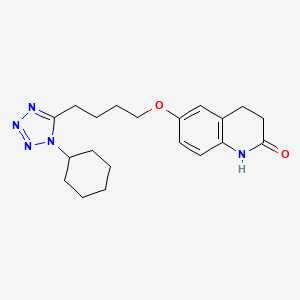
| Formula | C20H27N5O2 |
|---|---|
| Molecular weight | 369.47 g/mol |
| IUPAC name | 6-[4-(1-cyclohexyltetrazol-5-yl)butoxy]-3,4-dihydro-1H-quinolin-2-one |
| CAS | 73963-72-1 |
| PubChem CID | 2754 |
| InChIKey | RRGUKTPIGVIEKM-UHFFFAOYSA-N |
| logP | 3.46 (XLogP 3.1) |
| Polar surface area | 81.93 Ų |
| H-bond acceptors / donors | 6 / 1 |
| Drug-likeness (QED) | 0.76 |
| Lipinski violations | 0 |
SMILES
O=C1CCc2cc(OCCCCc3nnnn3C3CCCCC3)ccc2N1Biology & Pharmacokinetics
Pharmacokinetics
| BBB penetrant | No |
|---|
Enzyme interactions
| Enzyme | Role | Detail |
|---|---|---|
| CYP2C19 | Substrate | — |
| CYP2C9 | Inhibitor | IC₅₀ 10.0 µM |
| CYP3A4 | Inhibitor | — |
| CYP3A4 | Substrate | — |
Receptor binding (top 2)
| Target | Action | Affinity |
|---|---|---|
| phosphodiesterase 3A (PDE3A) | Inhibitor | pIC50 6.7 |
| phosphodiesterase 3B (PDE3B) | Inhibitor | pIC50 6.4 |
Transporters
BCRP (Inhibitor)BCRP (Inhibitor)BSEP (Inhibitor)BSEP (Inhibitor)MDR1 (Inhibitor)MRP1 (Inhibitor)MRP2 (Inhibitor)MRP3 (Inhibitor)MRP4 (Inhibitor)OATP1B1 (Inhibitor)OATP1B3 (Inhibitor)OATP1B3 (Inhibitor)P-gp (Inhibitor)MDR1 (Substrate)OAT (Substrate)OAT1 (Substrate)OAT2 (Substrate)OAT3 (Substrate)P-gp (Substrate)
Drug–drug interactions (100+, DDInter)
| Interacting drug | Severity | Management |
|---|---|---|
| Acalabrutinib | major | |
| Amisulpride | major | |
| Amprenavir | major | |
| Apixaban | major | |
| Aprepitant | major | |
| Ardeparin | major | |
| Argatroban | major | |
| Arsenic trioxide | major | |
| Atazanavir | major | |
| Avapritinib | major | |
| Bedaquiline | major | |
| Bepridil | major | |
| Berotralstat | major | |
| Betrixaban | major | |
| Bivalirudin | major | |
| Boceprevir | major | |
| Cabozantinib | major | |
| Ceritinib | major | |
| Chloroquine | major | |
| Cisapride | major | |
| Clarithromycin | major | |
| Clozapine | major | |
| Cobicistat | major | |
| Conivaptan | major | |
| Crizotinib | major | |
| Dalfopristin | major | |
| Dalteparin | major | |
| Danaparoid | major | |
| Darunavir | major | |
| Dasatinib | major | |
| Deferasirox | major | |
| Defibrotide | major | |
| Delavirdine | major | |
| Desirudin | major | |
| Diltiazem | major | |
| Disopyramide | major | |
| Dofetilide | major | |
| Dolasetron | major | |
| Dronedarone | major | |
| Droperidol | major |
Showing 40 of 100+.
Registered Products (1)
| Brand | Form / strength | Pack | Agent | Citizen (JOD) |
|---|---|---|---|---|
| Claditol® | Tablet 50.0 mg | 60 tab | / UNITED PHARM.MFG.CO.LTD(UPM)/JORDAN / General | — |