Acalabrutinib
JFDA label: Calquence 100mg capsule
Mechanism of Action
Inhibitor of Tyrosine-protein kinase BTK — Tyrosine-protein kinase BTK inhibitor
| Target | Action | Gene / class |
|---|---|---|
| Tyrosine-protein kinase BTK efficacy | INHIBITOR | BTK |
Indications
Approved
- Mantle cell lymphoma (previously treated)
Class profile
| mechanismClass | BTK kinase inhibitor (TKI) |
|---|---|
| targetMolecule | BTK (Bruton tyrosine kinase) |
| targetPathway | B-cell receptor signaling |
| generation | 2nd generation BTK inhibitor (irreversible, more selective) |
| primaryTumors | CLL,MCL |
| resistanceMechanisms | BTK C481S mutation,PLCG2 mutations; less off-target than ibrutinib |
| source | NCCN/OncoKB/Goodman&Gilman13ed |
Contraindications
Source: Lexicomp
- There are no contraindications listed in the manufacturer's labeling Absolute
Adverse Reactions
Cardiac disorders (2)
Common Atrial fibrillation · atrial flutter
Nervous system disorders (3)
Very Common fatigue · Headache
Not Known Progressive multifocal leukoencephalopathy
Renal and urinary disorders (1)
Common Increased serum creatinine
Blood and lymphatic system disorders (8)
Very Common anemia · bruise · malignant neoplasm · Neutropenia
Common hematoma · hemorrhage · skin carcinoma · Thrombocytopenia
Gastrointestinal disorders (5)
Very Common abdominal pain · constipation · Diarrhea · nausea · vomiting
Skin and subcutaneous tissue disorders (1)
Very Common Skin rash
Musculoskeletal and connective tissue disorders (1)
Very Common Myalgia
Infections and infestations (3)
Not Known Opportunistic infection · reactivation of HBV · serious infection
Respiratory, thoracic and mediastinal disorders (2)
Common Epistaxis
Not Known Pneumonia
Dosing
Source: Lexicomp
Warnings & Precautions
Source: Lexicomp
Bone marrow suppression
Grade 3 or 4 cytopenias including neutropenia, anemia, and thrombocytopenia have occurred in patients with hematologic malignancies treated with acalabrutinib (as a single agent). In studies, CBC was monitored monthly.
Cardiovascular adverse effects
Atrial fibrillation and atrial flutter (any grade) occurred in a small percentage of patients with hematologic malignancies treated with acalabrutinib (as a single agent); grade 3 events were reported. Monitor for atrial fibrillation and atrial flutter and manage as appropriate.
GI toxicity
Diarrhea, nausea, and vomiting may commonly occur, although generally mild.
Hemorrhage
Serious hemorrhagic events (some fatal) have been reported in patients with hematologic malignancies who received acalabrutinib. Overall, bleeding events, including bruising and petechiae (any grade), occurred in approximately half of patients with hematological malignancies who received acalabrutinib. Grade 3 or higher bleeding events (including GI, intracranial, and epistaxis) have been reported rarely. While the mechanism for bleeding events is not well understood, acalabrutinib may further increase the risk of hemorrhage in patients receiving antiplatelet or anticoagulant therapies; monitor these patients for signs of bleeding. Depending upon the type of surgery and the risk of bleeding, consider the benefit-risk of withholding acalabrutinib treatment for 3 to 7 days before and after surgery.
Infection
Serious bacterial, viral, or fungal infections (including fatal events and opportunistic infections) have occurred in patients with hematologic malignancies treated with acalabrutinib (as a single agent). Consider prophylaxis in patients who are at increased risk for opportunistic infections. Grade 3 or higher infections occurred in about one-fifth of these patients; pneumonia was the most frequent grade 3 or 4 infection. Infections due to hepatitis B virus (HBV) reactivation and progressive multifocal leukoencephalopathy (PML) have also occurred. Monitor for signs and symptoms of infection and manage as medically appropriate.
Secondary malignancies
Second primary malignancies, including non-skin carcinomas, have occurred in about one-tenth of patients with hematologic malignancies treated with acalabrutinib (as a single agent); the most frequent second primary malignancy was skin cancer. Advise patients to utilize protection from sun exposure. Concurrent drug therapy issues:
Drug-drug interactions
Potentially significant interactions may exist, requiring dose or frequency adjustment, additional monitoring, and/or selection of alternative therapy. Consult drug interactions database for more detailed information.
Drugs that affect gastric pH
Avoid concomitant use with proton pump inhibitors; administer acalabrutinib 2 hours prior to H2-receptor antagonists; separate acalabrutinib from antacids by at least 2 hours.
Pregnancy & Lactation
Pregnancy
Adverse events were observed in some animal reproduction studies.
Lactation
It is not known if acalabrutinib is present in breast milk. Due to the potential for adverse events in the breastfed infant, breastfeeding is not recommended by the manufacturer during therapy or for at least 2 weeks after treatment is complete.
Monitoring
| Efficacy | Tumour response (RECIST criteria, tumour markers, imaging); progression-free survival; performance status (ECOG/Karnofsky) |
|---|---|
| Toxicity | CBC with differential (nadir timing depends on agent); LFTs; renal function; ECG (QT for relevant agents); echocardiogram for cardiotoxic agents (anthracyclines, trastuzumab); cumulative dose tracking for dose-limited toxicities |
| Clinical pearl | Treatment response is assessed after 2–3 cycles. Grade 3–4 toxicities typically require dose reduction or interruption per protocol-defined criteria. |
| Counseling | Attend all scheduled blood tests and imaging appointments. Report fever > 38°C (risk of neutropaenic sepsis — medical emergency), unusual bleeding, or new pain immediately. |
Chemistry & Properties
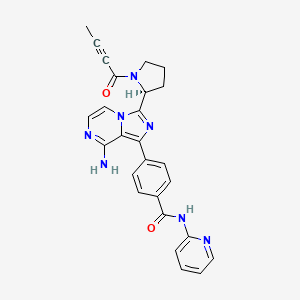
| Formula | C26H23N7O2 |
|---|---|
| Molecular weight | 465.52 g/mol |
| IUPAC name | 4-[8-amino-3-[(2S)-1-but-2-ynoylpyrrolidin-2-yl]imidazo[1,5-a]pyrazin-1-yl]-N-pyridin-2-ylbenzamide |
| CAS | 1420477-60-6 |
| PubChem CID | 71226662 |
| InChIKey | WDENQIQQYWYTPO-IBGZPJMESA-N |
| logP | 3.31 (XLogP 3.0) |
| Polar surface area | 118.51 Ų |
| H-bond acceptors / donors | 7 / 2 |
| Drug-likeness (QED) | 0.45 |
| Lipinski violations | 0 |
SMILES
CC#CC(=O)N1CCC[C@H]1c1nc(-c2ccc(C(=O)Nc3ccccn3)cc2)c2c(N)nccn12Biology & Pharmacokinetics
Pharmacokinetics
| BBB penetrant | No |
|---|
Enzyme interactions
| Enzyme | Role | Detail |
|---|---|---|
| CYP2C19 | Inhibitor | — |
| CYP2C8 | Inhibitor | — |
Receptor binding (top 16)
| Target | Action | Affinity |
|---|---|---|
| Bruton tyrosine kinase (BTK) | Inhibitor | pIC50 8.3 |
| Bruton tyrosine kinase (BTK) | Inhibitor | pEC50 8.0 |
| erb-b2 receptor tyrosine kinase 4 (ERBB4) | Inhibitor | pIC50 7.8 |
| BMX non-receptor tyrosine kinase (BMX) | Inhibitor | pIC50 7.3 |
| tec protein tyrosine kinase (TEC) | Inhibitor | pIC50 7.0 |
| TXK tyrosine kinase (TXK) | Inhibitor | pIC50 6.4 |
| BLK proto-oncogene, Src family tyrosine kinase (BLK) | Inhibitor | pIC50 6.0 |
| epidermal growth factor receptor (EGFR) | Inhibitor | pIC50 6.0 |
| erb-b2 receptor tyrosine kinase 2 (ERBB2) | Inhibitor | pIC50 6.0 |
| FYN proto-oncogene, Src family tyrosine kinase (FYN) | Inhibitor | pEC50 6.0 |
| IL2 inducible T cell kinase (ITK) | Inhibitor | pIC50 6.0 |
| Janus kinase 3 (JAK3) | Inhibitor | pIC50 6.0 |
| LCK proto-oncogene, Src family tyrosine kinase (LCK) | Inhibitor | pEC50 6.0 |
| LYN proto-oncogene, Src family tyrosine kinase (LYN) | Inhibitor | pIC50 6.0 |
| LYN proto-oncogene, Src family tyrosine kinase (LYN) | Inhibitor | pEC50 6.0 |
Transporters
BCRP (Inhibitor)BSEP (Inhibitor)MRP1 (Inhibitor)OATP1B1 (Inhibitor)OATP1B3 (Inhibitor)P-gp (Inhibitor)BCRP (Substrate)MDR1 (Substrate)P-gp (Substrate)
Drug–drug interactions (100+, DDInter)
| Interacting drug | Severity | Management |
|---|---|---|
| Abciximab | major | |
| Acetylsalicylic acid | major | |
| Adalimumab | major | |
| Alteplase | major | |
| Amprenavir | major | |
| Anagrelide | major | |
| Anisindione | major | |
| Anistreplase | major | |
| Antithrombin Alfa | major | |
| Antithrombin III human | major | |
| Apalutamide | major | |
| Apixaban | major | |
| Aprepitant | major | |
| Ardeparin | major | |
| Argatroban | major | |
| Atazanavir | major | |
| Avapritinib | major | |
| Bacillus calmette-guerin substrain tice live antigen | major | |
| Baricitinib | major | |
| Betrixaban | major | |
| Binimetinib | major | |
| Bivalirudin | major | |
| Boceprevir | major | |
| Bromfenac | major | |
| Cabozantinib | major | |
| Cangrelor | major | |
| Caplacizumab | major | |
| Carbamazepine | major | |
| Ceritinib | major | |
| Certolizumab pegol | major | |
| Cilostazol | major | |
| Ciprofloxacin | major | |
| Cladribine | major | |
| Clarithromycin | major | |
| Clopidogrel | major | |
| Clozapine | major | |
| Cobicistat | major | |
| Conivaptan | major | |
| Crizotinib | major | |
| Dalfopristin | major |
Showing 40 of 100+.
Registered Products (2)
| Brand | Form / strength | Pack | Agent | Citizen (JOD) |
|---|---|---|---|---|
| Calquence | Capsule 100 mg | 60 cap pack varies | Shawi & Rushedat Drug Store | — |
| Calquence 100mg Film Coated Tablet | Film-Coated Tablet 100 mg | 60 tab pack varies | Shawi & Rushedat Drug Store | — |