Apixaban
JFDA label: Paquix
- Discontinuation:
- Spinal/Epidural hematoma:
Mechanism of Action
Inhibitor of Coagulation factor X — Coagulation factor X inhibitor
| Target | Action | Gene / class |
|---|---|---|
| Coagulation factor X efficacy | INHIBITOR | F10 |
Indications
Approved
- Deep vein thrombosis
- Nonvalvular atrial fibrillation
- Postoperative venous thromboprophylaxis following hip or knee replacement surgery
- Pulmonary embolism
Off-label
- Recurrent stroke/transient ischemic attacks (prevention)
Contraindications
Source: Curated · Lexicomp
- Active pathological bleeding Absolute
- Hypersensitivity to apixaban or any component of the formulation Absolute
- Severe hypersensitivity reaction (ie, anaphylaxis) to apixaban or any component of the formulation Absolute
- clinically-significant active bleeding (including gastrointestinal bleeding) Absolute
- concomitant systemic treatment with agents that are strong inhibitors of both CYP3A4 and P-glycoprotein (P-gp) Absolute
- concomitant treatment with any other anticoagulant including unfractionated heparin (except at doses used to maintain patency of central venous or arterial catheter), low molecular weight heparins, heparin derivatives (eg, fondaparinux), and oral anticoagulants including warfarin, dabigatran, rivaroxaban except when transitioning to or from apixaban therapy Absolute
- hepatic disease associated with coagulopathy and clinically-relevant bleeding risk Absolute
- lesions or conditions at increased risk of clinically-significant bleeding (eg, cerebral infarct [ischemic or hemorrhagic], active peptic ulcer disease with recent bleeding Absolute
- patients with spontaneous or acquired impairment of hemostasis) Absolute
Adverse Reactions
Hepatobiliary disorders (1)
Common Increased serum transaminases
Renal and urinary disorders (2)
Common Hematuria · hypermenorrhea
Blood and lymphatic system disorders (6)
Common Anaemia · Anemia · bruise · hematoma · postprocedural hemorrhage · rectal hemorrhage
Metabolism and nutrition disorders (1)
Common Increased gamma-glutamyl transferase
Gastrointestinal disorders (3)
Common gingival hemorrhage · Nausea · Nausea
Injury, poisoning and procedural complications (2)
Common Bleeding (minor)
Uncommon Bleeding (major)
Other (1)
Very Common Hematologic & oncologic: Hemorrhage
Respiratory, thoracic and mediastinal disorders (2)
Common Epistaxis · hemoptysis
Dosing
Source: Lexicomp
Warnings & Precautions
Source: Lexicomp
Bleeding
May increase the risk of bleeding, including severe and potentially fatal bleeding. Concomitant use of drugs that affect hemostasis increases the risk of bleeding. Discontinue therapy with active pathological hemorrhage and promptly evaluate for bleeding source. No specific antidote for apixaban reversal exists. Apixaban is highly protein-bound; therefore, hemodialysis is ineffective. Depending on the bleeding severity, activated oral charcoal should be considered if ingestion occurred within 1 to 2 hours of presentation. The following alternative options may also be considered depending specific clinical scenario: 4-factor unactivated prothrombin concentrate (PCC) (eg, Kcentra) or 4-factor activated prothrombin complex concentrate (aPCC) (eg, FEIBA). Some studies and case reports have shown moderate success in correcting coagulation tests with some of these agents; however, correction of coagulation tests does not imply reversal of the anticoagulation effect of the medication (AHA/ASA [Hemphill 2015; EHRA [Heidbuchel 2015]; NCS/SCCM [Frontera 2016]).
Thromboembolic events
Premature discontinuation of any oral anticoagulant, including apixaban, in the absence of adequate alternative anticoagulation increases the risk of thrombotic events. When used to prevent stroke in patients with nonvalvular atrial fibrillation, an increased risk of stroke was observed upon transition from apixaban to warfarin in clinical trials. If apixaban must be discontinued for reasons other than bleeding or completion of a course of therapy, consider the use of another anticoagulant. In patients with non-valvular atrial fibrillation who had an acute ischemic stroke while receiving a DOAC (eg, apixaban), guidelines generally support withholding oral anticoagulation until 1 to 2 weeks after the ischemic stroke (time frame may vary with shorter times for transient ischemic attack or small, non-disabling stroke and longer times for moderate-to-severe stroke) (AHA/ASA [Kernan 2014]). Disease-related concerns:
Acute coronary syndrome (ACS)
In a clinical trial evaluating the use of apixaban in addition to standard antiplatelet therapy to reduce the risk of recurrent ischemic events post-ACS, an increased incidence of major bleeding (including intracranial and fatal bleeding) without any significant clinical benefit was observed (Alexander 2011).
Hepatic impairment
Use with caution in moderate impairment (Child-Pugh class B) as there is limited clinical experience in these patients; dosing recommendations cannot be provided. Use in severe hepatic impairment (Child-Pugh class C) is not recommended.
Renal impairment
Systemic exposure increases with worsening renal function. Bleeding risk may be increased in severe renal impairment (CrCl 2.5 mg/dL or CrCl • Valvular disease: Safety and efficacy have not been established in patients with prosthetic heart valves or significant rheumatic heart disease (eg, mitral stenosis); use is not recommended. Non-valvular atrial fibrillation is defined as atrial fibrillation that occurs in the absence of rheumatic mitral valve disease, mitral valve repair, or prosthetic heart valve (AHA/ACC/HRS [January 2014]). Concurrent drug therapy issues:
Drug-drug interactions
Potentially significant interactions may exist, requiring dose or frequency adjustment, additional monitoring, and/or selection of alternative therapy. Consult drug interactions database for more detailed information. Special populations:
Acutely ill medical patients
In acutely ill patients (eg, heart failure, respiratory failure) at risk for venous thromboembolism (VTE) receiving apixaban for extended VTE prophylaxis, an increased incidence of major bleeding without greater efficacy was observed with extended apixaban therapy (eg, 30 days) versus low molecular weight heparin (enoxaparin) therapy for 1 to 2 weeks (Goldhaber 2011).
Elderly
Systemic exposure is increased ~32% in patients >65 years of age; however, dose reductions are not required. Dosage reduction is recommended for patients with nonvalvular atrial fibrillation who are ≥80 years of age and either weigh ≤60 kg or with a serum creatinine ≥1.5 mg/dL. Other warnings/precautions:
Appropriate use
In hemodynamically unstable patients with acute PE or patients with PE requiring thrombolysis or pulmonary embolectomy, the use of apixaban is not recommended as an alternative to unfractionated heparin for initial treatment.
Body weight
Systemic exposure may be increased by 20% to 30% in patients 120 kg; dosage reduction is recommended for patients with nonvalvular atrial fibrillation weighing ≤60 kg and either ≥80 years of age or with a serum creatinine ≥1.5 mg/dL.
Spinal or epidural hematoma
Spinal or epidural hematomas resulting in long-term or permanent paralysis may occur with neuraxial anesthesia (epidural or spinal anesthesia) or spinal/epidural puncture; the risk is increased by the use of indwelling epidural catheters with concomitant administration of other drugs that affect hemostasis (eg, NSAIDS, platelet inhibitors, other anticoagulants), in patients with a history of traumatic or repeated epidural or spinal punctures, a history of spinal deformity or surgery, or if optimal timing between the administration of apixaban and neuraxial procedures is not known. Consider the potential benefit versus risk prior to neuraxial intervention in patients who are anticoagulated or scheduled to be anticoagulated for thromboprophylaxis. In patients who receive both apixaban and neuraxial anesthesia, avoid removal of epidural or intrathecal catheter for at least 24 hours following last apixaban dose; avoid apixaban administration for at least 5 hours following catheter removal. If traumatic puncture occurs, delay administration of apixaban for at least 48 hours. Monitor frequently for signs of neurologic impairment (eg, numbness/weakness of legs, bowel/bladder dysfunction). If neurologic impairment is noted, prompt treatment is necessary.
Pregnancy & Lactation
Pregnancy
Adverse events were not observed in animal reproduction studies. Data are insufficient to evaluate the safety of oral factor Xa inhibitors during pregnancy; use during pregnancy should be avoided (Bates 2012).
Lactation
It is not known if apixaban is excreted in breast milk. Apixaban is not recommended for use in breast-feeding women; use of alternative anticoagulants is preferred (Bates 2012)
Monitoring
| Efficacy | Clinical signs of thrombosis or bleeding; renal function annually or if clinically indicated; Hb |
|---|---|
| Toxicity | Hb/Hct for occult bleeding; eGFR and hepatic function (dose adjustment criteria) |
| Clinical pearl | Renal clearance is ~27% of total clearance; hepatic impairment affects bleeding risk more than renal impairment in many patients. |
| Counseling | Carry anticoagulant card. Report bleeding, dizziness, or weakness immediately. |
Chemistry & Properties
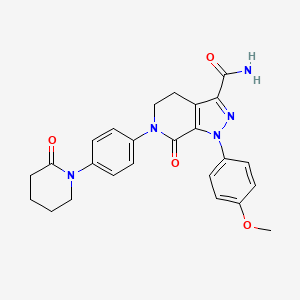
| Formula | C25H25N5O4 |
|---|---|
| Molecular weight | 459.51 g/mol |
| IUPAC name | 1-(4-methoxyphenyl)-7-oxo-6-[4-(2-oxopiperidin-1-yl)phenyl]-4,5-dihydropyrazolo[5,4-c]pyridine-3-carboxamide |
| CAS | 503612-47-3 |
| PubChem CID | 10182969 |
| InChIKey | QNZCBYKSOIHPEH-UHFFFAOYSA-N |
| logP | 2.7 (XLogP 2.2) |
| Polar surface area | 110.76 Ų |
| H-bond acceptors / donors | 6 / 1 |
| Drug-likeness (QED) | 0.63 |
| Lipinski violations | 0 |
SMILES
COc1ccc(-n2nc(C(N)=O)c3c2C(=O)N(c2ccc(N4CCCCC4=O)cc2)CC3)cc1Biology & Pharmacokinetics
Pharmacokinetics
| BBB penetrant | No |
|---|
Enzyme interactions
| Enzyme | Role | Detail |
|---|---|---|
| CYP1A2 | Substrate | — |
| CYP2C8 | Inhibitor | — |
| CYP2C9 | Substrate | — |
| CYP3A4 | Inhibitor | — |
| CYP3A4 | Substrate | — |
Receptor binding (top 1)
| Target | Action | Affinity |
|---|---|---|
| coagulation factor X (F10) | Inhibitor | pKi 10.1 |
Transporters
BCRP (Inhibitor)BSEP (Inhibitor)MDR1 (Inhibitor)MRP1 (Inhibitor)OATP1B1 (Inhibitor)OATP1B3 (Inhibitor)P-gp (Inhibitor)BCRP (Substrate)MDR1 (Substrate)OATP1B1 (Substrate)OATP1B3 (Substrate)OATP2B1 (Substrate)P-gp (Substrate)
Drug–drug interactions (100+, DDInter)
| Interacting drug | Severity | Management |
|---|---|---|
| Abciximab | major | |
| Acalabrutinib | major | |
| Acetylsalicylic acid | major | |
| Alteplase | major | |
| Anagrelide | major | |
| Anisindione | major | |
| Anistreplase | major | |
| Antithrombin Alfa | major | |
| Antithrombin III human | major | |
| Apalutamide | major | |
| Ardeparin | major | |
| Argatroban | major | |
| Avapritinib | major | |
| Betrixaban | major | |
| Bivalirudin | major | |
| Boceprevir | major | |
| Bromfenac | major | |
| Cabozantinib | major | |
| Cangrelor | major | |
| Caplacizumab | major | |
| Carbamazepine | major | |
| Cilostazol | major | |
| Clopidogrel | major | |
| Cobicistat | major | |
| Conivaptan | major | |
| Dalteparin | major | |
| Danaparoid | major | |
| Dasatinib | major | |
| Deferasirox | major | |
| Defibrotide | major | |
| Desirudin | major | |
| Dextran (-1) | major | |
| Dextran (high molecular weight) | major | |
| Dextran (low molecular weight) | major | |
| Diclofenac | major | |
| Dicoumarol | major | |
| Diflunisal | major | |
| Dipyridamole | major | |
| Drotrecogin alfa | major | |
| Edoxaban | major |
Showing 40 of 100+.
Registered Products (38)
| Brand | Form / strength | Pack | Agent | Citizen (JOD) |
|---|---|---|---|---|
| APIBAN 2.5 mg Each film coated tablet | Film-Coated Tablet 2.50 mg | 10 tab pack varies | Manar Drug Store | 4.960 |
| APIBAN 5 mg Each film coated tablet | Film-Coated Tablet 5 mg | 10 tab pack varies | Manar Drug Store | 4.960 |
| Clotexia 2.5 mg F.C. Tablet | Film-Coated Tablet 2.5 mg | 30 tab pack varies | Sana Pharmaceutical Industry Co. | 14.410 |
| APIBAN 2.5 mg Each film coated tablet | Film-Coated Tablet 2.50 mg | 30 tab pack varies | Manar Drug Store | 14.460 |
| APIBAN 5 mg Each film coated tablet | Film-Coated Tablet 5 mg | 30 tab pack varies | Manar Drug Store | 14.460 |
| Extensio | Tablet 2.5 mg | 20 tab pack varies | Hikma Pharmaceuticals Co.Ltd/Jordan | 16.230 |
| APIQX 2.5 | Tablet Apixaban 2.500 mg | (6 x 10âs BLISTERS) / | Omicron Pharma | 17.270 |
| Clotexia 5 mg F.C. Tablet | Film-Coated Tablet 5 mg | 30 tab pack varies | SANA PHARMACEUTICAL INDUSTRY/JORDAN | 23.000 |
| Payan | Tablet 2.5 mg | 30 tab pack varies | / Pharma International Company/Jordan / General | 25.740 |
| Paquix | Tablet 2.5 mg | 30 tab pack varies | UNITED PHARM.MFG.CO.LTD(UPM)/JORDAN | 26.520 |
| APIBAN 2.5 mg Each film coated tablet | Film-Coated Tablet 2.50 mg | 60 tab pack varies | Manar Drug Store | 26.860 |
| APIBAN 5 mg Each film coated tablet | Film-Coated Tablet 5 mg | 60 tab pack varies | Manar Drug Store | 26.860 |
| Clotexia 2.5 mg F.C. Tablet | Film-Coated Tablet 2.5 mg | 60 tab pack varies | Sana Pharmaceutical Industry Co. | 27.450 |
| Draxaban | Tablet Apixaban 2.5 mg | 30 tab pack varies | Al-Taqqadom Pharmaceutical Industries / Al-Taqqadom Pharmaceutical Industries / Drug | 28.960 |
| Draxaban | Tablet Apixaban 5 mg | 30 tab pack varies | Al-Taqqadom Pharmaceutical Industries / Al-Taqqadom Pharmaceutical Industries / Drug | 28.960 |
| APIQX 5 | Tablet Apixaban 5.000 mg | (6x10âs BLISTERS) / | Omicron Pharma | 36.770 |
| Apixalife 2.5 Tablets | Tablet 2.5 mg | 60 tab | The Jordanian Pharmaceutical Manufacturing Co. (JPM) | 42.300 |
| apixalife 5 Tablets | Tablet 5 mg | 60 tab | The Jordanian Pharmaceutical Manufacturing Co. (JPM) | 42.300 |
| Elixaban 2.5mg Film Coated Tablet | Film-Coated Tablet 2.5 mg | 60 tab pack varies | Al-Motakadema Pharmaceutical LTD. | 42.900 |
| Elixaban 2.5mg Film Coated Tablet | Film-Coated Tablet 2.5 mg | 30 tab pack varies | Al-Motakadema Pharmaceutical LTD. | 42.900 |
| Elixaban 5mg Film Coated Tablet | Film-Coated Tablet 5 mg | 60 tab | Al-Motakadema Pharmaceutical LTD. | 42.900 |
| Clotexia 5 mg F.C. Tablet | Film-Coated Tablet 5 mg | 60 tab pack varies | SANA PHARMACEUTICAL INDUSTRY/JORDAN | 45.000 |
| APIBAN 2.5 mg Each film coated tablet | Film-Coated Tablet 2.50 mg | 100 tab pack varies | Manar Drug Store | 45.920 |
| APIBAN 5 mg Each film coated tablet | Film-Coated Tablet 5 mg | 100 tab pack varies | Manar Drug Store | 45.920 |
| Extensio | Tablet 2.5 mg | 60 tab pack varies | Hikma Pharmaceuticals Co.Ltd/Jordan | 45.950 |
| Extensio | Tablet 5 mg | 60 tab | Hikma Pharmaceuticals Co.Ltd/Jordan | 45.950 |
| Payan | Tablet 5 mg | 60 tab | / Pharma International Company/Jordan / General | 49.030 |
| Payan | Tablet 2.5 mg | 60 tab pack varies | / Pharma International Company/Jordan / General | 49.030 |
| Paquix | Tablet 5 mg | 60 tab | UNITED PHARM.MFG.CO.LTD(UPM)/JORDAN | 50.520 |
| Paquix | Tablet 2.5 mg | 60 tab pack varies | UNITED PHARM.MFG.CO.LTD(UPM)/JORDAN | 50.520 |
| pexi | Tablet 5 mg | 60 tab | JORDAN SWEDEN MEDICAL&STERILE.CO (JOSWE)/JORDAN / General | 50.520 |
| Draxaban | Tablet Apixaban 2.5 mg | 60 tab pack varies | Al-Taqqadom Pharmaceutical Industries / Al-Taqqadom Pharmaceutical Industries / Drug | 55.160 |
| Draxaban | Tablet Apixaban 5 mg | 60 tab pack varies | Al-Taqqadom Pharmaceutical Industries / Al-Taqqadom Pharmaceutical Industries / Drug | 55.160 |
| Pixaclot | Tablet 2.5 mg | 60 tab | AL-RAM PHARMA.INDUS.CO.LTD/JORDAN / General | 55.160 |
| Preventis | Tablet Apixaban 5 mg | 60 tab | شركة الحياة للصناعات الدوائية / HAYAT PHARMA.INDUSTRIES.CO.LTD/JORDAN / Drug | 55.160 |
| pixaclot | Tablet 5 mg | 60 tab | AL-RAM PHARMA.INDUS.CO.LTD/JORDAN / General | 55.160 |
| Eliquis 2.5 | Tablet 2.5 mg | 60 tab | Khoury Drug Store | 61.290 |
| Eliquis 5 | Tablet 5 mg | 60 tab | Khoury Drug Store | 61.290 |