Salbutamol
JFDA label: Asmanore 2mg tablet
Mechanism of Action
Agonist of Beta-2 adrenergic receptor — Beta-2 adrenergic receptor agonist
| Target | Action | Gene / class |
|---|---|---|
| Beta-2 adrenergic receptor efficacy | AGONIST | ADRB2 |
Indications
Approved
- Bronchospasm
- Exercise-induced bronchospasm
Off-label
- Asthma (children younger than 4 years) (metered-dose inhaler)
- Hyperkalemia (Inhalation)
Contraindications
Source: Lexicomp
- Additional contraindications (not in US labeling): Injection: Ventolin: Hypersensitivity to albuterol or any component of the formulation Absolute
- Inhalation, Oral: Hypersensitivity to albuterol or any component of the formulation Absolute
- risk of abortion during first or second trimester Inhalation: Tocolytic use in patients at risk of premature labor or threatened abortion Absolute
- severe hypersensitivity to milk proteins (dry powder inhalers) Absolute
- tachyarrhythmias Absolute
Adverse Reactions
Cardiac disorders (3)
Common chest pain, headache, dizziness, diabetes mellitus, vomiting, unpleasant taste, gastroenteritis, increased appetite, viral gastroenteritis, diarrhea, difficulty in micturition · hypertension · Tachycardia
Nervous system disorders (2)
Very Common Excitement · nervousness
Hepatobiliary disorders (2)
Common Increased serum ALT · increased serum AST
Blood and lymphatic system disorders (4)
Common Decreased hematocrit · decreased hemoglobin · decreased white blood cell count · lymphadenopathy
Immune system disorders (1)
Common Hypersensitivity reaction
Musculoskeletal and connective tissue disorders (6)
Very Common Tremor
Common back pain · hyperkinesia · leg cramps · Muscle cramps · musculoskeletal pain
Ear and labyrinth disorders (2)
Common ear disease, viral upper respiratory tract infection, respiratory tract disease, nasopharyngitis, oropharyngeal pain, sinusitis, upper respiratory tract inflammation, cough, flu-like symptoms, dyspnea · Otitis media
Infections and infestations (2)
Common Cold symptoms · infection
Respiratory, thoracic and mediastinal disorders (5)
Very Common bronchospasm · exacerbation of asthma · pharyngitis · rhinitis · Upper respiratory tract infection
Dosing
Source: Lexicomp
Warnings & Precautions
Source: Lexicomp
Bronchospasm
Rarely, paradoxical bronchospasm may occur with use of inhaled bronchodilating agents (may be fatal); this should be distinguished from inadequate response.
Hypersensitivity reactions
Immediate hypersensitivity reactions (urticaria, angioedema, rash, bronchospasm, oropharyngeal edema), including anaphylaxis, have been reported. Disease-related concerns:
Asthma
Albuterol is a short-acting beta2-agonist (SABA) that should be used as needed for quick relief of asthma symptoms. Based on a step-wise treatment approach using asthma guidelines, monotherapy without concurrent use of a long-term controller medication should only be reserved for patients with mild, intermittent forms of asthma without the presence of risk factors (Step 1 and/or exercise-induced) (GINA 2016; NAEPP 2007).
Cardiovascular disease
Use with caution in patients with cardiovascular disease (arrhythmia, coronary insufficiency, hypertension, heart failure); beta-agonists may produce ECG changes (flattening of the T wave, prolongation of the QTc interval, ST segment depression) and/or cause elevation in blood pressure, heart rate and result in CNS stimulation/excitation. Beta2-agonists may also increase risk of arrhythmias. In a scientific statement from the American Heart Association, albuterol has been determined to be an agent that may either cause direct myocardial toxicity or exacerbate underlying myocardial dysfunction (magnitude: moderate to major) (AHA [Page 2016]).
Diabetes
Use with caution in patients with diabetes mellitus; beta2-agonists may increase serum glucose and aggravate preexisting diabetes and ketoacidosis.
Glaucoma
Use with caution in patients with glaucoma; may elevate intraocular pressure.
Hyperthyroidism
Use with caution in hyperthyroidism; may stimulate thyroid activity.
Hypokalemia
Use with caution in patients with hypokalemia; beta2-agonists may decrease serum potassium.
Renal impairment
Use with caution in patients with renal impairment.
Seizures
Use with caution in patients with seizure disorders; beta-agonists may result in CNS stimulation/excitation. Concurrent drug therapy issues:
Drug-drug interactions
Potentially significant interactions may exist, requiring dose or frequency adjustment, additional monitoring, and/or selection of alternative therapy. Consult drug interactions database for more detailed information. Special populations:
Pediatric
Use spacer for children Dosage form specific issues:
Benzyl alcohol and derivatives
Some dosage forms may contain sodium benzoate/benzoic acid; benzoic acid (benzoate) is a metabolite of benzyl alcohol; large amounts of benzyl alcohol (≥99 mg/kg/day) have been associated with a potentially fatal toxicity (“gasping syndrome”) in neonates; the “gasping syndrome” consists of metabolic acidosis, respiratory distress, gasping respirations, CNS dysfunction (including convulsions, intracranial hemorrhage), hypotension, and cardiovascular collapse (AAP ["Inactive" 1997]; CDC 1982); some data suggests that benzoate displaces bilirubin from protein binding sites (Ahlfors 2001); avoid or use dosage forms containing benzyl alcohol derivative with caution in neonates. See manufacturer's labeling.
Lactose
Powder for oral inhalation contains lactose; hypersensitivity reactions (eg, anaphylaxis, angioedema, pruritus, and rash) have been reported in patients with milk protein allergy. Other warnings/precautions:
Appropriate use
Do not exceed recommended dose; serious adverse events, including fatalities, have been associated with excessive use of inhaled sympathomimetics.
Patient information
Patients must be instructed to seek medical attention in cases where acute symptoms are not relieved or a previous level of response is diminished. The need to increase frequency of use may indicate deterioration of asthma, and treatment must not be delayed. A spacer device or valved holding chamber is recommended when using a metered-dose inhaler.
Pregnancy & Lactation
Pregnancy
Safe
Continue asthma inhaler therapy unchanged. Uncontrolled asthma (hypoxia, acidosis) is far more harmful than the drug. Parenteral salbutamol for tocolysis causes neonatal metabolic effects
Lactation
It is not known if albuterol is present in breast milk. The amount of albuterol available systemically following inhalation is significantly less in comparison to oral doses. According to the manufacturer, the decision to continue or discontinue breastfeeding during therapy should take into account the risk of exposure to the infant and the benefits of treatment to the mother. Women with asthma should be encouraged to breastfeed (GINA 2016). Use of albuterol is generally considered acceptable
Monitoring
| Clinical pearl | FEV1, peak flow, and/or other pulmonary function tests; blood pressure, heart rate; CNS stimulation; serum glucose, serum potassium, serum creatinine; asthma symptoms; arterial or capillary blood gases (if patients condition warrants) |
|---|
Chemistry & Properties
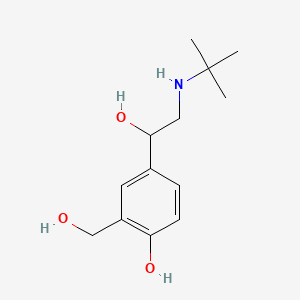
| Formula | C13H21NO3 |
|---|---|
| Molecular weight | 239.31 g/mol |
| IUPAC name | 4-[2-(tert-butylamino)-1-hydroxyethyl]-2-(hydroxymethyl)phenol |
| CAS | 18559-94-9 |
| PubChem CID | 2083 |
| InChIKey | NDAUXUAQIAJITI-UHFFFAOYSA-N |
| logP | 1.31 (XLogP 0.3) |
| Polar surface area | 72.72 Ų |
| H-bond acceptors / donors | 4 / 4 |
| Drug-likeness (QED) | 0.64 |
| Lipinski violations | 0 |
SMILES
CC(C)(C)NCC(O)c1ccc(O)c(CO)c1Biology & Pharmacokinetics
Pharmacokinetics
| BBB penetrant | No (logBB -1.3) |
|---|
Enzyme interactions
| Enzyme | Role | Detail |
|---|---|---|
| CYP2C19 | Substrate | — |
| CYP2D6 | Substrate | — |
| CYP3A4 | Substrate | — |
Receptor binding (top 3)
| Target | Action | Affinity |
|---|---|---|
| adrenergic Beta3 (ADRB3) | Binding | pKi 8.3 |
| adrenergic Beta1 (ADRB1) | Binding | pKi 6.9 |
| adrenergic Beta2 (ADRB2) | Binding | pKi 6.4 |
Transporters
BCRP (Inhibitor)BSEP (Inhibitor)BSEP (Inhibitor)MRP1 (Inhibitor)MRP2 (Inhibitor)MRP3 (Inhibitor)MRP4 (Inhibitor)OATP1B1 (Inhibitor)OATP1B3 (Inhibitor)P-gp (Inhibitor)MATE1 (Substrate)MATE2 (Substrate)OCT1 (Substrate)OCT2 (Substrate)OCT3 (Substrate)P-gp (Substrate)
Drug–drug interactions (100+, DDInter)
| Interacting drug | Severity | Management |
|---|---|---|
| Carteolol | major | |
| Carteolol (ophthalmic) | major | |
| Carvedilol | major | |
| Cocaine (nasal) | major | |
| Cocaine (topical) | major | |
| Labetalol | major | |
| Levobunolol (ophthalmic) | major | |
| Macimorelin | major | |
| Metipranolol (ophthalmic) | major | |
| Mifepristone | major | |
| Nadolol | major | |
| Ozanimod | major | |
| Papaverine | major | |
| Penbutolol | major | |
| Pindolol | major | |
| Propranolol | major | |
| Ribociclib | major | |
| Sotalol | major | |
| Timolol | major | |
| Timolol (ophthalmic) | major | |
| Abarelix | moderate | |
| Abiraterone | moderate | |
| Acarbose | moderate | |
| Acebutolol | moderate | |
| Acetazolamide | moderate | |
| Acetohexamide | moderate | |
| Adenosine | moderate | |
| Albiglutide | moderate | |
| Alfuzosin | moderate | |
| Alimemazine | moderate | |
| Alogliptin | moderate | |
| Aminophylline | moderate | |
| Amiodarone | moderate | |
| Amisulpride | moderate | |
| Amitriptyline | moderate | |
| Amoxapine | moderate | |
| Amphetamine | moderate | |
| Anagrelide | moderate | |
| Apalutamide | moderate | |
| Apomorphine | moderate |
Showing 40 of 100+.
Registered Products (25)
| Brand | Form / strength | Pack | Agent | Citizen (JOD) |
|---|---|---|---|---|
| Asmanore syrup | Syrup 2 mg/5 ml | 100 ml | THE JORDANIAN PHARMACEUTICAL MANUFACTURING COMPANY/JORDAN | 0.530 |
| Asmadil Tablets | Tablet 2 mg | 30 tab pack varies | The Arab Pharmaceutical Manufactruing Co. | 0.550 |
| Asmanore | Tablet 2 mg | 30 tab pack varies | THE JORDANIAN PHARMACEUTICAL MANUFACTURING COMPANY/JORDAN | 0.550 |
| Butalin Syrup | Syrup 2 mg/5 ml | 120 ml | Professional Drug Store | 0.650 |
| Ventol Syrup | Syrup 2 mg/5 ml | 120 ml | Sun Set Drug Store | 0.650 |
| Asmadil Syrup | Syrup 2 mg/5 ml | 120 ml | The Arab Pharmaceutical Manufactruing Co. | 0.730 |
| Asmanore | Tablet 4 mg | 30 tab | THE JORDANIAN PHARMACEUTICAL MANUFACTURING COMPANY/JORDAN | 0.810 |
| MEDOLIN TAB | Tablet 2 mg | 50 tab pack varies | Khoury Drug Store | 0.900 |
| VENTOGEED SYRUP | Syrup Salbutamol Sulfate 2.4 mg/5 ml | 100 ml | AlGadeed Pharmaceutical Industries | 1.000 |
| MEDOLIN TAB | Tablet 2 mg | 100 tab pack varies | Khoury Drug Store | 1.720 |
| Salbutamol Sol For Inhalation | Solution 0.5 % | 30 ml | AL-Faiasel Drug Store | 1.760 |
| Asthalin CFC Free | Inhaler 100 mcg | 200 MD | ORIENT DRUG STORE CO | 1.780 |
| Demoren nebulizer solution (0.5+ 2.5)mg/2.5 ml amp | Solution 2.5 mg, 0.5 mg | 10 ampoule pack varies | Al Hilal Drug Store | 2.270 |
| Butalin | Solution as sulphate 0.5 % | 20 ml | Professional Drug Store | 2.370 |
| Asthalin Respules | Ampoule 2.5 mg/2.5 ml | 20 amp | ORIENT DRUG STORE CO | 2.590 |
| Ventolin Injection | Injection 0.5 mg/ml | 1 ml | Suleiman Tannous & Sons Co. Ltd | 3.070 |
| Ventolin Evohaler | Inhaler 100 mcg | 200 Actuations | Suleiman Tannous & Sons Co. Ltd | 3.150 |
| Ventolin Resp. Solution | Solution (as sulphate)0.5 % | 20 ml | Suleiman Tannous & Sons Co. Ltd | 3.310 |
| Demoren nebulizer solution (0.5+ 2.5)mg/2.5 ml amp | Solution 2.5 mg, 0.5 mg | 20 ampoule pack varies | Al Hilal Drug Store | 4.280 |
| Duolin Respules | Ampoule 500 mcg/2.5 mg | 20 amp | ORIENT DRUG STORE CO | 4.640 |
| Demoren nebulizer solution (0.5+ 2.5)mg/2.5 ml amp | Solution 2.5 mg, 0.5 mg | 30 ampoule pack varies | Al Hilal Drug Store | 6.420 |
| Combivent Unit Dose Vial | Vial 3 mg, anhydrous 500 mcg dose | 2.5 ml | The Jordan Drugstore Co | 9.750 |
| Demoren nebulizer solution (0.5+ 2.5)mg/2.5 ml amp | Solution 2.5 mg, 0.5 mg | 50 ampoule pack varies | Al Hilal Drug Store | 10.700 |
| Asmanore | Tablet 2 mg | 1005 tab pack varies | THE JORDANIAN PHARMACEUTICAL MANUFACTURING COMPANY/JORDAN | 14.740 |
| Asmadil Tablets | Tablet 2 mg | 1000 tab pack varies | The Arab Pharmaceutical Manufactruing Co. | 15.580 |