Adenosine
JFDA label: Adenohardt 3mg /ml Solution for Inj
Mechanism of Action
Agonist of Adenosine receptor — Adenosine receptor agonist
| Target | Action | Gene / class |
|---|---|---|
| Adenosine receptor efficacy | AGONIST |
Indications
Approved
- Diagnostic aid
- Paroxysmal supraventricular tachycardia
Off-label
- Fractional flow reserve testing (diagnostic aid)
- Monomorphic wide-complex tachycardia (stable)
- Narrow-complex regular tachycardia (stable)
- Narrow-complex regular tachycardia (unstable)
- Pulmonary artery hypertension (acute vasodilator testing)
Contraindications
Source: Lexicomp
- Adenoscan prescribing information, 2014) Absolute
- Hypersensitivity to adenosine or any component of the formulation Absolute
- known or suspected bronchoconstrictive or bronchospastic lung disease (Adenoscan), asthma (ACLS [Neumar, 2010] Absolute
- second- or third-degree AV block, sick sinus syndrome, or symptomatic bradycardia (except in patients with a functioning artificial pacemaker) Absolute
Adverse Reactions
Cardiac disorders (3)
Very Common Cardiac arrhythmia · chest pressure
Common Atrioventricular block, paresthesia, numbness, apprehension
Nervous system disorders (2)
Very Common dizziness · Headache
Gastrointestinal disorders (2)
Very Common Gastrointestinal distress
Common Nausea
Skin and subcutaneous tissue disorders (2)
Very Common Facial flushing
Common Diaphoresis
Musculoskeletal and connective tissue disorders (2)
Very Common Neck discomfort
Common Upper extremity discomfort
Other (3)
Not Known Frequency varies based on use and is not always defined; higher frequency of infusion-related effects · such as flushing and lightheadedness/dizziness · were reported with continuous infusion (Adenoscan)
Respiratory, thoracic and mediastinal disorders (1)
Common Hyperventilation
Dosing
Source: Lexicomp
Warnings & Precautions
Source: Lexicomp
Atrial fibrillation/flutter
There have been reports of atrial fibrillation/flutter when administered to patients with paroxysmal supraventricular tachycardia (PSVT) and may be especially problematic in patients with PSVT and underlying Wolff-Parkinson-White syndrome; has also been reported in patients with or without a history of atrial fibrillation undergoing myocardial perfusion imaging with adenosine infusion.
Cardiovascular events (Adenoscan)
Cardiac arrest (fatal and nonfatal), myocardial infarction (MI), cerebrovascular accident (hemorrhagic and ischemic), and sustained ventricular tachycardia (requiring resuscitation) have occurred following Adenoscan use. Avoid use in patients with signs or symptoms of unstable angina, acute myocardial ischemia, or cardiovascular instability due to possible increased risk of significant cardiovascular consequences. Appropriate measures for resuscitation should be available during use.
Conduction disturbances
Adenosine decreases conduction through the AV node and may produce first-, second-, or third-degree heart block. Patients with preexisting SA nodal dysfunction may experience prolonged sinus pauses after adenosine; use caution in patients with first-degree AV block or bundle branch block; use is contraindicated in patients with high-grade AV block, sinus node dysfunction, or symptomatic bradycardia (unless a functional artificial pacemaker is in place). Rare, prolonged episodes of asystole have been reported, with fatal outcomes in some cases. Discontinue adenosine in any patient who develops persistent or symptomatic high-grade AV block.
Hypersensitivity
Hypersensitivity reactions (including dyspnea, pharyngeal edema, erythema, flushing, rash, or chest discomfort) have been reported following Adenoscan administration.
Hypertension
Systolic and diastolic pressure increases have been observed with Adenoscan infusion. In most instances, blood pressure increases resolved spontaneously within several minutes; occasionally, hypertension lasted for several hours.
Hypotension
May produce profound vasodilation with subsequent hypotension. When used as a bolus dose (PSVT), effects are generally self-limiting (due to the short half-life of adenosine). However, when used as a continuous infusion (pharmacologic stress testing), effects may be more pronounced and persistent, corresponding to continued exposure. Use infusions with caution in patients with autonomic dysfunction, carotid stenosis (with cerebrovascular insufficiency), hypovolemia, pericarditis, pleural effusion and/or stenotic valvular heart disease; discontinue infusion in patients who develop persistent or symptomatic hypotension.
Proarrhythmic effects
Monitor for proarrhythmic effects (eg, polymorphic ventricular tachycardia) during and shortly after administration/termination of arrhythmia. The benign transient occurrence of atrial and ventricular ectopy is common upon termination of arrhythmia.
Seizures
Seizures (new-onset or recurrent) have been reported following Adenoscan administration; risk may be increased with concurrent use of aminophylline. Use of any methylxanthine (eg aminophylline, caffeine, theophylline) is not recommended in patients experiencing seizures associated with Adenoscan administration. Disease-related concerns:
Arrhythmia (wide-complex tachycardia)
Avoid use in irregular or polymorphic wide-complex tachycardias; may cause degeneration to ventricular fibrillation (ACLS, 2010).
Electrolyte imbalance
Correct electrolyte disturbances, especially hypokalemia or hypomagnesemia, prior to use and throughout therapy.
Heart transplant recipients
Use with extreme caution in heart transplant recipients; adenosine may cause prolonged asystole; reduction of initial adenosine dose is recommended (ACLS, 2010); considered by some to be contraindicated in this setting (Delacrétaz, 2006).
Pulmonary artery hypertension
Acute vasodilator testing (not an approved use): Use with extreme caution in patients with concomitant heart failure (LV systolic dysfunction with significantly elevated left heart filling pressures) or pulmonary veno-occlusive disease/pulmonary capillary hemangiomatosis; significant decompensation has occurred with other highly selective pulmonary vasodilators resulting in acute pulmonary edema.
Respiratory disease
Avoid use in patients with bronchoconstriction or bronchospasm (eg, asthma); dyspnea, bronchoconstriction, and respiratory compromise have occurred during use. Per the ACLS guidelines and the manufacturer of Adenoscan, use considered contraindicated in patients with asthma. Use caution in patients with obstructive lung disease not associated with bronchoconstriction (eg, emphysema, bronchitis). Immediately discontinue therapy if severe respiratory difficulty is observed. Appropriate measures for resuscitation should be available during use.
Wolff-Parkinson-White (WPW) syndrome
Adenosine should not be used in patients with WPW syndrome and preexcited atrial fibrillation/flutter since ventricular fibrillation may result (AHA/ACC/HRS [January, 2014]). Concurrent drug therapy issues:
Drug-drug interactions
Potentially significant interactions may exist, requiring dose or frequency adjustment, additional monitoring, and/or selection of alternative therapy. Consult drug interactions database for more detailed information.
Caffeine
Pharmacologic stress testing: Since caffeine antagonizes the activity of adenosine, withhold for 5 half-lives prior to adenosine use; avoid dietary caffeine for at least 12 hours prior to pharmacologic stress testing (Henzlova, 2006).
Carbamazepine
Concomitant use potentiates the effects of adenosine; reduction of initial adenosine dose is recommended when used for SVT (ACLS, 2010).
Dipyridamole
Concomitant use potentiates the effects of adenosine; reduction of initial adenosine dose is recommended when used for SVT (ACLS, 2010); withhold dipyridamole-containing medications for at least 24 hours prior to pharmacologic stress testing (Henzlova, 2006)
Drugs which slow AV node conduction
Use with caution in patients receiving other drugs which slow AV node conduction (eg, digoxin, verapamil).
Theophylline (includes aminophylline)
Pharmacologic stress testing: Since theophylline antagonizes the activity of adenosine, withhold for 5 half-lives prior to adenosine use whenever possible. Special populations:
Elderly
Use with caution in the elderly; may be at increased risk of hemodynamic effects, bradycardia, and/or AV block. Dosage form specific issues:
Adenocard
Transient AV block is expected. When used in PSVT, at the time of conversion to normal sinus rhythm, a variety of new rhythms may appear on the ECG. Administer as a rapid bolus, either directly into a vein or (if administered into an IV line), as close to the patient as possible (followed by saline flush). Dose reduction recommended when administered via central line (ACLS, 2010). Other warnings/precautions:
Appropriate use
ECG monitoring is required during use. Equipment for resuscitation and trained personnel experienced in handling medical emergencies should always be immediately available. Adenosine does not convert atrial fibrillation/flutter to normal sinus rhythm; however, may be used diagnostically in these settings if the underlying rhythm is not apparent.
Pregnancy & Lactation
Pregnancy
Animal reproduction studies have not been conducted. Adenosine is an endogenous substance and adverse fetal effects would not be anticipated. Adenosine is recommended for the acute treatment of SVT in pregnant women. The usual recommended doses may be used, although higher doses may be needed in some cases (Page [ACC/AHA/HRS 2015]). ACLS guidelines suggest use is safe and effective in pregnancy (ACLS [Neumar 2010]).
Lactation
It is not known if adenosine is excreted in breast milk following maternal administration. Adenosine is endogenous in breast milk (Sugawara 1995). Due to the potential for adverse reactions in the nursing infant, the manufacturer recommends a decision be made to interrupt nursing or not administer adenosine taking into account the importance of treatment to the mother.
Monitoring
| Clinical pearl | ECG, heart rate, blood pressure; consult individual institutional policies and procedures |
|---|
Chemistry & Properties
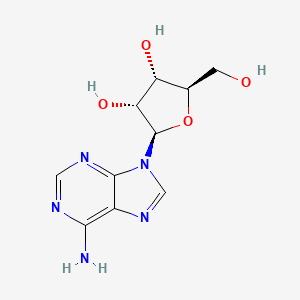
| Formula | C10H13N5O4 |
|---|---|
| Molecular weight | 267.25 g/mol |
| IUPAC name | (2R,3R,4S,5R)-2-(6-aminopurin-9-yl)-5-(hydroxymethyl)oxolane-3,4-diol |
| CAS | 58-61-7 |
| PubChem CID | 60961 |
| InChIKey | OIRDTQYFTABQOQ-KQYNXXCUSA-N |
| logP | -1.98 (XLogP -1.1) |
| Polar surface area | 139.54 Ų |
| H-bond acceptors / donors | 9 / 4 |
| Drug-likeness (QED) | 0.49 |
| Lipinski violations | 0 |
SMILES
Nc1ncnc2c1ncn2[C@@H]1O[C@H](CO)[C@@H](O)[C@H]1OBiology & Pharmacokinetics
Pharmacokinetics
| BBB penetrant | Yes |
|---|
Receptor binding (top 3)
| Target | Action | Affinity |
|---|---|---|
| A1 receptor (ADORA1) | Agonist | pKi 7.0 |
| A3 receptor (ADORA3) | Agonist | pKi 6.5 |
| A2A receptor (ADORA2A) | Agonist | pKi 6.5 |
Transporters
BCRP (Inhibitor)BSEP (Inhibitor)CNT1 (Inhibitor)CNT2 (Inhibitor)CNT3 (Inhibitor)ENT1 (Inhibitor)ENT2 (Inhibitor)MRP1 (Inhibitor)OATP1B1 (Inhibitor)OATP1B1 (Inhibitor)OATP1B3 (Inhibitor)OATP1B3 (Inhibitor)P-gp (Inhibitor)CNT(unspecified) (Substrate)CNT1 (Substrate)CNT2 (Substrate)CNT3 (Substrate)ENT1 (Substrate)ENT2 (Substrate)OAT2 (Substrate)P-gp (Substrate)
Drug–drug interactions (95, DDInter)
| Interacting drug | Severity | Management |
|---|---|---|
| Anagrelide | major | |
| Arsenic trioxide | major | |
| Astemizole | major | |
| Cabozantinib | major | |
| Ceritinib | major | |
| Cisapride | major | |
| Crizotinib | major | |
| Dolasetron | major | |
| Halofantrine | major | |
| Ivosidenib | major | |
| Lumefantrine | major | |
| Nilotinib | major | |
| Osimertinib | major | |
| Ozanimod | major | |
| Panobinostat | major | |
| Papaverine | major | |
| Pasireotide | major | |
| Quinine | major | |
| Ribociclib | major | |
| Siponimod | major | |
| Terfenadine | major | |
| Toremifene | major | |
| Vandetanib | major | |
| Vemurafenib | major | |
| Abarelix | moderate | |
| Abiraterone | moderate | |
| Alimemazine | moderate | |
| Aminophylline | moderate | |
| Apalutamide | moderate | |
| Bicalutamide | moderate | |
| Bosutinib | moderate | |
| Caffeine | moderate | |
| Chloroquine | moderate | |
| Cilostazol | moderate | |
| Clarithromycin | moderate | |
| Dasatinib | moderate | |
| Daunorubicin | moderate | |
| Daunorubicin (liposomal) | moderate | |
| Degarelix | moderate | |
| Dipyridamole | moderate |
Showing 40 of 95.
Registered Products (5)
| Brand | Form / strength | Pack | Agent | Citizen (JOD) |
|---|---|---|---|---|
| ADENORYTHM 3mg/ml Solution for Injection | Powder for Injection 3 mg | 6 vial | Manar Drug Store | — |
| Adenohardt 3mg /ml Solution for Inj | Injection 3 mg/ml | 6 vial | Sun Set Drug Store | — |
| Cardesine 6mg/2ml solution for injection | Injection 6 mg/2 ml | 1 vial pack varies | MS PHARMA/JORDAN | — |
| Cardesine 6mg/2ml solution for injection | Injection 6 mg/2 ml | 6 vial pack varies | MS PHARMA/JORDAN | — |
| Xoria | Ampoule 6 mg/2 ml | 6 amp | Hikma Pharmaceuticals Co.Ltd/Jordan | — |