Venetoclax
JFDA label: Xervexta
Mechanism of Action
Inhibitor of Apoptosis regulator Bcl-2 — Apoptosis regulator Bcl-2 inhibitor
| Target | Action | Gene / class |
|---|---|---|
| Apoptosis regulator Bcl-2 efficacy | INHIBITOR | BCL2 |
Indications
Approved
- Chronic lymphocytic leukemia
Contraindications
Source: Lexicomp
- Additional contraindications (not in the US labeling): Hypersensitivity to venetoclax or any component of the formulation Absolute
- Concomitant use with strong CYP3A inhibitors at initiation and during ramp-up phase Absolute
Adverse Reactions
Cardiac disorders (1)
Very Common Peripheral edema, headache, hyperphosphatemia, hypokalemia
Blood and lymphatic system disorders (2)
Very Common febrile neutropenia · Tumor lysis syndrome
Metabolism and nutrition disorders (2)
Very Common hyperuricemia · Hypocalcemia
Gastrointestinal disorders (1)
Very Common Diarrhea, anemia, thrombocytopenia
Musculoskeletal and connective tissue disorders (1)
Very Common Back pain
General disorders and administration site conditions (1)
Very Common Fever (16%; grades 3/4: 1% to 10%:
Respiratory, thoracic and mediastinal disorders (2)
Very Common cough · Upper respiratory tract infection
Dosing
Source: Lexicomp
Warnings & Precautions
Source: Lexicomp
Bone marrow suppression
Neutropenia, thrombocytopenia, and anemia may occur. Grade 3 and 4 neutropenia occurred in almost half of patients receiving venetoclax. Neutropenic fever has been reported. Monitor CBC with differential throughout treatment. May require treatment interruption and/or dose reduction. Consider antimicrobials and WBC growth factor support as clinically indicated.
Tumor lysis syndrome
Venetoclax may cause a rapid reduction in tumor volume and therefore a risk for tumor lysis syndrome (TLS) is present during the initial 5-week dose escalation phase of treatment. TLS has occurred with venetoclax in previously treated chronic lymphocytic leukemia (CLL) patients with high tumor burden; renal failure (requiring dialysis) and fatalities have been reported. Changes in blood chemistries consistent with TLS may occur as early as 6 to 8 hours after the first dose and with dose increases, and require prompt management. The risk for TLS is increased with high tumor burden and comorbidities; creatinine clearance Disease related concerns:
Hepatic impairment
Adverse events may be increased in patients with moderate impairment; monitor closely for toxicity.
Renal impairment
Patients with decreased renal function (CrCl Concurrent drug therapy issues:
Drug-drug interactions
Potentially significant interactions may exist, requiring dose or frequency adjustment, additional monitoring, and/or selection of alternative therapy. Consult drug interactions database for more detailed information. Other warnings/precautions:
Appropriate use
Select patients for treatment (of relapsed or refractory chronic lymphocytic leukemia) based on the presence of a 17p deletion. Patients without a 17p deletion at diagnosis should be re-tested at relapse as acquisition of 17p deletion may occur. Information on approved tests for 17p deletion detection may be found at http://www.fda.gov/CompanionDiagnostics.
Immunizations
Live vaccinations should not be administered prior to, during, or after venetoclax treatment until B-cell recovery occurs. Vaccines may be less effective.
Pregnancy & Lactation
Pregnancy
Based on the mechanism of action and data from animal reproduction studies, venetoclax is expected to cause fetal harm if administered during pregnancy. Females of reproductive potential should have a pregnancy test prior to therapy, and use effective contraception during treatment and for at least 30 days after the final dose. Based on animal data, venetoclax may compromise fertility in males.
Lactation
It is not known if venetoclax is excreted in breast milk. Due to the potential for serious adverse reactions in the breast-feeding infant, breast-feeding is not recommended by the manufacturer.
Monitoring
| Clinical pearl | 17p deletion status (prior to treatment initiation or at relapse); pregnancy test (prior to treatment in females of reproductive potential); CBC with differential (throughout treatment); blood chemistries (potassium, uric acid, phosphorus, calcium, and creatinine); assess tumor burden, including radiographic evaluation (eg, CT scan) for tumor lysis syndrome (TLS) risk evaluation. Blood chemistry monitoring based on tumor burden/TLS risk: Low risk (all lymph node 3) or medium risk (any lymph node 5 to 3): Prior to first dose, 6 to 8 hours, and 24 hours after first 20 mg and 50 mg dose, and prior to each subsequent initial ramp up dose. High risk (any lymph node ≥10 cm OR ALC ≥25,000/mm3 and any lymph node ≥5 cm): Prior to first dose, 4, 8, 12, and 24 hours after first 20 mg and 50 mg dose, and prior to plus 6 to 8 hours and 24 hours after each subsequent initial ramp up dose. |
|---|
Chemistry & Properties
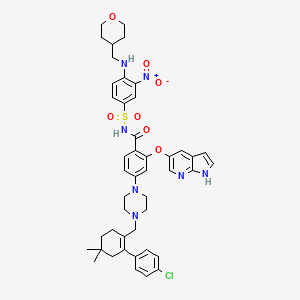
| Formula | C45H50ClN7O7S |
|---|---|
| Molecular weight | 868.46 g/mol |
| IUPAC name | 4-[4-[[2-(4-chlorophenyl)-4,4-dimethylcyclohexen-1-yl]methyl]piperazin-1-yl]-N-[3-nitro-4-(oxan-4-ylmethylamino)phenyl]sulfonyl-2-(1H-pyrrolo[2,3-b]pyridin-5-yloxy)benzamide |
| CAS | 1257044-40-8 |
| PubChem CID | 49846579 |
| InChIKey | LQBVNQSMGBZMKD-UHFFFAOYSA-N |
| logP | 8.66 (XLogP 8.2) |
| Polar surface area | 172.03 Ų |
| H-bond acceptors / donors | 11 / 3 |
| Drug-likeness (QED) | 0.08 |
| Lipinski violations | 3 |
SMILES
CC1(C)CCC(CN2CCN(c3ccc(C(=O)NS(=O)(=O)c4ccc(NCC5CCOCC5)c([N+](=O)[O-])c4)c(Oc4cnc5[nH]ccc5c4)c3)CC2)=C(c2ccc(Cl)cc2)C1Biology & Pharmacokinetics
Pharmacokinetics predicted
| Bioavailability | 10.0% |
|---|---|
| Half-life | 0.671 h |
| Volume of distribution | 0.982 L/kg |
| Protein binding | 99.6% |
| BBB penetrant | No |
Enzyme interactions
| Enzyme | Role | Detail |
|---|---|---|
| CYP2B6 | Inhibitor | — |
| CYP2C19 | Inhibitor | — |
| CYP2C19 | Substrate | — |
| CYP2C8 | Inhibitor | — |
| CYP2C9 | Inhibitor | IC₅₀ 1.770000000000001 µM |
| CYP2C9 | Substrate | — |
| CYP3A4 | Substrate | — |
Receptor binding (top 4)
| Target | Action | Affinity |
|---|---|---|
| BCL2 apoptosis regulator (BCL2) | Antagonist | pKi 11.0 |
| Bcl-2-like 1 (BCL2L1) | Antagonist | pKi 7.3 |
| Bcl-2-like 2 (BCL2L2) | Antagonist | pKi 6.6 |
| MCL1 apoptosis regulator, BCL2 family member (MCL1) | Antagonist | pKi 6.3 |
Transporters
BCRP (Inhibitor)BCRP (Inhibitor)BSEP (Inhibitor)MDR1 (Inhibitor)MRP1 (Inhibitor)OATP1B1 (Inhibitor)OATP1B1 (Inhibitor)OATP1B3 (Inhibitor)P-gp (Inhibitor)BCRP (Substrate)MDR1 (Substrate)OATP1B1 (Substrate)OATP1B3 (Substrate)P-gp (Substrate)
Drug–drug interactions (100+, DDInter)
| Interacting drug | Severity | Management |
|---|---|---|
| Abiraterone | major | |
| Adalimumab | major | |
| Amiodarone | major | |
| Amprenavir | major | |
| Apalutamide | major | |
| Aprepitant | major | |
| Atazanavir | major | |
| Bacillus calmette-guerin substrain tice live antigen | major | |
| Baricitinib | major | |
| Bepridil | major | |
| Berotralstat | major | |
| Boceprevir | major | |
| Bosentan | major | |
| Cabozantinib | major | |
| Capmatinib | major | |
| Captopril | major | |
| Carbamazepine | major | |
| Carvedilol | major | |
| Cenobamate | major | |
| Ceritinib | major | |
| Certolizumab pegol | major | |
| Ciprofloxacin | major | |
| Cladribine | major | |
| Clarithromycin | major | |
| Clozapine | major | |
| Cobicistat | major | |
| Colchicine | major | |
| Conivaptan | major | |
| Crizotinib | major | |
| Cyclosporine | major | |
| Dabrafenib | major | |
| Daclatasvir | major | |
| Dalfopristin | major | |
| Darunavir | major | |
| Deferiprone | major | |
| Delavirdine | major | |
| Dexamethasone | major | |
| Diltiazem | major | |
| Dronedarone | major | |
| Duvelisib | major |
Showing 40 of 100+.
Registered Products (4)
| Brand | Form / strength | Pack | Agent | Citizen (JOD) |
|---|---|---|---|---|
| Xervexta | Tablet 100 mg | 120 tab | Hikma Pharmaceuticals Co.Ltd/Jordan | — |
| Xervexta | Tablet 10, 50, 100 mg | 10 mg | HIKMA PHARMACEUTICALS - JORDAN | — |
| venclexta | Tablet 100 mg | 120 tab | Abu Sheikha Drug Store | — |
| venclexta Starter Dose | Tablet 10, 50, 100 mg | 42 tab | Abu Sheikha Drug Store | — |