Dabrafenib
JFDA label: Tafinlar hard capsule
Mechanism of Action
Dabrafenib selectively inhibits some mutated forms of the protein kinase B-raf (BRAF). BRAF V600 mutations result in constitutive activation of the BRAF pathway; through BRAF inhibition, dabrafenib inhibits tumor cell growth. The combination of dabrafenib and trametinib allows for greater inhibition of the MAPK pathway, resulting in BRAF V600 melanoma cell death (Flaherty 2012). Dabrafenib plus trametinib has been reported to synergistically inhibit cell growth in lung cancer cell lines which are BRAF V600E-mutant (Planchard 2016)
Indications
Approved
- Melanoma (metastatic or unresectable)
- Non-small cell lung cancer (metastatic)
Class profile
| mechanismClass | BRAF kinase inhibitor (TKI) |
|---|---|
| targetMolecule | BRAF V600E/K |
| targetPathway | MAPK/ERK signaling |
| generation | 2nd generation BRAF inhibitor |
| primaryTumors | Melanoma (BRAF V600E/K+),NSCLC,Thyroid,CRC (triple combo) |
| resistanceMechanisms | NRAS/KRAS mutation,MEK1/2 mutation,RAS-independent BRAF feedback reactivation |
| source | NCCN/OncoKB/Goodman&Gilman13ed |
Contraindications
Source: Lexicomp
- Hypersensitivity to dabrafenib or any component of the formulation Absolute
- There are no contraindications listed in the manufacturer's US labeling Absolute
Adverse Reactions
Cardiac disorders (3)
Very Common Peripheral edema
Common Hypertension · Prolonged Q-T interval on ECG
Nervous system disorders (5)
Very Common chills · Fatigue · headache
Common Dizziness · insomnia
Hepatobiliary disorders (4)
Very Common hyperbilirubinemia · Increased serum alkaline phosphatase · increased serum ALT · increased serum AST
Renal and urinary disorders (3)
Very Common Increased serum creatinine · Urinary tract infection
Common Interstitial nephritis
Blood and lymphatic system disorders (10)
Very Common anemia · leukopenia · Lymphocytopenia · malignant neoplasm of skin · papilloma
Common basal cell carcinoma · hemorrhage · malignant melanoma · Neutropenia · thrombocytopenia
Immune system disorders (1)
Common Hypersensitivity
Metabolism and nutrition disorders (11)
Very Common Hyperglycemia · hyperkalemia · hypoalbuminemia · hypokalemia · hyponatremia · hypophosphatemia · increased gamma-glutamyl transferase
Common dehydration · hypercalcemia · Hypocalcemia · hypomagnesemia
Gastrointestinal disorders (8)
Very Common abdominal pain · constipation · decreased appetite · Diarrhea · nausea · vomiting · xerostomia
Common Pancreatitis
Skin and subcutaneous tissue disorders (11)
Very Common alopecia · Dermatological reaction · hyperkeratosis · palmar-plantar erythrodysesthesia · pruritus · skin rash
Common acneiform eruption · Actinic keratosis · erythema · night sweats · xeroderma
Musculoskeletal and connective tissue disorders (5)
Very Common Arthralgia · back pain · limb pain · muscle spasm · myalgia
Eye disorders (1)
Common Uveitis
General disorders and administration site conditions (2)
Very Common Fever
Common Febrile reaction
Respiratory, thoracic and mediastinal disorders (2)
Very Common Cough · oropharyngeal pain
Dosing
Source: Lexicomp
Warnings & Precautions
Source: Lexicomp
Cardiomyopathy
Cardiomyopathy may occur when used as a single agent or in combination with trametinib. The median time to onset of cardiomyopathy in patients with melanoma was ~8 months (range: 28 days to ~25 months) when used in combination with trametinib, and ~4 months (range: 28 days to ~19 months) for single agent therapy. The median time of onset of cardiomyopathy in patients with NSCLC was 6.7 months (range: 1.4 to 14.1 months). Assess LVEF (by echocardiogram or MUGA scan) prior to combination therapy initiation, at 1 month, and then at 2- to 3-month intervals while on therapy. Cardiac dysfunction may require dabrafenib treatment interruption (see trametinib monograph for dosage modifications). Cardiomyopathy resolved in some patients following dose adjustments, treatment interruption or permanent discontinuation.
Dermatologic toxicity
Serious dermatologic toxicity (eg, rash, dermatitis, acneiform rash, palmar-plantar erythrodysesthesia syndrome, erythema) may occur when used in combination with trametinib (known complication of single-agent trametinib therapy); some patients required hospitalization for severe toxicity or for secondary skin infections. In melanoma studies, the median time to onset and resolution of skin toxicity for combination therapy was 2 months (range: 1 day to 22 months) and 1.2 months (range: 1 day to ~24 months), respectively. Monitor for dermatologic toxicity and signs/symptoms of secondary infections. Treatment interruption, dose reduction, and/or therapy discontinuation may be necessary.
Febrile reactions
Serious febrile reactions and fever (any severity) complicated by hypotension, rigors or chills, dehydration, or renal failure were observed in melanoma studies during dabrafenib single-agent therapy and when used in combination with trametinib. The incidence and severity were higher with combination therapy than with single-agent dabrafenib. The median time to initial fever (single-agent therapy) was 11 days (range: 1 day to 6.6 months); median duration was 3 days (range: 1 day to 4.2 months). In patients treated with combination therapy, the median time to onset of fever was 1 month (range: 1 day to 23.5 months) and the median duration was 3 days (range: 1 day to 11.3 months). Interrupt dabrafenib therapy for fever ≥38.5°C (101.3°F) or for any other serious febrile reaction complicated by hypotension, rigors/chills, dehydration, or renal failure; evaluate promptly for signs/symptoms of infection. Dosage reduction (or discontinuation) may be required; when resuming therapy after a febrile reaction, may require administration of antipyretics as secondary prophylaxis. Administer corticosteroids (eg, prednisone 10 mg daily or equivalent) for at least 5 days for second or subsequent episodes of pyrexia if temperature does not return to baseline within 3 days of fever onset, or for pyrexia associated with complications (eg, dehydration, hypotension, severe chills/rigors with no evidence of active infection).
Hemorrhage
Hemorrhage, including symptomatic bleeding in a critical area/organ, may occur with dabrafenib either as a single agent or in combination with trametinib. Major bleeding events (some fatal) included intracranial or gastrointestinal hemorrhage. May require treatment interruption and dosage reduction; permanently discontinue dabrafenib (and trametinib) for all grade 4 hemorrhagic events and any grade 3 event that does not improve with therapy interruption.
Hyperglycemia
Hyperglycemia may occur while on therapy (either as a single agent or in combination with trametinib); may require initiation of insulin or oral hypoglycemic agent therapy (or an increased dose if already taking). Monitor serum glucose at baseline and as clinically necessary in patients with preexisting diabetes or hyperglycemia. Instruct patients to report symptoms of severe hyperglycemia (eg, polydipsia, polyuria).
Malignancy
Cutaneous squamous cell carcinoma and keratoacanthoma (cuSCC) and new primary melanoma were observed during single-agent dabrafenib therapy at an increased incidence compared with control therapy in clinical trials. In melanoma, the median time to the first occurrence of cuSCC was 2.1 months (range: 1 to 53 weeks); approximately one-third of patients who developed cuSCC had more than one occurrence (with continued treatment). The median time between diagnosis of the first and second lesions was 6 weeks. When used in combination with trametinib for the treatment of melanoma, cuSCC occurred less frequently than with single-agent dabrafenib therapy; time to diagnosis ranged from 1.8 to 16.8 months after the initiation of combination treatment, and from 9 days to ~21 months for single-agent therapy. Cases of cuSCC also occurred in patients with NSCLC, with a first occurrence onset ranging from 25 days to ~12 months. Basal cell carcinoma (BCC) may also occur with combination or single-agent therapy; the incidence of BCC is ~3% for combination therapy versus 6% for single-agent dabrafenib. The time to BCC diagnosis ranged from ~3 to ~24 months for melanoma patients receiving combination therapy. Dermatologic evaluations should be performed prior to initiating therapy, every 2 months during therapy, and for up to 6 months post discontinuation. There are case reports of noncutaneous malignancies, including pancreatic cancer (KRAS mutation-positive), colorectal cancer (recurrent NRAS
Ocular toxicity
Retinal pigment epithelial detachments (RPED) were seen in melanoma clinical trials when used in combination with trametinib (a known complication of trametinib single-agent therapy). Detachments were typically bilateral and multifocal and occurred in the central macular area of the retina. Promptly (within 24 hours) refer patients for ophthalmological evaluations if loss of vision or other visual disturbances occur; dabrafenib dosage modification is not necessary for RPED (trametinib therapy modification may be required). Ophthalmic exams (including retinal evaluation) should be performed periodically during treatment with combination therapy. Uveitis, including iritis and iridocyclitis, has been reported with dabrafenib single-agent therapy and when used in combination with trametinib; manage symptomatically with local ophthalmic steroid and mydriatic drops. May require dabrafenib treatment interruption or permanent discontinuation (does not require alteration in trametinib therapy). Monitor for signs/symptoms of uveitis (eg, eye pain, photophobia, vision changes).
QT prolongation
QTcF prolongation >60 msec above baseline or to >500 msec was reported (rare), both as a single agent or when used in combination with trametinib. Use with caution in patients who may be at increased risk for arrhythmias.
Venous thromboembolism
Venous thromboembolism events (some fatal) may occur when dabrafenib is used in combination with trametinib. DVT and PE occurred at an increased incidence with combination therapy. Patients should seek immediate medical attention with symptoms of DVT or PE (shortness of breath, chest pain, arm/leg swelling). Dabrafenib therapy may be continued for uncomplicated DVT or PE; permanently discontinue trametinib for life-threatening PE. Concurrent drug therapy issues:
Combination therapy with trametinib
Serious adverse reactions (retinal vein occlusion, interstitial lung disease) that occur with single-agent trametinib may also occur when dabrafenib is administered in combination with trametinib.
Drugs affecting gastric pH
Drugs affecting gastric pH (eg, proton pump inhibitors, H2-receptor antagonists, antacids) may alter dabrafenib solubility, resulting in decreased bioavailability. Clinical trials have not been performed to evaluate concomitant administration and its effect on dabrafenib efficacy.
Drug-drug interactions
Potentially significant interactions may exist, requiring dose or frequency adjustment, additional monitoring, and/or selection of alternative therapy. Consult drug interactions database for more detailed information. Special populations:
Glucose-6-phosphate dehydrogenase deficiency
Patients with glucose-6-phosphate dehydrogenase (G6PD) deficiency may be at risk for hemolytic anemia when administered dabrafenib; use with caution and closely observe for signs/symptoms of hemolytic anemia. Other warnings/precautions:
Appropriate use
Appropriate use: Not indicated for treatment of patients with wild-type BRAF melanoma or wild-type BRAF NSCLC. Exposing wild-type cells to BRAF inhibitors such as dabrafenib may result in paradoxical activation of MAP-kinase signaling and increased cell proliferation. Prior to initiating therapy, confirm BRAF V600E or BRAF V600K mutation status with an approved test. Data regarding single agent use for melanoma in patients with BRAF V600K mutation is limited; compared to BRAF V600E mutation, lower response rates have been observed with BRAF V600K mutation. Data regarding other less common BRAF V600 mutations in melanoma is lacking.
Pregnancy & Lactation
Pregnancy
Adverse effects were observed in animal reproduction studies. Based on its mechanism of action, dabrafenib would be expected to cause fetal harm if administered to a pregnant woman. Females of reproductive potential should use a highly effective nonhormonal contraceptive during therapy and for at least 2 weeks for single-agent therapy or 4 months for combination therapy with trametinib after treatment is complete; hormonal contraceptives may not be effective. Spermatogenesis may be impaired in males (observed in animal studies); family planning and fertility counseling should be considered prior to therapy.
Lactation
It is not known if dabrafenib is present in breast milk. Due to the potential for serious adverse reactions in the breastfed infant, breastfeeding is not recommended by the manufacturer during treatment and for 2 weeks (single agent therapy) or 4 months (combination therapy with trametinib) after the last dose.
Monitoring
| Efficacy | Tumour response (RECIST criteria, tumour markers, imaging); progression-free survival; performance status (ECOG/Karnofsky) |
|---|---|
| Toxicity | CBC with differential (nadir timing depends on agent); LFTs; renal function; ECG (QT for relevant agents); echocardiogram for cardiotoxic agents (anthracyclines, trastuzumab); cumulative dose tracking for dose-limited toxicities |
| Clinical pearl | Treatment response is assessed after 2–3 cycles. Grade 3–4 toxicities typically require dose reduction or interruption per protocol-defined criteria. |
| Counseling | Attend all scheduled blood tests and imaging appointments. Report fever > 38°C (risk of neutropaenic sepsis — medical emergency), unusual bleeding, or new pain immediately. |
Chemistry & Properties
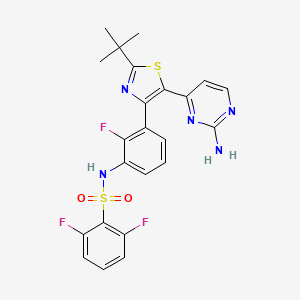
| Formula | C23H20F3N5O2S2 |
|---|---|
| Molecular weight | 519.57 g/mol |
| IUPAC name | N-[3-[5-(2-aminopyrimidin-4-yl)-2-tert-butyl-1,3-thiazol-4-yl]-2-fluorophenyl]-2,6-difluorobenzenesulfonamide |
| CAS | 1195765-45-7 |
| PubChem CID | 44462760 |
| InChIKey | BFSMGDJOXZAERB-UHFFFAOYSA-N |
| logP | 5.36 (XLogP 4.8) |
| Polar surface area | 110.86 Ų |
| H-bond acceptors / donors | 7 / 2 |
| Drug-likeness (QED) | 0.37 |
| Lipinski violations | 2 |
SMILES
CC(C)(C)c1nc(-c2cccc(NS(=O)(=O)c3c(F)cccc3F)c2F)c(-c2ccnc(N)n2)s1Biology & Pharmacokinetics
Pharmacokinetics predicted
| Bioavailability | 10.0% |
|---|---|
| Half-life | 0.928 h |
| Volume of distribution | 0.915 L/kg |
| Protein binding | 99.4% |
| BBB penetrant | No |
Enzyme interactions
| Enzyme | Role | Detail |
|---|---|---|
| CYP2C19 | Inhibitor | — |
| CYP2C8 | Inhibitor | — |
| CYP2C9 | Inhibitor | — |
| CYP3A4 | Inhibitor | — |
| CYP3A4 | Substrate | — |
Receptor binding (top 1)
| Target | Action | Affinity |
|---|---|---|
| B-Raf proto-oncogene, serine/threonine kinase (BRAF) | Inhibitor | pIC50 8.5 |
Transporters
BCRP (Inhibitor)BCRP (Inhibitor)BSEP (Inhibitor)MDR1 (Inhibitor)MRP1 (Inhibitor)OAT1 (Inhibitor)OAT3 (Inhibitor)OATP1B1 (Inhibitor)OATP1B1 (Inhibitor)OATP1B3 (Inhibitor)OATP1B3 (Inhibitor)OCT2 (Inhibitor)P-gp (Inhibitor)BCRP (Substrate)MDR1 (Substrate)OATP (Substrate)OATP1A2 (Substrate)OATP1B1 (Substrate)OATP1B3 (Substrate)OATP2B1 (Substrate)OCT1 (Substrate)OCT2 (Substrate)P-gp (Substrate)
Drug–drug interactions (100+, DDInter)
| Interacting drug | Severity | Management |
|---|---|---|
| Aminolevulinic acid | major | |
| Avapritinib | major | |
| Avatrombopag | major | |
| Axitinib | major | |
| Bedaquiline | major | |
| Benzhydrocodone | major | |
| Brigatinib | major | |
| Butorphanol | major | |
| Capmatinib | major | |
| Cobimetinib | major | |
| Daclatasvir | major | |
| Deflazacort | major | |
| Desogestrel | major | |
| Dienogest | major | |
| Doravirine | major | |
| Drospirenone | major | |
| Encorafenib | major | |
| Entrectinib | major | |
| Erdafitinib | major | |
| Ethinylestradiol | major | |
| Etonogestrel | major | |
| Fedratinib | major | |
| Fentanyl | major | |
| Glasdegib | major | |
| Grazoprevir | major | |
| Guanfacine | major | |
| Hydrocodone | major | |
| Lefamulin | major | |
| Levacetylmethadol | major | |
| Levonorgestrel | major | |
| Lonafarnib | major | |
| Lorlatinib | major | |
| Lumateperone | major | |
| Lurbinectedin | major | |
| Medroxyprogesterone acetate | major | |
| Methadone | major | |
| Neratinib | major | |
| Norethisterone | major | |
| Norgestimate | major | |
| Norgestrel | major |
Showing 40 of 100+.
Registered Products (2)
| Brand | Form / strength | Pack | Agent | Citizen (JOD) |
|---|---|---|---|---|
| Tafinlar hard capsule | Capsule 88.88 mg | 28 cap | The Jordan Drugstore Co | — |
| Tafinlar hard capsule | Capsule 59.25 mg | 28 cap | The Jordan Drugstore Co | — |