Lorlatinib
JFDA label: LORBRENA
Mechanism of Action
Inhibitor of ALK tyrosine kinase receptor — ALK tyrosine kinase receptor inhibitor; Inhibitor of EML4-ALK — EML4-ALK inhibitor
| Target | Action | Gene / class |
|---|---|---|
| ALK tyrosine kinase receptor efficacy | INHIBITOR | ALK |
| EML4-ALK efficacy | INHIBITOR |
Indications
Approved
- Carcinoma, Non-Small-Cell Lung — non-small cell lung carcinoma
- Lymphoma — lymphoma
- Neoplasms — neoplasm
Off-label
- Ganglioneuroblastoma
- Lung Neoplasms
- Lymphoma, Large-Cell, Anaplastic
- Neuroblastoma
Contraindications
Source: openFDA
- is contraindicated in patients taking strong CYP3A inducers, due to the potential for serious hepatotoxicity [see Warnings and Precautions (5.1) ] . Concomitant use with strong CYP3A inducers. ( 4 ) Absolute
Adverse Reactions
Cardiac disorders (2)
Uncommon Cardiac Failure Acute · Myocardial Infarction
Vascular disorders (2)
Common And Hypertension
Uncommon Embolism
Nervous system disorders (4)
Very Common Cognitive Effects · Peripheral Neuropathy
Common And Peripheral Neuropathy · T Discontinuation Of Lorbrena Was Cognitive Effects
Metabolism and nutrition disorders (7)
Very Common And Hypertriglyceridemia · Nts Who Received Lorbrena Were Hypercholesterolemia · Weight Gain
Common And Hypercholesterolemia · Hypercholesterolemia · Hypertriglyceridemia · Interruptions Of Lorbrena Were Hypertriglyceridemia
Gastrointestinal disorders (1)
Very Common Diarrhea
Musculoskeletal and connective tissue disorders (1)
Very Common Arthralgia
Psychiatric disorders (2)
Very Common Mood Effects
Uncommon And Mood Effects
Infections and infestations (4)
Common Pneumonia · Y Reported Serious Adverse Reactions Were Pneumonia
Uncommon Of Patients And Included Pneumonia · Tients Treated With Lorbrena And Included Pneumonia
Investigations (1)
Common Increased Lipase
General disorders and administration site conditions (17)
Very Common Asian · Fatigue · Female · Patients Who Received Lorbrena Were Edema · White · Years
Common And Psychotic Effects · And Pyrexia · Edema · Mental Status Changes · Pyrexia · Reactions That Led To Dose Interruptions Were Edema · Se Reactions That Led To Dose Reductions Were Edema · Were Psychotic Effects · Were Speech Effects
Uncommon And Sudden Death · Peripheral Artery Occlusion
Respiratory, thoracic and mediastinal disorders (8)
Very Common And Cough · Dyspnea
Common And Respiratory Failure · Permanent Discontinuation Were Respiratory Failure · Respiratory Failure
Uncommon Acute Pulmonary Edema · And Respiratory Distress · Pulmonary Embolism
Dosing
Source: openFDA
Warnings & Precautions
Source: openFDA
Warnings & Precautions
• Risk of Serious Hepatotoxicity with Concomitant Use of Strong CYP3A Inducers : Discontinue strong CYP3A inducers for 3 plasma half-lives of the strong CYP3A inducer prior to initiating LORBRENA. ( 2.4 , 5.1 ) • Central Nervous System (CNS) Effects : CNS effects include seizures, psychotic effects and changes in cognitive function, mood (including suicidal ideation), speech, mental status, and sleep. Withhold and resume LORBRENA at same or reduced dose or permanently discontinue LORBRENA based on severity. ( 2.3 , 5.2 ) • Hyperlipidemia : Initiate or increase the dose of lipid-lowering agents. Withhold and resume LORBRENA at same or reduced dose based on severity. ( 2.3 , 5.3 ) • Atrioventricular Block : Withhold and resume LORBRENA at same or reduced dose based on severity. ( 2.3 , 5.4 ) • Interstitial Lung Disease/Pneumonitis : Immediately withhold LORBRENA in patients with suspected ILD/pneumonitis. Permanently discontinue LORBRENA for treatment-related ILD/pneumonitis of any severity. ( 2.3 , 5.5 ) • Hypertension : Monitor blood pressure after 2 weeks and then at least monthly during treatment. For severe hypertension, withhold LORBRENA, then dose reduce or permanently discontinue. ( 2.3 , 5.6 ) • Hyperglycemia : Assess fasting serum glucose prior to starting LORBRENA and regularly during treatment. If not adequately controlled with optimal medical management, withhold LORBRENA, then consider dose reduction or permanently discontinue, based on severity. ( 2.3 , 5.7 ) • Embryo-Fetal Toxicity : Can cause fetal harm. Advise females of reproductive potential of the potential risk to a fetus. Advise males and females of reproductive potential to use an effective non-hormonal method of contraception. ( 5.8 , 7.2 , 8.1 , 8.3 )
Risk of Serious Hepatotoxicity with Concomitant Use of Strong CYP3A In
Risk of Serious Hepatotoxicity with Concomitant Use of Strong CYP3A Inducers Severe hepatotoxicity occurred in 10 of 12 healthy subjects receiving a single dose of LORBRENA with multiple daily doses of rifampin, a strong CYP3A inducer. Grade 4 alanine aminotransferase (ALT) or aspartate aminotransferase (AST) elevations occurred in 50% of subjects, Grade 3 ALT or AST elevations occurred in 33% and Grade 2 ALT or AST elevations occurred in 8%. ALT or AST elevations occurred within 3 days and returned to within normal limits after a median of 15 days (7 to 34 days); the median time to recovery was 18 days in subjects with Grade 3 or 4 ALT or AST elevations and 7 days in subjects with Grade 2 ALT or AST elevations [see Drug Interactions (7.1) ] . LORBRENA is contraindicated in patients taking strong CYP3A inducers. Discontinue strong CYP3A inducers for 3 plasma half-lives of the strong CYP3A inducer prior to initiating LORBRENA [see Contraindications (4) , Drug Interactions (7.1) ] .
Central Nervous System Effects A broad spectrum of central nervous sys
Central Nervous System Effects A broad spectrum of central nervous system (CNS) effects can occur in patients receiving LORBRENA. These include seizures, psychotic effects and changes in cognitive function, mood (including suicidal ideation), speech, mental status, and sleep. Overall, CNS effects occurred in 52% of the 476 patients who received 100 mg LORBRENA once daily in clinical trials [see Adverse Reactions (6.1) ] . Cognitive effects occurred in 28% of the 476 patients; 2.9% of these events were severe (Grade 3 or 4). Mood effects occurred in 21% of patients; 1.7% of these events were severe. Speech effects occurred in 11% of patients; 0.6% of these events were severe. Psychotic effects occurred in 7% of patients; 0.6% of these events were severe. Mental status changes occurred in 1.3% of patients; 1.1% of these events were severe. Seizures occurred in 1.9% of patients, sometimes in conjunction with other neurologic findings. Sleep effects occurred in 12% of patients. The median time to first onset of any CNS effect was 1.4 months (1 day to 3.4 years). Overall, 2.1% of patients required permanent discontinuation of LORBRENA for a CNS effect; 10% required temporary discontinuation and 8% required dose reduction. Withhold and resume at the same dose or at a reduced dose or permanently discontinue LORBRENA based on severity [see Dosage and Administration (2.3) ] .
Hyperlipidemia Increases in serum cholesterol and triglycerides can oc
Hyperlipidemia Increases in serum cholesterol and triglycerides can occur in patients receiving LORBRENA [see Adverse Reactions (6.1) ] . Grade 3 or 4 elevations in total cholesterol occurred in 18% and Grade 3 or 4 elevations in triglycerides occurred in 19% of the 476 patients who received 100 mg LORBRENA once daily. The median time to onset was 15 days for both hypercholesterolemia and hypertriglyceridemia. Approximately 4% and 7% of patients required temporary discontinuation and 1% and 3% of patients required dose reduction of LORBRENA for elevations in cholesterol and in triglycerides in Study B7461001 and Study B7461006, respectively. Eighty-three percent of patients required initiation of lipid-lowering medications, with a median time to onset of start of such medications of 17 days. Initiate or increase the dose of lipid-lowering agents in patients with hyperlipidemia. Monitor serum cholesterol and triglycerides before initiating LORBRENA, 1 and 2 months after initiating LORBRENA, and periodically thereafter. Withhold and resume at the same dose for the first occurrence; resume at the same or a reduced dose of LORBRENA for recurrence based on severity [see Dosage and Administration (2.3) ].
Atrioventricular Block PR interval prolongation and atrioventricular (
Atrioventricular Block PR interval prolongation and atrioventricular (AV) block can occur in patients receiving LORBRENA [see Adverse Reactions (6.1) , Clinical Pharmacology (12.2) ]. In 476 patients who received 100 mg LORBRENA once daily and who had a baseline electrocardiography (ECG), 1.9% experienced AV block and 0.2% experienced Grade 3 AV block and underwent pacemaker placement. Monitor ECG prior to initiating LORBRENA and periodically thereafter. Withhold and resume at a reduced dose or at the same dose in patients who undergo pacemaker placement. Permanently discontinue for recurrence in patients without a pacemaker [see Dosage and Administration (2.3) ] .
Interstitial Lung Disease/Pneumonitis Severe or life-threatening pulmo
Interstitial Lung Disease/Pneumonitis Severe or life-threatening pulmonary adverse reactions consistent with interstitial lung disease (ILD)/pneumonitis can occur with LORBRENA. ILD/pneumonitis occurred in 1.9% of patients who received 100 mg LORBRENA once daily, including Grade 3 or 4 ILD/pneumonitis in 0.6% of patients. Four patients (0.8%) discontinued LORBRENA for ILD/pneumonitis. Promptly investigate for ILD/pneumonitis in any patient who presents with worsening of respiratory symptoms indicative of ILD/pneumonitis (e.g., dyspnea, cough, and fever). Immediately withhold LORBRENA in patients with suspected ILD/pneumonitis. Permanently discontinue LORBRENA for treatment-related ILD/pneumonitis of any severity [see Dosage and Administration (2.3) ] .
Hypertension Hypertension can occur in patients receiving LORBRENA [se
Hypertension Hypertension can occur in patients receiving LORBRENA [see Adverse Reactions (6.1) ] . Hypertension occurred in 13% of patients who received 100 mg LORBRENA once daily, including Grade 3 or 4 in 6% of patients. The median time to onset of hypertension was 6.4 months (1 day to 2.8 years), and 2.3% of patients temporarily discontinued LORBRENA for hypertension. Control blood pressure prior to initiation of LORBRENA. Monitor blood pressure after 2 weeks and at least monthly thereafter during treatment with LORBRENA. Withhold and resume at a reduced dose or permanently discontinue LORBRENA based on severity [see Dosage and Administration (2.3) ] .
Hyperglycemia Hyperglycemia can occur in patients receiving LORBRENA [
Hyperglycemia Hyperglycemia can occur in patients receiving LORBRENA [see Adverse Reactions (6.1) ] . Hyperglycemia occurred in 9% of patients who received 100 mg LORBRENA, including Grade 3 or 4 in 3.2% of patients. The median time to onset of hyperglycemia was 4.8 months (1 day to 2.9 years), and 0.8% of patients temporarily discontinued LORBRENA for hyperglycemia. Assess fasting serum glucose prior to initiation of LORBRENA and monitor periodically thereafter. Withhold and resume at a reduced dose or permanently discontinue LORBRENA based on severity [see Dosage and Administration (2.3) ] .
Embryo-Fetal Toxicity Based on findings from animal studies and its me
Embryo-Fetal Toxicity Based on findings from animal studies and its mechanism of action, LORBRENA can cause fetal harm when administered to a pregnant woman. Administration of lorlatinib to pregnant rats and rabbits by oral gavage during the period of organogenesis resulted in malformations, increased post-implantation loss, and abortion at maternal exposures that were equal to or less than the human exposure at the recommended dose of 100 mg once daily based on area under the curve (AUC). Advise pregnant women of the potential risk to a fetus. Advise females of reproductive potential to use an effective non-hormonal method of contraception, since LORBRENA can render hormonal contraceptives ineffective, during treatment with LORBRENA and for at least 6 months after the final dose. Advise males with female partners of reproductive potential to use effective contraception during treatment with LORBRENA and for 3 months after the final dose [see Drug Interactions (7.2) , Use in Specific Populations (8.1 , 8.3) , Nonclinical Toxicology (13.1) ] .
Pregnancy & Lactation
Lactation
The manufacturer recommends that breastfeeding be discontinued during lorlatinib therapy and for 7 days after the last dose.
Chemistry & Properties
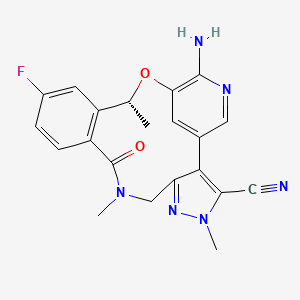
| Formula | C21H19FN6O2 |
|---|---|
| Molecular weight | 406.42 g/mol |
| IUPAC name | (16R)-19-amino-13-fluoro-4,8,16-trimethyl-9-oxo-17-oxa-4,5,8,20-tetrazatetracyclo[16.3.1.02,6.010,15]docosa-1(22),2,5,10(15),11,13,18,20-octaene-3-carbonitrile |
| CAS | 1454846-35-5 |
| PubChem CID | 71731823 |
| InChIKey | IIXWYSCJSQVBQM-LLVKDONJSA-N |
| logP | 2.8 (XLogP 1.5) |
| Polar surface area | 110.06 Ų |
| H-bond acceptors / donors | 7 / 1 |
| Drug-likeness (QED) | 0.61 |
| Lipinski violations | 0 |
SMILES
C[C@H]1Oc2cc(cnc2N)-c2c(nn(C)c2C#N)CN(C)C(=O)c2ccc(F)cc21Biology & Pharmacokinetics
Pharmacokinetics predicted
| Bioavailability | 70.0% |
|---|---|
| Half-life | 1.134 h |
| Volume of distribution | 7.974 L/kg |
| Protein binding | 91.0% |
| BBB penetrant | No |
Enzyme interactions
| Enzyme | Role | Detail |
|---|---|---|
| CYP1A2 | Substrate | — |
| CYP2B6 | Inhibitor | — |
| CYP3A4 | Substrate | — |
Receptor binding (top 3)
| Target | Action | Affinity |
|---|---|---|
| c-ros oncogene 1, receptor tyrosine kinase (ROS1) | Inhibitor | pKi 11.3 |
| ALK receptor tyrosine kinase (ALK) | Inhibitor | pKi 9.1 |
| FES proto-oncogene, tyrosine kinase (FES) | Inhibitor | pIC50 8.2 |
Transporters
BCRP (Inhibitor)BSEP (Inhibitor)MRP1 (Inhibitor)OATP1B1 (Inhibitor)OATP1B3 (Inhibitor)P-gp (Inhibitor)P-gp (Substrate)
Drug–drug interactions (100+, DDInter)
| Interacting drug | Severity | Management |
|---|---|---|
| Apalutamide | major | |
| Atazanavir | major | |
| Avapritinib | major | |
| Axitinib | major | |
| Bedaquiline | major | |
| Benzhydrocodone | major | |
| Berotralstat | major | |
| Boceprevir | major | |
| Bosentan | major | |
| Bosutinib | major | |
| Brigatinib | major | |
| Butorphanol | major | |
| Capmatinib | major | |
| Carbamazepine | major | |
| Cenobamate | major | |
| Ceritinib | major | |
| Clarithromycin | major | |
| Cobicistat | major | |
| Cobimetinib | major | |
| Conivaptan | major | |
| Dabrafenib | major | |
| Daclatasvir | major | |
| Darolutamide | major | |
| Deflazacort | major | |
| Delavirdine | major | |
| Dexamethasone | major | |
| Doravirine | major | |
| Efavirenz | major | |
| Encorafenib | major | |
| Entrectinib | major | |
| Enzalutamide | major | |
| Erdafitinib | major | |
| Eslicarbazepine | major | |
| Etravirine | major | |
| Fedratinib | major | |
| Fentanyl | major | |
| Fosphenytoin | major | |
| Glasdegib | major | |
| Grazoprevir | major | |
| Guanfacine | major |
Showing 40 of 100+.
Registered Products (2)
| Brand | Form / strength | Pack | Agent | Citizen (JOD) |
|---|---|---|---|---|
| LORBRENA | Tablet 100 mg | 30 tab | Petra Drug Store | — |
| LORBRENA | Tablet 25 mg | 30 tab | Petra Drug Store | — |