Encorafenib
JFDA label: Braftovi
Mechanism of Action
Inhibitor of Serine/threonine-protein kinase B-raf — Serine/threonine-protein kinase B-raf inhibitor
| Target | Action | Gene / class |
|---|---|---|
| Serine/threonine-protein kinase B-raf efficacy | INHIBITOR | BRAF |
Indications
Approved
- Colorectal Neoplasms — colorectal adenocarcinoma
- Melanoma — melanoma
- Neoplasms — neoplasm
Off-label
- Biliary Tract Neoplasms
- Carcinoma, Non-Small-Cell Lung
- Leukemia, Hairy Cell
- Multiple Myeloma
- Pancreatic Neoplasms
- Pulmonary Disease, Chronic Obstructive
- Thyroid Neoplasms
Contraindications
Source: openFDA
- None. None. ( 4 ) Absolute
Adverse Reactions
Vascular disorders (1)
Common Of Patients Were Hemorrhage
Nervous system disorders (1)
Common And Peripheral Neuropathy
Hepatobiliary disorders (1)
Common Ast Increased
Renal and urinary disorders (1)
Common And Acute Kidney Injury
Blood and lymphatic system disorders (1)
Common Of Patients Included Febrile Neutropenia
Gastrointestinal disorders (10)
Very Common Were Diarrhea
Common And Abdominal Pain · And Diarrhea · And Nausea · Diarrhea · Nausea · Of Patients Included Intestinal Obstruction · The Most Common Were Nausea · The Most Common Were Vomiting · Vomiting
Musculoskeletal and connective tissue disorders (2)
Common Arthralgia · The Most Common Were Arthralgia
Infections and infestations (1)
Common Sepsis
General disorders and administration site conditions (7)
Very Common Ten Percent
Common And Infusion Related Reaction · And Pyrexia · Fatigue · Five Percent · Pyrexia · The Most Common Were Fatigue
Dosing
Source: openFDA
Warnings & Precautions
Source: openFDA
Warnings & Precautions
• New Primary Malignancies, cutaneous and noncutaneous : Can occur. Monitor for malignancies and perform dermatologic evaluations prior to, while on therapy, and following discontinuation of treatment. ( 5.1 ) • Tumor Promotion in BRAF Wild-Type Tumors : Increased cell proliferation can occur with BRAF inhibitors. ( 5.2 ) • Cardiomyopathy : Assess left ventricular ejection fraction (LVEF) before initiating treatment with BRAFTOVI and binimetinib, and after one month of treatment, then every 2 to 3 months thereafter. The safety of BRAFTOVI in combination with binimetinib has not been established in patients with LVEF below 50%. ( 5.3 ) • Hepatotoxicity : Monitor liver function tests before and during treatment with BRAFTOVI and binimetinib and as clinically indicated. ( 5.4 ) • Hemorrhage : Major hemorrhagic events can occur in patients receiving BRAFTOVI and binimetinib. ( 5.5 ) • Uveitis : Perform ophthalmologic evaluation at regular intervals and for any visual disturbances. ( 5.6 ) • QT Prolongation : Monitor electrolytes before and during treatment. Correct electrolyte abnormalities and control for cardiac risk factors for QT prolongation. Withhold BRAFTOVI for QTc of 500 ms or greater. ( 5.7 ) • Embryo-Fetal Toxicity : Can cause fetal harm. Advise females with reproductive potential of potential risk to the fetus and to use effective nonhormonal method of contraception. ( 5.8 , 8.1 , 8.3 ) • Risks Associated with BRAFTOVI as a Single Agent : If binimetinib is temporarily interrupted or permanently discontinued, reduce the dose of BRAFTOVI as recommended. ( 5.9 ) • Risks Associated with Combination Treatment : BRAFTOVI is indicated for use as part of a regimen in combination with binimetinib or cetuximab. ( 5.10 )
New Primary Malignancies New primary malignancies, cutaneous and noncu
New Primary Malignancies New primary malignancies, cutaneous and noncutaneous, have been observed in patients treated with BRAF inhibitors and can occur with BRAFTOVI. Cutaneous Malignancies In COLUMBUS, cutaneous squamous cell carcinoma (cuSCC), including keratoacanthoma (KA), occurred in 2.6%, and basal cell carcinoma occurred in 1.6% of patients who received BRAFTOVI in combination with binimetinib. Median time to first occurrence of cuSCC/KA was 5.8 months (range 1 to 9 months) [see Adverse Reactions (6.1) ] . For patients who received BRAFTOVI as a single agent, cuSCC/KA was reported in 8%, basal cell carcinoma in 1%, and a new primary melanoma in 5% of patients. In BEACON CRC, cuSCC/KA occurred in 1.4% of patients with CRC, and a new primary melanoma occurred in 1.4% of patients who received BRAFTOVI in combination with cetuximab. In PHAROS, cuSCC and skin papilloma, each occurred in 2% of patients who received BRAFTOVI in combination with binimetinib. In BREAKWATER, the following cutaneous malignancies occurred in patients receiving BRAFTOVI in combination with cetuximab and mFOLFOX6: melanocytic nevus in 5.6%, skin papilloma in 3% , basal cell carcinoma in 1.3%, squamous cell carcinoma of skin in 0.9%, keratoacanthoma in 0.4% and malignant melanoma in situ in 0.4%. In patients who received BRAFTOVI in combination with cetuximab and FOLFIRI, skin papilloma occurred in 2.8% and keratoacanthoma in 1.4% of patients. Perform dermatologic evaluations prior to initiating treatment, every 2 months during treatment, and for up to 6 months following discontinuation of treatment. Manage suspicious skin lesions with excision and dermatopathologic evaluation. Dose modification is not recommended for new primary cutaneous malignancies. Noncutaneous Malignancies Based on its mechanism of action, BRAFTOVI may promote malignancies associated with activation of RAS through mutation or other mechanisms [see Warnings and Precautions (5.2) ] . Monitor patients receiving BRAFTOVI for signs and symptoms of noncutaneous malignancies. Discontinue BRAFTOVI for RAS mutation-positive noncutaneous malignancies [see Dosage and Administration (2.5) ] .
Tumor Promotion in BRAF Wild-Type Tumors In vitro experiments have dem
Tumor Promotion in BRAF Wild-Type Tumors In vitro experiments have demonstrated paradoxical activation of MAP-kinase signaling and increased cell proliferation in BRAF wild-type cells, which are exposed to BRAF inhibitors. Confirm evidence of BRAF V600E or V600K mutation prior to initiating BRAFTOVI [see Indications and Usage (1) , Dosage and Administration (2.1) ] .
Cardiomyopathy Cardiomyopathy, manifesting as left ventricular dysfunc
Cardiomyopathy Cardiomyopathy, manifesting as left ventricular dysfunction associated with symptomatic or asymptomatic decreases in ejection fraction, has been reported in patients treated with BRAFTOVI in combination with binimetinib. In COLUMBUS, evidence of cardiomyopathy (decreased in LVEF below the institutional LLN with an absolute decreased in LVEF ≥10% below baseline as detected by echocardiography or MUGA) occurred in 7% of patients receiving BRAFTOVI plus binimetinib. Grade 3 left ventricular dysfunction occurred in 1.6% of patients. The median time to first occurrence of left ventricular dysfunction (any grade) in patients receiving BRAFTOVI in combination with binimetinib was 3.6 months (range 0 to 21 months). Cardiomyopathy resolved in 87% of patients receiving BRAFTOVI plus binimetinib. In PHAROS, evidence of cardiomyopathy (decrease in LVEF below the institutional LLN with an absolute decrease in LVEF ≥10% below baseline as detected by echocardiography or MUGA) occurred in 11% of patients receiving BRAFTOVI in combination with binimetinib. Grade 3 left ventricular dysfunction occurred in 1% of patients. Cardiomyopathy resolved in 82% of patients receiving BRAFTOVI plus binimetinib. Assess ejection fraction by echocardiogram or MUGA scan prior to initiating treatment, one month after initiating treatment, and every 2 to 3 months during treatment. The safety of BRAFTOVI in combination with binimetinib has not been established in patients with baseline ejection fraction that is either below 50% or below the institutional lower limit of normal (LLN). Patients with cardiovascular risk factors should be monitored closely when treated with BRAFTOVI. Withhold, reduce dose, or permanently discontinue based on severity of adverse reaction [see Dosage and Administration (2.3) , Adverse Reactions (6.1) ] .
Hepatotoxicity Hepatotoxicity can occur when BRAFTOVI is administered
Hepatotoxicity Hepatotoxicity can occur when BRAFTOVI is administered in combination with binimetinib. In COLUMBUS, the incidence of Grade 3 or 4 increases in liver function laboratory tests in patients receiving BRAFTOVI in combination with binimetinib was 6% for alanine aminotransferase (ALT), 2.6% for aspartate aminotransferase (AST), and 0.5% for alkaline phosphatase. In PHAROS, the incidence of Grade 3 or 4 increases in liver function laboratory tests in patients receiving BRAFTOVI in combination with binimetinib was 10% for AST, 9% for ALT, and 3.2% for alkaline phosphatase. In BREAKWATER, the incidence of Grade 3 or 4 increases in liver function laboratory tests in patients receiving BRAFTOVI in combination with cetuximab and mFOLFOX6 was 2.6% for alkaline phosphatase, and 1.3% each for ALT and AST. In patients receiving BRAFTOVI in combination with cetuximab and FOLFIRI, the incidence of Grade 3 or 4 increases in liver function laboratory tests was 1.5% each for ALT and AST. Monitor liver laboratory tests before initiation of BRAFTOVI, monthly during treatment, and as clinically indicated. Withhold, reduce dose, or permanently discontinue based on severity of adverse reaction [see Dosage and Administration (2.3) , Adverse Reactions (6.1) ] .
Hemorrhage In COLUMBUS, hemorrhage occurred in 19% of patients receivi
Hemorrhage In COLUMBUS, hemorrhage occurred in 19% of patients receiving BRAFTOVI in combination with binimetinib; Grade 3 or greater hemorrhage occurred in 3.2% of patients. The most frequent hemorrhagic events were gastrointestinal, including rectal hemorrhage (4.2%), hematochezia (3.1%), and hemorrhoidal hemorrhage (1%). Fatal intracranial hemorrhage in the setting of new or progressive brain metastases occurred in 1.6% of patients. In BEACON CRC, hemorrhage occurred in 19% of patients receiving BRAFTOVI in combination with cetuximab; Grade 3 or higher hemorrhage occurred in 1.9% of patients, including fatal gastrointestinal hemorrhage in 0.5% of patients. The most frequent hemorrhagic events were epistaxis (6.9%), hematochezia (2.3%), and rectal hemorrhage (2.3%). In PHAROS, hemorrhage occurred in 12% of patients receiving BRAFTOVI in combination with binimetinib including fatal hemorrhage intracranial (1%); Grade 3 or 4 hemorrhage occurred in 4.1% of patients. The most frequent hemorrhagic events were anal hemorrhage and hemothorax (2% each). In BREAKWATER, hemorrhage occurred in 34 % of patients receiving BRAFTOVI in combination with cetuximab and mFOLFOX6; Grade 3 or 4 hemorrhage occurred in 3% of patients. In patients receiving BRAFTOVI in combination with cetuximab and FOLFIRI, hemorrhage occurred in 21% of patients. Withhold, reduce dose, or permanently discontinue based on severity of adverse reaction [see Dosage and Administration (2.5) , Adverse Reactions (6.1) ] .
Uveitis Uveitis, including iritis and iridocyclitis, has been reported
Uveitis Uveitis, including iritis and iridocyclitis, has been reported in patients treated with BRAFTOVI in combination with binimetinib. In COLUMBUS, the incidence of uveitis among patients treated with BRAFTOVI in combination with binimetinib was 4%. In PHAROS, the incidence of uveitis among patients treated with BRAFTOVI in combination with binimetinib was 1%. In BREAKWATER, the incidence of uveitis among patients who received BRAFTOVI in combination with cetuximab and mFOLFOX6 was 0.4%. Assess for visual symptoms at each visit. Perform an ophthalmologic evaluation at regular intervals and for new or worsening visual disturbances, and to follow new or persistent ophthalmologic findings. Withhold, reduce dose, or permanently discontinue based on severity of adverse reaction [see Dosage and Administration (2.5) , Adverse Reactions (6.1) ] .
QT Prolongation BRAFTOVI is associated with dose-dependent QTc interva
QT Prolongation BRAFTOVI is associated with dose-dependent QTc interval prolongation in some patients [see Clinical Pharmacology (12.2) ] . In COLUMBUS, an increase in QTcF to >500 ms was measured in 0.5% (1/192) of patients who received BRAFTOVI in combination with binimetinib. In PHAROS, an increase in QTcF to >500 ms was measured in 2.1% (2/95) of patients who received BRAFTOVI in combination with binimetinib. In BREAKWATER, an increase of QTcF >500 ms was measured in 4% (9/226) of patients receiving BRAFTOVI in combination with cetuximab and mFOLFOX6. In patients receiving BRAFTOVI in combination with cetuximab and FOLFIRI, an increase of QTcF >500 ms was measured in 1.5% (1/65) of patients. Monitor patients who already have or who are at significant risk of developing QTc prolongation, including patients with known long QT syndromes, clinically significant bradyarrhythmias, severe or uncontrolled heart failure and those taking other medicinal products associated with QT prolongation. Correct hypokalemia and hypomagnesemia prior to and during BRAFTOVI administration. Withhold, reduce dose, or permanently discontinue for QTc >500 ms [see Dosage and Administration (2.5) , Adverse Reactions (6.1) ] .
Embryo-Fetal Toxicity Based on its mechanism of action, BRAFTOVI can c
Embryo-Fetal Toxicity Based on its mechanism of action, BRAFTOVI can cause fetal harm when administered to a pregnant woman. Encorafenib produced embryo-fetal developmental changes in rats and rabbits and was an abortifacient in rabbits at doses greater than or equal to those resulting in exposures approximately 26 (in the rat) and 178 (in the rabbit) times the human exposure at the recommended dose of 450 mg, with no clear findings at lower doses. Advise pregnant women and females of reproductive potential of the potential risk to a fetus. Advise females of reproductive potential to use an effective, nonhormonal method of contraception since BRAFTOVI can render hormonal contraceptives ineffective, during treatment and for 2 weeks after the last dose of BRAFTOVI [see Use in Specific Populations (8.1 , 8.3) ] .
Risks Associated with BRAFTOVI as a Single Agent BRAFTOVI when used as
Risks Associated with BRAFTOVI as a Single Agent BRAFTOVI when used as a single agent is associated with an increased risk of certain adverse reactions compared to when BRAFTOVI is used in combination with binimetinib. In COLUMBUS, Grades 3 or 4 dermatologic reactions occurred in 21% of patients treated with BRAFTOVI single agent compared to 2% of patients treated with BRAFTOVI in combination with binimetinib [see Warnings and Precautions (5.1) , Adverse Reactions (6.1) ] . If binimetinib is temporarily interrupted or permanently discontinued, reduce the dose of BRAFTOVI as recommended [see Dosage and Administration (2.5) ] .
Risks Associated with Combination Treatment BRAFTOVI is indicated for
Risks Associated with Combination Treatment BRAFTOVI is indicated for use as part of a regimen in combination with binimetinib, in combination with cetuximab, in combination with cetuximab and mFOLFOX6 or FOLFIRI . Refer to the prescribing information for binimetinib, cetuximab and individual product components of mFOLFOX6 and FOLFIRI for additional risk information.
Pregnancy & Lactation
Lactation
The manufacturer recommends that breastfeeding be discontinued during encorafenib therapy and for at least 2 weeks after the final dose.
Chemistry & Properties
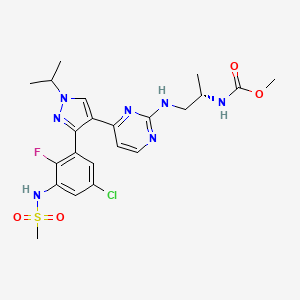
| Formula | C22H27ClFN7O4S |
|---|---|
| Molecular weight | 540.02 g/mol |
| IUPAC name | methyl N-[(2S)-1-[[4-[3-[5-chloro-2-fluoro-3-(methanesulfonamido)phenyl]-1-propan-2-ylpyrazol-4-yl]pyrimidin-2-yl]amino]propan-2-yl]carbamate |
| CAS | 1269440-17-6 |
| PubChem CID | 50922675 |
| InChIKey | CMJCXYNUCSMDBY-ZDUSSCGKSA-N |
| logP | 3.91 (XLogP 2.7) |
| Polar surface area | 140.13 Ų |
| H-bond acceptors / donors | 9 / 3 |
| Drug-likeness (QED) | 0.37 |
| Lipinski violations | 1 |
SMILES
COC(=O)N[C@@H](C)CNc1nccc(-c2cn(C(C)C)nc2-c2cc(Cl)cc(NS(C)(=O)=O)c2F)n1Biology & Pharmacokinetics
Pharmacokinetics predicted
| Bioavailability | 70.0% |
|---|---|
| Half-life | 0.675 h |
| Volume of distribution | 0.648 L/kg |
| Protein binding | 98.8% |
| BBB penetrant | No |
Enzyme interactions
| Enzyme | Role | Detail |
|---|---|---|
| CYP1A2 | Inhibitor | — |
| CYP1A2 | Substrate | — |
| CYP2B6 | Inhibitor | — |
| CYP2C19 | Substrate | — |
| CYP3A4 | Substrate | — |
Transporters
BCRP (Inhibitor)BCRP (Inhibitor)BSEP (Inhibitor)MDR1 (Inhibitor)MRP1 (Inhibitor)OAT1 (Inhibitor)OAT3 (Inhibitor)OATP1B1 (Inhibitor)OATP1B1 (Inhibitor)OATP1B3 (Inhibitor)OATP1B3 (Inhibitor)OCT2 (Inhibitor)P-gp (Inhibitor)MDR1 (Substrate)OATP1B (Substrate)OATP1B1 (Substrate)OATP1B3 (Substrate)P-gp (Substrate)
Drug–drug interactions (100+, DDInter)
| Interacting drug | Severity | Management |
|---|---|---|
| Acalabrutinib | major | |
| Amiodarone | major | |
| Amisulpride | major | |
| Amprenavir | major | |
| Anagrelide | major | |
| Apalutamide | major | |
| Aprepitant | major | |
| Arsenic trioxide | major | |
| Atazanavir | major | |
| Avapritinib | major | |
| Bedaquiline | major | |
| Bepridil | major | |
| Berotralstat | major | |
| Boceprevir | major | |
| Bosentan | major | |
| Cabozantinib | major | |
| Carbamazepine | major | |
| Cenobamate | major | |
| Ceritinib | major | |
| Chloramphenicol | major | |
| Chloroquine | major | |
| Cisapride | major | |
| Citalopram | major | |
| Clarithromycin | major | |
| Clozapine | major | |
| Cobicistat | major | |
| Conivaptan | major | |
| Crizotinib | major | |
| Dabrafenib | major | |
| Dalfopristin | major | |
| Darunavir | major | |
| Deferasirox | major | |
| Delavirdine | major | |
| Dexamethasone | major | |
| Dienogest | major | |
| Diltiazem | major | |
| Disopyramide | major | |
| Dofetilide | major | |
| Dolasetron | major | |
| Dronedarone | major |
Showing 40 of 100+.
Registered Products (2)
| Brand | Form / strength | Pack | Agent | Citizen (JOD) |
|---|---|---|---|---|
| Braftovi | Capsule 75 mg | 42 cap | Petra Drug Store | — |
| Braftovi | Capsule 50 mg | 28 cap | Petra Drug Store | — |