Tamoxifen
Active form: N-Desmethyltamoxifen.
JFDA label: Tamocit - 10mg tablets
- Ductal carcinoma in situ/women at high risk for breast cancer:
Mechanism of Action
Tamoxifen competitively binds to estrogen receptors on tumors and other tissue targets, producing a nuclear complex that decreases DNA synthesis and inhibits estrogen effects; nonsteroidal agent with potent antiestrogenic properties which compete with estrogen for binding sites in breast and other tissues; cells accumulate in the G0 and G1 phases; therefore, tamoxifen is cytostatic rather than cytocidal.
Indications
Approved
- Breast cancer
Off-label
- Desmoid tumors, progressive or recurrent
- Endometrial carcinoma, recurrent, metastatic, or high-risk (endometrioid histologies only)
- Gynecomastia
- Induction of ovulation
- Mastalgia, severe
- Oligospermia
- Ovarian cancer, advanced and/or recurrent
- Precocious puberty (females) due to McCune-Albright syndrome
Contraindications
Source: Curated · Lexicomp
- History of deep vein thrombosis or pulmonary embolism — relative CI Absolute
- Known hypersensitivity to tamoxifen or any component of the formulation Absolute
- Pregnancy (teratogenic; embryotoxic) Absolute
- concurrent warfarin therapy or history of deep vein thrombosis or pulmonary embolism (when tamoxifen is used for breast cancer risk reduction in women at high risk for breast cancer or with ductal carcinoma in situ [DCIS]) Absolute
Adverse Reactions
Cardiac disorders (15)
Very Common flushing · hypertension · peripheral edema · Vasodilatation
Common angina pectoris · Chest pain · deep vein thrombosis · edema · ischemic heart disease · myocardial infarction · venous thrombosis
Not Known Cerebrovascular accident · phlebitis (including superficial) · pulmonary embolism · thrombosis (retinal vein)
Nervous system disorders (10)
Very Common depression · Mood changes · pain
Common anxiety · dizziness · fatigue · headache · Insomnia · paresthesia
Not Known Tumor pain (during treatment of metastatic breast cancer; generally resolves with continuation)
Hepatobiliary disorders (5)
Common Increased serum AST · increased serum bilirubin
Not Known Hepatic necrosis · hepatitis · liver steatosis
Renal and urinary disorders (12)
Very Common Vaginal discharge · vaginal hemorrhage
Common Increased serum creatinine · leukorrhea · mastalgia · Urinary tract infection · vaginitis · vulvovaginitis
Not Known Endometrial hyperplasia · endometrial polyps · endometriosis · vaginal dryness
Blood and lymphatic system disorders (8)
Very Common Lymphedema
Common anemia · breast neoplasm · neoplasm · Thrombocytopenia
Not Known Endometrial carcinoma · tumor flare (during treatment of metastatic breast cancer; generally resolves with continuation; includes increased lesion size and erythema) · uterine fibroids
Immune system disorders (1)
Common Hypersensitivity reaction
Metabolism and nutrition disorders (11)
Very Common amenorrhea · fluid retention · Hot flash · menstrual disease · weight loss
Common hypercholesterolemia · Oligomenorrhea · ovarian cyst · weight gain
Not Known Hypercalcemia · hyperlipidemia
Gastrointestinal disorders (10)
Very Common Nausea · vomiting
Common abdominal cramps · Abdominal pain · anorexia · constipation · diarrhea · dyspepsia
Not Known Cholestasis · dysgeusia
Skin and subcutaneous tissue disorders (5)
Very Common Skin changes · skin rash
Common alopecia · Diaphoresis
Not Known Pruritus vulvae
Musculoskeletal and connective tissue disorders (10)
Very Common arthralgia · arthritis · Weakness
Common arthropathy · Back pain · bone fracture · musculoskeletal pain · myalgia · ostealgia · osteoporosis
Eye disorders (3)
Common Cataract
Not Known Corneal changes · retinopathy
Infections and infestations (2)
Common Infection · sepsis
General disorders and administration site conditions (1)
Common Cyst
Respiratory, thoracic and mediastinal disorders (7)
Very Common Pharyngitis
Common bronchitis · Cough · dyspnea · flu-like symptoms · sinusitis · throat irritation
Dosing
Source: Lexicomp
Warnings & Precautions
Source: Lexicomp
Bone marrow suppression
Thrombocytopenia and/or leukopenia may occur; neutropenia and pancytopenia have been reported rarely. Although the relationship to tamoxifen therapy is uncertain, rare hemorrhagic episodes have occurred in patients with significant thrombocytopenia.
Gynecologic effects/malignancies
Tamoxifen use for breast cancer risk reduction in women at high-risk for breast cancer and in women with ductal carcinoma in situ (DCIS) is associated with an increased incidence of uterine or endometrial cancers (some fatal). Endometrial hyperplasia, polyps, endometriosis, uterine fibroids, and ovarian cysts have occurred. Amenorrhea and menstrual irregularities have been reported with tamoxifen use. Monitor and promptly evaluate any report of abnormal vaginal bleeding.
Hepatotoxicity
Liver abnormalities such as cholestasis, fatty liver, hepatitis, and hepatic necrosis have occurred (some fatal). Hepatocellular carcinomas have been reported in some studies; relationship to treatment is unclear.
Ocular effects
Decreased visual acuity, retinal vein thrombosis, retinopathy, corneal changes, color perception changes and increased incidence of cataracts (and the need for cataract surgery) have been reported.
Thromboembolic events
Serious and life-threatening events (some fatal), including stroke and pulmonary emboli have occurred at an incidence greater than placebo during use for breast cancer risk reduction in women at high-risk for breast cancer and in women with DCIS; these events are rare, but require consideration in risk:benefit evaluation. In patients already diagnosed with breast cancer, the benefits of tamoxifen use are greater than the risks. An increased incidence of thromboembolic events has been associated with use; risk is increased with concomitant chemotherapy; use with caution in individuals with a history of thromboembolic events. Disease-related concerns:
Bone mineral density
Tamoxifen use may be associated with changes in bone mineral density (BMD) and the effects may be dependent upon menstrual status. In postmenopausal women, tamoxifen use is associated with a protective effect on bone mineral density (BMD), preventing loss of BMD which lasts over the 5-year treatment period. In premenopausal women, a decline (from baseline) in BMD mineral density has been observed in women who continued to menstruate; may be associated with an increased risk of fractures.
Hyperlipidemia
Use with caution in patients with hyperlipidemias; infrequent postmarketing cases of hyperlipidemias have been reported.
Metastatic breast cancer
Local disease flare and increased bone and tumor pain may occur; may be associated with (good) tumor response; onset is shortly after therapy initiation and usually resolves rapidly. In some patients with bone metastasis, hypercalcemia has occurred, usually within a few weeks of therapy initiation. Institute appropriate hypercalcemia management; discontinue if severe. Concurrent drug therapy issues:
Drug-drug interactions
Potentially significant interactions may exist, requiring dose or frequency adjustment, additional monitoring, and/or selection of alternative therapy. Consult drug interactions database for more detailed information. Decreased efficacy and an increased risk of breast cancer recurrence has been reported with concurrent moderate or strong CYP2D6 inhibitors (Aubert 2009; Dezentje 2009).
Selective serotonin reuptake inhibitors (SSRI)
Concomitant use with select SSRIs may result in decreased tamoxifen efficacy. Strong CYP2D6 inhibitors (eg, fluoxetine, paroxetine) and moderate CYP2D6 inhibitors (eg, sertraline) are reported to interfere with transformation to the active metabolite endoxifen; when possible, select alternative medications with minimal or no impact on endoxifen levels (Sideras 2010). Weak CYP2D6 inhibitors (eg, venlafaxine, citalopram) have minimal effect on the conversion to endoxifen (Jin 2005); escitalopram is also a weak CYP2D6 inhibitor. In a retrospective analysis of breast cancer patients taking tamoxifen and SSRIs, concomitant use of paroxetine and tamoxifen was associated with an increased risk of death due to breast cancer (Kelly 2010). Special populations:
CYP2D6 poor metabolizers
Lower plasma concentrations of endoxifen (active metabolite) have been observed in patients with reduced CYP2D6 activity (Jin, 2005; Schroth, 2009) and may be associated with reduced efficacy, although data is conflicting. Routine CYP2D6 testing is not recommended at this time in order to determine optimal endocrine therapy (Visvanathan 2009). Other warnings/precautions:
Risks vs benefits
In women already diagnosed with breast cancer, the benefits of tamoxifen treatment outweigh risks; evaluate risks versus benefits (and discuss with patients) when used for breast cancer risk reduction.
Pregnancy & Lactation
Pregnancy
Avoid
Generally classified D or X depending on reference. Avoid in pregnancy. Effective contraception required during treatment and for 2 months after stopping
Lactation
It is not known if tamoxifen is present in breast milk; however, it has been shown to inhibit lactation. Due to the potential for serious adverse reactions in the breastfed infant, breastfeeding is not recommended by the manufacturer.
Monitoring
| Clinical pearl | CBC with platelets, serum calcium, LFTs; triglycerides and cholesterol (in patients with pre-existing hyperlipidemias); INR and PT (in patients on vitamin K antagonists); pregnancy test (prior to treatment in females of reproductive potential); monitor for abnormal vaginal bleeding; breast and gynecologic exams (baseline and routine), mammogram (baseline and routine); signs/symptoms of DVT (leg swelling, tenderness) or PE (shortness of breath); ophthalmic exam (if vision problem or cataracts); bone mineral density (premenopausal women) |
|---|
Chemistry & Properties
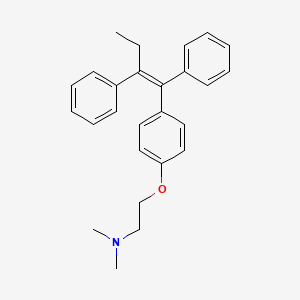
| Formula | C26H29NO |
|---|---|
| Molecular weight | 371.52 g/mol |
| IUPAC name | 2-[4-[(Z)-1,2-diphenylbut-1-enyl]phenoxy]-N,N-dimethylethanamine |
| CAS | 10540-29-1 |
| PubChem CID | 2733526 |
| InChIKey | NKANXQFJJICGDU-QPLCGJKRSA-N |
| logP | 6.0 (XLogP 7.1) |
| Polar surface area | 12.47 Ų |
| H-bond acceptors / donors | 2 / 0 |
| Drug-likeness (QED) | 0.45 |
| Lipinski violations | 1 |
SMILES
CC/C(=C(\c1ccccc1)c1ccc(OCCN(C)C)cc1)c1ccccc1Biology & Pharmacokinetics
Pharmacokinetics
| BBB penetrant | Yes (logBB 0.92) |
|---|
Enzyme interactions
| Enzyme | Role | Detail |
|---|---|---|
| CYP1A2 | Substrate | — |
| CYP2B6 | Inhibitor | Ki 0.8999999999999998 µM |
| CYP2B6 | Substrate | — |
| CYP2C19 | Substrate | — |
| CYP2C8 | Inhibitor | IC₅₀ 14.299999999999986 µM |
| CYP2C9 | Substrate | — |
| CYP2D6 | Inhibitor | — |
| CYP2D6 | Substrate | IC₅₀ 13.699999999999996 µM |
| CYP3A4 | Inhibitor | — |
| CYP3A4 | Substrate | Ki 0.20000000000000004 µM |
Receptor binding (top 3)
| Target | Action | Affinity |
|---|---|---|
| Estrogen receptor-α (ESR1) | Agonist | pKi 7.8 |
| Estrogen receptor-β (ESR2) | Agonist | pKi 7.2 |
| GPER (GPER1) | Agonist | pKi 6.0 |
Transporters
BCRP (Inhibitor)BCRP (Inhibitor)BSEP (Inhibitor)BSEP (Inhibitor)MDR1 (Inhibitor)MRP1 (Inhibitor)MRP2 (Inhibitor)MRP3 (Inhibitor)MRP4 (Inhibitor)OATP1B1 (Inhibitor)OATP1B1 (Inhibitor)OATP1B3 (Inhibitor)OATP1B3 (Inhibitor)OCT1 (Inhibitor)OCT2 (Inhibitor)P-gp (Inhibitor)BCRP (Substrate)MDR1 (Substrate)OATP1B3 (Substrate)P-gp (Substrate)
Drug–drug interactions (100+, DDInter)
| Interacting drug | Severity | Management |
|---|---|---|
| Abiraterone | major | |
| Amiodarone | major | |
| Amisulpride | major | |
| Anagrelide | major | |
| Anisindione | major | |
| Arsenic trioxide | major | |
| Bedaquiline | major | |
| Bepridil | major | |
| Bupropion | major | |
| Cabozantinib | major | |
| Carfilzomib | major | |
| Celecoxib | major | |
| Ceritinib | major | |
| Chloroquine | major | |
| Cimetidine | major | |
| Cinacalcet | major | |
| Cisapride | major | |
| Citalopram | major | |
| Clozapine | major | |
| Colchicine | major | |
| Crizotinib | major | |
| Dacomitinib | major | |
| Dalfopristin | major | |
| Darifenacin | major | |
| Dexfenfluramine | major | |
| Dextropropoxyphene | major | |
| Dicoumarol | major | |
| Diphenhydramine | major | |
| Disopyramide | major | |
| Dofetilide | major | |
| Dolasetron | major | |
| Dronedarone | major | |
| Droperidol | major | |
| Duloxetine | major | |
| Edoxaban | major | |
| Efavirenz | major | |
| Eliglustat | major | |
| Escitalopram | major | |
| Fedratinib | major | |
| Fenfluramine | major |
Showing 40 of 100+.
Registered Products (11)
| Brand | Form / strength | Pack | Agent | Citizen (JOD) |
|---|---|---|---|---|
| TAMOXIFEN EBEWE TABS | Tablet 10 mg | 30 tab | Sabbagh Drug Store | 3.180 |
| Medotamifen TAB | Tablet 10 mg | 30 tab | Al Hilal Drug Store | 3.580 |
| NOVOFEN 10 TABS | Tablet 10 mg | 30 tab | JAWEDA INT. DRUD STORE | 3.670 |
| Tamocit - | Tablet 10 mg | 30 tab pack varies | AL-RAM PHARMA.INDUS.CO.LTD/JORDAN | 3.990 |
| NOVOFEN 20 TABS | Tablet 20 mg | 30 tab | JAWEDA INT. DRUD STORE | 5.860 |
| Medotamifen DS TAB | Tablet 20 mg | 30 tab pack varies | Al Hilal Drug Store | 6.350 |
| Tamocit -20mg tablets | Tablet 20 mg | 30 tab | AL-RAM PHARMA.INDUS.CO.LTD/JORDAN | 7.500 |
| Nolvadex D Tablet | Tablet 20 mg | 30 tab | Shawi & Rushedat Drug Store | 7.660 |
| Tamocit - | Tablet 10 mg | 500 tab pack varies | AL-RAM PHARMA.INDUS.CO.LTD/JORDAN | 57.860 |
| Tamocit - | Tablet 10 mg | 1000 tab pack varies | AL-RAM PHARMA.INDUS.CO.LTD/JORDAN | 113.050 |
| Medotamifen DS TAB | Tablet 20 mg | 1000 tab pack varies | Al Hilal Drug Store | 179.850 |