Diphenhydramine
JFDA label: Histafen 20 mg
Indications
Approved
- Hypersensitivity — allergic disease
- Pruritus — Pruritus
Off-label
- Alcoholism
- Anxiety
- Autistic Disorder
- Breast Carcinoma In Situ
- Breast Neoplasms
- Carcinoma, Non-Small-Cell Lung
- Carcinoma, Renal Cell
- Chronic Urticaria
- Cocaine-Related Disorders
- Cough
- Dementia
- Depressive Disorder
- Endometrial Neoplasms
- Graft vs Host Disease
- Hepatitis B, Chronic
- Immunoglobulin G4-Related Disease
- Inflammation
- Kidney Diseases
- Leukemia, Hairy Cell
- Leukemia, Mast-Cell
- Leukemia, Myeloid, Acute
- Leukemia, T-Cell
- Lupus Erythematosus, Systemic
- Lupus Nephritis
- Lymphoma
- Lymphoma, Follicular
- Lymphoma, Large B-Cell, Diffuse
- Lymphoma, Non-Hodgkin
- Migraine Disorders
- Multiple Myeloma
- Multiple Sclerosis
- Multiple Sclerosis, Chronic Progressive
- Myelodysplastic Syndromes
- Neoplasms
- Pain
- Precursor Cell Lymphoblastic Leukemia-Lymphoma
- Precursor T-Cell Lymphoblastic Leukemia-Lymphoma
- Prostatic Neoplasms, Castration-Resistant
- Restless Legs Syndrome
- Rhinitis
- Schizophrenia
- Stomach Neoplasms
- Stomatitis
- Stomatitis, Aphthous
- Urticaria
Contraindications
Source: openFDA
- Use in Neonates or Premature Infants This drug should not be used in neonates or premature infants. Use in Nursing Mothers Because of the higher risk of antihistamines for infants generally, and for neonates and prematures in particular, antihistamine therapy is contraindicated in nursing mothers. Use as a Local Anesthetic Because of the risk of local necrosis, this drug should not be used as a local anesthetic. Antihistamines are also Contraindicated in the Following Conditions Hypersensitivity to diphenhydramine hydrochloride and other antihistamines of similar chemical structure. Absolute
Adverse Reactions
Cardiac disorders (3)
Not Known Extrasystoles · Palpitations · Tachycardia
Vascular disorders (1)
Not Known Hypotension
Nervous system disorders (7)
Not Known Convulsion · Dizziness · Headache · Neuropathy peripheral · Paraesthesia · Somnolence · Tremor
Renal and urinary disorders (2)
Not Known Pollakiuria · Urinary retention
Blood and lymphatic system disorders (3)
Not Known Agranulocytosis · Haemolytic anaemia · Thrombocytopenia
Gastrointestinal disorders (6)
Not Known Constipation · Decreased appetite · Diarrhoea · Dyspepsia · Nausea · Vomiting
Skin and subcutaneous tissue disorders (3)
Not Known Hyperhidrosis · Photosensitivity reaction · Urticaria
Psychiatric disorders (5)
Not Known Agitation · Confusional state · Euphoric mood · Insomnia · Irritability
Eye disorders (2)
Not Known Diplopia · Vision blurred
Ear and labyrinth disorders (3)
Not Known Labyrinthitis · Tinnitus · Vertigo
Investigations (1)
Not Known Feeling abnormal
General disorders and administration site conditions (8)
Not Known Asthenia · Chest discomfort · Chills · Drug eruption · Fatigue · Nervousness · Neuritis · Tension
Respiratory, thoracic and mediastinal disorders (2)
Not Known Nasal congestion · Wheezing
Dosing
Source: openFDA
Warnings & Precautions
Source: openFDA
Warnings & Precautions
Antihistamines should be used with considerable caution in patients with narrow-angle glaucoma, stenosing peptic ulcer, pyloroduodenal obstruction, symptomatic prostatic hypertrophy or bladder-neck obstruction. Local necrosis has been associated with the use of subcutaneous or intradermal use of intravenous diphenhydramine. Use in Pediatric Patients In pediatric patients, especially, antihistamines in overdosage may cause hallucinations, convulsions or death. As in adults, antihistamines may diminish mental alertness in pediatric patients. In the young pediatric patient, particularly, they may produce excitation. Use in the Elderly (approximately 60 years or older) Antihistamines are more likely to cause dizziness, sedation and hypotension in elderly patients.
Pregnancy & Lactation
Pregnancy
Caution
Short-term use safe. Avoid prolonged use near term
Lactation
Small (25 mg or less), occasional doses of diphenhydramine would not be expected to cause any adverse
Chemistry & Properties
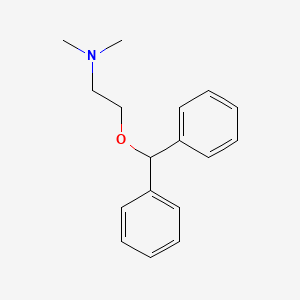
| Formula | C17H21NO |
|---|---|
| Molecular weight | 255.36 g/mol |
| IUPAC name | 2-benzhydryloxy-N,N-dimethylethanamine |
| CAS | 58-73-1 |
| PubChem CID | 3100 |
| InChIKey | ZZVUWRFHKOJYTH-UHFFFAOYSA-N |
| logP | 3.35 (XLogP 3.3) |
| Polar surface area | 12.47 Ų |
| H-bond acceptors / donors | 2 / 0 |
| Drug-likeness (QED) | 0.78 |
| Lipinski violations | 0 |
SMILES
CN(C)CCOC(c1ccccc1)c1ccccc1Biology & Pharmacokinetics
Pharmacokinetics
| BBB penetrant | Yes (logBB 1.3) |
|---|
Enzyme interactions
| Enzyme | Role | Detail |
|---|---|---|
| CYP1A2 | Substrate | — |
| CYP2B6 | Inhibitor | — |
| CYP2B6 | Substrate | — |
| CYP2C19 | Substrate | — |
| CYP2D6 | Inhibitor | — |
| CYP2D6 | Substrate | — |
| CYP3A4 | Substrate | — |
Receptor binding (top 1)
| Target | Action | Affinity |
|---|---|---|
| H1 receptor (HRH1) | Antagonist | pKi 7.9 |
Transporters
BCRP (Inhibitor)BSEP (Inhibitor)BSEP (Inhibitor)MATE1 (Inhibitor)MATE2 (Inhibitor)MDR1 (Inhibitor)MRP1 (Inhibitor)MRP2 (Inhibitor)OATP1B1 (Inhibitor)OATP1B1 (Inhibitor)OATP1B3 (Inhibitor)OATP1B3 (Inhibitor)OCT1 (Inhibitor)OCT2 (Inhibitor)OCT3 (Inhibitor)OCTN2 (Inhibitor)P-gp (Inhibitor)Proton-coupled organic cation antiporter (Inhibitor)MDR1 (Substrate)OCT3 (Substrate)P-gp (Substrate)Proton-coupled organic cation antiporter (Substrate)
Drug–drug interactions (100+, DDInter)
| Interacting drug | Severity | Management |
|---|---|---|
| Brexpiprazole | major | |
| Dextropropoxyphene | major | |
| Eliglustat | major | |
| Levacetylmethadol | major | |
| Potassium chloride | major | |
| Potassium citrate | major | |
| Sodium oxybate | major | |
| Tamoxifen | major | |
| Thioridazine | major | |
| Topiramate | major | |
| Zonisamide | major | |
| Abiraterone | moderate | |
| Acebutolol | moderate | |
| Acetylcholine | moderate | |
| Aclidinium | moderate | |
| Acrivastine | moderate | |
| Aldesleukin | moderate | |
| Alfentanil | moderate | |
| Alfuzosin | moderate | |
| Alimemazine | moderate | |
| Alprazolam | moderate | |
| Amantadine | moderate | |
| Amiloride | moderate | |
| Amiodarone | moderate | |
| Amitriptyline | moderate | |
| Amobarbital | moderate | |
| Amoxapine | moderate | |
| Amyl Nitrite | moderate | |
| Apomorphine | moderate | |
| Apraclonidine | moderate | |
| Aripiprazole | moderate | |
| Asenapine | moderate | |
| Atenolol | moderate | |
| Atomoxetine | moderate | |
| Atropine | moderate | |
| Azatadine | moderate | |
| Azelastine (nasal) | moderate | |
| Azilsartan medoxomil | moderate | |
| Baclofen | moderate | |
| Belladonna | moderate |
Showing 40 of 100+.
Registered Products (11)
| Brand | Form / strength | Pack | Agent | Citizen (JOD) |
|---|---|---|---|---|
| PECTOLYN PEDIATRIC | Suspension 125 mg/5 ml, 0.55 mg/5 ml, 7 mg/5 ml, 28.5 mg/ml | 150 ml | Dar Al Dawa Development and Investment Co Ltd/Jordan | 0.790 |
| PECTOLYN DECONGESTANT | Suspension 1.1 mg/5 ml, 57 mg/5 ml, 22.5 mg/5 ml, 14 mg/5 ml | 150 ml | Dar Al Dawa Development and Investment Co Ltd/Jordan | 0.850 |
| Panda-H Syrup | Syrup 120 mg/5 ml, 12.5 mg/5 ml | 100 ml | Jordan Sweden Medical & Sterilization Co. | 0.870 |
| bebe Cold | Suspension 120 mg/5 ml, 12.5 mg/5 ml | 100 ml | Al-Gadeed Pharmaceutical Industries | 0.870 |
| Pamol Night F.C Tab | Film-Coated Tablet 500 mg, 25 mg | 20 tab | Dar Al Dawa Development and Investment Co Ltd/Jordan | 1.300 |
| Riva N Syrup | Syrup 2.5 mg/5 ml, 6.25 mg/5 ml | 100 ml | Al-Gadeed Pharmaceutical Industries/JORDAN | 1.360 |
| Panda Night | Tablet 500 mg, 25 mg | 24 tab | JORDAN SWEDEN MEDICAL&STERILE.CO(JOSWE)/JORDAN | 1.550 |
| Revanin Night Caplet | Tablet 500 mg, 25 mg | 20 tab | The Arab Pharmaceutical Manufactruing Co. | 1.620 |
| Triaminic Night Time Cold & Cough Syrup | Syrup 2.5 mg/5 ml, 6.25 mg/5 ml | 118 ml | Nabulsi Drug Store | 2.000 |
| Histafen | Solution 20 mg | 13 ml | Dar Al Dawa Development and Investment Co Ltd/Jordan | 2.290 |
| Panadol Night | Tablet 500 mg, 25 mg | 24 tab | Sukhtian Group | 2.590 |