Albendazole
Active form: Albendazole Oxide.
JFDA label: Cystazole Tablet
Mechanism of Action
Inhibitor of Tubulin — Tubulin inhibitor
| Target | Action | Gene / class |
|---|---|---|
| Tubulin efficacy | INHIBITOR |
Indications
Approved
- Hydatid disease
- Neurocysticercosis
Off-label
- Microsporidiosis in HIV-infected patients (adolescents and adults)
Antimicrobial Spectrum
Expected / intrinsic spectrum (EUCAST breakpoints & labels) — not local resistance. Source: openfda-label.
Helminths
| Organism | Activity | MIC |
|---|---|---|
| Taenia solium | Active | — |
Contraindications
Source: Lexicomp
- Hypersensitivity to albendazole, benzimidazoles, or any component of the formulation Absolute
Adverse Reactions
Nervous system disorders (5)
Very Common dizziness · Headache · Increased intracranial pressure · meningism · vertigo
Hepatobiliary disorders (1)
Very Common Increased liver enzymes (hydatid: 16%; neurocysticercosis: 1% to 10%:
Skin and subcutaneous tissue disorders (1)
Very Common Alopecia, nausea and vomiting
General disorders and administration site conditions (1)
Very Common Fever
Dosing
Source: Lexicomp
Warnings & Precautions
Source: Lexicomp
Bone marrow suppression
Agranulocytosis, aplastic anemia, granulocytopenia, leukopenia, and pancytopenia have occurred leading to fatalities (rare); use with caution in patients with hepatic impairment (more susceptible to hematologic toxicity). Discontinue therapy in all patients who develop clinically significant decreases in blood cell counts.
Transaminase elevations
Reversible elevations in hepatic enzymes have been reported. Patients with abnormal LFTs and hepatic echinococcosis are at an increased risk of hepatotoxicity. Discontinue therapy if LFT elevations are >2 times the upper limit of normal; may consider restarting treatment (with frequent monitoring of LFTs) when hepatic enzymes return to pretreatment values. Discontinue therapy if hepatic enzymes are significantly increased. Disease-related concerns:
Neurocysticercosis
Appropriate use: Corticosteroids should be administered before or upon initiation of albendazole therapy to minimize inflammatory reactions and prevent increased intracranial pressure. Anticonvulsant therapy should be used concurrently to prevent seizures. If retinal lesions exist, weigh risk of further retinal damage due to albendazole-induced inflammatory changes to the retinal lesion vs benefit of disease treatment.
Pregnancy & Lactation
Pregnancy
Adverse events were observed in animal reproduction studies. Albendazole should not be used during pregnancy, if at all possible. The manufacturer recommends a pregnancy test prior to therapy in women of reproductive potential. Women should be advised to avoid pregnancy during and for at least 1 month following therapy. Discontinue if pregnancy occurs during treatment.
Lactation
Albendazole excretion into breast milk was studied following a single oral 400 mg dose in breast-feeding women 2 weeks to 6 months postpartum (n=33). Mean albendazole concentrations 6 hours after the dose were 63.7 ± 11.9 ng/mL (maternal serum) and 31.9 ± 9.2 ng/mL (milk). An active and inactive metabolite was also detected in breast milk (Abdel-tawab, 2009). The manufacturer recommends that caution be exercised when administering albendazole to nursing women.
Monitoring
| Clinical pearl | LFTs and CBC with differential at start of each 28-day cycle and every 2 weeks during therapy (more frequent monitoring for patients with liver disease); ophthalmic exam for retinal lesions (patients with neurocysticercosis); pregnancy test |
|---|
Chemistry & Properties
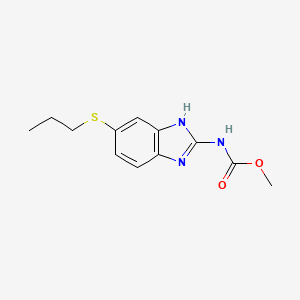
| Formula | C12H15N3O2S |
|---|---|
| Molecular weight | 265.34 g/mol |
| IUPAC name | methyl N-(6-propylsulfanyl-1H-benzimidazol-2-yl)carbamate |
| CAS | 54965-21-8 |
| PubChem CID | 2082 |
| InChIKey | HXHWSAZORRCQMX-UHFFFAOYSA-N |
| logP | 3.24 (XLogP 2.9) |
| Polar surface area | 67.01 Ų |
| H-bond acceptors / donors | 4 / 2 |
| Drug-likeness (QED) | 0.83 |
| Lipinski violations | 0 |
SMILES
CCCSc1ccc2[nH]c(NC(=O)OC)nc2c1Biology & Pharmacokinetics
Pharmacokinetics predicted
| Bioavailability | 70.0% |
|---|---|
| Half-life | 0.844 h |
| Volume of distribution | 0.849 L/kg |
| Protein binding | 85.4% |
| BBB penetrant | Yes |
Enzyme interactions
| Enzyme | Role | Detail |
|---|---|---|
| CYP1A2 | Inhibitor | — |
| CYP1A2 | Substrate | — |
| CYP2C8 | Inhibitor | — |
| CYP2C9 | Substrate | — |
| CYP3A4 | Substrate | — |
Transporters
BCRP (Inhibitor)BSEP (Inhibitor)BSEP (Inhibitor)MDR1 (Inhibitor)MRP1 (Inhibitor)MRP2 (Inhibitor)MRP3 (Inhibitor)MRP4 (Inhibitor)OATP1B1 (Inhibitor)OATP1B1 (Inhibitor)OATP1B3 (Inhibitor)P-gp (Inhibitor)BCRP (Substrate)MDR1 (Substrate)P-gp (Substrate)
Drug–drug interactions (96, DDInter)
| Interacting drug | Severity | Management |
|---|---|---|
| Cladribine | major | |
| Clozapine | major | |
| Abametapir (topical) | moderate | |
| Alemtuzumab | moderate | |
| Amprenavir | moderate | |
| Anagrelide | moderate | |
| Apalutamide | moderate | |
| Aprepitant | moderate | |
| Bendamustine | moderate | |
| Bexarotene | moderate | |
| Binimetinib | moderate | |
| Boceprevir | moderate | |
| Bosentan | moderate | |
| Brigatinib | moderate | |
| Carbamazepine | moderate | |
| Cenobamate | moderate | |
| Cobicistat | moderate | |
| Conivaptan | moderate | |
| Dabrafenib | moderate | |
| Darunavir | moderate | |
| Dasatinib | moderate | |
| Deferasirox | moderate | |
| Diltiazem | moderate | |
| Dronedarone | moderate | |
| Duvelisib | moderate | |
| Echinacea | moderate | |
| Efavirenz | moderate | |
| Entrectinib | moderate | |
| Enzalutamide | moderate | |
| Etravirine | moderate | |
| Fedratinib | moderate | |
| Fluvoxamine | moderate | |
| Fosamprenavir | moderate | |
| Fosaprepitant | moderate | |
| Fosnetupitant | moderate | |
| Fosphenytoin | moderate | |
| Fostamatinib | moderate | |
| Ganciclovir | moderate | |
| Grepafloxacin | moderate | |
| Idelalisib | moderate |
Showing 40 of 96.
Registered Products (4)
| Brand | Form / strength | Pack | Agent | Citizen (JOD) |
|---|---|---|---|---|
| Cystazole Tablet | Tablet 200 mg | 2 tab pack varies | Jordan Sweden Medical & Sterilization Co. | 0.300 |
| Cystazole Tablet | Tablet 200 mg | 6 tab pack varies | Jordan Sweden Medical & Sterilization Co. | 0.850 |
| Cystazole Tablet | Tablet 200 mg | 30 tab pack varies | Jordan Sweden Medical & Sterilization Co. | 3.960 |
| Cystazole Tablet | Tablet 200 mg | 600 tab pack varies | Jordan Sweden Medical & Sterilization Co. | 71.360 |