Ganciclovir
Active form: Ganciclovir Triphosphate.
JFDA label: GANCISALA 500 mg powder for concentrate for solution for infusion
- Hematologic toxicity:
- Impairment of fertility:
- Fetal toxicity:
- Mutagenesis and carcinogenesis:
Mechanism of Action
Inhibitor of DNA polymerase catalytic subunit — Human herpesvirus 1 DNA polymerase inhibitor
| Target | Action | Gene / class |
|---|---|---|
| DNA polymerase catalytic subunit efficacy | INHIBITOR |
Indications
Approved
- Cytomegalovirus disease, prophylaxis (transplant patients)
- Cytomegalovirus retinitis (immunocompromised patients)
Off-label
- CMV disease, preemptive therapy (hematopoietic cell transplant recipients)
- CMV disease, treatment (solid organ transplant recipients)
- CMV neurological disease in HIV-infected patients (adolescents and adults)
- CMV retinitis, secondary prevention in HIV-infected patients (adolescents and adults)
- Cytomegalovirus (CMV) esophagitis or colitis treatment in HIV-infected patients (adolescents and adults)
- Varicella-zoster: Acute retinal necrosis (ARN) in HIV-infected patients (adolescent and adults)
- Varicella-zoster: Progressive outer retinal necrosis (PORN) in HIV-infected patients (adolescents and adults)
Antimicrobial Spectrum
Expected / intrinsic spectrum (EUCAST breakpoints & labels) — not local resistance. Source: openfda-label.
Viruses
| Organism | Activity | MIC |
|---|---|---|
| Cmv | Active | — |
| Cytomegalovirus | Active | — |
Class profile
| targetVirus | CMV/HSV |
|---|---|
| viralClass | Herpesviridae (dsDNA) |
| targetStep | Viral DNA polymerase (chain terminator; UL97 kinase phosphorylation) |
| resistanceBarrier | Moderate (UL97 mutations: M460V/I, C592G, A594V; UL54 pol mutation) |
| crossResistance | Cross-resistance with valganciclovir; partial with foscarnet depends on UL54 |
| source | DHHS/AASLD/manufacturer-PIL |
Contraindications
Source: Lexicomp
- Hypersensitivity to ganciclovir, valganciclovir, acyclovir, or any component of the formulation Absolute
Adverse Reactions
Nervous system disorders (2)
Common Chills · neuropathy
Renal and urinary disorders (1)
Very Common Increased serum creatinine
Blood and lymphatic system disorders (4)
Very Common anemia · leukopenia · neutropenia · Thrombocytopenia
Gastrointestinal disorders (3)
Very Common anorexia · Diarrhea · vomiting
Skin and subcutaneous tissue disorders (2)
Very Common Diaphoresis
Common Pruritus
Eye disorders (1)
Very Common Retinal detachment
Infections and infestations (1)
Very Common Sepsis
General disorders and administration site conditions (1)
Very Common Fever
Dosing
Source: Lexicomp
Warnings & Precautions
Source: Lexicomp
Carcinogenic/teratogenic
May cause temporary or permanent inhibition of spermatogenesis and suppression of fertility; has the potential to cause birth defects and cancers in humans. Due to its teratogenic potential, females should undergo pregnancy testing prior to initiation and use effective contraception during treatment and for 30 days after; males should use barrier contraception during treatment and for 90 days after.
Hematologic toxicity
Granulocytopenia (neutropenia), anemia, thrombocytopenia, and pancytopenia may occur. Neutropenia usually occurs during the first 1 to 2 weeks of treatment but may occur at any time; cell counts usually begin to recover within 3 to 7 days of treatment discontinuation. Colony-stimulating factors have been shown to increase neutrophil and white blood cell counts in patients receiving ganciclovir. Use with caution in patients with pre-existing cytopenias and in patients receiving myelosuppressive drugs or irradiation. Frequently monitor complete blood count with differential and platelet counts, especially in patients with renal impairment and in patients who have previously experienced drug-induced leukopenia or who have neutrophil counts 3 at the beginning of treatment. Ganciclovir is not recommended in patients with an absolute neutrophil count (ANC) 3, hemoglobin 3.
Renal toxicity
Increased serum creatinine levels have been reported in elderly patients and transplant patients receiving concomitant nephrotoxic medications (eg, cyclosporine, amphotericin B). Monitor renal function during therapy, especially in elderly patients and those receiving concomitant nephrotoxic agents. Disease-related concerns:
Renal impairment
Use with caution in patients with renal impairment; dosage adjustment recommended. Special populations:
Elderly
Increased serum creatinine levels have been reported; use with caution and closely monitor serum creatinine. Concurrent drug therapy issues:
Drug-drug interactions
Potentially significant interactions may exist, requiring dose or frequency adjustment, additional monitoring, and/or selection of alternative therapy. Consult drug interactions database for more detailed information. Other warnings/precautions:
Administration
Ensure patients are adequately hydrated. Avoid rapid infusion. Phlebitis and/or pain may occur at injection site despite adequate dilution; infuse solution into veins with adequate blood flow.
Pregnancy & Lactation
Pregnancy
[US Boxed Warning]: Based on animal data, use may suppress fertility in females, inhibit spermatogenesis in males, and cause birth defects if used in pregnant women. Ganciclovir crosses the placenta. Female patients should undergo pregnancy testing prior to initiation and use effective contraception during and for at least 30 days after therapy. Male patients should use a barrier contraceptive during and for at least 90 days after therapy. The inhibition of spermatogenesis may be temporary or permanent.
Lactation
It is not known if ganciclovir is present in breast milk. Due to the potential for serious adverse reactions in the breastfeeding infant, breastfeeding is not recommended by the manufacturer. In addition, in the US, females with HIV infection should completely avoid breastfeeding to decrease the potential transmission of HIV (HHS [perinatal] 2017).
Monitoring
| Efficacy | Viral load (undetectable = success); CD4 count (HIV); hepatic enzymes and HBV/HCV DNA (hepatitis); clinical resolution of acute viral illness |
|---|---|
| Toxicity | Renal function (most antivirals are renally cleared); LFTs; resistance testing if virological failure; CBC |
| Clinical pearl | For HIV, undetectable viral load at 6 months predicts long-term treatment success. Resistance testing is mandatory at virological failure. |
| Counseling | Do not miss doses — even brief interruptions can cause viral rebound and resistance selection. Report any side effects early rather than stopping independently. |
Chemistry & Properties
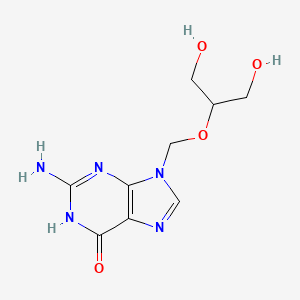
| Formula | C9H13N5O4 |
|---|---|
| Molecular weight | 255.23 g/mol |
| IUPAC name | 2-amino-9-(1,3-dihydroxypropan-2-yloxymethyl)-1H-purin-6-one |
| CAS | 82410-32-0 |
| PubChem CID | 135398740 |
| InChIKey | IRSCQMHQWWYFCW-UHFFFAOYSA-N |
| logP | -1.97 (XLogP -2.5) |
| Polar surface area | 139.28 Ų |
| H-bond acceptors / donors | 8 / 4 |
| Drug-likeness (QED) | 0.49 |
| Lipinski violations | 0 |
SMILES
Nc1nc2c(ncn2COC(CO)CO)c(=O)[nH]1Biology & Pharmacokinetics
Pharmacokinetics predicted
| Bioavailability | 70.0% |
|---|---|
| Half-life | 1.754 h |
| Volume of distribution | 0.972 L/kg |
| Protein binding | 4.1% |
| BBB penetrant | No |
Receptor binding (top 2)
| Target | Action | Affinity |
|---|---|---|
| Metabotropic Glutamate 1a | Binding | pKi 6.0 |
| metabotropic glutamate 5a | Binding | pKi 5.4 |
Transporters
BCRP (Inhibitor)BCRP (Inhibitor)BSEP (Inhibitor)BSEP (Inhibitor)CNT2 (Inhibitor)MRP1 (Inhibitor)MRP2 (Inhibitor)MRP3 (Inhibitor)MRP4 (Inhibitor)OAT1 (Inhibitor)OAT2 (Inhibitor)OAT3 (Inhibitor)OAT4 (Inhibitor)OATP1B1 (Inhibitor)OATP1B3 (Inhibitor)OCT1 (Inhibitor)OCT2 (Inhibitor)P-gp (Inhibitor)MATE1 (Substrate)MATE2 (Substrate)OAT (Substrate)OAT1 (Substrate)OAT2 (Substrate)OAT3 (Substrate)OCT1 (Substrate)OCT2 (Substrate)P-gp (Substrate)Transporter(unspecified) (Substrate)
Drug–drug interactions (100+, DDInter)
| Interacting drug | Severity | Management |
|---|---|---|
| Adalimumab | major | |
| Certolizumab pegol | major | |
| Cladribine | major | |
| Deferiprone | major | |
| Etanercept | major | |
| Golimumab | major | |
| Infliximab | major | |
| Abemaciclib | moderate | |
| Acalabrutinib | moderate | |
| Aflibercept | moderate | |
| Albendazole | moderate | |
| Aldesleukin | moderate | |
| Alemtuzumab | moderate | |
| Altretamine | moderate | |
| Amphotericin B | moderate | |
| Amphotericin B (cholesteryl sulfate) | moderate | |
| Amphotericin B (lipid complex) | moderate | |
| Amphotericin B (liposomal) | moderate | |
| Asparaginase Escherichia coli | moderate | |
| Azacitidine | moderate | |
| Azathioprine | moderate | |
| Baricitinib | moderate | |
| Belinostat | moderate | |
| Bendamustine | moderate | |
| Bexarotene | moderate | |
| Bleomycin | moderate | |
| Blinatumomab | moderate | |
| Bortezomib | moderate | |
| Bosutinib | moderate | |
| Brentuximab vedotin | moderate | |
| Busulfan | moderate | |
| Cabazitaxel | moderate | |
| Capecitabine | moderate | |
| Carboplatin | moderate | |
| Carfilzomib | moderate | |
| Carmustine | moderate | |
| Chlorambucil | moderate | |
| Chloramphenicol | moderate | |
| Cisplatin | moderate | |
| Clofarabine | moderate |
Showing 40 of 100+.
Registered Products (3)
| Brand | Form / strength | Pack | Agent | Citizen (JOD) |
|---|---|---|---|---|
| CYMEVENE VIAL | Vial 500 mg | 1 | Shawi & Rushedat Drug Store | — |
| GANCISALA 500 mg powder for concentrate for solution for infusion | Infusion 500 mg | 5 vial | Reda Jardaneh Drug Store | — |
| Gevalox 500mg/vial Powder for Solution for Infusion | Infusion 500 mg | 1 vial | / MS PHARMA/JORDAN / General | — |