Clofarabine
Active form: Clofarabine-5'-Triphosphate.
JFDA label: Nuclofar (Clofarabine injection)
Mechanism of Action
Inhibitor of Ribonucleoside-diphosphate reductase RR1 — Ribonucleoside-diphosphate reductase RR1 inhibitor; Inhibitor of DNA — DNA inhibitor; Inhibitor of DNA polymerase (alpha/delta/epsilon) — DNA polymerase (alpha/delta/epsilon) inhibitor
| Target | Action | Gene / class |
|---|---|---|
| DNA efficacy | INHIBITOR | |
| DNA polymerase (alpha/delta/epsilon) efficacy | INHIBITOR | |
| Ribonucleoside-diphosphate reductase RR1 efficacy | INHIBITOR |
Indications
Approved
- Acute lymphoblastic leukemia, relapsed or refractory
Off-label
- Acute lymphoblastic leukemia, refractory or relapsed (adults)
- Acute myeloid leukemia, refractory (patients
Contraindications
Source: Lexicomp
- Hypersensitivity to clofarabine or any component of the formulation Absolute
- There are no contraindications listed in the manufacturer’s US labeling Absolute
- history of serious heart, liver, kidney, or pancreas disease Absolute
- severe hepatic impairment (AST and/or ALT >5 x ULN, and/or bilirubin >3 x ULN) Absolute
- severe renal impairment (CrCl Absolute
- symptomatic CNS involvement Absolute
Adverse Reactions
Cardiac disorders (7)
Very Common edema · flushing · hypertension · hypotension · Tachycardia
Common capillary leak syndrome · Pericardial effusion
Nervous system disorders (10)
Very Common anxiety · chills · fatigue · Headache · pain
Common agitation · Drowsiness · irritability · lethargy · mental status changes
Hepatobiliary disorders (6)
Very Common increased bilirubin · Increased serum ALT · increased serum AST
Common hepatic sinusoidal obstruction syndrome · hyperbilirubinemia · Jaundice
Renal and urinary disorders (3)
Very Common Hematuria · Increased serum creatinine
Common Acute renal failure
Blood and lymphatic system disorders (9)
Very Common anemia · febrile neutropenia · Leukopenia · lymphocytopenia · neutropenia · petechia · thrombocytopenia
Common oral mucosal petechiae · Tumor lysis syndrome
Immune system disorders (1)
Common Hypersensitivity
Gastrointestinal disorders (14)
Very Common abdominal pain · anorexia · diarrhea · gingival bleeding · mucosal inflammation · nausea · oral candidiasis · Vomiting
Common pancreatitis · pseudomembranous colitis · Rectal pain · stomatitis · typhlitis · upper abdominal pain
Skin and subcutaneous tissue disorders (6)
Very Common erythema · palmar-plantar erythrodysesthesia · Pruritus · skin rash
Common Cellulitis · pruritic rash
Musculoskeletal and connective tissue disorders (6)
Very Common Limb pain · myalgia
Common arthralgia · Back pain · ostealgia · weakness
Infections and infestations (10)
Very Common Infection · sepsis
Common bacteremia · candidiasis · Herpes simplex infection · herpes zoster · influenza · sepsis syndrome · staphylococcal bacteremia · staphylococcal sepsis
General disorders and administration site conditions (2)
Very Common Catheter infection · Fever
Respiratory, thoracic and mediastinal disorders (9)
Very Common dyspnea · Epistaxis · pleural effusion
Common Pneumonia · pulmonary edema · respiratory distress · sinusitis · tachypnea · upper respiratory tract infection
Dosing
Source: Lexicomp
Warnings & Precautions
Source: Lexicomp
Bone marrow suppression
Dose-dependent, reversible myelosuppression (neutropenia, thrombocytopenia, and anemia) is common; may be severe and prolonged. Monitor blood counts and platelets. May be at increased risk for infection due to neutropenia. Monitor for signs and symptoms of infection and treat promptly if infection develops; may require discontinuation.
Capillary leak syndrome/systemic inflammatory response syndrome (SIRS)
Cytokine release syndrome (eg, tachypnea, tachycardia, hypotension, pulmonary edema) may develop into capillary leak syndrome/SIRS, and organ dysfunction; immediately discontinue with signs/symptoms of SIRS or capillary leak syndrome (rapid-onset respiratory distress, hypotension, pleural/pericardial effusion, and multiorgan failure) and manage appropriately. Consider supportive treatment with diuretics, corticosteroids, and/or albumin. Prophylactic corticosteroids may prevent or diminish the signs/symptoms of cytokine release. May require dosage reduction.
Dermatologic reactions
Serious and fatal cases of Stevens-Johnson syndrome (SJS) and toxic epidermal necrolysis (TEN) have been reported. Discontinue clofarabine for exfoliative or bullous rash, or if SJS or TEN are suspected.
Gastrointestinal toxicity
Clofarabine is associated with a moderate emetic potential; antiemetics are recommended to prevent nausea and vomiting (Dupuis 2011; Hesketh 2017; Roila 2016). Serious and fatal enterocolitis (including neutropenic colitis, cecitis, and C. difficile colitis) has been reported, usually occurring within 30 days of treatment, and when used in combination with other chemotherapy. May lead to necrosis, perforation, hemorrhage or sepsis complications. Monitor for signs/symptoms of enterocolitis and manage promptly.
Hemorrhage
Serious and fatal hemorrhages (including cerebral, gastrointestinal, and pulmonary hemorrhage) have occurred, usually associated with thrombocytopenia. Monitor and manage coagulation parameters.
Hepatotoxicity
Transaminases and bilirubin may be increased during treatment; hepatitis and hepatic failure have been reported. Transaminase elevations generally occur within 10 days of administration and persist for ≤15 days. In some cases, hepatotoxicity was severe and fatal. The risk for hepatotoxicity, including hepatic sinusoidal obstruction syndrome (SOS; formerly called veno-occlusive disease [VOD]), is increased in patients who have previously undergone a hematopoietic stem cell transplant; discontinue if SOS is suspected. Avoid the concomitant use of drugs that may cause hepatotoxicity. Monitor liver function closely; discontinue immediately for grade ≥ 3 elevations in hepatic enzymes and/or bilirubin.
Hypotension
Monitor blood pressure during 5 days of treatment; discontinue if hypotension develops. Monitor if on concurrent medications known to affect blood pressure.
Infection
The risk for infections, including opportunistic infection or sepsis (may be severe or fatal), is increased due to prolonged neutropenia and immunocompromised state. Monitor for signs and symptoms of infection and treat promptly if infection develops; may require therapy discontinuation.
Renal toxicity
Elevated creatinine, acute renal failure, and hematuria were observed in clinical studies. Infection, sepsis, or tumor lysis syndrome may cause an increased risk of renal toxicity in patients receiving clofarabine. Monitor renal function closely; may require dosage reduction or therapy discontinuation.
Tumor lysis syndrome/hyperuricemia
Tumor lysis syndrome may occur as a consequence of leukemia treatment, including treatment with clofarabine, usually occurring in the first treatment cycle. May lead to life-threatening acute renal failure; adequate hydration and prophylactic antihyperuricemic therapy throughout treatment will reduce the risk/effects of tumor lysis syndrome; monitor closely. Disease-related concerns:
Renal impairment
A pharmacokinetic study demonstrated that systemic exposure increases as creatinine clearance decreases (CrCl Concurrent drug therapy issues:
Drug-drug interactions
Potentially significant interactions may exist, requiring dose or frequency adjustment, additional monitoring, and/or selection of alternative therapy. Consult drug interactions database for more detailed information.
Pregnancy & Lactation
Pregnancy
Adverse events were observed in animal reproduction studies. May cause fetal harm if administered to a pregnant woman. Women of childbearing potential should avoid becoming pregnant during therapy. All patients should use effective contraception to prevent pregnancy during treatment.
Lactation
It is not known if clofarabine is excreted in breast milk. Due to the potential for serious adverse reactions in the nursing infant, breast-feeding is not recommended by the manufacturer.
Monitoring
| Clinical pearl | CBC with differential and platelets (daily during treatment, then 1 to 2 times weekly or as necessary); liver and kidney function (during 5 days of clofarabine administration); coagulation parameters, blood pressure, cardiac function, and respiratory status during infusion; signs and symptoms of tumor lysis syndrome, infection, hepatic sinusoidal obstruction syndrome, enterocolitis, and cytokine release syndrome (tachypnea, tachycardia, hypotension, pulmonary edema); hydration status |
|---|
Chemistry & Properties
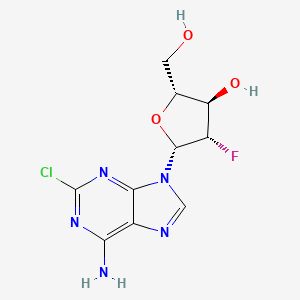
| Formula | C10H11ClFN5O3 |
|---|---|
| Molecular weight | 303.68 g/mol |
| IUPAC name | (2R,3R,4S,5R)-5-(6-amino-2-chloropurin-9-yl)-4-fluoro-2-(hydroxymethyl)oxolan-3-ol |
| CAS | 123318-82-1 |
| PubChem CID | 119182 |
| InChIKey | WDDPHFBMKLOVOX-AYQXTPAHSA-N |
| logP | -0.35 (XLogP 0.9) |
| Polar surface area | 119.31 Ų |
| H-bond acceptors / donors | 8 / 3 |
| Drug-likeness (QED) | 0.65 |
| Lipinski violations | 0 |
SMILES
Nc1nc(Cl)nc2c1ncn2[C@@H]1O[C@H](CO)[C@@H](O)[C@@H]1FBiology & Pharmacokinetics
Pharmacokinetics predicted
| Bioavailability | 10.0% |
|---|---|
| Half-life | 1.93 h |
| Volume of distribution | 1.99 L/kg |
| Protein binding | 46.6% |
| BBB penetrant | No |
Enzyme interactions
| Enzyme | Role | Detail |
|---|---|---|
| CYP2B6 | Inhibitor | — |
Receptor binding (top 2)
| Target | Action | Affinity |
|---|---|---|
| ribonucleotide reductase catalytic subunit M1 (RRM1) | Inhibitor | pIC50 8.3 |
| ribonucleotide reductase regulatory subunit M2 (RRM2) | Inhibitor | pIC50 8.3 |
Transporters
BCRP (Inhibitor)BSEP (Inhibitor)BSEP (Inhibitor)CNT3 (Inhibitor)ENT1 (Inhibitor)ENT2 (Inhibitor)MRP1 (Inhibitor)MRP2 (Inhibitor)MRP3 (Inhibitor)MRP4 (Inhibitor)OATP1B1 (Inhibitor)OATP1B3 (Inhibitor)P-gp (Inhibitor)BCRP (Substrate)CNT1 (Substrate)CNT2 (Substrate)CNT3 (Substrate)ENT1 (Substrate)ENT2 (Substrate)OAT3 (Substrate)OCT1 (Substrate)P-gp (Substrate)
Drug–drug interactions (100+, DDInter)
| Interacting drug | Severity | Management |
|---|---|---|
| Adalimumab | major | |
| Bacillus calmette-guerin substrain tice live antigen | major | |
| Baricitinib | major | |
| Certolizumab pegol | major | |
| Cidofovir | major | |
| Cladribine | major | |
| Clozapine | major | |
| Deferiprone | major | |
| Diatrizoate | major | |
| Etanercept | major | |
| Fingolimod | major | |
| Golimumab | major | |
| Infliximab | major | |
| Inotersen | major | |
| Iodipamide | major | |
| Iodixanol | major | |
| Iohexol | major | |
| Iopamidol | major | |
| Iopromide | major | |
| Iothalamic acid | major | |
| Ioversol | major | |
| Ioxilan | major | |
| Leflunomide | major | |
| Lomitapide | major | |
| Measles virus vaccine live attenuated | major | |
| Mipomersen | major | |
| Mumps virus strain B level jeryl lynn live antigen | major | |
| Natalizumab | major | |
| Ozanimod | major | |
| Pexidartinib | major | |
| Rotavirus vaccine | major | |
| Rubella virus vaccine | major | |
| Samarium (153Sm) lexidronam | major | |
| Siponimod | major | |
| Smallpox (Vaccinia) Vaccine, Live | major | |
| Talimogene laherparepvec | major | |
| Teriflunomide | major | |
| Thalidomide | major | |
| Tofacitinib | major | |
| Typhoid vaccine (live) | major |
Showing 40 of 100+.
Registered Products (2)
| Brand | Form / strength | Pack | Agent | Citizen (JOD) |
|---|---|---|---|---|
| Nuclofar (Clofarabine injection) | Injection 20 mg/20 ml | 1 vial pack varies | Manar Drug Store | — |
| Nuclofar (Clofarabine injection) | Injection 20 mg/20 ml | 10 vial pack varies | Manar Drug Store | — |