Carmustine
JFDA label: CARMUSTINE 100 MG
- Myelosuppression (injection)
- Pulmonary toxicity (injection)
Mechanism of Action
Inhibitor of Glutathione reductase, mitochondrial — Glutathione reductase inhibitor; Inhibitor of DNA — DNA inhibitor; Inhibitor of RNA — RNA inhibitor
| Target | Action | Gene / class |
|---|---|---|
| DNA efficacy | INHIBITOR | |
| Glutathione reductase, mitochondrial efficacy | INHIBITOR | GSR |
| RNA efficacy | INHIBITOR |
Indications
Approved
- Brain tumors
- Hodgkin lymphoma, relapsed/refractory
- Injection
- Multiple myeloma
- Non-Hodgkin lymphomas, relapsed/refractory
- Wafer (implant)
Off-label
- Mycosis fungoides (topical)
- Stem cell or bone marrow transplant (autologous) conditioning regimen
Contraindications
Source: Lexicomp
- IV: Hypersensitivity to carmustine or any component of the formulation Implant: There are no contraindications listed in the manufacturer's labeling Absolute
Adverse Reactions
Cardiac disorders (4)
Common Chest pain · flushing (with rapid infusion) · occlusive arterial disease · tachycardia
Nervous system disorders (8)
Very Common cerebral edema · depression · Seizure
Common Brain disease · cerebral hemorrhage · headache · Intracranial hypertension · meningitis
Hepatobiliary disorders (3)
Common Increased serum alkaline phosphatase · increased serum bilirubin · increased serum transaminases
Renal and urinary disorders (5)
Very Common Urinary tract infection
Common Azotemia (progressive) · Gynecomastia · nephron atrophy · renal failure
Blood and lymphatic system disorders (6)
Common Acute leukemia · anemia · bone marrow dysplasia · leukemia · leukopenia (common; onset: 5 to 6 weeks; recovery: after 1 to 2 weeks) · thrombocytopenia (common: onset: ~4 weeks; recovery: after 1 to 2 weeks)
Immune system disorders (1)
Common Hypersensitivity reaction
Gastrointestinal disorders (6)
Very Common constipation · Nausea · vomiting
Common Abdominal pain · Anorexia · diarrhea
Skin and subcutaneous tissue disorders (4)
Very Common Skin rash
Common Alopecia · burning sensation of skin · hyperpigmentation
Musculoskeletal and connective tissue disorders (2)
Very Common Weakness
Common Back pain
Eye disorders (5)
Common Blurred vision · conjunctival edema · conjunctival hemorrhage · ophthalmic signs and symptoms (loss of depth perception) · suffusion of the conjunctiva (with rapid infusion)
Infections and infestations (2)
Common Abscess · Opportunistic infection
General disorders and administration site conditions (7)
Very Common fever · Wound healing impairment
Common Burning sensation at injection site · erythema at injection site · pain at injection site · swelling at injection site · tissue necrosis at injection site
Respiratory, thoracic and mediastinal disorders (4)
Common Interstitial pulmonary disease · pneumonitis · pulmonary fibrosis (occurring up to 17 years after treatment) · pulmonary infiltrates
Dosing
Source: Lexicomp
Warnings & Precautions
Source: Lexicomp
Bone marrow suppression
Carmustine IV causes bone marrow suppression, primarily thrombocytopenia (which may lead to bleeding) and leukopenia (which may cause infection). Monitor blood counts weekly for at least 6 weeks following each dose. Adjust dosage based on nadir blood counts from prior dose for dosage adjustment. Do not administer a repeat course until blood counts recover. Hematologic toxicity is dose-limiting, may be severe, and is generally delayed and cumulative; thrombocytopenia is usually more severe than leukopenia. Myelosuppression generally occurs 4 to 6 weeks after administration; thrombocytopenia occurs at ~4 weeks and persists for 1 to 2 weeks; leukopenia occurs at 5 to 6 weeks and persists for 1 to 2 weeks. Anemia may occur (less common and less severe than leukopenia or thrombocytopenia). Platelet counts should be >100,000/mm3 and leukocytes should be >4,000/mm3 prior to a repeat course (repeat courses should not be administered more frequently than every 6 weeks).
Gastrointestinal toxicity
Carmustine IV is associated with a moderate to high emetic potential (dose-related); antiemetics are recommended to prevent nausea and vomiting (Dupuis 2011; Hesketh 2017; Roila 2016).
Hepatic
Reversible increases in transaminases, bilirubin, and alkaline phosphatase have been reported (rare) with the IV formulation. Monitor liver function tests periodically during treatment.
Infusion-site reactions
Rapid infusions are associated with skin flushing and suffusion of the conjunctiva (onset: • Intracranial hypertension: Brain edema has been reported in patients with newly diagnosed glioma receiving wafer implants, including one report of intracranial mass effect unresponsive to corticosteroids that led to brain herniation. Monitor closely for intracranial hypertension related to brain edema, inflammation, or necrosis of brain tissue surrounding resection. Re-operation to remove wafers (or remnants) may be necessary for refractory cases.
Meningitis
Cases of meningitis have occurred in patients with recurrent glioma receiving wafer implants. Two cases were bacterial (one patient required removal of implants 4 days after implantation and the other developed meningitis following reoperation for recurrent tumor). Another case was determined to be chemical meningitis and resolved with corticosteroids. Monitor postoperatively for signs/symptoms of meningitis and CNS infection.
Ocular toxicity
Investigational administration (intraarterial intracarotid route [not an approved route]) has been associated with ocular toxicity.
Pulmonary toxicity
Carmustine IV is associated with dose-related pulmonary toxicity; patients receiving cumulative doses >1,400 mg/m2 are at significantly higher risk. Delayed onset of pulmonary fibrosis may occur years after treatment (may be fatal), particularly in children. Pulmonary toxicity has occurred in children and adolescents up to 17 years after treatment; this occurred in ages 1 to 16 for the treatment of intracranial tumors; cumulative doses ranged from 770 to 1,800 mg/m2 (in combination with cranial radiotherapy). Pulmonary toxicity is characterized by pulmonary infiltrates and/or fibrosis and has been reported from 9 days to 43 months after nitrosourea treatment (including carmustine). Although pulmonary toxicity generally occurs in patients who have received prolonged treatment, pulmonary fibrosis has been reported with cumulative doses below 1,400 mg/m2. Interstitial fibrosis at lower doses has occurred (rare). In addition to high cumulative doses, other risk factors for pulmonary toxicity include history of lung disease and baseline predicted forced vital capacity (FVC) or carbon monoxide diffusing capacity (DLCO) • Renal: Renal failure, progressive azotemia, and decreased kidney size have been reported in patients who have received large cumulative IV doses or prolonged IV treatment. Renal toxicity has also been reported in patients who have received lower cumulative doses. Monitor renal function tests periodically during treatment.
Secondary malignancies
Long-term IV use is associated with the development of secondary malignancies (acute leukemias and bone marrow dysplasias).
Seizures
Seizures occurred in patients who received carmustine wafer implants, including new or worsening seizures and treatment-emergent seizures. Just over half of treatment-emergent seizures occurred within 5 days of surgery; the median onset of first new or worsened post-operative seizure was 4 days. Optimal anti-seizure therapy should be initiated prior to surgery. Monitor (postoperatively) for seizures.
Wound healing impairment
Impaired neurosurgical wound healing, including would dehiscence, delayed healing, and subdural, subgleal or wound effusions may occur with carmustine wafer implant treatment; cerebrospinal fluid leaks have also been reported. Monitor post-operatively for impaired neurosurgical wound healing. Disease related concerns:
Renal impairment
May require dosage adjustment or discontinuation in patients with renal impairment. Do not administer carmustine IV in patients with compromised renal function. Concurrent drug therapy issues:
Drug-drug interactions
Potentially significant interactions may exist, requiring dose or frequency adjustment, additional monitoring, and/or selection of alternative therapy. Consult drug interactions database for more detailed information. Special populations:
Pediatric
Children are at higher risk of delayed pulmonary toxicity with the IV formulation. Dosage form specific issues:
Injection
Diluent contains ethanol.
Wafer
Monitor closely for known craniotomy-related complications (seizure, intracranial infection, abnormal wound healing, brain edema). Wafer migration may occur; avoid communication between the resection cavity and the ventricular system to prevent wafer migration; communications larger than the wafer should be closed prior to implantation; wafer migration into the ventricular system may cause obstructive hydrocephalus. Monitor for signs/symptoms of obstructive hydrocephalus.
Pregnancy & Lactation
Pregnancy
Adverse events have been observed in animal reproduction studies. Based on the mechanism of action, carmustine may cause fetal harm if administered to a pregnant woman. Females of reproductive potential should use highly effective contraceptives during and for at least 6 months following treatment. Males of reproductive potential should use highly effective contraceptives during and for at least 3 months following treatment. May impair male fertility. Advise males of potential risk of infertility and to seek fertility/family planning counseling prior to receiving carmustine wafer implants.
Lactation
It is not known if carmustine is present in breast milk. Due to the potential for serious adverse reactions in the breastfed infant, the manufacturer recommends breastfeeding be discontinued during treatment.
Monitoring
| Clinical pearl | Injection: CBC with differential and platelet count (weekly for at least 6 weeks after a dose), pulmonary function tests (FVC, DLCO; at baseline and frequently during treatment), liver function (periodically), renal function tests (periodically); monitor blood pressure and vital signs during administration, monitor infusion site for possible infiltration; monitor for signs/symptoms of pulmonary toxicity Wafer: Monitor postoperatively for seizures, impaired neurosurgical wound healing, and signs/symptoms of meningitis, CNS infection, and obstructive hydrocephalus; monitor closely for intracranial hypertension related to brain edema, inflammation, or necrosis of brain tissue surrounding resection. |
|---|
Chemistry & Properties
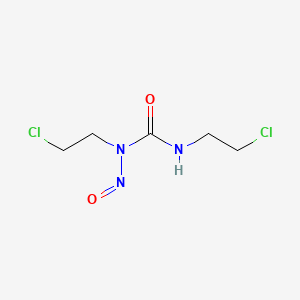
| Formula | C5H9Cl2N3O2 |
|---|---|
| Molecular weight | 214.05 g/mol |
| IUPAC name | 1,3-bis(2-chloroethyl)-1-nitrosourea |
| CAS | 154-93-8 |
| PubChem CID | 2578 |
| InChIKey | DLGOEMSEDOSKAD-UHFFFAOYSA-N |
| logP | 1.16 (XLogP 1.5) |
| Polar surface area | 61.77 Ų |
| H-bond acceptors / donors | 3 / 1 |
| Drug-likeness (QED) | 0.42 |
| Lipinski violations | 0 |
SMILES
O=NN(CCCl)C(=O)NCCClBiology & Pharmacokinetics
Pharmacokinetics
| BBB penetrant | Yes (logBB -0.52) |
|---|
Enzyme interactions
| Enzyme | Role | Detail |
|---|---|---|
| CYP1A2 | Substrate | — |
| CYP2B6 | Substrate | — |
| CYP2C19 | Substrate | — |
| CYP2D6 | Substrate | — |
| CYP3A4 | Substrate | — |
Transporters
BCRP (Inhibitor)BSEP (Inhibitor)BSEP (Inhibitor)MRP1 (Inhibitor)MRP2 (Inhibitor)MRP3 (Inhibitor)MRP4 (Inhibitor)OATP1B1 (Inhibitor)OATP1B3 (Inhibitor)P-gp (Inhibitor)P-gp (Substrate)
Drug–drug interactions (100+, DDInter)
| Interacting drug | Severity | Management |
|---|---|---|
| Adalimumab | major | |
| Bacillus calmette-guerin substrain tice live antigen | major | |
| Baricitinib | major | |
| Certolizumab pegol | major | |
| Cimetidine | major | |
| Cladribine | major | |
| Clozapine | major | |
| Deferiprone | major | |
| Etanercept | major | |
| Fingolimod | major | |
| Golimumab | major | |
| Infliximab | major | |
| Leflunomide | major | |
| Lomitapide | major | |
| Measles virus vaccine live attenuated | major | |
| Mipomersen | major | |
| Mumps virus strain B level jeryl lynn live antigen | major | |
| Nalidixic acid | major | |
| Natalizumab | major | |
| Ozanimod | major | |
| Pexidartinib | major | |
| Rotavirus vaccine | major | |
| Rubella virus vaccine | major | |
| Samarium (153Sm) lexidronam | major | |
| Siponimod | major | |
| Smallpox (Vaccinia) Vaccine, Live | major | |
| Talimogene laherparepvec | major | |
| Teriflunomide | major | |
| Thalidomide | major | |
| Thiotepa | major | |
| Tofacitinib | major | |
| Typhoid vaccine (live) | major | |
| Upadacitinib | major | |
| Varicella Zoster Vaccine (Recombinant) | major | |
| Yellow Fever Vaccine | major | |
| Aldesleukin | moderate | |
| Alefacept | moderate | |
| Alemtuzumab | moderate | |
| Anakinra | moderate | |
| Anthrax vaccine | moderate |
Showing 40 of 100+.
Registered Products (1)
| Brand | Form / strength | Pack | Agent | Citizen (JOD) |
|---|---|---|---|---|
| CARMUSTINE | Vial 100 mg | one vial | Baider International Drug Store | — |