Capecitabine
Active form: Fluorouracil.
JFDA label: Dirogit 500mg F.C tab
- Warfarin interaction:
Mechanism of Action
Inhibitor of Thymidylate synthase — Thymidylate synthase inhibitor; Inhibitor of DNA — DNA inhibitor; Inhibitor of RNA — RNA inhibitor
| Target | Action | Gene / class |
|---|---|---|
| DNA efficacy | INHIBITOR | |
| RNA efficacy | INHIBITOR | |
| Thymidylate synthase efficacy | INHIBITOR | TYMS |
Indications
Approved
- Breast cancer (metastatic)
- Colorectal cancer
- Combination therapy
- Monotherapy
Off-label
- Anal carcinoma
- Breast cancer (adjuvant therapy)
- Esophageal and gastric cancers
- Hepatobiliary cancer (adjuvant therapy)
- Hepatobiliary cancers (advanced)
- Neuroendocrine (islet cell) tumors (metastatic or unresectable)
- Ovarian, fallopian tube, or peritoneal cancers (refractory)
- Pancreatic cancer (adjuvant therapy)
- Pancreatic cancer (locally advanced or metastatic)
- Unknown primary cancer
Class profile
| mechanismClass | Antimetabolite (5-FU prodrug, oral) |
|---|---|
| targetMolecule | Thymidylate synthase |
| targetPathway | Pyrimidine synthesis |
| generation | Oral 5-FU prodrug |
| primaryTumors | Colorectal,Breast,Gastric |
| resistanceMechanisms | Same as 5-FU (TS overexpression,DPYD); also TP downregulation (activation step) |
| source | NCCN/OncoKB/Goodman&Gilman13ed |
Contraindications
Source: Lexicomp
- Additional contraindications (not in the US labeling): Known complete absence of dihydropyrimidine dehydrogenase (DPD) activity Absolute
- Known hypersensitivity to capecitabine, fluorouracil, or any component of the formulation Absolute
- concomitant administration with sorivudine or chemically related analogues (eg, brivudine) Absolute
- severe renal impairment (CrCl Absolute
Adverse Reactions
Cardiac disorders (4)
Very Common Edema
Common atrial fibrillation, peripheral sensory neuropathy, headache, insomnia, dizziness, ataxia, skin discoloration, skin rash, alopecia, erythema, dermal ulcer, hot flash, GI inflammation, oral discomfort, · chest pain · Venous thrombosis
Nervous system disorders (3)
Very Common Fatigue · pain · paresthesia
Hepatobiliary disorders (1)
Very Common Hyperbilirubinemia
Blood and lymphatic system disorders (4)
Very Common anemia · Lymphocytopenia · neutropenia · thrombocytopenia
Gastrointestinal disorders (8)
Very Common abdominal pain · anorexia · constipation · decreased appetite · Diarrhea · nausea · stomatitis · vomiting
Skin and subcutaneous tissue disorders (2)
Very Common dermatitis · Palmar-plantar erythrodysesthesia
Musculoskeletal and connective tissue disorders (6)
Very Common Weakness
Common arthralgia · Back pain · limb pain · myalgia · tremor, conjunctivitis, keratoconjunctivitis, chest mass (
Eye disorders (1)
Very Common Eye irritation
General disorders and administration site conditions (1)
Very Common Fever
Dosing
Source: Lexicomp
Warnings & Precautions
Source: Lexicomp
Bone marrow suppression
Bone marrow suppression may occur, hematologic toxicity is more common when used in combination therapy; use with caution; dosage adjustments may be required. The product labeling recommends that patients with baseline platelets 3 and/or neutrophils 3 not receive capecitabine therapy and also to withhold therapy for grade 3 or 4 hematologic toxicity during treatment.
Cardiotoxicity
Cardiotoxicity has been observed with capecitabine, including myocardial infarction, ischemia, angina, dysrhythmias, cardiac arrest, cardiac failure, sudden death, ECG changes, and cardiomyopathy. These adverse events may be more common in patients with a history of coronary artery disease. In a scientific statement from the American Heart Association, capecitabine has been determined to be an agent that may either cause reversible direct myocardial toxicity or exacerbate underlying myocardial dysfunction (magnitude: moderate/major) (AHA [Page 2016]).
Dermatologic toxicity
Stevens-Johnson syndrome and toxic epidermal necrolysis (TEN) have been reported (some fatal); permanently discontinue capecitabine if a severe dermatologic or mucocutaneous reaction occurs.
Gastrointestinal toxicity
May cause diarrhea (may be severe); median time to first occurrence of grade 2 to 4 diarrhea was 34 days and median duration of grades 3 or 4 diarrhea was 5 days. Withhold treatment for grades 2 to 4 diarrhea; subsequent doses should be reduced after grade 3 or 4 diarrhea or recurrence of grade 2 diarrhea. Antidiarrheal therapy (eg, loperamide) is recommended. Dehydration may occur rapidly in patients with diarrhea, nausea, vomiting, anorexia, and/or weakness; adequately hydrate prior to treatment initiation. Elderly patients may be at higher risk for dehydration. Interrupt treatment for grade 2 or higher dehydration; correct precipitating factors and ensure rehydration prior to resuming therapy; may require dose modification (based on precipitating factor). Necrotizing enterocolitis (typhlitis) has been reported.
Hand-and-foot syndrome
May cause hand-and-foot syndrome (palmar-plantar erythrodysesthesia or chemotherapy-induced acral erythema); characterized by numbness, dysesthesia/paresthesia, tingling, painless or painful swelling, erythema, desquamation, blistering, and severe pain. The median onset is 79 days (range: 11 to 360 days). Persistent hand-and-foot syndrome (grade 2 and higher) could eventually lead to fingerprint loss. If grade 2 or 3 hand-and-foot syndrome occurs, interrupt administration of capecitabine until the event resolves or decreases in intensity to grade 1. Following grade 3 hand-and-foot syndrome, decrease subsequent doses of therapy.
Hepatotoxicity
Grade 3 and 4 hyperbilirubinemia have been observed in patients with and without hepatic metastases at baseline (median onset: 64 days). Transaminase and alkaline phosphatase elevations have also been reported. If capecitabine-related grade 3 or 4 hyperbilirubinemia occurs, interrupt treatment until bilirubin ≤3 times ULN. Bilirubin elevations may also require dose reductions. Disease-related concerns:
Dihydropyrimidine dehydrogenase deficiency
Patients with certain homozygous or heterozygous mutations of the dihydropyrimidine dehydrogenase (DPD) enzyme are at increased risk for acute early-onset (potentially severe, life-threatening, or fatal) toxicity due to total or near total absence of DPD activity. Toxicity may include mucositis/stomatitis, diarrhea, neutropenia, and neurotoxicity. Patients with partial DPD activity are also at risk for severe, life-threatening, or fatal toxicity. May require therapy interruption or permanent discontinuation, depending on the onset, duration, and severity of toxicity observed. No capecitabine dose has been shown to be safe in patients with complete DPD deficiency; data is insufficient to recommend a dose in patients with partial DPD activity.
Hepatic impairment
Use with caution in patients with mild to moderate hepatic impairment due to liver metastases. The effect of severe hepatic impairment has not been studied.
Renal impairment
Dehydration may occur, resulting in acute renal failure (may be fatal); concomitant use with nephrotoxic agents and baseline renal dysfunction may increase the risk. Use with caution in patients with mild to moderate renal impairment; reduce dose with moderate impairment (exposure to capecitabine and metabolites is increased) and carefully monitor and reduce subsequent dose (with any grade 2 or higher adverse effect) with mild to moderate impairment. Use is contraindicated in severe impairment. Concurrent drug therapy issues:
Drug-drug interactions
Potentially significant interactions may exist, requiring dose or frequency adjustment, additional monitoring, and/or selection of alternative therapy. Consult drug interactions database for more detailed information.
Fluorouracil/leucovorin (FU/LV)
In patients with colorectal cancer, treatment with capecitabine immediately following 6 weeks of FU/LV therapy has been associated with an increased incidence of grade ≥3 toxicity, when compared to patients receiving the reverse sequence, capecitabine (two 3-week courses) followed by FU/LV (Hennig 2008).
Proton pump inhibitors
Concomitant use of proton pump inhibitors and capecitabine may alter capecitabine dissolution and absorption due to higher gastric pH levels. Secondary analysis of a large phase III study comparing capecitabine and oxaliplatin with or without lapatinib for the treatment of gastroesophageal cancer showed decreased overall survival in patients who received concurrent proton pump inhibitors (Chu 2017). Consider avoiding proton pump inhibitors (if possible) in patients receiving capecitabine.
Warfarin
Capecitabine may increase the anticoagulant effects of warfarin; bleeding events, including death, have occurred with concomitant use. Clinically significant increases in prothrombin time (PT) and INR have occurred within several days to months after capecitabine initiation (in patients previously stabilized on anticoagulants), and may continue up to 1 month after capecitabine discontinuation. May occur in patients with or without liver metastases. Monitor PT and INR frequently and adjust anticoagulation dosing accordingly. An increased risk of coagulopathy is correlated with a cancer diagnosis and age >60 years. Special populations:
Elderly
Use with caution in patients ≥60 years of age; the incidence of treatment-related adverse events may be higher. Other warnings/precautions:
Fluoropyrimidine overdose
Uridine triacetate (formerly called vistonuridine), has been studied in cases of fluoropyrimidine overdose. In a clinical study of 98 patients who received uridine triacetate for fluorouracil toxicity (due to overdose, accidental capecitabine ingestion, or possible DPD deficiency), 96 patients recovered fully (Bamat 2013). Of 17 patients receiving uridine triacetate beginning within 8 to 96 hours after fluorouracil overdose, all patients fully recovered (von Borstel 2009). An additional case report describes accidental capecitabine ingestion by a 22-month-old child; uridine triacetate was initiated approximately 7 hours after exposure. The patient received uridine triacetate every 6 hours for a total of 20 doses through nasogastric tube administration; he was asymptomatic throughout his course and was discharged with normal laboratory values (Kanie 2011). Refer to Uridine Triacetate monograph.
Pregnancy & Lactation
Pregnancy
Based on animal reproduction studies and its mechanism of action, fetal harm may occur if capecitabine is administered during pregnancy. Pregnancy testing is recommended prior to therapy initiation. Women of reproductive potential should use effective contraception during treatment and for 6 months after the last dose. Males with female partners of reproductive potential should use effective contraception during treatment and for 3 months after the last dose.
Lactation
It is not known if capecitabine is present in breast milk. Due to the potential for serious adverse reactions in the breastfed infant, breast-feeding is not recommended by the manufacturer during treatment and for 2 weeks after the last dose.
Monitoring
| Efficacy | Tumour response (RECIST criteria, tumour markers, imaging); progression-free survival; performance status (ECOG/Karnofsky) |
|---|---|
| Toxicity | CBC with differential (nadir timing depends on agent); LFTs; renal function; ECG (QT for relevant agents); echocardiogram for cardiotoxic agents (anthracyclines, trastuzumab); cumulative dose tracking for dose-limited toxicities |
| Clinical pearl | Treatment response is assessed after 2–3 cycles. Grade 3–4 toxicities typically require dose reduction or interruption per protocol-defined criteria. |
| Counseling | Attend all scheduled blood tests and imaging appointments. Report fever > 38°C (risk of neutropaenic sepsis — medical emergency), unusual bleeding, or new pain immediately. |
Chemistry & Properties
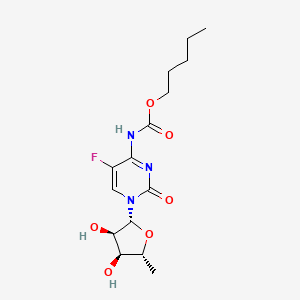
| Formula | C15H22FN3O6 |
|---|---|
| Molecular weight | 359.35 g/mol |
| IUPAC name | pentyl N-[1-[(2R,3R,4S,5R)-3,4-dihydroxy-5-methyloxolan-2-yl]-5-fluoro-2-oxopyrimidin-4-yl]carbamate |
| CAS | 154361-50-9 |
| PubChem CID | 60953 |
| InChIKey | GAGWJHPBXLXJQN-UORFTKCHSA-N |
| logP | 0.76 (XLogP 0.6) |
| Polar surface area | 122.91 Ų |
| H-bond acceptors / donors | 8 / 3 |
| Drug-likeness (QED) | 0.64 |
| Lipinski violations | 0 |
SMILES
CCCCCOC(=O)Nc1nc(=O)n([C@@H]2O[C@H](C)[C@@H](O)[C@H]2O)cc1FBiology & Pharmacokinetics
Pharmacokinetics
| BBB penetrant | Yes |
|---|
Enzyme interactions
| Enzyme | Role | Detail |
|---|---|---|
| CYP2B6 | Inhibitor | — |
Transporters
BCRP (Inhibitor)BSEP (Inhibitor)CNT1 (Inhibitor)CNT2 (Inhibitor)MRP1 (Inhibitor)OATP1B1 (Inhibitor)OATP1B3 (Inhibitor)P-gp (Inhibitor)P-gp (Substrate)
Drug–drug interactions (100+, DDInter)
| Interacting drug | Severity | Management |
|---|---|---|
| Adalimumab | major | |
| Anisindione | major | |
| Bacillus calmette-guerin substrain tice live antigen | major | |
| Baricitinib | major | |
| Certolizumab pegol | major | |
| Cladribine | major | |
| Clozapine | major | |
| Deferiprone | major | |
| Dicoumarol | major | |
| Etanercept | major | |
| Fingolimod | major | |
| Folic acid | major | |
| Golimumab | major | |
| Infliximab | major | |
| Leflunomide | major | |
| Leucovorin | major | |
| Levoleucovorin | major | |
| Levomefolic acid | major | |
| Levomefolic acid (calcium) | major | |
| Measles virus vaccine live attenuated | major | |
| Mumps virus strain B level jeryl lynn live antigen | major | |
| Natalizumab | major | |
| Ozanimod | major | |
| Rotavirus vaccine | major | |
| Rubella virus vaccine | major | |
| Samarium (153Sm) lexidronam | major | |
| Siponimod | major | |
| Smallpox (Vaccinia) Vaccine, Live | major | |
| Talimogene laherparepvec | major | |
| Teriflunomide | major | |
| Thalidomide | major | |
| Tofacitinib | major | |
| Typhoid vaccine (live) | major | |
| Upadacitinib | major | |
| Varicella Zoster Vaccine (Recombinant) | major | |
| Warfarin | major | |
| Yellow Fever Vaccine | major | |
| Aldesleukin | moderate | |
| Alefacept | moderate | |
| Alemtuzumab | moderate |
Showing 40 of 100+.
Registered Products (7)
| Brand | Form / strength | Pack | Agent | Citizen (JOD) |
|---|---|---|---|---|
| CAPETERO 500 | Tablet 500 mg | 120 tab | Omicron Pharma | 88.040 |
| Aceda (Capecitabine) 500mg F.C Tab | Film-Coated Tablet 500 mg | 120 tab | شركة مستودع ادوية جرينلاند | 111.300 |
| Caxeta | Tablet 500 mg | 120 tab | Reda Jardaneh Drug Store | 111.300 |
| Kapetral | Tablet 500 mg | 120 tab | JAWEDA INT. DRUD STORE | 111.300 |
| Cabitex | Tablet 500 mg | 120 tab | MS PHARMA/JORDAN | 123.600 |
| Dirogit 500mg F.C tab | Film-Coated Tablet 500 mg | 120 tab | Hikma Pharmaceuticals Co.Ltd/Jordan | — |
| Xeloda Tablet | Tablet 500 mg | 120 tab | Shawi & Rushedat Drug Store | — |