Carboplatin
JFDA label: Neoplatin Vial
- Experienced physician:
- Bone marrow suppression:
- Vomiting:
- Hypersensitivity reactions:
- Vomiting
Mechanism of Action
Inhibitor of DNA — DNA inhibitor
| Target | Action | Gene / class |
|---|---|---|
| DNA efficacy | INHIBITOR |
Indications
Approved
- Ovarian cancer, advanced
Off-label
- Anal cancer (advanced)
- Bladder cancer
- Breast cancer (metastatic)
- CNS tumors (pediatric)
- Cervical cancer (recurrent or metastatic)
- Endometrial cancer
- Esophageal cancer
- Gastric cancer
- Head and neck cancer
- Hematopoietic stem cell transplant (adults)
- Hematopoietic stem cell transplant (pediatric)
- Hodgkin lymphoma (relapsed or refractory)
- Malignant pleural mesothelioma
- Melanoma (advanced or metastatic)
- Merkel cell carcinoma
- Neuroendocrine tumors, advanced, atypical or poorly differentiated (nonpulmonary)
- Non-Hodgkin lymphomas (relapsed or refractory)
- Non-small cell lung cancer
- Retinoblastoma
- Sarcomas (Ewing sarcoma and osteosarcoma)
- Small cell lung cancer
- Testicular cancer
- Thymic malignancies
- Thyroid cancer (anaplastic), advanced
- Unknown primary adenocarcinoma
- Wilms tumor (pediatric)
Class profile
| mechanismClass | Platinum compound |
|---|---|
| targetMolecule | DNA (intrastrand cross-links) |
| targetPathway | DNA damage response/apoptosis |
| generation | 2nd generation platinum |
| primaryTumors | Ovarian,Lung,Head and neck,Testicular |
| resistanceMechanisms | Cross-resistance with cisplatin (shared NER mechanism),ERCC1 overexpression |
| source | NCCN/OncoKB/Goodman&Gilman13ed |
Contraindications
Source: Lexicomp
- History of severe allergic reaction to carboplatin, cisplatin, other platinum-containing formulations, mannitol, or any component of the formulation Absolute
- should not be used in patients with severe bone marrow depression or significant bleeding Absolute
Adverse Reactions
Nervous system disorders (3)
Very Common Pain
Common neurotoxicity · Peripheral neuropathy
Hepatobiliary disorders (3)
Very Common Increased serum alkaline phosphatase · increased serum AST
Common Increased serum bilirubin
Renal and urinary disorders (3)
Very Common Decreased creatinine clearance · increased blood urea nitrogen
Common Increased serum creatinine
Blood and lymphatic system disorders (7)
Very Common anemia · Bone marrow depression (dose related and dose limiting; nadir at ~21 days with single-agent therapy) · leukopenia · neutropenia · thrombocytopenia
Common Bleeding complications · hemorrhage
Immune system disorders (1)
Very Common Hypersensitivity
Metabolism and nutrition disorders (4)
Very Common hypocalcemia · hypokalemia · hypomagnesemia · Hyponatremia
Gastrointestinal disorders (7)
Very Common abdominal pain · nausea
Common Constipation · diarrhea · dysgeusia · mucositis · stomatitis
Skin and subcutaneous tissue disorders (1)
Common Alopecia
Musculoskeletal and connective tissue disorders (1)
Very Common Weakness
Eye disorders (1)
Common Visual disturbance
Ear and labyrinth disorders (1)
Common Ototoxicity
Infections and infestations (1)
Common Infection
Dosing
Source: Lexicomp
Warnings & Precautions
Source: Lexicomp
Bone marrow suppression
Bone marrow suppression, which may be severe, is dose related; may result in infection (due to neutropenia) or bleeding (due to thrombocytopenia); anemia may require blood transfusion. Reduce dosage in patients with bone marrow suppression; cycles should be delayed until WBC and platelet counts have recovered. In patients receiving single agent carboplatin, the median nadir typically occurs at day 21. Patients who have received prior myelosuppressive therapy and patients with renal dysfunction are at increased risk for bone marrow suppression. Anemia is cumulative. Monitor blood counts closely.
GI toxicity
Vomiting may occur. Carboplatin is associated with a moderate to high emetic potential in adult patients (dose dependent) and a high emetic potential in pediatric patients; antiemetics are recommended to prevent nausea and vomiting (Dupuis 2011; Hesketh 2017; Roila 2016). Nausea and vomiting may be more severe in patients who have received prior emetogenic therapy.
Hypersensitivity/anaphylactoid reactions
Anaphylactic-like reactions have been reported with carboplatin; may occur within minutes of administration. Epinephrine, corticosteroids, and antihistamines have been used to treat symptoms. The risk of allergic reactions (including anaphylaxis) is increased in patients previously exposed to platinum therapy. Skin testing and desensitization protocols have been reported (Confina-Cohen 2005; Lee 2004; Markman 2003).
Liver function abnormalities
High doses (>4 times the recommended dose) have resulted in severe abnormalities of liver function tests.
Neurotoxicity
Although peripheral neuropathy occurs infrequently, the incidence of peripheral neuropathy is increased in patients >65 years of age and those who have previously received cisplatin treatment.
Ototoxicity
Ototoxicity may occur when administered concomitantly with aminoglycosides. Clinically significant hearing loss has been reported to occur in pediatric patients when therapy was administered at higher-than-recommended doses in combination with other ototoxic agents (eg, aminoglycosides). In a study of children receiving carboplatin for the treatment of retinoblastoma, those • Renal toxicity: Carboplatin has a limited potential for nephrotoxicity unless administered concomitantly with aminoglycosides. Use caution with concomitant administration with aminoglycosides or other nephrotoxic medications.
Vision loss
Loss of vision (usually reversible within weeks of discontinuing) has been reported with higher-than-recommended doses. Disease-related concerns:
Renal impairment
Use with caution in patients with renal impairment; patients with renal dysfunction are at increased risk for bone marrow suppression. Concurrent drug therapy issues:
Drug-drug interactions
Potentially significant interactions may exist, requiring dose or frequency adjustment, additional monitoring, and/or selection of alternative therapy. Consult drug interactions database for more detailed information.
Taxane derivatives
When administered as sequential infusions, taxane derivatives (docetaxel, paclitaxel) should be administered before the platinum derivatives (carboplatin, cisplatin) to limit myelosuppression and to enhance efficacy. Special populations:
Elderly
Patients >65 years of age are more likely to develop thrombocytopenia (severe) and peripheral neuropathy. Other warnings/precautions:
Dosing with Calvert formula
When calculating the carboplatin dose using the Calvert formula and an eGFR, the laboratory method used to measure serum creatinine may impact dosing. Compared to other methods, standardized isotope dilution mass spectrometry (IDMS) may underestimate serum creatinine values in patients with low creatinine values (eg, ≤0.7 mg/dL) and may overestimate GFR in patients with normal renal function. This may result in higher calculated carboplatin doses and increased toxicities. If using IDMS, the FDA recommends that clinicians consider capping estimated GFR at a maximum of 125 mL/minute to avoid potential toxicity.
Experienced physician
Should be administered under the supervision of an experienced cancer chemotherapy physician.
Pregnancy & Lactation
Pregnancy
Adverse events have been observed in animal reproduction studies. May cause fetal harm if administered during pregnancy. Women of childbearing potential should avoid becoming pregnant during treatment.
Lactation
It is not known if carboplatin is present in breast milk. Due to the potential for toxicity in the breasfed infant, the manufacturer recommends discontinuing breastfeeding during carboplatin treatment.
Monitoring
| Efficacy | Tumour response (RECIST criteria, tumour markers, imaging); progression-free survival; performance status (ECOG/Karnofsky) |
|---|---|
| Toxicity | CBC with differential (nadir timing depends on agent); LFTs; renal function; ECG (QT for relevant agents); echocardiogram for cardiotoxic agents (anthracyclines, trastuzumab); cumulative dose tracking for dose-limited toxicities |
| Clinical pearl | Treatment response is assessed after 2–3 cycles. Grade 3–4 toxicities typically require dose reduction or interruption per protocol-defined criteria. |
| Counseling | Attend all scheduled blood tests and imaging appointments. Report fever > 38°C (risk of neutropaenic sepsis — medical emergency), unusual bleeding, or new pain immediately. |
Chemistry & Properties
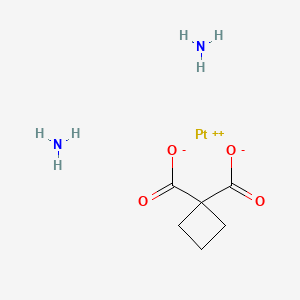
| Formula | C6H12N2O4Pt |
|---|---|
| Molecular weight | 371.25 g/mol |
| IUPAC name | azane;cyclobutane-1,1-dicarboxylate;platinum(2+) |
| CAS | 41575-94-4 |
| PubChem CID | 10339178 |
Biology & Pharmacokinetics
Pharmacokinetics predicted
| Bioavailability | 10.0% |
|---|---|
| Half-life | 1.489 h |
| Volume of distribution | 0.638 L/kg |
| Protein binding | 20.5% |
| BBB penetrant | No |
Enzyme interactions
| Enzyme | Role | Detail |
|---|---|---|
| CYP2C19 | Inhibitor | — |
| CYP2C9 | Inhibitor | — |
Transporters
BCRP (Inhibitor)BSEP (Inhibitor)MRP1 (Inhibitor)OATP1B1 (Inhibitor)OATP1B1 (Inhibitor)OATP1B3 (Inhibitor)OATP1B3 (Inhibitor)OCT1 (Inhibitor)P-gp (Inhibitor)BCRP (Substrate)MRP2 (Substrate)OATP1B3 (Substrate)OCT2 (Substrate)OCT3 (Substrate)P-gp (Substrate)
Drug–drug interactions (100+, DDInter)
| Interacting drug | Severity | Management |
|---|---|---|
| Adalimumab | major | |
| Bacillus calmette-guerin substrain tice live antigen | major | |
| Baricitinib | major | |
| Certolizumab pegol | major | |
| Cidofovir | major | |
| Cladribine | major | |
| Clozapine | major | |
| Deferiprone | major | |
| Etanercept | major | |
| Fingolimod | major | |
| Golimumab | major | |
| Infliximab | major | |
| Inotersen | major | |
| Leflunomide | major | |
| Measles virus vaccine live attenuated | major | |
| Mumps virus strain B level jeryl lynn live antigen | major | |
| Natalizumab | major | |
| Ozanimod | major | |
| Rotavirus vaccine | major | |
| Rubella virus vaccine | major | |
| Samarium (153Sm) lexidronam | major | |
| Siponimod | major | |
| Smallpox (Vaccinia) Vaccine, Live | major | |
| Sorafenib | major | |
| Talimogene laherparepvec | major | |
| Teriflunomide | major | |
| Thalidomide | major | |
| Thiotepa | major | |
| Tofacitinib | major | |
| Topotecan | major | |
| Typhoid vaccine (live) | major | |
| Upadacitinib | major | |
| Varicella Zoster Vaccine (Recombinant) | major | |
| Yellow Fever Vaccine | major | |
| Aldesleukin | moderate | |
| Alefacept | moderate | |
| Alemtuzumab | moderate | |
| Amikacin | moderate | |
| Amikacin (liposome) | moderate | |
| Amiodarone | moderate |
Showing 40 of 100+.
Registered Products (15)
| Brand | Form / strength | Pack | Agent | Citizen (JOD) |
|---|---|---|---|---|
| ADCARB | Vial 150 mg/15 ml | 1 vial | Ibn Rushd Drug Store | — |
| Adcarb | Vial 450 mg/45 ml | 1 vial | Beta Drugs Ltd | — |
| Carboplan Solution For Infusion | Infusion 450 mg/45 ml | 1 vial | Manar Drug Store | — |
| Carboplan Solution For Infusion 150mg/15 Vial | Infusion 150 mg/15 ml | 1 vial | Manar Drug Store | — |
| Carboplatin Vial | Vial 450 mg/45 ml | 1 vial | Petra Drug Store | — |
| Carboplatin Vial | Vial 10 mg/ml | 1 vial | Petra Drug Store | — |
| Carboplatin Vial | Vial 50 mg/5 ml | 1 vial | Petra Drug Store | — |
| KARBOTEEN | Vial 450 mg/45 ml | 1 vial | Hikma Pharmaceuticals Co.Ltd/Jordan | — |
| Karboteen | Vial 150 mg/15 ml | 1 vial | Hikma Pharmaceuticals Co.Ltd/Jordan | — |
| Kemocarb Inj | Injection 10 mg/ml | 15 ml pack varies | Sun Set Drug Store | — |
| Kemocarb Inj | Injection 10 mg/ml | 45 ml pack varies | Sun Set Drug Store | — |
| Megaplatin Vial | Vial 150 mg/15 ml | 1 vial | Orient Montreal Drug Store | — |
| Neoplatin Injection | Injection 150 mg/15 ml | 15 ml | Ibn Rushd Drug Store | — |
| Neoplatin Injection | Injection 50 mg/5 ml | 5 ml | Ibn Rushd Drug Store | — |
| Neoplatin Vial | Vial 450 mg/45 mg | 45 ml | Ibn Rushd Drug Store | — |