Azacitidine
Active form: 5-Aza-Ctp.
JFDA label: Vidaza 100mg
Mechanism of Action
Inhibitor of DNA (cytosine-5)-methyltransferase 3A — DNA (cytosine-5)-methyltransferase 3A inhibitor; Inhibitor of DNA (cytosine-5)-methyltransferase 1 — DNA (cytosine-5)-methyltransferase 1 inhibitor; Inhibitor of DNA — DNA inhibitor; Inhibitor of RNA — RNA inhibitor
| Target | Action | Gene / class |
|---|---|---|
| DNA efficacy | INHIBITOR | |
| DNA (cytosine-5)-methyltransferase 1 efficacy | INHIBITOR | DNMT1 |
| DNA (cytosine-5)-methyltransferase 3A efficacy | INHIBITOR | DNMT3A |
| RNA efficacy | INHIBITOR |
Indications
Approved
- Myelodysplastic syndromes
Off-label
- Acute myeloid leukemia (AML) in patients requiring low-intensity therapy
Contraindications
Source: Lexicomp
- Hypersensitivity to azacitidine, mannitol, or any component of the formulation Absolute
- advanced malignant hepatic tumors Absolute
Adverse Reactions
Cardiac disorders (8)
Very Common chest pain · Peripheral edema
Common chest wall pain · Heart murmur · hypertension · hypotension · syncope · tachycardia
Nervous system disorders (12)
Very Common anxiety · depression · dizziness · Fatigue · headache · insomnia · malaise · pain · rigors
Common hypoesthesia · Lethargy · postoperative pain
Renal and urinary disorders (3)
Common dysuria · hematuria · Urinary tract infection
Blood and lymphatic system disorders (13)
Very Common anemia · bone marrow depression (nadir: days 10 to 17; recovery: days 28 to 31) · bruise · febrile neutropenia · leukopenia · neutropenia · petechia · Thrombocytopenia
Common hematoma · Lymphadenopathy · oral hemorrhage · oral mucosal petechiae · postprocedural hemorrhage
Immune system disorders (1)
Common Transfusion reaction
Metabolism and nutrition disorders (3)
Very Common hypokalemia · pitting edema · Weight loss
Gastrointestinal disorders (15)
Very Common abdominal pain · abdominal tenderness · anorexia · constipation · diarrhea · Nausea · vomiting
Common abdominal distention · dyspepsia · dysphagia · Gingival hemorrhage · hemorrhoids · loose stools · stomatitis · tongue ulcer
Skin and subcutaneous tissue disorders (12)
Very Common diaphoresis · Erythema · pallor · pruritus · skin lesion · skin rash
Common cellulitis · Night sweats · rash at injection site · skin nodules · urticaria · xeroderma
Musculoskeletal and connective tissue disorders (6)
Very Common arthralgia · back pain · limb pain · myalgia · Weakness
Common Muscle cramps
Infections and infestations (1)
Common Herpes simplex infection
General disorders and administration site conditions (11)
Very Common bruising · Fever · Injection site reactions: Erythema
Common hematoma at injection site · herpes simplex · induration at injection site · injection site granuloma · Itching at injection site · mouth hemorrhage · skin discoloration at injection site · swelling at injection site
Respiratory, thoracic and mediastinal disorders (19)
Very Common Cough · dyspnea · epistaxis · nasopharyngitis · pharyngitis · pneumonia · rales · upper respiratory infection
Common abnormal breath sounds · atelectasis · nasal congestion · pharyngolaryngeal pain · pleural effusion · post nasal drip · rhinitis · Rhinorrhea · rhonchi · sinusitis · wheezing
Dosing
Source: Lexicomp
Warnings & Precautions
Source: Lexicomp
Bone marrow suppression
Neutropenia, thrombocytopenia, and anemia are common; may cause therapy delays and/or dosage reductions. Monitor blood counts prior to each cycle (at a minimum), and as clinically indicated. Adjust dose in subsequent cycles based on nadir counts and hematologic response.
Hepatotoxicity
May cause hepatotoxicity in patients with preexisting hepatic impairment. Progressive hepatic coma leading to death has been reported in patients with extensive tumor burden due to metastatic disease, especially those with a baseline albumin • Gastrointestinal toxicity: Azacitidine is associated with a moderate emetic potential (Dupuis 2011; Hesketh 2017; Roila 2016); antiemetics are recommended to prevent nausea and vomiting.
Injection site reactions
Injection site reactions commonly occurred with subcutaneous administration.
Nephrotoxicity
Renal toxicities, including serum creatinine elevations, renal tubular acidosis (serum bicarbonate decrease to • Tumor lysis syndrome: May cause serious or fatal tumor lysis syndrome (TLS). TLS has occurred in patients despite receiving antihyperuricemic therapy (eg, allopurinol). Assess TLS risk at baseline and monitor for TLS symptoms; treat accordingly. Concurrent drug therapy issues:
Drug-drug interactions
Potentially significant interactions may exist, requiring dose or frequency adjustment, additional monitoring, and/or selection of alternative therapy. Consult drug interactions database for more detailed information. Dosage form specific issues:
Polysorbate 80
Some dosage forms may contain polysorbate 80 (also known as Tweens). Hypersensitivity reactions, usually a delayed reaction, have been reported following exposure to pharmaceutical products containing polysorbate 80 in certain individuals (Isaksson 2002; Lucente 2000; Shelley 1995). Thrombocytopenia, ascites, pulmonary deterioration, and renal and hepatic failure have been reported in premature neonates after receiving parenteral products containing polysorbate 80 (Alade 1986; CDC 1984). See manufacturer’s labeling.
Pregnancy & Lactation
Pregnancy
Adverse events were observed in animal reproduction studies. Based on its mechanism of action, azacitidine may cause fetal harm if administered during pregnancy. Women of childbearing potential should be advised to avoid pregnancy during treatment; verify pregnancy status prior to therapy initiation. In addition, males should be advised to avoid fathering a child while on azacitidine therapy and should use effective contraception during therapy.
Lactation
It is not known if azacitidine is present in breast milk. Due to the potential for serious adverse reactions in the breastfed infant, breastfeeding is not recommended by the manufacturer.
Monitoring
| Clinical pearl | Monitor liver function tests, electrolytes, CBC with differential and platelets, renal function (BUN and serum creatinine) at baseline, prior to each cycle, and more frequently if indicated. Also monitor for hematologic response, nausea/vomiting, and for injection site reactions. |
|---|
Chemistry & Properties
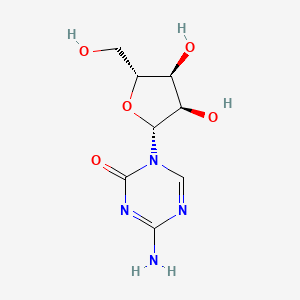
| Formula | C8H12N4O5 |
|---|---|
| Molecular weight | 244.21 g/mol |
| IUPAC name | 4-amino-1-[(2R,3R,4S,5R)-3,4-dihydroxy-5-(hydroxymethyl)oxolan-2-yl]-1,3,5-triazin-2-one |
| CAS | 320-67-2 |
| PubChem CID | 9444 |
| InChIKey | NMUSYJAQQFHJEW-KVTDHHQDSA-N |
| logP | -3.17 (XLogP -2.2) |
| Polar surface area | 143.72 Ų |
| H-bond acceptors / donors | 9 / 4 |
| Drug-likeness (QED) | 0.43 |
| Lipinski violations | 0 |
SMILES
Nc1ncn([C@@H]2O[C@H](CO)[C@@H](O)[C@H]2O)c(=O)n1Biology & Pharmacokinetics
Pharmacokinetics predicted
| Bioavailability | 35.0% |
|---|---|
| Half-life | 2.237 h |
| Volume of distribution | 0.517 L/kg |
| Protein binding | 30.4% |
| BBB penetrant | No |
Enzyme interactions
| Enzyme | Role | Detail |
|---|---|---|
| CYP3A4 | Substrate | — |
Transporters
BCRP (Inhibitor)BSEP (Inhibitor)MATE1 (Inhibitor)MRP1 (Inhibitor)OATP1B1 (Inhibitor)OATP1B3 (Inhibitor)OATP1B3 (Inhibitor)P-gp (Inhibitor)CNT1 (Substrate)P-gp (Substrate)
Drug–drug interactions (85, DDInter)
| Interacting drug | Severity | Management |
|---|---|---|
| Adalimumab | major | |
| Bacillus calmette-guerin substrain tice live antigen | major | |
| Baricitinib | major | |
| Certolizumab pegol | major | |
| Cladribine | major | |
| Clozapine | major | |
| Deferiprone | major | |
| Etanercept | major | |
| Fingolimod | major | |
| Golimumab | major | |
| Infliximab | major | |
| Leflunomide | major | |
| Measles virus vaccine live attenuated | major | |
| Mumps virus strain B level jeryl lynn live antigen | major | |
| Natalizumab | major | |
| Ozanimod | major | |
| Rotavirus vaccine | major | |
| Rubella virus vaccine | major | |
| Samarium (153Sm) lexidronam | major | |
| Siponimod | major | |
| Smallpox (Vaccinia) Vaccine, Live | major | |
| Talimogene laherparepvec | major | |
| Teriflunomide | major | |
| Thalidomide | major | |
| Tofacitinib | major | |
| Typhoid vaccine (live) | major | |
| Upadacitinib | major | |
| Varicella Zoster Vaccine (Recombinant) | major | |
| Yellow Fever Vaccine | major | |
| Alefacept | moderate | |
| Alemtuzumab | moderate | |
| Anakinra | moderate | |
| Anthrax vaccine | moderate | |
| Azathioprine | moderate | |
| Bifidobacterium longum infantis | moderate | |
| Canakinumab | moderate | |
| Candida albicans | moderate | |
| Cedazuridine | moderate | |
| Chloramphenicol | moderate | |
| Chloramphenicol (ophthalmic) | moderate |
Showing 40 of 85.
Registered Products (3)
| Brand | Form / strength | Pack | Agent | Citizen (JOD) |
|---|---|---|---|---|
| AZACITIDINE NEAPOLIS | Vial Azacitidine 100 mg | 1 vial | Professional Drug Store | — |
| Vidaza | Vial 100 mg | 1 vial | Petra Drug Store | — |
| Zydrome 100mg Lyophilized Powder For injection Vials | Powder for Injection 100 mg | 1 vial | Hikma Pharmaceuticals Co.Ltd/Jordan | — |