Tranexamic Acid
JFDA label: CYKLOKAPRON TABS
Mechanism of Action
Inhibitor of Plasminogen — Plasminogen inhibitor
| Target | Action | Gene / class |
|---|---|---|
| Plasminogen efficacy | INHIBITOR | PLG |
Indications
Approved
- Cyclic heavy menstrual bleeding (oral)
Off-label
- Bleeding associated with dental procedures in patients on oral anticoagulant therapy (topical mouth rinse)
- Bleeding associated with hip fracture surgery (prevention)
- Hereditary angioedema (long-term prophylaxis
- Perioperative blood loss in total hip arthroplasty
- Perioperative blood loss reduction in bilateral total knee arthroplasty
- Perioperative blood loss reduction in unilateral total knee arthroplasty
- Post-operative bleeding associated with cervical conization
- Postpartum hemorrhage
- Reduction of blood loss associated with cesarean delivery
- Trauma-associated hemorrhage
- Traumatic hyphema
- acute treatment)
Contraindications
Source: Lexicomp
- Injection, oral: Hypersensitivity to tranexamic acid or any component of the formulation Absolute
- Injection: Hypersensitivity to tranexamic acid or any component of the formulation Absolute
- acquired defective color vision Absolute
- active intravascular clotting Absolute
- active thromboembolic disease (eg, cerebral thrombosis, DVT, or PE) Absolute
- active thromboembolic disease (eg, deep vein thrombosis, pulmonary embolism, cerebral thrombosis) Absolute
- concurrent use of combination hormonal contraception Absolute
- history of thrombosis or thromboembolism, including retinal vein or retinal artery occlusion Absolute
- history or risk of thrombosis (unless concurrent anticoagulation therapy is possible) Absolute
- intrinsic risk of thrombosis or thromboembolism (eg, hypercoagulopathy, thrombogenic cardiac rhythm disease, thrombogenic valvular disease) Absolute
- subarachnoid hemorrhage Absolute
- subarachnoid hemorrhage Oral: Hypersensitivity to tranexamic acid or any component of the formulation Absolute
Adverse Reactions
Nervous system disorders (2)
Very Common Headache
Common Fatigue
Blood and lymphatic system disorders (1)
Common Anemia
Gastrointestinal disorders (1)
Very Common Abdominal pain
Musculoskeletal and connective tissue disorders (5)
Very Common Back pain · musculoskeletal pain
Common Arthralgia · muscle cramps · muscle spasm
Respiratory, thoracic and mediastinal disorders (1)
Very Common Nasal signs and symptoms
Dosing
Source: Lexicomp
Warnings & Precautions
Source: Lexicomp
CNS depression
May cause CNS depression, which may impair physical or mental abilities; patients must be cautioned about performing tasks which require mental alertness (eg, operating machinery or driving).
Hypersensitivity reactions
Severe hypersensitivity reactions, including anaphylaxis or anaphylactoid reaction have been reported.
Ocular effects
Visual defects (eg, color vision change, visual loss) and retinal venous and arterial occlusions have been reported; discontinue treatment if ocular changes occur; prompt ophthalmic examination should be performed by an ophthalmologist. Use of the injection is contraindicated in patients with acquired defective color vision. Ligneous conjunctivitis has been reported with the oral formulation, but resolved upon discontinuation of therapy.
Seizure
Seizures have been reported with use; most often with intraoperative use (eg, open chamber cardiac surgery) and in older patients (Murkin 2010). The mechanism by which tranexamic acid use results in seizures may be secondary to neuronal gamma aminobutyric acid (GABA) inhibition.
Thrombotic events
Venous and arterial thrombosis or thromboembolism, including central retinal artery/vein obstruction, has been reported. Use the injection with caution in patients with thromboembolic disease; oral formulation is contraindicated in patients with a history of or active thromboembolic disease or with an intrinsic risk of thromboembolic events (eg, thrombogenic valvular disease, thrombogenic cardiac rhythm disease, hypercoagulopathy). Concomitant use with certain procoagulant agents (eg, anti-inhibitor coagulant complex/factor IX complex concentrates, oral tretinoin, hormonal contraceptives) may further increase the risk of thrombosis; concurrent use with either the oral or injectable formulation may be contraindicated, not recommended, or to be used with caution.
Ureteral obstruction
Use the injection with caution in patients with upper urinary tract bleeding, ureteral obstruction due to clot formation has been reported. Disease-related concerns:
Disseminated intravascular coagulation (DIC)
Use with extreme caution in patients with DIC requiring antifibrinolytic therapy; patients should be under strict supervision of a health care provider experienced in treating this disorder.
Renal impairment
Use with caution in patients with renal impairment; dosage modification necessary.
Subarachnoid hemorrhage
Use oral formulation with caution in patients with subarachnoid hemorrhage; cerebral edema and infarction may occur. Use of the injection is contraindicated.
Vascular disease
Use with caution in patients with uncorrected cardiovascular or cerebrovascular disease due to the complications of thrombosis. Concurrent drug therapy issues:
Drug-drug interactions
Potentially significant interactions may exist, requiring dose or frequency adjustment, additional monitoring, and/or selection of alternative therapy. Consult drug interactions database for more detailed information.
Pregnancy & Lactation
Pregnancy
Adverse events have not been observed in animal reproduction studies. Tranexamic acid crosses the placenta and concentrations within cord blood are similar to maternal concentrations. Tranexamic acid has been evaluated for the treatment of postpartum hemorrhage (Ducloy-Bouthors 2011; Gungorduk 2011; WOMAN Trial Collaborators 2017). A significant reduction in risk of death due to bleeding was observed when treatment was started within 3 hours of vaginal birth or cesarean section (WOMAN Trial Collaborators 2017). Oral tranexamic acid (Lysteda) is not indicated for use in pregnant women.
Lactation
Tranexamic acid is present in breast milk. Concentrations are approximately 1/100th of the maximum maternal serum concentration. Breastfeeding is not recommended by the manufacturer.
Monitoring
| Clinical pearl | Ophthalmic examination (visual acuity, color vision, eye-ground, and visual fields) at baseline and regular intervals during the course of therapy in patients being treated for longer than several days; signs/symptoms of hypersensitivity reactions, seizures, thrombotic events, and ureteral obstruction |
|---|
Chemistry & Properties
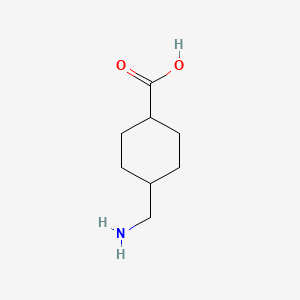
| Formula | C8H15NO2 |
|---|---|
| Molecular weight | 157.21 g/mol |
| IUPAC name | 4-(aminomethyl)cyclohexane-1-carboxylic acid |
| CAS | 701-54-2 |
| PubChem CID | 5526 |
| InChIKey | GYDJEQRTZSCIOI-LJGSYFOKSA-N |
| logP | 0.84 (XLogP -2.0) |
| Polar surface area | 63.32 Ų |
| H-bond acceptors / donors | 2 / 2 |
| Drug-likeness (QED) | 0.62 |
| Lipinski violations | 0 |
SMILES
NC[C@H]1CC[C@H](C(=O)O)CC1Biology & Pharmacokinetics
Pharmacokinetics predicted
| Bioavailability | 70.0% |
|---|---|
| Half-life | 1.828 h |
| Volume of distribution | 0.394 L/kg |
| Protein binding | 3.1% |
| BBB penetrant | No |
Enzyme interactions
| Enzyme | Role | Detail |
|---|---|---|
| CYP2C9 | Substrate | — |
Transporters
BCRP (Inhibitor)BSEP (Inhibitor)MRP1 (Inhibitor)OATP1B1 (Inhibitor)OATP1B1 (Inhibitor)OATP1B3 (Inhibitor)OATP1B3 (Inhibitor)OCT1 (Inhibitor)P-gp (Inhibitor)P-gp (Substrate)
Drug–drug interactions (34, DDInter)
| Interacting drug | Severity | Management |
|---|---|---|
| Anti-inhibitor coagulant complex | major | |
| Carfilzomib | major | |
| Conjugated estrogens | major | |
| Conjugated estrogens (topical) | major | |
| Dienestrol (topical) | major | |
| Diethylstilbestrol | major | |
| Drospirenone | major | |
| Esterified estrogens | major | |
| Estradiol | major | |
| Estradiol (topical) | major | |
| Estramustine | major | |
| Estrone | major | |
| Estrone sulfate | major | |
| Estrone sulfate (topical) | major | |
| Ethinylestradiol | major | |
| Etonogestrel | major | |
| Factor IX Complex (Human) | major | |
| Levonorgestrel | major | |
| Medroxyprogesterone acetate | major | |
| Norethisterone | major | |
| Norgestrel | major | |
| Ospemifene | major | |
| Quinestrol | major | |
| Raloxifene | major | |
| Tamoxifen | major | |
| Toremifene | major | |
| Tretinoin | major | |
| Alteplase | moderate | |
| Anistreplase | moderate | |
| Reteplase | moderate | |
| Streptokinase | moderate | |
| Tenecteplase | moderate | |
| Urokinase | moderate | |
| Ticagrelor | minor |
Registered Products (2)
| Brand | Form / strength | Pack | Agent | Citizen (JOD) |
|---|---|---|---|---|
| CYKLOKAPRON TABS | Tablet 500 mg | 50 tab | Khoury Drug Store | 7.150 |
| Xenamex 500mg/5ml Solution for Injection | Injection 500 mg/5 ml | 10 vial | MS PHARMA/JORDAN | — |