Tretinoin
JFDA label: Vesanoid Cap
- hematological toxicity — ChEMBL drug_warning (Black Box Warning) | United States
- teratogenicity — ChEMBL drug_warning (Black Box Warning) | United States
- carcinogenicity — ChEMBL drug_warning (Black Box Warning) | United States
- EMBRYO-FETAL TOXICITY and DIFFERENTIATION SYNDROME • Tretinoin capsules can cause embryo-fetal loss and malformations when administered to a pregnant woman. Advise pregnant women of the potential risk
Mechanism of Action
Agonist of Retinoic acid receptor — Retinoic acid receptor agonist
| Target | Action | Gene / class |
|---|---|---|
| Retinoic acid receptor efficacy | AGONIST |
Indications
Approved
- Acne Vulgaris — acne
- Hyperpigmentation — hyperpigmentation of the skin
- Leukemia, Promyelocytic, Acute — acute promyelocytic leukemia
- Melanosis — freckles
- Neoplasms — neoplasm
Off-label
- Anemia
- Anti-Neutrophil Cytoplasmic Antibody-Associated Vasculitis
- Breast Neoplasms
- Carcinoma, Adenoid Cystic
- Carcinoma, Basal Cell
- Carcinoma, Non-Small-Cell Lung
- Carcinoma, Squamous Cell
- Cholangitis, Sclerosing
- Colorectal Neoplasms
- Emphysema
- Keratosis, Actinic
- Kidney Neoplasms
- Leukemia
- Leukemia, Myeloid, Acute
- Lung Neoplasms
- Lymphoma
- Melanoma
- Multiple Myeloma
- Myelodysplastic Syndromes
- Myeloproliferative Disorders
- Neuroblastoma
- Pancreatic Neoplasms
- Prostatic Neoplasms
- Prostatic Neoplasms, Castration-Resistant
- Purpura, Thrombocytopenic, Idiopathic
- Rosacea
- Severe Acute Respiratory Syndrome
- Skin Neoplasms
- Small Cell Lung Carcinoma
- Striae Distensae
Contraindications
Source: openFDA
- Tretinoin capsules are contraindicated in patients with a known hypersensitivity to tretinoin capsules, any of its components, or other retinoids. Reactions have included rash, pruritus, face edema, and dyspnea. [see Adverse Reactions ( 6.1 )]. Hypersensitivity to tretinoin, any of its components, or other retinoids ( 4 ) Absolute
Dosing
Source: openFDA
Warnings & Precautions
Source: openFDA
Boxed Warning
EMBRYO-FETAL TOXICITY and DIFFERENTIATION SYNDROME • Tretinoin capsules can cause embryo-fetal loss and malformations when administered to a pregnant woman. Advise pregnant women of the potential risk to a fetus. Females of reproductive potential must have a negative pregnancy test before initiating tretinoin capsules. Advise females of reproductive potential to use two effective methods of contraception during treatment with tretinoin capsules and for 1 month after the last dose. Advise males with female partners of reproductive potential to use effective contraception during treatment with tretinoin capsules and for 1 week after the last dose [see Warnings and Precautions ( 5.1 ), Use in Specific Populations ( 8.1 , 8.3 )] . • Differentiation Syndrome, which can be life-threatening or fatal, occurred in about 26% of patients with APL who received tretinoin capsules. At first signs or symptoms of this syndrome, immediately initiate high-dose corticosteroid therapy and hemodynamic monitoring until resolution of signs and symptoms. Consider withholding tretinoin capsules for moderate and severe Differentiation Syndrome until resolution [see Warnings and Precautions ( 5.2 )] . WARNING: EMBRYO-FETAL TOXICITY and DIFFERENTIATION SYNDROME See full prescribing information for complete boxed warning. • Embryo-Fetal Toxicity: Tretinoin capsules can cause embryo-fetal loss and malformations when administered to a pregnant woman. Advise pregnant women of the potential risk to a fetus. Females of reproductive potential must have a negative pregnancy test before initiating tretinoin capsules. Advise females of reproductive potential to use two effective methods of contraception during treatment with tretinoin capsules and for 1 month after the last dose. Advise males with female partners of reproductive potential to use effective contraception during treatment with tretinoin capsules and for 1 week after the last dose. ( 5.1 , 8.1 , 8.3 ) • Differentiation Syndrome, which can be life-threatening or fatal, occurred in about 26% of patients with APL who received tretinoin capsules. At first signs or symptoms of this syndrome, immediately initiate high-dose corticosteroid therapy and hemodynamic monitoring until resolution of signs and symptoms. Consider withholding tretinoin capsules for moderate and severe Differentiation Syndrome until resolution. ( 5.2 )
Warnings & Precautions
• Patients Without t(15;17) Translocation or PML/RARα Fusion : Tretinoin capsules may be initiated based on morphological diagnosis of APL. Confirm diagnosis by detection of the t(15;17) translocation or PML/RARα fusion. ( 5.3 ) • Leukocytosis : Consider administering cytoreductive chemotherapy (including an anthracycline if not contraindicated or hydroxyurea) with tretinoin capsules in the setting of leukocytosis, as clinically indicated. ( 5.4 ) • Intracranial Hypertension : Tretinoin capsules have been associated with benign intracranial hypertension, especially in pediatric patients. Consider interruption, dose reduction, or discontinuation of tretinoin capsules as appropriate. ( 5.5 ) • Lipid Abnormalities : Patients experienced hypercholesterolemia and/or hypertriglyceridemia, which may be reversible upon completion of treatment. Monitor fasting triglycerides and cholesterol at baseline and periodically during treatment. ( 5.6 ) • Hepatotoxicity : Monitor liver function test results at baseline and during treatment as clinically indicated. ( 5.7 ) • Thromboembolic Events : Venous and arterial events have been reported; these events may occur during the first month of treatment with tretinoin capsules. ( 5.8 , 7.4 )
Embryo-Fetal Toxicity Tretinoin capsules can cause embryo-fetal loss a
Embryo-Fetal Toxicity Tretinoin capsules can cause embryo-fetal loss and malformations when administered to a pregnant woman. Tretinoin capsules are a retinoid and there is an increased risk of major congenital malformations, spontaneous abortions and premature births following exposure to retinoids during pregnancy in humans. Tretinoin has teratogenic and embryotoxic effects in mice, rats, hamsters, rabbits and pigtail monkeys at doses less than the human dose on a mg/m 2 basis. Advise pregnant women of the potential risk to a fetus. Advise females of reproductive potential to use 2 effective methods of contraception during treatment with tretinoin capsules and for 1 month following the last dose. Advise males with female partners of reproductive potential to use effective contraception during treatment with tretinoin capsules and for 1 week following the last dose [see Use in Specific Populations ( 8.1 , 8.3 )] .
Differentiation Syndrome Differentiation Syndrome, which may be life-t
Differentiation Syndrome Differentiation Syndrome, which may be life-threatening or fatal, occurred in about 26% of patients with APL who received tretinoin capsules [see Adverse Reactions ( 6.1 )] . Symptoms include fever, dyspnea, acute respiratory distress, weight gain, radiographic pulmonary infiltrates, pleural and pericardial effusions, edema, and hepatic, renal, and multi-organ failure. This syndrome has been accompanied by impaired myocardial contractility and episodic hypotension and it has been observed with or without concomitant leukocytosis. This syndrome generally occurs during the first month of treatment, as early as following the first dose. Endotracheal intubation and mechanical ventilation were required in some cases due to progressive hypoxemia and several patients have died with multi-organ failure. At the first signs or symptoms of this syndrome, immediately administer dexamethasone 10 mg intravenously every 12 hours until signs and symptoms have abated for at least 3 days and initiate hemodynamic monitoring until resolution of signs and symptoms. Consider withholding tretinoin capsules for moderate and severe differentiation syndrome until resolution [see Adverse Reactions ( 6.1 )] .
Patients Without t(15;17) Translocation or PML/RARα Fusion Tretinoin c
Patients Without t(15;17) Translocation or PML/RARα Fusion Tretinoin capsules may be initiated based on the morphological diagnosis of acute promyelocytic leukemia (APL). Confirm the diagnosis of APL by detection of the t(15;17) translocation using cytogenetic studies or PML/RARα fusion using molecular diagnostic techniques. Tretinoin capsules are not recommended for use in patients without these genetic markers [see Indications and Usage ( 1 )] .
Leukocytosis Rapidly evolving leukocytosis, which can be life-threaten
Leukocytosis Rapidly evolving leukocytosis, which can be life-threatening, occurred in about 40% of patients with APL who received tretinoin capsules [see Adverse Reactions ( 6.1 )] . Patients who present with a baseline white blood cell count (WBC) > 5 × 10 9 /L have an increased risk. Patients who receive chemotherapy with tretinoin capsules may be at a reduced risk. Rapidly evolving leukocytosis is associated with a higher risk of life-threatening complications. Consider administering cytoreductive chemotherapy (including an anthracycline if not contraindicated or hydroxyurea) with tretinoin capsules in the setting of leukocytosis, as clinically indicated.
Intracranial Hypertension Retinoids, including tretinoin capsules, hav
Intracranial Hypertension Retinoids, including tretinoin capsules, have been associated with intracranial hypertension, especially in pediatric patients. Early signs and symptoms include papilledema, headache, nausea, vomiting, and visual disturbances. Evaluate patients with these symptoms for intracranial hypertension, and, if present, institute appropriate care in concert with neurological assessment. Consider interruption, dose reduction, or discontinuation of tretinoin capsules as appropriate. The concomitant use of other products (e.g., tetracyclines) that can cause intracranial hypertension may increase the risk. Avoid concomitant use of tretinoin capsules with other products that can cause intracranial hypertension [see Drug Interactions ( 7.2 )] .
Lipid Abnormalities Hypercholesterolemia and/or hypertriglyceridemia h
Lipid Abnormalities Hypercholesterolemia and/or hypertriglyceridemia has occurred in up to 60% of patients who received tretinoin capsules. These changes may be reversible upon completion of treatment. The clinical consequences of increased triglycerides and cholesterol are unknown, but venous thrombosis and myocardial infarction have been reported in patients who ordinarily are at low risk for such complications. Monitor fasting triglycerides and cholesterol at baseline and periodically during treatment.
Hepatotoxicity Elevated liver function test results occurred in 50% to
Hepatotoxicity Elevated liver function test results occurred in 50% to 60% of patients during treatment with tretinoin capsules. Most of these abnormalities resolved without interruption of tretinoin capsules or after completion of treatment. Monitor liver function test at baseline and during treatment as clinically indicated. Consider withholding tretinoin capsules if liver function test results increase to greater than 5 times the upper limit of normal values until resolution.
Thromboembolic Events Venous and arterial thromboembolic events, inclu
Thromboembolic Events Venous and arterial thromboembolic events, including cerebrovascular accident, myocardial infarction and renal infarct have been reported with tretinoin capsules [see Adverse Reactions ( 6.2 )]. These events may occur during the first month of treatment. Patients taking anti-fibrinolytic agents may have an increased risk. Avoid concomitant use of tretinoin capsules and anti-fibrinolytic agents, such as tranexamic acid, aminocaproic acid or aprotinin [see Drug Interactions ( 7.4 )] .
Pregnancy & Lactation
Lactation
Tretinoin has not been studied during breastfeeding.
Chemistry & Properties
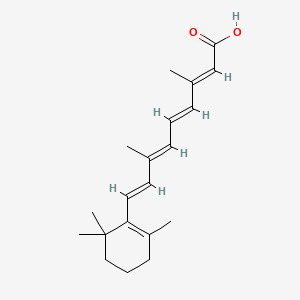
| Formula | C20H28O2 |
|---|---|
| Molecular weight | 300.44 g/mol |
| IUPAC name | (2E,4E,6E,8E)-3,7-dimethyl-9-(2,6,6-trimethylcyclohexen-1-yl)nona-2,4,6,8-tetraenoic acid |
| CAS | 302-79-4 |
| PubChem CID | 444795 |
| InChIKey | SHGAZHPCJJPHSC-YCNIQYBTSA-N |
| logP | 5.6 (XLogP 6.3) |
| Polar surface area | 37.3 Ų |
| H-bond acceptors / donors | 1 / 1 |
| Drug-likeness (QED) | 0.53 |
| Lipinski violations | 1 |
SMILES
CC1=C(/C=C/C(C)=C/C=C/C(C)=C/C(=O)O)C(C)(C)CCC1Biology & Pharmacokinetics
Pharmacokinetics
| BBB penetrant | Yes (logBB -0.49) |
|---|
Enzyme interactions
| Enzyme | Role | Detail |
|---|---|---|
| CYP1A2 | Substrate | — |
| CYP2B6 | Inhibitor | — |
| CYP2B6 | Substrate | — |
| CYP2C19 | Substrate | — |
| CYP2C8 | Inhibitor | — |
| CYP2C9 | Substrate | — |
| CYP2D6 | Substrate | — |
| CYP3A4 | Substrate | — |
Receptor binding (top 10)
| Target | Action | Affinity |
|---|---|---|
| RAR-related orphan receptor-β (RORB) | Antagonist | pIC50 9.8 |
| Retinoic acid receptor-γ (RARG) | Agonist | pEC50 9.7 |
| Retinoic acid receptor-γ (RARG) | Agonist | pKd 9.6 |
| Retinoic acid receptor-α (RARA) | Agonist | pKd 9.4 |
| Retinoic acid receptor-β (RARB) | Agonist | pKi 9.4 |
| Retinoic acid receptor-β (RARB) | Agonist | pEC50 7.9 |
| Peroxisome proliferator-activated receptor-β/δ (PPARD) | Agonist | pKd 7.8 |
| Retinoic acid receptor-α (RARA) | Agonist | pEC50 7.8 |
| RAR-related orphan receptor-β (RORB) | Antagonist | pKi 6.5 |
| TLX (NR2E1) | Agonist | pEC50 5.7 |
Transporters
BCRP (Inhibitor)BSEP (Inhibitor)BSEP (Inhibitor)MRP1 (Inhibitor)MRP3 (Inhibitor)MRP4 (Inhibitor)OATP1B1 (Inhibitor)OATP1B3 (Inhibitor)P-gp (Inhibitor)P-gp (Substrate)
Drug–drug interactions (100+, DDInter)
| Interacting drug | Severity | Management |
|---|---|---|
| Acitretin | major | |
| Aminocaproic acid | major | |
| Aminolevulinic acid | major | |
| Aprotinin | major | |
| Bexarotene | major | |
| Demeclocycline | major | |
| Doxycycline | major | |
| Eravacycline | major | |
| Fluconazole | major | |
| Isotretinoin | major | |
| Itraconazole | major | |
| Ketoconazole | major | |
| Leflunomide | major | |
| Lomitapide | major | |
| Minocycline | major | |
| Mipomersen | major | |
| Omadacycline | major | |
| Oxytetracycline | major | |
| Pexidartinib | major | |
| Sarecycline | major | |
| Teriflunomide | major | |
| Tetracycline | major | |
| Tranexamic acid | major | |
| Vitamin A | major | |
| Voriconazole | major | |
| Abametapir (topical) | moderate | |
| Abiraterone | moderate | |
| Aminolevulinic acid (topical) | moderate | |
| Amprenavir | moderate | |
| Aprepitant | moderate | |
| Asparaginase Erwinia chrysanthemi | moderate | |
| Asparaginase Escherichia coli | moderate | |
| Atazanavir | moderate | |
| Bedaquiline | moderate | |
| Berotralstat | moderate | |
| Boceprevir | moderate | |
| Bosentan | moderate | |
| Brentuximab vedotin | moderate | |
| Brigatinib | moderate | |
| Calaspargase pegol | moderate |
Showing 40 of 100+.
Registered Products (11)
| Brand | Form / strength | Pack | Agent | Citizen (JOD) |
|---|---|---|---|---|
| Optimal gel | Gel 0.025 % | 30 g tube | Pharma International Company/ Jordan | 3.240 |
| Acnelin cream | Cream 0.5 mg/1 g | 30 g tube | Hayat Pharmaceutical Industries CO.PLC/JORDAN | 3.400 |
| SMOODERM CREAM | Cream 0.50 mg/g | 30 gm | Dar Al Dawa Development and Investment Co Ltd/Jordan | 3.400 |
| Acretin | Cream 0.025 % | 30 g tube | شركة مستودع ادوية الايمان | 3.500 |
| Acretin | Cream 0.05 % | 30 g tube | شركة مستودع ادوية الايمان | 3.610 |
| Tretoquin | Cream 0.025 %, 2 % | 30 g tube | Arab Center for Pharmaceuticals & Chemicals | 3.800 |
| optimal Cream | Cream 0.05 % | 30 g tube | Pharma International Company/ Jordan | 3.940 |
| Acticare 1.2%,0.025% | Cream 0.025 %, 1.2 % | 30 gm pack varies | Hayat Pharmaceutical Industries CO.PLC/JORDAN | 6.170 |
| Acticare 1.2%,0.025% | Cream 0.025 %, 1.2 % | 45 gm pack varies | Hayat Pharmaceutical Industries CO.PLC/JORDAN | 9.260 |
| Triderma | Cream 0.05 %, 4 %, 0.01 % | 30 g tube | PELLA PHARMACEUTICALS CO.LTD/JORDAN | 11.510 |
| Vesanoid Cap | Capsule 10 mg | 100 cap | Shawi & Rushedat Drug Store | — |