Erythromycin
🧬 Cross-allergy: Macrolides
JFDA label: Rythromac suspension 200mg
Mechanism of Action
Inhibitor of Bacterial 70S ribosome — Bacterial 70S ribosome inhibitor
| Target | Action | Gene / class |
|---|---|---|
| Bacterial 70S ribosome efficacy | INHIBITOR |
Indications
Approved
- Acne Vulgaris — acne
- Bacterial Infections — bacterial disease
- Eye Infections — eye infection
- Infections — infection
- Whooping Cough — whooping cough
Off-label
- Bulimia Nervosa
- Carcinoma, Non-Small-Cell Lung
- Chlamydia Infections
- Colorectal Neoplasms
- Epidermolysis Bullosa
- Feeding and Eating Disorders
- Gastrointestinal Hemorrhage
- Gastroparesis
- HIV Infections
- Hematemesis
- Pneumonia
- Pulmonary Disease, Chronic Obstructive
- Stomach Neoplasms
Antimicrobial Spectrum
Expected / intrinsic spectrum (EUCAST breakpoints & labels) — not local resistance. Source: EUCAST v16 · curated · openfda-label.
Bacteria
| Organism | Activity | MIC |
|---|---|---|
| Bacillus spp. | Susceptible | 0.5 mg/L |
| Campylobacter jejuni/coli | Susceptible | 4.0 mg/L |
| Chlamydia trachomatis | Active | — |
| Entamoeba histolytica | Active | — |
| Haemophilus influenzae | Active | — |
| Legionella pneumophila | Active | — |
| Listeria monocytogenes | Active | — |
| Moraxella catarrhalis | Susceptible | 0.25 mg/L |
| Mycoplasma pneumoniae | Susceptible | 0.5 mg/L |
| Neisseria gonorrhoeae | Active | — |
| Staphylococcus aureus | Active | — |
| Staphylococcus spp. | Susceptible | 11.0 mg/L |
| Streptococcus A/B/C/G | Susceptible | 0.251 mg/L |
| Streptococcus pneumoniae | Susceptible | 0.25 mg/L |
| Streptococcus pneumoniae | Susceptible | 0.251 mg/L |
| Streptococcus pyogenes | Susceptible | 0.25 mg/L |
| Treponema pallidum | Active | — |
| Campylobacter jejuni/coli | Resistant | 8.0 mg/L |
| Streptococcus pneumoniae | Resistant | 1.0 mg/L |
| Streptococcus pyogenes | Resistant | 1.0 mg/L |
Class profile
| gramStatus | Gram+ |
|---|---|
| spectrumBreadth | Moderate |
| atypicalCoverage | Yes |
| isBactericidal | 0 |
| moaCategory | Protein synthesis inhibitor (50S ribosomal, 23S rRNA) |
| pdIndex | Time-dependent |
| postAntibioticEffect | Short |
| mrsaCoverage | 0 |
| resistanceMechanisms | Target site methylation (erm genes),Active efflux (mef genes),Ribosomal mutation |
Contraindications
Source: openFDA
- Erythromycin is contraindicated in patients with known hypersensitivity to this antibiotic. Erythromycin is contraindicated in patients taking terfenadine, astemizole, cisapride, pimozide, ergotamine, or dihydroergotamine. (See PRECAUTIONS – Drug Interactions. ) Do not use erythromycin concomitantly with HMG CoA reductase inhibitors (statins) that are extensively metabolized by CYP3A4 (lovastatin or simvastatin), due to the increased risk of myopathy, including rhabdomyolysis. Absolute
Adverse Reactions
Skin and subcutaneous tissue disorders (2)
Not Known Erythema · Itching
General disorders and administration site conditions (1)
Not Known Dryness
Dosing
Source: openFDA
Warnings & Precautions
Source: openFDA
Warnings & Precautions
Hepatotoxicity There have been reports of hepatic dysfunction, including increased liver enzymes, and hepatocellular and/or cholestatic hepatitis, with or without jaundice, occurring in patients receiving oral erythromycin products. QT Prolongation Erythromycin has been associated with prolongation of the QT interval and infrequent cases of arrhythmia. Cases of torsades de pointes have been spontaneously reported during postmarketing surveillance in patients receiving erythromycin. Fatalities have been reported. Erythromycin should be avoided in patients with known prolongation of the QT interval, patients with ongoing proarrhythmic conditions such as uncorrected hypokalemia or hypomagnesemia, clinically significant bradycardia, and in patients receiving Class IA (quinidine, procainamide) or Class III (dofetilide, amiodarone, sotalol) antiarrhythmic agents. Elderly patients may be more susceptible to drug-associated effects on the QT interval. Syphilis in Pregnancy There have been reports suggesting that erythromycin does not reach the fetus in adequate concentration to prevent congenital syphilis. Infants born to women treated during pregnancy with oral erythromycin for early syphilis should be treated with an appropriate penicillin regimen. Clostridium difficile Associated Diarrhea Clostridium difficile associated diarrhea (CDAD) has been reported with use of nearly all antibacterial agents, including erythromycin delayed-release tablets, and may range in severity from mild diarrhea to fatal colitis. Treatment with antibacterial agents alters the normal flora of the colon leading to overgrowth of C. difficile . C. difficile produces toxins A and B which contribute to the development of CDAD. Hypertoxin producing strains of C. difficile cause increased morbidity and mortality, as these infections can be refractory to antimicrobial therapy and may require colectomy. CDAD must be considered in all patients who present with diarrhea following antibiotic use. Careful medical history is necessary since CDAD has been reported to occur over two months after the administration of antibacterial agents. If CDAD is suspected or confirmed, ongoing antibiotic use not directed against C. difficile may need to be discontinued. Appropriate fluid and electrolyte management, protein supplementation, antibiotic treatment of C. difficile , and surgical evaluation should be instituted as clinically indicated. Drug Interactions Serious adverse reactions have been reported in p
Pregnancy & Lactation
Pregnancy
Lactation
Only water-miscible cream or gel products should be applied to the breast because ointments may expose the infant to high levels of mineral paraffins via licking.
LactMed: monitor the infant.
Monitoring
| Efficacy | Culture and susceptibility testing; clinical resolution (temperature, WBC, CRP, procalcitonin) |
|---|---|
| Toxicity | Renal function (dose adjustment in renal impairment); hepatic function for hepatically cleared agents; signs of C. difficile infection (diarrhoea) |
| Clinical pearl | Culture results guide de-escalation to narrower-spectrum therapy. Review antibiotic appropriateness at 48–72 h (antimicrobial stewardship). |
| Counseling | Complete the full course. Report persistent diarrhoea, rash, or lack of improvement after 48–72 h. |
Chemistry & Properties
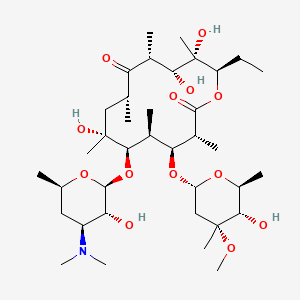
| Formula | C37H67NO13 |
|---|---|
| Molecular weight | 733.94 g/mol |
| IUPAC name | (3R,4S,5S,6R,7R,9R,11R,12R,13S,14R)-6-[(2S,3R,4S,6R)-4-(dimethylamino)-3-hydroxy-6-methyloxan-2-yl]oxy-14-ethyl-7,12,13-trihydroxy-4-[(2R,4R,5S,6S)-5-hydroxy-4-methoxy-4,6-dimethyloxan-2-yl]oxy-3,5,7,9,11,13-hexamethyl-oxacyclotetradecane-2,10-dione |
| CAS | 114-07-8 |
| PubChem CID | 12560 |
| InChIKey | ULGZDMOVFRHVEP-RWJQBGPGSA-N |
| logP | 1.79 (XLogP 2.7) |
| Polar surface area | 193.91 Ų |
| H-bond acceptors / donors | 14 / 5 |
| Drug-likeness (QED) | 0.24 |
| Lipinski violations | 2 |
SMILES
CC[C@H]1OC(=O)[C@H](C)[C@@H](O[C@H]2C[C@@](C)(OC)[C@@H](O)[C@H](C)O2)[C@H](C)[C@@H](O[C@@H]2O[C@H](C)C[C@H](N(C)C)[C@H]2O)[C@](C)(O)C[C@@H](C)C(=O)[C@H](C)[C@@H](O)[C@]1(C)OBiology & Pharmacokinetics
Pharmacokinetics
| BBB penetrant | No |
|---|
Enzyme interactions
| Enzyme | Role | Detail |
|---|---|---|
| CYP2B6 | Inhibitor | — |
| CYP2C19 | Substrate | — |
| CYP3A4 | Substrate | IC₅₀ 2.2838822745859857 µM |
Receptor binding (top 1)
| Target | Action | Affinity |
|---|---|---|
| Motilin | Binding | pKi 6.2 |
Transporters
BCRP (Inhibitor)BCRP (Inhibitor)BSEP (Inhibitor)BSEP (Inhibitor)MATE1 (Inhibitor)MDR1 (Inhibitor)MRP (Inhibitor)MRP1 (Inhibitor)MRP1 (Inhibitor)MRP2 (Inhibitor)MRP3 (Inhibitor)MRP4 (Inhibitor)OAT2 (Inhibitor)OATP (Inhibitor)OATP1A2 (Inhibitor)OATP1B1 (Inhibitor)OATP1B1 (Inhibitor)OATP1B3 (Inhibitor)OATP1B3 (Inhibitor)OATP2B1 (Inhibitor)OCT1 (Inhibitor)OCTN2 (Inhibitor)P-gp (Inhibitor)BCRP (Substrate)BSEP (Substrate)MDR1 (Substrate)MRP2 (Substrate)OAT2 (Substrate)OATP1A2 (Substrate)OATP1B1 (Substrate)P-gp (Substrate)Transporter(unspecified) (Substrate)
Drug–drug interactions (100+, DDInter)
| Interacting drug | Severity | Management |
|---|---|---|
| Acalabrutinib | major | |
| Alfentanil | major | |
| Alfuzosin | major | |
| Amiodarone | major | |
| Amisulpride | major | |
| Amprenavir | major | |
| Anagrelide | major | |
| Anisindione | major | |
| Arsenic trioxide | major | |
| Artemether | major | |
| Astemizole | major | |
| Atorvastatin | major | |
| Avanafil | major | |
| Avapritinib | major | |
| Axitinib | major | |
| Bedaquiline | major | |
| Benzhydrocodone | major | |
| Bepridil | major | |
| Berotralstat | major | |
| Betrixaban | major | |
| Boceprevir | major | |
| Bosutinib | major | |
| Brexpiprazole | major | |
| Brigatinib | major | |
| Butorphanol | major | |
| Cabergoline | major | |
| Cabozantinib | major | |
| Carbamazepine | major | |
| Ceritinib | major | |
| Cerivastatin | major | |
| Chloroquine | major | |
| Cilostazol | major | |
| Cisapride | major | |
| Citalopram | major | |
| Clarithromycin | major | |
| Cobicistat | major | |
| Cobimetinib | major | |
| Colchicine | major | |
| Conivaptan | major | |
| Crizotinib | major |
Showing 40 of 100+.
Registered Products (17)
| Brand | Form / strength | Pack | Agent | Citizen (JOD) |
|---|---|---|---|---|
| Erocin Eye Ointment | Ointment 0.5 % | 5 g tube | Amman Pharmaceutical Indusries | 1.250 |
| AKNE-MYCIN OINTMENT | Ointment 2 % | 10 g tube pack varies | Reda Jardaneh Drug Store | 1.400 |
| ERYTHRODAR 200 G.F.SUSP. | Suspension 200 mg/5 ml | 100 ml | Dar Al Dawa Development and Investment Co Ltd/Jordan | 1.400 |
| Rythromac suspension | Suspension 200 mg/5 ml | 100 ml | AL-RAM PHARMA.INDUS.CO.LTD/JORDAN | 1.400 |
| Oftalmolosa Cusi Erythromycin E/O | Cream 0.5 % | 3.5 g tube | Jarzeem Drug Store | 1.620 |
| Rythromac -200mg tablets | Tablet 200 mg | 20 tab | AL-RAM PHARMA.INDUS.CO.LTD/JORDAN | 1.700 |
| Erythrodar 250 Tabs | Tablet (as ethylsuccinate)250 mg | 20 tab pack varies | Dar Al Dawa Development and Investment Co Ltd/Jordan | 1.790 |
| Erythrodar Forte Tablet | Tablet (as Ethylsuccinate)400 mg | 16 tab pack varies | Dar Al Dawa Development and Investment Co Ltd/Jordan | 1.910 |
| Rythromac-400 mg tablets | Tablet 400 mg | 16 tab | AL-RAM PHARMA.INDUS.CO.LTD/JORDAN | 1.910 |
| Erythrodar Forte Tablet | Tablet (as Ethylsuccinate)400 mg | 20 tab pack varies | Dar Al Dawa Development and Investment Co Ltd/Jordan | 2.380 |
| AKNE-MYCIN SOLUTION | Solution 2 % | 25 ml pack varies | Reda Jardaneh Drug Store | 3.490 |
| AKNE-MYCIN EMULSION | Emulsion 1 % | 25 g | Reda Jardaneh Drug Store | 4.080 |
| Spotex | Cream 4 % | 30 g tube | PELLA PHARMACEUTICALS CO.LTD/JORDAN | 5.310 |
| Rythiderm Lotion | Lotion 40 mg/ml, 12 mg/ml | 30 ml | Hikma Pharmaceuticals Co.Ltd/Jordan | 6.180 |
| Zineryt Lotion | Lotion 40 mg/ml, 12 mg/ml | 30 ml | Shawi & Rushedat Drug Store | 8.230 |
| Erythrodar 250 Tabs | Tablet (as ethylsuccinate)250 mg | 500 tab pack varies | Dar Al Dawa Development and Investment Co Ltd/Jordan | 29.700 |
| Erythrodar Forte Tablet | Tablet (as Ethylsuccinate)400 mg | 500 tab pack varies | Dar Al Dawa Development and Investment Co Ltd/Jordan | 37.540 |