Benzylpenicillin
🧬 Cross-allergy: Penicillins
JFDA label: Injpen
- Appropriate administration:
Mechanism of Action
Interferes with bacterial cell wall synthesis during active multiplication, causing cell wall death and resultant bactericidal activity against susceptible bacteria
Indications
Approved
- Acute glomerulonephritis
- Respiratory tract infections
- Rheumatic fever and chorea
- Rheumatic heart disease
- Syphilis and other venereal diseases
Antimicrobial Spectrum
Expected / intrinsic spectrum (EUCAST breakpoints & labels) — not local resistance. Source: EUCAST v16.
Bacteria
| Organism | Activity | MIC |
|---|---|---|
| Anaerobes | Susceptible | 0.51 mg/L |
| Corynebacterium spp. | Susceptible | 0.001 mg/L |
| Neisseria gonorrhoeae | Susceptible | 0.061 mg/L |
| Neisseria meningitidis | Susceptible | 0.25 mg/L |
| Pasteurella multocida | Susceptible | 0.5 mg/L |
| Viridans group streptococci | Susceptible | 0.251 mg/L |
Contraindications
Source: Lexicomp
- Hypersensitivity to penicillin(s) or any component of the formulation Absolute
Adverse Reactions
Cardiac disorders (8)
Not Known Cerebrovascular accident · hypotension · palpitations · syncope · tachycardia · vasodepressor syncope · vasodilatation · vasospasm
Nervous system disorders (15)
Not Known Anxiety · coma · confusion · dizziness · drowsiness · euphoria · fatigue · headache · localized warm feeling · nervousness · neurologic abnormality (neurogenic bladder) · numbness · pain · seizure · transverse myelitis
Hepatobiliary disorders (1)
Not Known Increased serum AST
Renal and urinary disorders (8)
Not Known Hematuria · impotence · Increased blood urea nitrogen · increased serum creatinine · myoglobinuria · priapism · proteinuria · renal failure
Blood and lymphatic system disorders (2)
Not Known Local hemorrhage (at injection site) · lymphadenopathy
Immune system disorders (2)
Not Known Hypersensitivity reaction · Jarisch-Herxheimer reaction
Gastrointestinal disorders (4)
Not Known Bloody stools · intestinal necrosis · nausea · vomiting
Skin and subcutaneous tissue disorders (5)
Not Known Diaphoresis · gangrene of skin or other tissue · pallor · skin mottling · skin ulceration at injection site
Musculoskeletal and connective tissue disorders (6)
Not Known Arthropathy · exacerbation of arthritis · periosteal disease (periostitis) · rhabdomyolysis · tremor · weakness
Eye disorders (2)
Not Known Blindness · blurred vision
General disorders and administration site conditions (10)
Not Known Abscess at injection site · atrophy at injection site · bruising at injection site · cellulitis at injection site · inflammation at injection site · injection site reaction (neurovascular damage) · localized edema (at injection site) · pain at injection site · residual mass at injection site · tissue necrosis at injection site
Respiratory, thoracic and mediastinal disorders (1)
Not Known Cyanosis
Dosing
Source: Lexicomp
Warnings & Precautions
Source: Lexicomp
Hypersensitivity reactions
Serious and occasionally severe or fatal hypersensitivity (anaphylactic) reactions have been reported in patients on penicillin therapy, especially with a history of beta-lactam hypersensitivity (including cephalosporins), history of sensitivity to multiple allergens, or previous IgE-mediated reactions (eg, anaphylaxis, angioedema, urticaria). Serious anaphylactic reactions require immediate emergency treatment with epinephrine, oxygen, intravenous steroids and airway management (including intubation) as indicated.
Superinfection
Prolonged use may result in fungal or bacterial superinfection, including C. difficile-associated diarrhea (CDAD) and pseudomembranous colitis; CDAD has been observed >2 months postantibiotic treatment. Disease-related concerns:
Renal impairment
Use with caution in patients with renal impairment.
Seizure disorders
Use with caution in patients with a history of seizure disorder; high levels, particularly in the presence of renal impairment, may increase risk of seizures.
Syphilis/neurosyphilis use
CDC and AAP do not currently recommend the use of penicillin G benzathine for the initial treatment regimen for congenital syphilis or neurosyphilis due to reported treatment failures and lack of published clinical data on its efficacy (CDC [Workowski 2015]). Other warnings/precautions:
Appropriate administration
Not for intravenous use; cardiopulmonary arrest and death have occurred from inadvertent IV administration. Administer by deep IM injection only. Quadriceps femoris fibrosis and atrophy have been reported after repeated IM injections of penicillin preparations into the anterolateral thigh. Injection into or near an artery or nerve could result in severe neurovascular damage or permanent neurological damage.
Appropriate use
Use only for treatment of infections due to penicillin G sensitive gram positive organisms, few gram-negative organisms such as Neisseria gonorrhoeae, and some anaerobes and spirochetes. Use only for infections susceptible to the low and very prolonged serum concentrations of benzathine penicillin G.
Prolonged use
Extended duration of therapy or use associated with high serum concentrations (eg, in renal insufficiency) may be associated with an increased risk for some adverse reactions (neutropenia, hemolytic anemia, serum sickness).
Pregnancy & Lactation
Pregnancy
Adverse events have not been observed in animal reproduction studies. Penicillin G benzathine crosses the placenta (Nathan 1993; Weeks 1997). Maternal use of penicillins has generally not resulted in an increased risk of adverse fetal effects. Penicillin G is the drug of choice for treatment of syphilis during pregnancy (CDC [Workowski 2015]).
Lactation
Soluble penicillin G is excreted in breast milk. The manufacturer recommends that caution be exercised when administering penicillin to nursing women. Nondose-related effects could include modification of bowel flora and allergic sensitization.
Monitoring
| Clinical pearl | Observe for signs and symptoms of anaphylaxis during first dose |
|---|
Chemistry & Properties
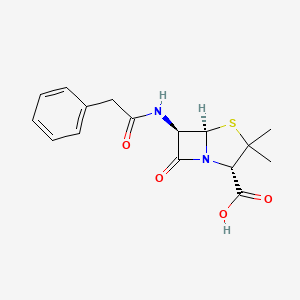
| Formula | C16H18N2O4S |
|---|---|
| Molecular weight | 334.4 g/mol |
| IUPAC name | (2S,5R,6R)-3,3-dimethyl-7-oxo-6-[(2-phenylacetyl)amino]-4-thia-1-azabicyclo[3.2.0]heptane-2-carboxylic acid |
| CAS | 61-33-6 |
| PubChem CID | 5904 |
| InChIKey | JGSARLDLIJGVTE-MBNYWOFBSA-N |
| logP | 0.86 (XLogP 1.8) |
| Polar surface area | 86.71 Ų |
| H-bond acceptors / donors | 4 / 2 |
| Drug-likeness (QED) | 0.80 |
| Lipinski violations | 0 |
SMILES
CC1(C)S[C@@H]2[C@H](NC(=O)Cc3ccccc3)C(=O)N2[C@H]1C(=O)OBiology & Pharmacokinetics
Pharmacokinetics
| BBB penetrant | No |
|---|
Enzyme interactions
| Enzyme | Role | Detail |
|---|---|---|
| CYP2C19 | Substrate | — |
| CYP2D6 | Inhibitor | — |
Transporters
BCRP (Inhibitor)BSEP (Inhibitor)BSEP (Inhibitor)MRP1 (Inhibitor)MRP2 (Inhibitor)OAT1 (Inhibitor)OAT3 (Inhibitor)OAT4 (Inhibitor)OATP1A2 (Inhibitor)OATP1B1 (Inhibitor)OATP1B1 (Inhibitor)OATP1B3 (Inhibitor)OATP1B3 (Inhibitor)OATP2B1 (Inhibitor)OCTN1 (Inhibitor)OCTN2 (Inhibitor)P-gp (Inhibitor)PEPT1 (Inhibitor)PEPT2 (Inhibitor)MDR1 (Substrate)OAT1 (Substrate)OAT3 (Substrate)OATP1A2 (Substrate)OATP2B1 (Substrate)P-gp (Substrate)PEPT1 (Substrate)
Drug–drug interactions (17, DDInter)
| Interacting drug | Severity | Management |
|---|---|---|
| Methotrexate | major | |
| Chloramphenicol | moderate | |
| Demeclocycline | moderate | |
| Dicoumarol | moderate | |
| Doxycycline | moderate | |
| Ethinylestradiol | moderate | |
| Iodide I-123 | moderate | |
| Iodide I-131 | moderate | |
| Minocycline | moderate | |
| Mycophenolic acid | moderate | |
| Oxytetracycline | moderate | |
| Pemetrexed | moderate | |
| Picosulfuric acid | moderate | |
| Tetracycline | moderate | |
| Warfarin | moderate | |
| Clarithromycin | minor | |
| Erythromycin | minor |
Registered Products (2)
| Brand | Form / strength | Pack | Agent | Citizen (JOD) |
|---|---|---|---|---|
| Retarpen 6:3:3 Vial | Vial 300000 IU, 600000 IU, 300000 IU | 5 ml | Nabulsi Drug Store | 1.220 |
| Injpen | Vial 1 mega | 10 vial | Oasis of Hope | 5.630 |