Esomeprazole
Active form: Omeprazole Sulfenamide.
JFDA label: Nexium Tablet
Mechanism of Action
Proton pump inhibitor suppresses gastric acid secretion by inhibition of the H+/K+-ATPase in the gastric parietal cell. Esomeprazole is the S-isomer of omeprazole.
Indications
Approved
- Esomeprazole magnesium
- Esomeprazole magnesium and esomeprazole strontium
- Gastroesophageal reflux disease (Rx only)
- Healing of erosive esophagitis
- Heartburn (OTC labeling)
- Helicobacter pylori eradication (Rx only)
- IV
- Maintenance of healing of erosive esophagitis
- Oral
- Pathological hypersecretory conditions, including Zollinger-Ellison syndrome (Rx only)
- Risk reduction of nonsteroidal anti-inflammatory drug-associated gastric ulcer (Rx only)
- Risk reduction of ulcer rebleeding postprocedure (Rx only)
- Symptomatic gastroesophageal reflux disease
Off-label
- Stress ulcer prophylaxis in critically-ill patients
- Treatment of NSAID-induced gastric ulcers
Contraindications
Source: Lexicomp
- Additional contraindications (not in US labeling): Concurrent use with rilprivirine. OTC labeling: When used for self-medication (OTC), do not use if you have trouble or pain when swallowing food Absolute
- Hypersensitivity (eg, anaphylaxis, anaphylactic shock, angioedema, bronchospasm, acute interstitial nephritis, urticaria) to esomeprazole, other substituted benzimidazole proton pump inhibitors, or any component of the formulation Absolute
- chest pain or shoulder pain with shortness of breath, sweating, pain spreading to arms, neck or shoulders, or lightheadedness Absolute
- frequent chest pain Absolute
- heartburn with lightheadedness, dizziness, or sweating Absolute
- vomiting with blood, or bloody or black stools Absolute
Adverse Reactions
Cardiac disorders (1)
Common Esophageal varices
Nervous system disorders (3)
Common dizziness, decreased serum potassium, decreased serum sodium, decreased thyroid hormones, increased gastrin, increased serum potassium, increased serum sodium, increased thyroid stimulating hormone le · Headache · Irritability
Hepatobiliary disorders (3)
Common Increased serum alkaline phosphatase · increased serum ALT · increased serum AST
Renal and urinary disorders (2)
Common Increased serum creatinine
Rare Interstitial nephritis
Blood and lymphatic system disorders (1)
Common Benign polyp
Metabolism and nutrition disorders (1)
Uncommon Hypomagnesaemia (long-term)
Gastrointestinal disorders (15)
Common Abdominal pain · abdominal pain · Barrett esophagus · diarrhea · Diarrhoea · duodenitis · esophageal stenosis · esophageal ulcer · esophagitis · Flatulence · gastritis · mucosal discoloration · Nausea · nausea · vomiting
General disorders and administration site conditions (2)
Common Benign nodule · Injection site reaction
Other (1)
Very Common Central nervous system: Headache
Respiratory, thoracic and mediastinal disorders (1)
Common Cough (intravenous: 1%; oral: Miscellaneous: Fever (intravenous: 4%; oral: Frequency not defined:
Dosing
Source: Lexicomp
Warnings & Precautions
Source: Lexicomp
Carcinoma
No reports of enterochromaffin-like (ECL) cell carcinoids, dysplasia, or neoplasia have occurred.
Clostridium difficile-associated diarrhea (CDAD)
Use of proton pump inhibitors (PPIs) may increase risk of CDAD, especially in hospitalized patients; consider CDAD diagnosis in patients with persistent diarrhea that does not improve. Use the lowest dose and shortest duration of PPI therapy appropriate for the condition being treated.
Cutaneous and systemic lupus erythematosus
Has been reported as new onset or exacerbation of existing autoimmune disease; most cases were cutaneous lupus erythematosus (CLE), most commonly, subacute CLE (occurring within weeks to years after continuous therapy). Systemic lupus erythematosus (SLE) is less common (typically occurs within days to years after initiating treatment) and occurred primarily in young adults up to the elderly. Discontinue therapy if signs or symptoms of CLE or SLE occur and refer to specialist for evaluation; most patients improve 4 to 12 weeks after discontinuation of esomeprazole.
Fractures
Increased incidence of osteoporosis-related bone fractures of the hip, spine, or wrist may occur with proton pump inhibitor (PPI) therapy. Patients on high-dose or long-term therapy (≥1 year) should be monitored. Use the lowest effective dose for the shortest duration of time, use vitamin D and calcium supplementation, and follow appropriate guidelines to reduce risk of fractures in patients at risk.
Gastrointestinal infection (eg, Salmonella, Campylobacter)
Use of proton pump inhibitors may increase risk of these infections.
Hypomagnesemia
Reported rarely, usually with prolonged PPI use of ≥3 months (most cases >1 year of therapy). May be symptomatic or asymptomatic; severe cases may cause tetany, seizures, and cardiac arrhythmias. Consider obtaining serum magnesium concentrations prior to beginning long-term therapy, especially if taking concomitant digoxin, diuretics, or other drugs known to cause hypomagnesemia; and periodically thereafter. Hypomagnesemia may be corrected by magnesium supplementation, although discontinuation of esomeprazole may be necessary; magnesium levels typically return to normal within 1 week of stopping.
Interstitial nephritis
Acute interstitial nephritis has been observed in patients taking PPIs; may occur at any time during therapy and is generally due to an idiopathic hypersensitivity reaction. Discontinue if acute interstitial nephritis develops.
Vitamin B12 deficiency
Prolonged treatment (≥2 years) may lead to vitamin B12 malabsorption and subsequent vitamin B12 deficiency. The magnitude of the deficiency is dose-related and the association is stronger in females and those younger in age ( Disease-related concerns:
Gastric malignancy
Relief of symptoms does not preclude the presence of a gastric malignancy.
Hepatic impairment
Patients with severe hepatic impairment may require dosage reductions.
Renal impairment
Pharmacokinetics of esomeprazole are not expected to be altered in renal impairment; dosage adjustments are not necessary for any degree of renal impairment when using esomeprazole magnesium or esomeprazole sodium. However, since pharmacokinetics of the strontium may be reduced in mild to moderate renal impairment, esomeprazole strontium is not recommended for use in severe impairment (has not been studied). Concurrent drug therapy issues:
Clopidogrel
Proton pump inhibitors (PPIs) may diminish the therapeutic effect of clopidogrel, thought to be due to reduced formation of the active metabolite of clopidogrel. The manufacturer of clopidogrel recommends either avoidance of both omeprazole (even when scheduled 12 hours apart) and esomeprazole or use of a PPI with comparatively less effect on the active metabolite of clopidogrel (eg, pantoprazole). In contrast to these warnings, others have recommended the continued use of PPIs, regardless of the degree of inhibition, in patients with a history of GI bleeding or multiple risk factors for GI bleeding who are also receiving clopidogrel since no evidence has established clinically meaningful differences in outcome; however, a clinically significant interaction cannot be excluded in those who are poor metabolizers of clopidogrel (Abraham 2010; Levine 2011).
Drug-drug interactions
Potentially significant interactions may exist, requiring dose or frequency adjustment, additional monitoring, and/or selection of alternative therapy. Consult drug interactions database for more detailed information. Special populations:
Elderly
Bioavailability may be increased in elderly patients.
Pediatric
Esomeprazole strontium: Strontium competes with calcium for intestinal absorption and is incorporated into bone; use of esomeprazole strontium in pediatric patients is not recommended. Dosage form specific issues:
Intravenous
Safety and efficacy of IV treatment for GERD beyond 10 days have not been established; transition from IV to oral therapy as soon possible. Other warnings/precautions:
Appropriate use
Helicobacter pylori eradication: Short-term combination therapy (≤7 days) has been associated with a higher incidence of treatment failure. The American College of Gastroenterology recommends 10 to 14 days of therapy (triple or quadruple) for eradication of H. pylori (Chey 2017).
Laboratory test interference
Serum chromogranin A (CgA) levels increase secondary to drug-induced decreases in gastric acid; may cause false-positive results in diagnostic investigations for neuroendocrine tumors. Temporarily stop esomeprazole treatment ≥14 days before CgA test; if CgA level high, repeat test to confirm. Use same commercial laboratory for testing to prevent variable results.
Self-medication (OTC use)
When used for self-medication (OTC), notify health care provider before use if any of the following are present: heartburn for >3 months; frequent wheezing, particularly with heartburn; unexplained weight loss; nausea or vomiting; or stomach pain. Discontinue use and notify health care provider if heartburn continues or worsens; diarrhea occurs; if >14 days of therapy is needed; or if >1 course of therapy is needed every 4 months.
Pregnancy & Lactation
Pregnancy
Adverse events have been observed in some animal reproduction studies. An increased risk of hypospadias was reported following maternal use of proton pump inhibitors (PPIs) during pregnancy (Anderka, 2012), but this was based on a small number of exposures and the same association was not found in another study (Erichsen, 2012). An increased risk of major birth defects following maternal use of PPIs during pregnancy was not observed in an additional study (Pasternak, 2010). Esomeprazole is the s-isomer of omeprazole; refer to the omeprazole monograph for additional information. When treating GERD in pregnancy, PPIs may be used when clinically indicated (Katz, 2013).
Lactation
Esomeprazole and strontium (limited data) are excreted in breast milk. According to the manufacturer, the decision to continue or discontinue breastfeeding during therapy should take into account the risk of infant exposure, the benefits of breastfeeding to the infant, and benefits of treatment to the mother. Esomeprazole is the s-isomer of omeprazole, and omeprazole is excreted in breast milk; refer to Omeprazole monograph for additional information.
Monitoring
| Clinical pearl | Susceptibility testing recommended in patients who fail H. pylori eradication regimen. Monitor for rebleeding in patients with peptic ulcer bleed. For patients expected to be on prolonged therapy or who take PPIs with medications such as digoxin or drugs that may cause hypomagnesemia (eg, diuretics), consider monitoring magnesium levels prior to initiation of treatment and periodically thereafter. |
|---|
Chemistry & Properties
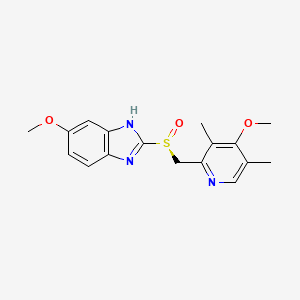
| Formula | C17H19N3O3S |
|---|---|
| Molecular weight | 345.42 g/mol |
| IUPAC name | 6-methoxy-2-[(S)-(4-methoxy-3,5-dimethyl-2-pyridinyl)methylsulfinyl]-1H-benzimidazole |
| CAS | 119141-88-7 |
| PubChem CID | 9568614 |
| InChIKey | SUBDBMMJDZJVOS-DEOSSOPVSA-N |
| logP | 2.9 (XLogP 2.2) |
| Polar surface area | 83.09 Ų |
| H-bond acceptors / donors | 5 / 1 |
| Drug-likeness (QED) | 0.72 |
| Lipinski violations | 0 |
SMILES
COc1ccc2[nH]c([S@@+]([O-])Cc3ncc(C)c(OC)c3C)nc2c1Biology & Pharmacokinetics
Pharmacokinetics predicted
| Bioavailability | 10.0% |
|---|---|
| Half-life | 0.654 h |
| Volume of distribution | 0.292 L/kg |
| Protein binding | 95.4% |
| BBB penetrant | No |
Enzyme interactions
| Enzyme | Role | Detail |
|---|---|---|
| CYP1A2 | Inhibitor | — |
| CYP1A2 | Substrate | — |
| CYP2C19 | Inhibitor | — |
| CYP2C19 | Substrate | — |
| CYP2C8 | Inhibitor | — |
| CYP2C9 | Substrate | — |
| CYP2D6 | Substrate | — |
| CYP3A4 | Inhibitor | — |
| CYP3A4 | Substrate | — |
Transporters
BCRP (Inhibitor)BSEP (Inhibitor)MDR1 (Inhibitor)MRP1 (Inhibitor)OAT3 (Inhibitor)OATP1B1 (Inhibitor)OATP1B1 (Inhibitor)OATP1B3 (Inhibitor)OATP1B3 (Inhibitor)OATP2B1 (Inhibitor)OCT1 (Inhibitor)P-gp (Inhibitor)MDR1 (Substrate)P-gp (Substrate)
Drug–drug interactions (100+, DDInter)
| Interacting drug | Severity | Management |
|---|---|---|
| Acalabrutinib | major | |
| Atazanavir | major | |
| Citalopram | major | |
| Clopidogrel | major | |
| Dacomitinib | major | |
| Dasatinib | major | |
| Erlotinib | major | |
| Methotrexate | major | |
| Nelfinavir | major | |
| Neratinib | major | |
| Pazopanib | major | |
| Pexidartinib | major | |
| Rilpivirine | major | |
| Selpercatinib | major | |
| Tacrolimus | major | |
| Velpatasvir | major | |
| Abametapir (topical) | moderate | |
| Amikacin | moderate | |
| Amikacin (liposome) | moderate | |
| Amphetamine | moderate | |
| Amphotericin B | moderate | |
| Amphotericin B (cholesteryl sulfate) | moderate | |
| Amphotericin B (lipid complex) | moderate | |
| Amphotericin B (liposomal) | moderate | |
| Anisindione | moderate | |
| Apalutamide | moderate | |
| Armodafinil | moderate | |
| Atorvastatin | moderate | |
| Bacampicillin | moderate | |
| Bendamustine | moderate | |
| Bendroflumethiazide | moderate | |
| Benzthiazide | moderate | |
| Bosutinib | moderate | |
| Bumetanide | moderate | |
| Capreomycin | moderate | |
| Carboplatin | moderate | |
| Cefditoren | moderate | |
| Cefpodoxime | moderate | |
| Cefuroxime | moderate | |
| Cenobamate | moderate |
Showing 40 of 100+.
Registered Products (28)
| Brand | Form / strength | Pack | Agent | Citizen (JOD) |
|---|---|---|---|---|
| Emanera | Capsule 21.688 mg/20 mg | 28 cap | Abu Sheikha Drug Store | 2.960 |
| Novera | Tablet 20 mg | 14 tab pack varies | AL-TAQADDOM PHARMACEUTICAL INDUSTRIES/JORDAN | 3.590 |
| Pumpinox | Tablet 20 mg | 14 tab pack varies | Pharma International Company/ Jordan | 3.850 |
| Novera | Tablet 40 mg | 14 tab pack varies | AL-TAQADDOM PHARMACEUTICAL INDUSTRIES/JORDAN | 4.180 |
| Emanera | Capsule 43.376 mg | 28 cap | Abu Sheikha Drug Store | 4.250 |
| Pazel | Tablet 40 mg | 14 tab | Dar Al Dawa Development and Investment Co Ltd/Jordan | 4.480 |
| Pumpinox | Tablet (Magnesium Trihydrate)40 mg | 14 tab pack varies | Pharma International Company/ Jordan | 4.480 |
| Pumpinox | Tablet 20 mg | 20 tab pack varies | Pharma International Company/ Jordan | 5.240 |
| Esomep | Tablet 40 mg | 28 tab | Nabulsi Drug Store | 7.060 |
| Novera | Tablet 20 mg | 30 tab pack varies | AL-TAQADDOM PHARMACEUTICAL INDUSTRIES/JORDAN | 7.330 |
| Pumpinox | Tablet 20 mg | 28 tab pack varies | Pharma International Company/ Jordan | 7.330 |
| Nexium Tablet | Tablet 20 mg | 28 tab | Shawi & Rushedat Drug Store | 8.140 |
| Novera | Tablet 40 mg | 30 tab pack varies | AL-TAQADDOM PHARMACEUTICAL INDUSTRIES/JORDAN | 8.540 |
| Pumpinox | Tablet (Magnesium Trihydrate)40 mg | 28 tab pack varies | Pharma International Company/ Jordan | 8.540 |
| Nexium Tablet | Tablet 40 mg | 28 tab | Shawi & Rushedat Drug Store | 9.490 |
| Nexium Granules For Oral Susp. | Suspension 10 mg | 28 sachet | Shawi & Rushedat Drug Store | 18.550 |
| Kleprum | Tablet 500 mg, 20 mg | 30 tab pack varies | Pharma International Company/ Jordan | 20.260 |
| Kleprum | Tablet 500 mg, 20 mg | 60 tab pack varies | Pharma International Company/ Jordan | 38.350 |
| Demolox 40 mg/vial Powder for solution for injection/infusion | Infusion 40 mg | 10 vial | Al Hilal Drug Store | — |
| Demolox 40 mg/vial Powder for solution for injection/infusion | Infusion Esomeprazole 40 mg | 1 vial pack varies | Al Hilal Drug Store | — |
| Demolox 40 mg/vial Powder for solution for injection/infusion | Infusion Esomeprazole 40 mg | 50 vial pack varies | Al Hilal Drug Store | — |
| Esomeprazol Azevedos | Vial 40 mg | 10 vial pack varies | Alshefra Dru Store company | — |
| Esomeprazol Azevedos | Vial 40 mg | 1 vial pack varies | Alshefra Dru Store company | — |
| Essium | Vial Esomeprazole 40.00 mg | 40 mg | JAWEDA INT. DRUD STORE | — |
| Gordex | Vial 40 mg | 1 vial | Professional Drug Store | — |
| Kenzoprazol | Vial 40 mg | 10 vial | MS PHARMA/JORDAN | — |
| Nexium Powder for solution Inj/Inf | Powder for Injection 40 mg | 10 vial | Shawi & Rushedat Drug Store | — |
| Nexus | Vial 40 mg | 1 vial | Hikma Pharmaceuticals Co.Ltd/Jordan | — |