Erlotinib
JFDA label: Mirata 100mg F.C Tab
Mechanism of Action
Reversibly inhibits overall epidermal growth factor receptor (HER1/EGFR) - tyrosine kinase activity. Intracellular phosphorylation is inhibited which prevents further downstream signaling, resulting in cell death. Erlotinib has higher binding affinity for EGFR exon 19 deletion or exon 21 L858R mutations than for the wild type receptor.
Indications
Approved
- Non-small cell lung cancer, metastatic
- Pancreatic cancer
Class profile
| mechanismClass | Tyrosine kinase inhibitor (EGFR TKI) |
|---|---|
| targetMolecule | EGFR (EGFR T790M-sensitive range) |
| targetPathway | EGFR signaling |
| generation | 1st generation EGFR TKI |
| primaryTumors | NSCLC (EGFR-mutant),Pancreatic |
| resistanceMechanisms | T790M gatekeeper mutation,MET amplification,EMT,KRAS mutation |
| source | NCCN/OncoKB/Goodman&Gilman13ed |
Contraindications
Source: Lexicomp
- Hypersensitivity to erlotinib or any component of the formulation Absolute
- There are no contraindications listed in the manufacturer’s US labeling Absolute
Adverse Reactions
Cardiac disorders (5)
Very Common Chest pain · Edema · thrombosis
Common Cardiac arrhythmia (Gastrointestinal: Intestinal obstruction (Hematologic & oncologic: Hemolytic anemia (Renal: Renal insufficiency (Respiratory: Interstitial pulmonary disease ( · Peripheral edema
Nervous system disorders (10)
Very Common depression · Fatigue
Common anxiety · dizziness · headache · insomnia · neurotoxicity · Pain · paresthesia · voice disorder
Hepatobiliary disorders (4)
Common hepatic failure · Hyperbilirubinemia · increased gamma-glutamyl transferase · increased serum ALT
Renal and urinary disorders (2)
Common Increased serum creatinine · renal failure
Blood and lymphatic system disorders (4)
Very Common Anemia
Common leukopenia · Lymphocytopenia · thrombocytopenia
Metabolism and nutrition disorders (1)
Common Weight loss
Gastrointestinal disorders (10)
Very Common abdominal pain · anorexia · diarrhea · flatulence · Nausea · stomatitis · vomiting
Common Dyspepsia · taste disorder · xerostomia
Skin and subcutaneous tissue disorders (13)
Very Common alopecia · Skin rash
Common acneiform eruption · bullous dermatitis · dermatitis · erythema · erythematous rash · exfoliative dermatitis · Folliculitis · hypertrichosis · nail disease · palmar-plantar erythrodysesthesia · skin fissure
Musculoskeletal and connective tissue disorders (10)
Very Common arthralgia · back pain · musculoskeletal pain · myalgia · neuropathy · rigors · Weakness
Common Muscle spasm · musculoskeletal chest pain · ostealgia
Eye disorders (2)
Very Common Conjunctivitis · keratoconjunctivitis sicca
Ear and labyrinth disorders (1)
Common Tinnitus
Infections and infestations (1)
Very Common Increased susceptibility to infection
General disorders and administration site conditions (1)
Very Common Fever
Respiratory, thoracic and mediastinal disorders (8)
Very Common Cough · dyspnea
Common epistaxis · Nasopharyngitis · pneumonitis · pulmonary embolism · pulmonary fibrosis · respiratory tract infection
Dosing
Source: Lexicomp
Warnings & Precautions
Source: Lexicomp
Cardiovascular events
Cerebrovascular accidents, MI, and myocardial ischemia have been reported (some fatal).
Dermatologic toxicity
Bullous, blistering, and/or exfoliating skin conditions, some suggestive of Stevens-Johnson or toxic epidermal necrolysis (TEN), have been reported (some fatal). An acne-like rash commonly appears on the face, back, and upper chest. Generalized or severe acneiform, erythematous or maculopapular rash may occur. Skin rash may correlate with treatment response and prolonged survival (Saif 2008); management of skin rashes that are not serious should include alcohol-free lotions, topical antibiotics, or topical corticosteroids, or if necessary, oral antibiotics and systemic corticosteroids; avoid sunlight. Reduce dose or temporarily interrupt treatment for severe skin reactions; discontinue treatment for bullous, blistering, or exfoliative skin toxicity.
Gastrointestinal (GI) perforation
GI perforation (including fatalities) has been reported; risk for perforation is increased with concurrent anti-angiogenic agents, corticosteroids, NSAIDs, and/or taxane based-chemotherapy, and patients with history of peptic ulcers or diverticular disease. Permanently discontinue in patients who develop perforation.
Hematologic effects
Microangiopathic hemolytic anemia (MAHA) with thrombocytopenia has been reported (rarely) with erlotinib in combination with gemcitabine.
Hemorrhage
Elevated INR and bleeding events (including fatal hemorrhage) have been reported when erlotinib was administered concomitantly with warfarin; monitor prothrombin time and INR closely.
Hepatotoxicity
Hepatic failure and hepatorenal syndrome have been reported (some fatal), particularly in patients with baseline hepatic impairment (although have also been observed in patients with normal hepatic function). Monitor liver function (transaminases, bilirubin, and alkaline phosphatase); patients with any hepatic impairment (total bilirubin >ULN; Child-Pugh class A, B, or C) should be closely and more frequently monitored, including those with hepatic disease due to tumor burden. Increased monitoring of liver function is required in patients with preexisting hepatic impairment or biliary obstruction. Dosage reduction, interruption, or discontinuation may be necessary for changes in hepatic function. Use with extreme caution in patients with total bilirubin >3 times ULN. Interrupt therapy if total bilirubin is >3 times ULN or transaminases are >5 times ULN in patients without preexisting hepatic impairment. In patients with baseline hepatic dysfunction or biliary obstruction, interrupt therapy if bilirubin doubles or transaminases triple from baseline values.
Ocular toxicity
Corneal perforation and ulceration have been reported; decreased tear production, abnormal eyelash growth, keratoconjunctivitis sicca, or keratitis have also been reported and are known risk factors for corneal ulceration/perforation. Interrupt or discontinue treatment in patients presenting with eye pain or other acute or worsening ocular symptoms. Consider a baseline ophthalmologic exam and reassess for ocular toxicities at 4 to 8 weeks after treatment initiation (Renouf 2012).
Pulmonary toxicity
Rare, sometimes fatal, interstitial lung disease (ILD) has occurred; symptoms include acute respiratory distress syndrome, interstitial pneumonia, obliterative bronchiolitis, pneumonitis (including radiation and hypersensitivity), pulmonary fibrosis, and pulmonary infiltrates. The onset of symptoms has been within 5 days to more than 9 months after treatment initiation (median: 39 days). Interrupt treatment for unexplained new or worsening pulmonary symptoms (dyspnea, cough, and fever); permanently discontinue for confirmed ILD.
Renal impairment
Acute renal failure (some fatal), renal insufficiency, and hepatorenal syndrome have been reported, either secondary to hepatic impairment at baseline or due to severe dehydration; use with caution in patients with or at risk for renal impairment. Monitor closely for dehydration; monitor renal function and electrolytes in patients at risk for dehydration. If severe renal impairment develops, interrupt therapy until toxicity resolves. Disease-related concerns:
NSCLC
Some factors which correlate positively with response to EGFR-tyrosine kinase inhibitor (TKI) therapy in NSCLC include patients who have never smoked, EGFR mutation, and patients of Asian origin. EGFR mutations, specifically exon 19 deletions and exon 21 mutation (L858R), are associated with better response to erlotinib in patients with NSCLC (Riely 2006). Erlotinib treatment is not recommended in patients with NSCLC with K-ras mutations; they are not likely to benefit from erlotinib treatment (Eberhard 2005; Miller 2008). K-ras mutations correlated with poorer outcome with EGFR-TKI therapy in patients with NSCLC (Jackman 2009; Masarelli 2007; Shepherd 2005). The cobas EGFR mutation test has been approved to detect EGFR mutation for NSCLC treatment. Concurrent drug therapy issues:
Drug-drug interactions
Potentially significant interactions may exist, requiring dose or frequency adjustment, additional monitoring, and/or selection of alternative therapy. Consult drug interactions database for more detailed information.
Drugs affecting gastric pH
Avoid concomitant use with proton pump inhibitors. If taken with an H2-receptor antagonist (eg, ranitidine), administer erlotinib 10 hours after the H2-receptor antagonist dose and at least 2 hours prior to the next H2-receptor dose. If an antacid is necessary, separate dosing by several hours. Special populations:
Smokers
Erlotinib levels may be lower in patients who smoke; advise patients to stop smoking. Smokers treated with 300 mg/day exhibited steady-state erlotinib levels comparable to former- and never-smokers receiving 150 mg/day (Hughes 2009). Other warnings/precautions:
Appropriate use
Concurrent erlotinib plus platinum-based chemotherapy is not recommended for treatment of locally-advanced or metastatic NSCLC due to a lack of clinical benefit. Treatment in patients with metastatic NSCLC with EGFR mutations other than exon 19 deletion or exon 21 (L858R) substitution has not been evaluated. Select patients for metastatic NSCLC treatment based on EGFR exon 19 deletions and exon 21 mutation (L858R) in tumor or plasma specimens; if these mutations are not detected in plasma specimen, tumor tissue (if available) may be tested.
Lactose intolerance
Product may contain lactose; avoid use in patients with Lapp lactase deficiency, glucose-galactose malabsorption, or glucose intolerance.
Pregnancy & Lactation
Pregnancy
Adverse events were observed in animal reproduction studies. Erlotinib crosses the placenta (Ji 2015; Jovelet 2015). Information related to the use of erlotinib in pregnancy is limited (Ji 2015; Rivas 2012; Zambelli 2008). Based on the mechanism of action, erlotinib may cause fetal harm if administered in pregnancy. Advise females of reproductive potential to use effective contraception during treatment and for at least 1 month after the last erlotinib dose.
Lactation
It is not known if erlotinib is excreted in breast milk. Due to the potential for serious adverse reactions in the nursing infant (including bullous and exfoliative skin disorders, diarrhea, hepatotoxicity, interstitial lung disease, microangiopathic hemolytic anemia with thrombocytopenia, and ocular disorders) lactating women should not breastfeed during treatment and for 2 weeks after the final erlotinib dose.
Monitoring
| Efficacy | Tumour response (RECIST criteria, tumour markers, imaging); progression-free survival; performance status (ECOG/Karnofsky) |
|---|---|
| Toxicity | CBC with differential (nadir timing depends on agent); LFTs; renal function; ECG (QT for relevant agents); echocardiogram for cardiotoxic agents (anthracyclines, trastuzumab); cumulative dose tracking for dose-limited toxicities |
| Clinical pearl | Treatment response is assessed after 2–3 cycles. Grade 3–4 toxicities typically require dose reduction or interruption per protocol-defined criteria. |
| Counseling | Attend all scheduled blood tests and imaging appointments. Report fever > 38°C (risk of neutropaenic sepsis — medical emergency), unusual bleeding, or new pain immediately. |
Chemistry & Properties
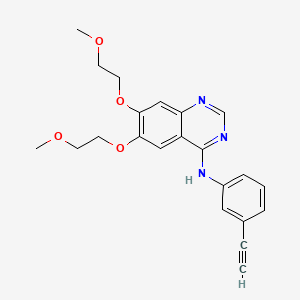
| Formula | C22H23N3O4 |
|---|---|
| Molecular weight | 393.44 g/mol |
| IUPAC name | N-(3-ethynylphenyl)-6,7-bis(2-methoxyethoxy)quinazolin-4-amine |
| CAS | 183321-74-6 |
| PubChem CID | 176870 |
| InChIKey | AAKJLRGGTJKAMG-UHFFFAOYSA-N |
| logP | 3.41 (XLogP 3.3) |
| Polar surface area | 74.73 Ų |
| H-bond acceptors / donors | 7 / 1 |
| Drug-likeness (QED) | 0.42 |
| Lipinski violations | 0 |
SMILES
C#Cc1cccc(Nc2ncnc3cc(OCCOC)c(OCCOC)cc23)c1Biology & Pharmacokinetics
Pharmacokinetics
| BBB penetrant | Yes |
|---|
Enzyme interactions
| Enzyme | Role | Detail |
|---|---|---|
| CYP1A2 | Substrate | — |
| CYP2B6 | Inhibitor | — |
| CYP2C8 | Inhibitor | — |
| CYP2C9 | Inhibitor | — |
| CYP3A4 | Inhibitor | Ki 6.3 µM |
| CYP3A4 | Substrate | — |
Receptor binding (top 3)
| Target | Action | Affinity |
|---|---|---|
| epidermal growth factor receptor (EGFR) | Inhibitor | pKd 9.2 |
| epidermal growth factor receptor (EGFR) | Inhibitor | pIC50 7.0 |
| OATP2B1 (SLCO2B1) | Inhibitor | pKi 6.3 |
Transporters
BCRP (Inhibitor)BCRP (Inhibitor)BSEP (Inhibitor)BSEP (Inhibitor)CNT1 (Inhibitor)CNT2 (Inhibitor)ENT1 (Inhibitor)ENT2 (Inhibitor)MATE1 (Inhibitor)MATE2 (Inhibitor)MDR1 (Inhibitor)MRP1 (Inhibitor)MRP2 (Inhibitor)OAT3 (Inhibitor)OATP1A2 (Inhibitor)OATP1B1 (Inhibitor)OATP1B1 (Inhibitor)OATP1B3 (Inhibitor)OATP1B3 (Inhibitor)OATP2B1 (Inhibitor)OCT1 (Inhibitor)OCT2 (Inhibitor)OCT3 (Inhibitor)P-gp (Inhibitor)BCRP (Substrate)MDR1 (Substrate)OATP1B1 (Substrate)OATP1B3 (Substrate)P-gp (Substrate)Transporter(unspecified) (Substrate)
Drug–drug interactions (100+, DDInter)
| Interacting drug | Severity | Management |
|---|---|---|
| Aminolevulinic acid | major | |
| Dexlansoprazole | major | |
| Esomeprazole | major | |
| Lansoprazole | major | |
| Leflunomide | major | |
| Lomitapide | major | |
| Mipomersen | major | |
| Omeprazole | major | |
| Pantoprazole | major | |
| Pexidartinib | major | |
| Rabeprazole | major | |
| Teriflunomide | major | |
| Abametapir (topical) | moderate | |
| Alpelisib | moderate | |
| Aluminum hydroxide | moderate | |
| Aminoglutethimide | moderate | |
| Aminolevulinic acid (topical) | moderate | |
| Amiodarone | moderate | |
| Amobarbital | moderate | |
| Amprenavir | moderate | |
| Anisindione | moderate | |
| Apalutamide | moderate | |
| Asparaginase Erwinia chrysanthemi | moderate | |
| Asparaginase Escherichia coli | moderate | |
| Atazanavir | moderate | |
| Bedaquiline | moderate | |
| Bexarotene | moderate | |
| Boceprevir | moderate | |
| Bosentan | moderate | |
| Brentuximab vedotin | moderate | |
| Brigatinib | moderate | |
| Butabarbital | moderate | |
| Butalbital | moderate | |
| Cabozantinib | moderate | |
| Calaspargase pegol | moderate | |
| Calcium carbonate | moderate | |
| Cannabidiol | moderate | |
| Capmatinib | moderate | |
| Carbamazepine | moderate | |
| Cenobamate | moderate |
Showing 40 of 100+.
Registered Products (7)
| Brand | Form / strength | Pack | Agent | Citizen (JOD) |
|---|---|---|---|---|
| Mirata 100mg F.C Tab | Film-Coated Tablet 100 mg | 30 tab | Hikma Pharmaceuticals Co.Ltd/Jordan | — |
| Mirata 150mg F.C Tab | Film-Coated Tablet 150 mg | 30 tab | Hikma Pharmaceuticals Co.Ltd/Jordan | — |
| Orliba 100mg Film Coated Tablet | Film-Coated Tablet 100 mg | 30 tab | MS PHARMA/JORDAN | — |
| Orliba 150mg Film Coated Tablet | Film-Coated Tablet 150 mg | 30 tab | MS PHARMA/JORDAN | — |
| Orliba 25mg Film Coated Tablet | Film-Coated Tablet 25.00 mg | 30 tab | MS PHARMA/JORDAN | — |
| Tarceva | Tablet 100 mg | 30 tab | Shawi & Rushedat Drug Store | — |
| Tarceva F.C.Tablet | Film-Coated Tablet 150 mg | 30 tab | Shawi & Rushedat Drug Store | — |