Rabeprazole
JFDA label: Ulcerbrex 20mg Tab
Mechanism of Action
Potent proton pump inhibitor; suppresses gastric acid secretion by inhibiting the parietal cell H+/K+ ATP pump
Indications
Approved
- Canadian labeling
- Duodenal ulcers (tablets only)
- Erosive or ulcerative (tablets only)
- Gastroesophageal reflux disease
- Helicobacter pylori eradication (tablets only)
- Pathological hypersecretory conditions (tablets only)
- Symptomatic
Off-label
- Duodenal ulcer (maintenance of healing/prevention of relapse)
- NSAID-induced ulcer (treatment/prevention)
- Stress ulcer prophylaxis in critically-ill patients
Contraindications
Source: Lexicomp
- Hypersensitivity (eg, anaphylaxis, anaphylactic shock, angioedema, bronchospasm, acute interstitial nephritis, urticaria) to rabeprazole, other substituted benzimidazoles, or any component of the formulation Absolute
- concomitant use with rilpivirine-containing products Absolute
Adverse Reactions
Cardiac disorders (1)
Very Common Peripheral edema, flatulence, constipation, xerostomia
Musculoskeletal and connective tissue disorders (1)
Very Common Arthralgia
Other (1)
Very Common Gastrointestinal: Diarrhea (children and adolescents: 5% to 21%; adults: 1% to 10%:
Dosing
Source: Lexicomp
Warnings & Precautions
Source: Lexicomp
Atrophic gastritis
Long-term omeprazole therapy has caused atrophic gastritis (by biopsy); this may also occur with rabeprazole.
Carcinoma
No reports of adenomatoid, dysplastic or neoplastic changes of enterochromaffin-like (ECL) cells in the gastric mucosa have occurred.
Clostridium difficile-associated diarrhea (CDAD)
Use of proton pump inhibitors (PPIs) may increase risk of CDAD, especially in hospitalized patients; consider CDAD diagnosis in patients with persistent diarrhea that does not improve. Use the lowest dose and shortest duration of PPI therapy appropriate for the condition being treated.
Cutaneous and systemic lupus erythematosus
Has been reported as new onset or exacerbation of existing autoimmune disease; most cases were cutaneous lupus erythematosus (CLE), most commonly, subacute CLE (occurring within weeks to years after continuous therapy). Systemic lupus erythematosus (SLE) is less common (typically occurs within days to years after initiating treatment) and occurred primarily in young adults up to the elderly. Discontinue therapy if signs or symptoms of CLE or SLE occur and refer to specialist for evaluation; most patients improve 4 to 12 weeks after discontinuation of rabeprazole.
Fractures
Increased incidence of osteoporosis-related bone fractures of the hip, spine, or wrist may occur with proton pump inhibitor (PPI) therapy. Patients on high-dose (multiple daily doses) or long-term therapy (≥1 year) should be monitored. Use the lowest effective dose for the shortest duration of time, use vitamin D and calcium supplementation, and follow appropriate guidelines to reduce risk of fractures in patients at risk.
Gastrointestinal infection (eg, Salmonella, Campylobacter)
Use of proton pump inhibitors may increase risk of these infections.
Hypomagnesemia
Reported rarely, usually with prolonged PPI use of ≥3 months (most cases >1 year of therapy). May be symptomatic or asymptomatic; severe cases may cause tetany, seizures, and cardiac arrhythmias. Consider obtaining serum magnesium concentrations prior to beginning long-term therapy, especially if taking concomitant digoxin, diuretics, or other drugs known to cause hypomagnesemia; and periodically thereafter. Hypomagnesemia may be corrected by magnesium supplementation, although discontinuation of rabeprazole may be necessary; magnesium levels typically return to normal within 1 week of stopping.
Interstitial nephritis
Acute interstitial nephritis has been observed in patients taking PPIs; may occur at any time during therapy and is generally due to an idiopathic hypersensitivity reaction. Discontinue if acute interstitial nephritis develops.
Vitamin B12 deficiency
Prolonged treatment (>3 years) may lead to vitamin B12 malabsorption and subsequent vitamin B12 deficiency. The magnitude of the deficiency is dose-related and the association is stronger in females and those younger in age ( Disease-related concerns:
Gastric malignancy
Relief of symptoms does not preclude the presence of a gastric malignancy.
Hepatic impairment
Avoid use in patients with severe hepatic impairment; if treatment is necessary monitor for adverse reactions. Concurrent drug therapy issues:
Clopidogrel
Proton pump inhibitors (PPIs) may diminish the therapeutic effect of clopidogrel, thought to be due to reduced formation of the active metabolite of clopidogrel. The manufacturer of clopidogrel recommends either avoidance of both omeprazole (even when scheduled 12 hours apart) and esomeprazole or use of a PPI with comparatively less effect on the active metabolite of clopidogrel. Avoidance of rabeprazole appears prudent due to potent in vitro CYP2C19 inhibition (Li 2004) and lack of sufficient comparative in vivo studies with other PPIs. In contrast to these warnings, others have recommended the continued use of PPIs, regardless of the degree of inhibition, in patients with a history of GI bleeding or multiple risk factors for GI bleeding who are also receiving clopidogrel since no evidence has established clinically meaningful differences in outcome; however, a clinically-significant interaction cannot be excluded in those who are poor metabolizers of clopidogrel (Abraham 2010; Levine 2011).
Drug-drug interactions
Potentially significant interactions may exist, requiring dose or frequency adjustment, additional monitoring, and/or selection of alternative therapy. Consult drug interactions database for more detailed information. Other warnings/precautions:
Appropriate use
Helicobacter pylori eradication: Short-term combination therapy (≤7 days) has been associated with a higher incidence of treatment failure. The American College of Gastroenterology recommends 10 to 14 days of therapy (triple or quadruple) for eradication of H. pylori (Chey 2017).
Pregnancy & Lactation
Pregnancy
Available studies have not shown an increased risk of major birth defects following maternal use of proton pump inhibitors during pregnancy; however, information specific to rabeprazole is limited (Pasternak 2010); most information available for omeprazole. When treating GERD in pregnancy, PPIs may be used when clinically indicated (Katz 2013).
Lactation
It is not known if rabeprazole is present in breast milk. According to the manufacturer, the decision to continue or discontinue breastfeeding during therapy should take into account the risk of infant exposure, the benefits of breastfeeding to the infant, and benefits of treatment to the mother.
Monitoring
| Clinical pearl | Magnesium levels (prior to initiation of therapy and periodically thereafter) in patients on long-term treatment or those taking digoxin, diuretics, or other drugs that cause hypomagnesemia; susceptibility testing recommended in patients who fail H. pylori eradication regimen. |
|---|
Chemistry & Properties
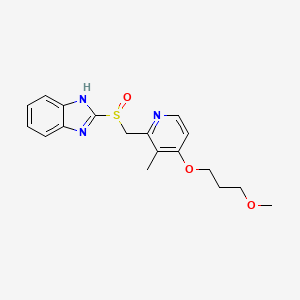
| Formula | C18H21N3O3S |
|---|---|
| Molecular weight | 359.45 g/mol |
| IUPAC name | 2-[[4-(3-methoxypropoxy)-3-methyl-2-pyridinyl]methylsulfinyl]-1H-benzimidazole |
| CAS | 117976-89-3 |
| PubChem CID | 5029 |
| InChIKey | YREYEVIYCVEVJK-UHFFFAOYSA-N |
| logP | 2.99 (XLogP 1.9) |
| Polar surface area | 83.09 Ų |
| H-bond acceptors / donors | 5 / 1 |
| Drug-likeness (QED) | 0.49 |
| Lipinski violations | 0 |
SMILES
COCCCOc1ccnc(C[S+]([O-])c2nc3ccccc3[nH]2)c1CBiology & Pharmacokinetics
Pharmacokinetics predicted
| Bioavailability | 10.0% |
|---|---|
| Half-life | 0.651 h |
| Volume of distribution | 0.273 L/kg |
| Protein binding | 95.0% |
| BBB penetrant | No |
Enzyme interactions
| Enzyme | Role | Detail |
|---|---|---|
| CYP1A2 | Inhibitor | — |
| CYP1A2 | Substrate | — |
| CYP2C19 | Inhibitor | — |
| CYP2C19 | Substrate | — |
| CYP2C8 | Inhibitor | — |
| CYP3A4 | Inhibitor | — |
| CYP3A4 | Substrate | — |
Transporters
BCRP (Inhibitor)BCRP (Inhibitor)BSEP (Inhibitor)BSEP (Inhibitor)MDR1 (Inhibitor)MRP1 (Inhibitor)MRP2 (Inhibitor)MRP3 (Inhibitor)MRP4 (Inhibitor)OAT3 (Inhibitor)OATP1B1 (Inhibitor)OATP1B3 (Inhibitor)OCT1 (Inhibitor)OCT2 (Inhibitor)OCT3 (Inhibitor)P-gp (Inhibitor)Transporter(unspecified) (Inhibitor)P-gp (Substrate)
Drug–drug interactions (100+, DDInter)
| Interacting drug | Severity | Management |
|---|---|---|
| Acalabrutinib | major | |
| Atazanavir | major | |
| Clopidogrel | major | |
| Dacomitinib | major | |
| Dasatinib | major | |
| Erlotinib | major | |
| Methotrexate | major | |
| Nelfinavir | major | |
| Neratinib | major | |
| Pazopanib | major | |
| Pexidartinib | major | |
| Rilpivirine | major | |
| Selpercatinib | major | |
| Velpatasvir | major | |
| Abametapir (topical) | moderate | |
| Amikacin | moderate | |
| Amikacin (liposome) | moderate | |
| Amphetamine | moderate | |
| Amphotericin B | moderate | |
| Amphotericin B (cholesteryl sulfate) | moderate | |
| Amphotericin B (lipid complex) | moderate | |
| Amphotericin B (liposomal) | moderate | |
| Anisindione | moderate | |
| Apalutamide | moderate | |
| Aprepitant | moderate | |
| Armodafinil | moderate | |
| Bacampicillin | moderate | |
| Bendroflumethiazide | moderate | |
| Benzthiazide | moderate | |
| Bosutinib | moderate | |
| Brigatinib | moderate | |
| Bumetanide | moderate | |
| Capreomycin | moderate | |
| Carboplatin | moderate | |
| Cefditoren | moderate | |
| Cefpodoxime | moderate | |
| Cefuroxime | moderate | |
| Ceritinib | moderate | |
| Cetuximab | moderate | |
| Chlorothiazide | moderate |
Showing 40 of 100+.
Registered Products (2)
| Brand | Form / strength | Pack | Agent | Citizen (JOD) |
|---|---|---|---|---|
| Ulcerbrex | Tablet 20 mg | 14 tab | Ibn Rushd Drug Store | 5.690 |
| Rabex | Tablet 20 mg | 28 tab | Alshefra Dru Store company | 11.060 |