Omeprazole
Active form: Omeprazole Sulfenamide.
JFDA label: Omisec Capsules
Mechanism of Action
Inhibitor of Potassium-transporting ATPase — Potassium-transporting ATPase inhibitor
| Target | Action | Gene / class |
|---|---|---|
| Potassium-transporting ATPase efficacy | INHIBITOR |
Indications
Approved
- Dual therapy
- Duodenal ulcer (Rx only)
- Gastric ulcer (Rx only)
- Gastroesophageal reflux disease (Rx only)
- Heartburn (OTC only)
- Helicobacter pylori eradication (Rx only)
- Maintenance healing of erosive esophagitis
- Pathological hypersecretory conditions (Rx only)
- Symptomatic gastroesophageal reflux disease
- Treatment of erosive esophagitis
- Triple therapy
Off-label
- Healing NSAID-induced ulcers
- Prevention of NSAID-induced ulcer
- Stress ulcer prophylaxis in critically-ill patients
Contraindications
Source: Lexicomp
- Hypersensitivity (eg, anaphylaxis, anaphylactic shock, angioedema, bronchospasm, interstitial nephritis, urticaria) to omeprazole, other substituted benzimidazole proton pump inhibitors, or any component of the formulation Absolute
- chest pain or shoulder pain with shortness of breath, sweating, pain spreading to arms, neck or shoulders, or lightheadedness Absolute
- concomitant use with products that contain rilpivirine OTC labeling: When used for self-medication (OTC), do not use if trouble or pain when swallowing food Absolute
- frequent chest pain Absolute
- heartburn with lightheadedness, dizziness, or sweating Absolute
- vomiting with blood, or bloody or black stools Absolute
Adverse Reactions
Nervous system disorders (3)
Common dizziness · Headache · Headache
Renal and urinary disorders (1)
Rare Interstitial nephritis
Metabolism and nutrition disorders (2)
Uncommon Hypomagnesaemia (long-term use) · Vitamin B12 deficiency (long-term use)
Gastrointestinal disorders (11)
Common Abdominal pain · Abdominal pain · acid regurgitation · constipation · diarrhea · Diarrhoea · flatulence · Fundic gland polyps (long-term) · Nausea · nausea · vomiting
Skin and subcutaneous tissue disorders (1)
Common Skin rash
Musculoskeletal and connective tissue disorders (2)
Common Back pain · weakness
Infections and infestations (1)
Uncommon Clostridioides difficile colitis (increased risk)
Respiratory, thoracic and mediastinal disorders (2)
Common cough · Upper respiratory infection
Dosing
Source: Lexicomp
Warnings & Precautions
Source: Lexicomp
Carcinoma
In long-term (2-year) studies in rats, omeprazole produced a dose-related increase in gastric carcinoid tumors. While available endoscopic evaluations and histologic examinations of biopsy specimens from human stomachs have not detected a risk from short-term exposure to omeprazole, further human data on the effect of sustained hypochlorhydria and hypergastrinemia are needed to rule out the possibility of an increased risk for the development of tumors in humans receiving long-term therapy.
Clostridium difficile-associated diarrhea (CDAD)
Use of proton pump inhibitors (PPIs) may increase risk of CDAD, especially in hospitalized patients; consider CDAD diagnosis in patients with persistent diarrhea that does not improve. Use the lowest dose and shortest duration of PPI therapy appropriate for the condition being treated.
Cutaneous and systemic lupus erythematosus
Has been reported as new onset or exacerbation of existing autoimmune disease; most cases were cutaneous lupus erythematosus (CLE), most commonly, subacute CLE (occurring within weeks to years after continuous therapy). Systemic lupus erythematosus (SLE) is less common (typically occurs within days to years after initiating treatment) and occurred primarily in young adults up to the elderly. Discontinue therapy if signs or symptoms of CLE or SLE occur and refer to specialist for evaluation; most patients improve 4 to 12 weeks after discontinuation of omeprazole.
Fractures
Increased incidence of osteoporosis-related bone fractures of the hip, spine, or wrist may occur with proton pump inhibitor (PPI) therapy. Patients on high-dose (multiple daily doses) or long-term (≥1 year) therapy should be monitored. Use the lowest effective dose for the shortest duration of time, use vitamin D and calcium supplementation, and follow appropriate guidelines to reduce risk of fractures in patients at risk.
Hypomagnesemia
Reported rarely, usually with prolonged PPI use of ≥3 months (most cases >1 year of therapy). May be symptomatic or asymptomatic; severe cases may cause tetany, seizures, and cardiac arrhythmias. Consider obtaining serum magnesium concentrations prior to beginning long-term therapy, especially if taking concomitant digoxin, diuretics, or other drugs known to cause hypomagnesemia; and periodically thereafter. Hypomagnesemia may be corrected by magnesium supplementation, although discontinuation of omeprazole may be necessary; magnesium levels typically return to normal within 1 week of stopping.
Interstitial nephritis
Acute interstitial nephritis has been observed in patients taking PPIs; may occur at any time during therapy and is generally due to an idiopathic hypersensitivity reaction. Discontinue if acute interstitial nephritis develops.
Vitamin B12 deficiency
Prolonged treatment (>3 years) may lead to vitamin B12 malabsorption and subsequent vitamin B12 deficiency. The magnitude of the deficiency is dose-related and the association is stronger in females and those younger in age ( Disease-related concerns:
Gastric malignancy
Relief of symptoms does not preclude the presence of a gastric malignancy.
Gastrointestinal infection (eg, Salmonella, Campylobacter)
Use of PPIs may increase risk of these infections.
Hepatic impairment
In patients with hepatic impairment (Child-Pugh class A, B, or C) exposure to omeprazole is increased; dosage reduction is recommended. Concurrent drug therapy issues:
Clopidogrel
Proton pump inhibitors (PPIs) may diminish the therapeutic effect of clopidogrel, thought to be due to reduced formation of the active metabolite of clopidogrel. The manufacturer of clopidogrel recommends either avoidance of both omeprazole (even when scheduled 12 hours apart) and esomeprazole or use of a PPI with comparatively less effect on the active metabolite of clopidogrel (eg, pantoprazole). In contrast to these warnings, others have recommended the continued use of PPIs, regardless of the degree of inhibition, in patients with a history of GI bleeding or multiple risk factors for GI bleeding who are also receiving clopidogrel since no evidence has established clinically meaningful differences in outcome; however, a clinically significant interaction cannot be excluded in those who are poor metabolizers of clopidogrel (Abraham, 2010; Levine, 2011).
Drug-drug interactions
Potentially significant interactions may exist, requiring dose or frequency adjustment, additional monitoring, and/or selection of alternative therapy. Consult drug interactions database for more detailed information. Special populations:
Asian ethnicity
Bioavailability is increased in patients of Asian descent; dosage reduction is recommended for maintenance healing of erosive esophagitis.
Elderly
Bioavailability may be increased in the elderly. Dosage form specific issues:
Benzyl alcohol and derivatives
Some dosage forms may contain benzyl alcohol; large amounts of benzyl alcohol (≥99 mg/kg/day) have been associated with a potentially fatal toxicity (“gasping syndrome”) in neonates; the “gasping syndrome” consists of metabolic acidosis, respiratory distress, gasping respirations, CNS dysfunction (including convulsions, intracranial hemorrhage), hypotension, and cardiovascular collapse (AAP ["Inactive" 1997]; CDC 1982); some data suggests that benzoate displaces bilirubin from protein binding sites (Ahlfors 2001); avoid or use dosage forms containing benzyl alcohol with caution in neonates. See manufacturer's labeling. Other warnings/precautions:
Appropriate use
Helicobacter pylori eradication: Short-term combination therapy (≤7 days) has been associated with a higher incidence of treatment failure. The American College of Gastroenterology recommends 10 to 14 days of therapy (triple or quadruple) for eradication of H. pylori (Chey 2017).
Laboratory test interference
Serum chromogranin A (CgA) levels increase secondary to drug-induced decreases in gastric acid; may cause false-positive results in diagnostic investigations for neuroendocrine tumors. Temporarily stop omeprazole treatment at least 14 days before CgA test; if initial CgA levels are high, repeat test to confirm. Use same commercial laboratory for testing to prevent variable results.
Self-medication (OTC use)
When used for self-medication (OTC), notify health care provider before use if any of the following are present: heartburn for >3 months; frequent wheezing, particularly with heartburn; unexplained weight loss; nausea or vomiting; or stomach pain. Discontinue use and notify health care provider if heartburn continues or worsens; diarrhea occurs; if >14 days of therapy is needed; or if >1 course of therapy is needed every 4 months.
Pregnancy & Lactation
Pregnancy
Safe
First-line PPI in pregnancy when antacids and H2 blockers insufficient. Ranitidine (H2 blocker) sometimes preferred as older data
Lactation
Omeprazole is excreted in breast milk. The relative infant dose (RID) of omeprazole is 0.2% to 0.43% when calculated using the highest average breast milk concentration located and compared to an infant therapeutic dose of 0.7 to 1.5 mg/kg/day. In general, breastfeeding is considered acceptable when the RID is 25% breastfeeding should generally be avoided (Anderson 2016; Ito 2000). Using the highest average milk concentration (20.03 mcg/L), the estimated daily infant dose via breast milk is 0.
Monitoring
| Clinical pearl | Susceptibility testing is recommended in patients who fail H. pylori-eradication regimen; magnesium levels (prior to initiation of therapy and periodically thereafter). |
|---|
Chemistry & Properties
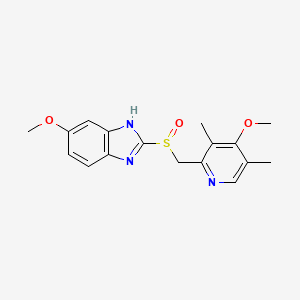
| Formula | C17H19N3O3S |
|---|---|
| Molecular weight | 345.42 g/mol |
| IUPAC name | 6-methoxy-2-[(4-methoxy-3,5-dimethyl-2-pyridinyl)methylsulfinyl]-1H-benzimidazole |
| CAS | 73590-58-6 |
| PubChem CID | 4594 |
| InChIKey | SUBDBMMJDZJVOS-UHFFFAOYSA-N |
| logP | 2.9 (XLogP 2.2) |
| Polar surface area | 83.09 Ų |
| H-bond acceptors / donors | 5 / 1 |
| Drug-likeness (QED) | 0.72 |
| Lipinski violations | 0 |
SMILES
COc1ccc2[nH]c([S+]([O-])Cc3ncc(C)c(OC)c3C)nc2c1Biology & Pharmacokinetics
Pharmacokinetics
| BBB penetrant | Yes (logBB -0.82) |
|---|
Enzyme interactions
| Enzyme | Role | Detail |
|---|---|---|
| CYP1A2 | Inhibitor | — |
| CYP1A2 | Substrate | — |
| CYP2C19 | Inhibitor | — |
| CYP2C19 | Substrate | IC₅₀ 6.324769553762809 µM |
| CYP2C8 | Inhibitor | — |
| CYP2C9 | Inhibitor | Ki 45.00000000000003 µM |
| CYP2C9 | Substrate | — |
| CYP2D6 | Substrate | — |
| CYP3A4 | Inhibitor | — |
| CYP3A4 | Substrate | IC₅₀ 77.98301000000002 µM |
Transporters
BCRP (Inhibitor)BCRP (Inhibitor)BSEP (Inhibitor)BSEP (Inhibitor)MATE1 (Inhibitor)MDR1 (Inhibitor)MRP1 (Inhibitor)MRP2 (Inhibitor)MRP3 (Inhibitor)MRP4 (Inhibitor)OAT1 (Inhibitor)OAT3 (Inhibitor)OATP1B1 (Inhibitor)OATP1B1 (Inhibitor)OATP1B3 (Inhibitor)OATP1B3 (Inhibitor)OATP2B1 (Inhibitor)OCT1 (Inhibitor)OCT2 (Inhibitor)OCTN2 (Inhibitor)P-gp (Inhibitor)MDR1 (Substrate)P-gp (Substrate)
Drug–drug interactions (100+, DDInter)
| Interacting drug | Severity | Management |
|---|---|---|
| Acalabrutinib | major | |
| Atazanavir | major | |
| Cilostazol | major | |
| Citalopram | major | |
| Clopidogrel | major | |
| Dacomitinib | major | |
| Dasatinib | major | |
| Erlotinib | major | |
| Methotrexate | major | |
| Nelfinavir | major | |
| Neratinib | major | |
| Pazopanib | major | |
| Pexidartinib | major | |
| Rilpivirine | major | |
| Selpercatinib | major | |
| Tacrolimus | major | |
| Velpatasvir | major | |
| Abametapir (topical) | moderate | |
| Alprazolam | moderate | |
| Amikacin | moderate | |
| Amikacin (liposome) | moderate | |
| Amphetamine | moderate | |
| Amphotericin B | moderate | |
| Amphotericin B (cholesteryl sulfate) | moderate | |
| Amphotericin B (lipid complex) | moderate | |
| Amphotericin B (liposomal) | moderate | |
| Anagrelide | moderate | |
| Anisindione | moderate | |
| Apalutamide | moderate | |
| Armodafinil | moderate | |
| Atorvastatin | moderate | |
| Bacampicillin | moderate | |
| Bendamustine | moderate | |
| Bendroflumethiazide | moderate | |
| Benzthiazide | moderate | |
| Binimetinib | moderate | |
| Bosutinib | moderate | |
| Bumetanide | moderate | |
| Capreomycin | moderate | |
| Carboplatin | moderate |
Showing 40 of 100+.
Registered Products (52)
| Brand | Form / strength | Pack | Agent | Citizen (JOD) |
|---|---|---|---|---|
| OMEDAR TABS. | Tablet 20 mg | 7 tab pack varies | Dar Al Dawa Development and Investment Co Ltd/Jordan | 2.840 |
| Gasec Gastro resistant | Capsule 20 mg | 14 cap pack varies | 3R Pharmaceutical Industries | 3.250 |
| Odasol | Tablet 20 mg | 14 tab | Orient Montreal Drug Store | 3.250 |
| Oprazole 10 Tablets | Tablet 10 mg | 10 tab pack varies | Hikma Pharmaceuticals Co.Ltd/Jordan | 3.330 |
| Omeprex Capsules | Capsule 20 mg | 14 cap pack varies | Ibn Rushd Drug Store | 3.520 |
| Rythmogastryl | Tablet 20 mg | 14 tab pack varies | Mohamad Zreiqat Drug Store | 3.660 |
| Hyposec- | Capsule 20 mg | 10 cap pack varies | AL-RAM PHARMA.INDUS.CO.LTD/JORDAN | 4.300 |
| Omisec Capsules | Capsule 20 mg | 10 cap pack varies | UNITED PHARM.MFG.CO.LTD(UPM)/JORDAN | 4.300 |
| Oprazole 20 EC Tablets | Tablet 20 mg | 10 tab pack varies | Hikma Pharmaceuticals Co.Ltd/Jordan | 4.300 |
| Omedar E/C Tablet | Tablet 10 mg | 14 tab pack varies | Dar Al Dawa Development and Investment Co Ltd/Jordan | 4.660 |
| Oprazole 10 Tablets | Tablet 10 mg | 14 tab pack varies | Hikma Pharmaceuticals Co.Ltd/Jordan | 4.660 |
| Oprazole Plus | Capsule 20 mg, 1100 mg | 1 cap | Hikma Pharmaceuticals Co.Ltd/Jordan | 4.810 |
| LOSEC MUPS TAB | Tablet 10 mg | 14 tab | Shawi & Rushedat Drug Store | 4.910 |
| Losec Mups Tablet | Tablet 20 mg | 14 tab | Shawi & Rushedat Drug Store | 5.030 |
| OMEDAR TABS. | Tablet 20 mg | 14 tab pack varies | Dar Al Dawa Development and Investment Co Ltd/Jordan | 5.410 |
| ProRise 40MG/1100MG , Hard gelatin Capsule | Capsule Omeprazole 40 mg, Sodium Bicarbonate 1100 mg | 14 cap pack varies | Professional Drug Store | 5.910 |
| Hyposec- | Capsule 20 mg | 14 cap pack varies | AL-RAM PHARMA.INDUS.CO.LTD/JORDAN | 6.020 |
| Lopraz Capsule | Capsule 20 mg | 14 cap pack varies | Hayat Pharmaceutical Industries CO.PLC/JORDAN | 6.020 |
| Omisec Capsules | Capsule 20 mg | 14 cap pack varies | UNITED PHARM.MFG.CO.LTD(UPM)/JORDAN | 6.020 |
| Oprazole 20 EC Tablets | Tablet 20 mg | 14 tab pack varies | Hikma Pharmaceuticals Co.Ltd/Jordan | 6.020 |
| Risek Capsule | Capsule 20 mg | 14 cap | Professional Drug Store | 6.040 |
| Gasec Gastro resistant | Capsule 20 mg | 28 cap pack varies | 3R Pharmaceutical Industries | 6.180 |
| Omeprex Capsules | Capsule 20 mg | 28 cap pack varies | Ibn Rushd Drug Store | 6.690 |
| ZEGACID 40 | Capsule 40 mg, 1100 mg | 30 cap | Sahar Drug Store | 6.690 |
| Omezyn Plus | Capsule 40 mg, 1100 mg | 14 cap pack varies | Noor Drug Store | 6.890 |
| Rythmogastryl | Capsule 20 mg | 28 cap pack varies | Mohamad Zreiqat Drug Store | 8.150 |
| Hyposec- | Capsule 20 mg | 20 cap pack varies | AL-RAM PHARMA.INDUS.CO.LTD/JORDAN | 8.600 |
| Hyposec- | Capsule 20 mg | 28 cap pack varies | AL-RAM PHARMA.INDUS.CO.LTD/JORDAN | 9.560 |
| Omedar Tablet | Tablet 20 mg | 28 tab | Dar Al Dawa Development and Investment Co Ltd/Jordan | 10.280 |
| Lopraz Capsule | Capsule 20 mg | 28 cap pack varies | Hayat Pharmaceutical Industries CO.PLC/JORDAN | 11.440 |
| Oprazole 20 EC Tablets | Tablet 20 mg | 28 tab pack varies | Hikma Pharmaceuticals Co.Ltd/Jordan | 11.440 |
| RISEK CAP. | Capsule 20 mg | 28 cap | Professional Drug Store | 11.470 |
| ProRise 40MG/1100MG , Hard gelatin Capsule | Capsule Omeprazole 40 mg, Sodium Bicarbonate 1100 mg | 30 cap pack varies | Professional Drug Store | 12.060 |
| Hyposec- | Capsule 20 mg | 30 cap pack varies | AL-RAM PHARMA.INDUS.CO.LTD/JORDAN | 12.130 |
| Omezyn Plus | Capsule 40 mg, 1100 mg | 28 cap pack varies | Noor Drug Store | 13.130 |
| Oprazole Plus | Capsule 40 mg, 1100 mg | 1 cap | Hikma Pharmaceuticals Co.Ltd/Jordan | 15.020 |
| Hyposec- | Capsule 20 mg | 45 cap pack varies | AL-RAM PHARMA.INDUS.CO.LTD/JORDAN | 18.190 |
| Hyposec- | Capsule 20 mg | 56 cap pack varies | AL-RAM PHARMA.INDUS.CO.LTD/JORDAN | 22.120 |
| Omisec Capsules | Capsule 20 mg | 350 cap pack varies | UNITED PHARM.MFG.CO.LTD(UPM)/JORDAN | 127.930 |
| Omedar E/C Tablet | Tablet 10 mg | 504 tab pack varies | Dar Al Dawa Development and Investment Co Ltd/Jordan | 142.600 |
| OMEDAR TABS. | Tablet 20 mg | 504 tab pack varies | Dar Al Dawa Development and Investment Co Ltd/Jordan | 165.550 |
| Hyposec- | Capsule 20 mg | 700 cap pack varies | AL-RAM PHARMA.INDUS.CO.LTD/JORDAN | 246.090 |
| Omisec Capsules | Capsule 20 mg | 700 cap pack varies | UNITED PHARM.MFG.CO.LTD(UPM)/JORDAN | 255.850 |
| Ipproton | Vial 40 mg | 10 vial | Professional Drug Store | — |
| Lordin | Ampoule 40 mg | 1 amp | Manar Drug Store | — |
| Odasol | Ampoule 40 mg | 1 amp | Orient Montreal Drug Store | — |
| Omisec 40mg Vial Powder for solution fro inj | Powder for Injection 40 mg | 1 vial pack varies | MS PHARMA/JORDAN | — |
| Omisec 40mg Vial Powder for solution fro inj | Powder for Injection 40 mg | 5 vial pack varies | MS PHARMA/JORDAN | — |
| Oprazole IV Infusion | Infusion 40 mg | 1 vial | Hikma Pharmaceuticals Co.Ltd/Jordan | — |
| Risek | Vial 40 mg | 1 vial | Professional Drug Store | — |
| Ulcazal | Vial 40 mg | 1 vial pack varies | Adonis Drug Store | — |
| Ulcazal | Vial 40 mg | 10 vial pack varies | Adonis Drug Store | — |