Irinotecan
Active form: 7-Ethyl-10-Hydroxycamptothecin.
JFDA label: Irinotel
- Diarrhea:
- Bone marrow suppression:
- Diarrhea
Mechanism of Action
Irinotecan and its active metabolite (SN-38) bind reversibly to topoisomerase I-DNA complex preventing religation of the cleaved DNA strand. This results in the accumulation of cleavable complexes and double-strand DNA breaks. As mammalian cells cannot efficiently repair these breaks, cell death consistent with S-phase cell cycle specificity occurs, leading to termination of cellular replication.
Indications
Approved
- Colorectal cancer, metastatic
Off-label
- CNS tumor, (recurrent glioblastoma)
- Cervical cancer (recurrent or metastatic)
- Esophageal cancer (metastatic or locally advanced)
- Ewing sarcoma (recurrent or progressive)
- Gastric cancer (metastatic or locally advanced)
- Non-small cell lung cancer (advanced)
- Ovarian cancer (recurrent)
- Pancreatic cancer (advanced)
- Rhabdomyosarcoma (metastatic or relapsed/progressive) (pediatrics)
- Small cell lung cancer (extensive stage)
- Small cell lung cancer (limited stage)
- Unknown primary adenocarcinoma
Class profile
| mechanismClass | Plant alkaloid (camptothecin, topoisomerase I inhibitor) |
|---|---|
| targetMolecule | Topoisomerase I (DNA strand re-ligation) |
| targetPathway | DNA replication (S-phase) |
| generation | Classic |
| primaryTumors | Colorectal,Lung,Cervical,Ovarian |
| resistanceMechanisms | MRP1/ABCG2 efflux of active metabolite SN-38,UGT1A1 slow metabolizer (accumulation),Topoisomerase I mutation |
| source | NCCN/OncoKB/Goodman&Gilman13ed |
Contraindications
Source: Lexicomp
- Additional contraindications (not in US labeling): Coadministraton with azole antifungals (ketoconazole, fluconazole, itraconazole) Absolute
- Known hypersensitivity to irinotecan or any component of the formulation Absolute
- patients with hereditary fructose intolerance Absolute
Adverse Reactions
Cardiac disorders (4)
Very Common Vasodilatation
Common Edema · hypotension · thromboembolism
Nervous system disorders (8)
Very Common chills · Cholinergic syndrome · dizziness · headache · insomnia · pain
Common confusion · Drowsiness
Hepatobiliary disorders (5)
Very Common increased serum alkaline phosphatase · Increased serum bilirubin
Common ascites · Increased serum AST · jaundice
Blood and lymphatic system disorders (7)
Very Common Anemia · leukopenia · neutropenia · thrombocytopenia
Common Febrile neutropenia · hemorrhage · neutropenic infection
Metabolism and nutrition disorders (2)
Very Common dehydration · Weight loss
Gastrointestinal disorders (11)
Very Common abdominal cramps · abdominal pain · anorexia · constipation · flatulence · mucositis · nausea · stomatitis · vomiting
Common Abdominal distention · dyspepsia
Skin and subcutaneous tissue disorders (3)
Very Common Alopecia · diaphoresis · skin rash
Musculoskeletal and connective tissue disorders (2)
Very Common back pain · Weakness
Infections and infestations (1)
Very Common Infection
General disorders and administration site conditions (1)
Very Common Fever
Respiratory, thoracic and mediastinal disorders (4)
Very Common cough · Dyspnea · rhinitis
Common Pneumonia
Dosing
Source: Lexicomp
Warnings & Precautions
Source: Lexicomp
Bone marrow suppression
May cause severe myelosuppression. Deaths due to sepsis following severe neutropenia have been reported. Complications due to neutropenia should be promptly managed with antibiotics. Therapy should be temporarily withheld if neutropenic fever occurs or if the absolute neutrophil count is 3; reduce the dose upon recovery to an absolute neutrophil count ≥1,000/mm3. Patients who have previously received pelvic/abdominal radiation therapy have an increased risk of severe bone marrow suppression; the incidence of grade 3 or 4 neutropenia was higher in patients receiving weekly irinotecan who have previously received pelvic/abdominal radiation therapy. Concurrent radiation therapy is not recommended with irinotecan (based on limited data).
Diarrhea
Severe diarrhea may be dose-limiting and potentially fatal; early-onset and late-onset diarrhea may occur. Early diarrhea occurs during or within 24 hours of receiving irinotecan and is characterized by cholinergic symptoms; may be prevented or treated with atropine. Late diarrhea may be life-threatening and should be promptly treated with loperamide. Antibiotics may be necessary if patient develops ileus, fever, or severe neutropenia. Interrupt treatment and reduce subsequent doses for severe diarrhea. Early diarrhea is generally transient and rarely severe; cholinergic symptoms may include increased salivation, rhinitis, miosis, diaphoresis, flushing, abdominal cramping, and lacrimation; bradycardia may also occur. Cholinergic symptoms may occur more frequently with higher irinotecan doses. Late diarrhea occurs more than 24 hours after treatment, which may lead to dehydration, electrolyte imbalance, or sepsis. Late diarrhea may be complicated by colitis, ulceration, bleeding, ileus, obstruction, or infection; cases of megacolon and intestinal perforation have been reported. The median time to onset for late diarrhea is 5 days with every 3 week irinotecan dosing and 11 days with weekly dosing. Advise patients to have loperamide readily available for the treatment of late diarrhea. Patients with diarrhea should be carefully monitored and treated promptly; may require fluid and electrolyte therapy. Bowel function should be returned to baseline for at least 24 hours prior to re
Extravasation
Irinotecan is an irritant. Avoid extravasation; if extravasation occurs, the manufacturer recommends flushing the external site with sterile water and applying ice.
Gastrointestinal toxicity
Irinotecan is associated with a moderate emetic potential; antiemetics are recommended to prevent nausea and vomiting (Dupuis 2011; Hesketh 2017; Roila 2016).
Hypersensitivity
Severe hypersensitivity reactions (including anaphylaxis) have occurred. Monitor closely; discontinue therapy if hypersensitivity occurs.
Pulmonary toxicity
Fatal cases of interstitial pulmonary disease (IPD)-like events have been reported with single-agent and combination therapy. Risk factors for pulmonary toxicity include preexisting lung disease, use of pulmonary toxic medications, radiation therapy, and colony-stimulating factors. Patients with risk factors should be monitored for respiratory symptoms before and during irinotecan treatment. Promptly evaluate progressive changes in baseline pulmonary symptoms or any new-onset pulmonary symptoms (eg, dyspnea, cough, fever). Discontinue all chemotherapy if IPD is diagnosed.
Renal toxicity
Renal impairment and acute renal failure have been reported, possibly due to dehydration secondary to diarrhea. Use with caution in patients with renal impairment; not recommended in patients on dialysis.
Thromboembolism
Thromboembolic events have been reported. Disease-related concerns:
Bowel obstruction
Patients with bowel obstruction should not be treated with irinotecan until resolution of obstruction.
Hepatic impairment
Use with caution in patients with hepatic impairment; exposure to the active metabolite (SN-38) is increased; toxicities may be increased. Patients with even modest elevations in total serum bilirubin levels (1 to 2 mg/dL) have a significantly greater likelihood of experiencing first-course grade 3 or 4 neutropenia than those with bilirubin levels that were Concurrent drug therapy issues:
Drug-drug interactions
Potentially significant interactions may exist, requiring dose or frequency adjustment, additional monitoring, and/or selection of alternative therapy. Consult drug interactions database for more detailed information. CYP3A4 enzyme inducers may decrease exposure to irinotecan and SN-38 (active metabolite); enzyme inhibitors may increase exposure. For use in patients with CNS tumors (off-label use), selection of antiseizure medications that are not enzyme inducers is preferred. Special populations:
Elderly
Patients >65 years of age are at greater risk for early and late diarrhea. A dose reduction is recommended for patients ≥70 years of age receiving the every-3-week regimen.
Patients homozygous/heterozygous for the UGT1A1*28 allele
Patients homozygous for the UGT1A1*28 allele are at increased risk of neutropenia; consider reducing the initial dose by at least one dose level for both single-agent and combination regimens. Heterozygous carriers of the UGT1A1*28 allele may also be at increased neutropenic risk; however, most patients have tolerated normal starting doses. A test is available for clinical determination of UGT phenotype, although a dose reduction is already recommended in patients who have experienced toxicity.
Pelvic/abdominal radiation recipients
Use with caution in patients who have previously received pelvic/abdominal radiation; may increase risk of severe myelosuppression.
Performance status
Higher rates of hospitalization, neutropenic fever, thromboembolism, first-cycle discontinuation, and early mortality were observed in patients with a performance status of 2 than in patients with a performance status of 0 or 1. Dosage form specific issues:
Conventional vs liposomal formulation dosing
Irinotecan (conventional) and irinotecan (liposomal) are NOT interchangeable. Dosing differs between formulations; verify intended product and dose prior to preparation and administration.
Sorbitol
Product contains sorbitol; do not use in patients with hereditary fructose intolerance. Other warnings/precautions:
Appropriate use
Except as part of a clinical trial, use in combination with the fluorouracil and leucovorin administered for 4 or 5 consecutive days every 4 weeks (“Mayo Clinic” regimen) is not recommended due to increased toxicity.
Pregnancy & Lactation
Pregnancy
Adverse events were observed in animal reproduction studies. Information related to the use of irinotecan (conventional) during pregnancy is limited (Cirillo 2012; Taylor 2009). May cause fetal harm if administered during pregnancy. Women of childbearing potential should avoid becoming pregnant while receiving treatment.
Lactation
It is not known if irinotecan is present in breast milk. Due to the potential for serious adverse reactions in the breastfed infant, the manufacturer recommends a decision be made to discontinue breastfeeding or to discontinue the drug, taking into account the importance of treatment to the mother.
Monitoring
| Efficacy | Tumour response (RECIST criteria, tumour markers, imaging); progression-free survival; performance status (ECOG/Karnofsky) |
|---|---|
| Toxicity | CBC with differential (nadir timing depends on agent); LFTs; renal function; ECG (QT for relevant agents); echocardiogram for cardiotoxic agents (anthracyclines, trastuzumab); cumulative dose tracking for dose-limited toxicities |
| Clinical pearl | Treatment response is assessed after 2–3 cycles. Grade 3–4 toxicities typically require dose reduction or interruption per protocol-defined criteria. |
| Counseling | Attend all scheduled blood tests and imaging appointments. Report fever > 38°C (risk of neutropaenic sepsis — medical emergency), unusual bleeding, or new pain immediately. |
Chemistry & Properties
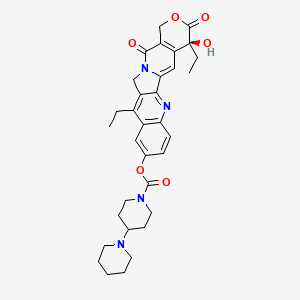
| Formula | C33H38N4O6 |
|---|---|
| Molecular weight | 586.69 g/mol |
| IUPAC name | [(19S)-10,19-diethyl-19-hydroxy-14,18-dioxo-17-oxa-3,13-diazapentacyclo[11.8.0.02,11.04,9.015,20]henicosa-1(21),2,4(9),5,7,10,15(20)-heptaen-7-yl] 4-piperidin-1-ylpiperidine-1-carboxylate |
| CAS | 97682-44-5 |
| PubChem CID | 60838 |
| InChIKey | UWKQSNNFCGGAFS-XIFFEERXSA-N |
| logP | 4.09 (XLogP 3.0) |
| Polar surface area | 114.2 Ų |
| H-bond acceptors / donors | 9 / 1 |
| Drug-likeness (QED) | 0.36 |
| Lipinski violations | 1 |
SMILES
CCc1c2c(nc3ccc(OC(=O)N4CCC(N5CCCCC5)CC4)cc13)-c1cc3c(c(=O)n1C2)COC(=O)[C@]3(O)CCBiology & Pharmacokinetics
Pharmacokinetics
| BBB penetrant | No |
|---|
Enzyme interactions
| Enzyme | Role | Detail |
|---|---|---|
| CYP1A2 | Substrate | — |
| CYP2C19 | Substrate | — |
| CYP3A4 | Inhibitor | Ki 24.000000000000018 µM |
| CYP3A4 | Substrate | — |
Transporters
BCRP (Inhibitor)BCRP (Inhibitor)BSEP (Inhibitor)MATE1 (Inhibitor)MATE2 (Inhibitor)MRP1 (Inhibitor)MRP2 (Inhibitor)OATP1B1 (Inhibitor)OATP1B1 (Inhibitor)OATP1B3 (Inhibitor)OATP1B3 (Inhibitor)OATP2B1 (Inhibitor)OCT1 (Inhibitor)OCT2 (Inhibitor)OCT3 (Inhibitor)OCTN2 (Inhibitor)P-gp (Inhibitor)BCRP (Substrate)MDR1 (Substrate)MRP1 (Substrate)MRP2 (Substrate)OATP1B1 (Substrate)P-gp (Substrate)
Drug–drug interactions (100+, DDInter)
| Interacting drug | Severity | Management |
|---|---|---|
| Adalimumab | major | |
| Amprenavir | major | |
| Apalutamide | major | |
| Atazanavir | major | |
| Bacillus calmette-guerin substrain tice live antigen | major | |
| Baricitinib | major | |
| Boceprevir | major | |
| Carbamazepine | major | |
| Ceritinib | major | |
| Certolizumab pegol | major | |
| Cladribine | major | |
| Clarithromycin | major | |
| Clozapine | major | |
| Cobicistat | major | |
| Conivaptan | major | |
| Deferiprone | major | |
| Delavirdine | major | |
| Enzalutamide | major | |
| Etanercept | major | |
| Fingolimod | major | |
| Fosamprenavir | major | |
| Fosphenytoin | major | |
| Gemfibrozil | major | |
| Golimumab | major | |
| Idelalisib | major | |
| Indinavir | major | |
| Infliximab | major | |
| Itraconazole | major | |
| Ketoconazole | major | |
| Leflunomide | major | |
| Lonafarnib | major | |
| Lumacaftor | major | |
| Measles virus vaccine live attenuated | major | |
| Mifepristone | major | |
| Mitotane | major | |
| Mumps virus strain B level jeryl lynn live antigen | major | |
| Natalizumab | major | |
| Nefazodone | major | |
| Nelfinavir | major | |
| Ozanimod | major |
Showing 40 of 100+.
Registered Products (10)
| Brand | Form / strength | Pack | Agent | Citizen (JOD) |
|---|---|---|---|---|
| Irinotecan Actavis | Vial 100 mg | 1 vial | Beta Drug Store | — |
| Irinotecan Actavis | Vial 40 mg | 1 vial | Beta Drug Store | — |
| Irinotecan Labatec | Vial 100 mg/5 ml | 1 vial | ORIENT DRUG STORE CO | — |
| Irinotecan Solution for Injection | Injection 100 mg/5 ml | 5 ml | Petra Drug Store | — |
| Irinotecan Thymoorgan | Vial 100 mg/5 ml | 1 vial | Hikma Pharmaceuticals Co.Ltd/Jordan | — |
| Irinotecan Thymoorgan | Vial 40 mg/2 ml | 1 vial | Hikma Pharmaceuticals Co.Ltd/Jordan | — |
| Irinotel | Vial 40 mg/2 ml | 2 ml | Sun Set Drug Store | — |
| Irinotel | Vial 100 mg | 5 ml | Sun Set Drug Store | — |
| Iritec | Vial 100 mg/5 ml | 1 vial | Manar Drug Store | — |
| Iritec | Vial 40 mg/2 ml | 1 vial | Manar Drug Store | — |