Triamcinolone
JFDA label: Kenacort A IM Inj.
Mechanism of Action
Agonist of Glucocorticoid receptor — Glucocorticoid receptor agonist
| Target | Action | Gene / class |
|---|---|---|
| Glucocorticoid receptor efficacy | AGONIST | NR3C1 |
Indications
Approved
- Eye Diseases — eye inflammation
- Hemorrhoids — hemorrhoid
- Lung Diseases, Obstructive — Airway obstruction
- Nasal Obstruction — Nasal congestion
- Skin Diseases — skin disease
Off-label
- Abdominal Pain
- Acneiform Eruptions
- Alopecia Areata
- Corneal Edema
- Dermatitis, Atopic
- Geographic Atrophy
- Keloid
- Lichen Planus, Oral
- Lung Diseases
- Macular Edema
- Melanoma
- Melanosis
- Orbital Pseudotumor
- Osteoarthritis
- Osteoarthritis, Hip
- Osteoarthritis, Knee
- Pain
- Pancreatitis, Chronic
- Psoriasis
- Pulmonary Disease, Chronic Obstructive
- Radiculopathy
- Retinal Vein Occlusion
- Rhinitis, Allergic, Perennial
- Rhinitis, Allergic, Seasonal
- Shoulder Pain
- Vascular Diseases
- Vitiligo
- Wet Macular Degeneration
Contraindications
Source: openFDA
- Triamcinolone acetonide injectable suspension is contraindicated in patients who are hypersensitive to any components of this product (see WARNINGS: General ). Intramuscular corticosteroid preparations are contraindicated for idiopathic thrombocytopenic purpura. Absolute
Adverse Reactions
Skin and subcutaneous tissue disorders (5)
Not Known Acneiform Eruptions · Allergic Contact Dermatitis · Hypopigmentation · Itching · Perioral Dermatitis
Infections and infestations (1)
Not Known Secondary Infection
General disorders and administration site conditions (6)
Not Known Dryness · Folliculitis · Hypertrichosis · Irritation · Skin Atrophy · Striae
Dosing
Source: openFDA
Warnings & Precautions
Source: openFDA
Warnings & Precautions
Serious Neurologic Adverse Reactions with Epidural Administration Serious neurologic events, some resulting in death, have been reported with epidural injection of corticosteroids (see WARNINGS: Neurologic ). Specific events reported include, but are not limited to, spinal cord infarction, paraplegia, quadriplegia, cortical blindness, and stroke. These serious neurologic events have been reported with and without use of fluoroscopy. The safety and effectiveness of epidural administration of corticosteroids have not been established, and corticosteroids are not approved for this use. General Exposure to excessive amounts of benzyl alcohol has been associated with toxicity (hypotension, metabolic acidosis), particularly in neonates, and an increased incidence of kernicterus, particularly in small preterm infants. There have been rare reports of deaths, primarily in preterm infants, associated with exposure to excessive amounts of benzyl alcohol. The amount of benzyl alcohol from medications is usually considered negligible compared to that received in flush solutions containing benzyl alcohol. Administration of high dosages of medications containing this preservative must take into account the total amount of benzyl alcohol administered. The amount of benzyl alcohol at which toxicity may occur is not known. If the patient requires more than the recommended dosages or other medications containing this preservative, the practitioner must consider the daily metabolic load of benzyl alcohol from these combined sources (see PRECAUTIONS: Pediatric Use ). Rare instances of anaphylaxis have occurred in patients receiving corticosteroid therapy (see ADVERSE REACTIONS ). Cases of serious anaphylaxis, including death, have been reported in individuals receiving triamcinolone acetonide injection, regardless of the route of administration. Because triamcinolone acetonide injectable suspension is suspension, it should not be administered intravenously. Unless a deep intramuscular injection is given, local atrophy is likely to occur. (For recommendations on injection techniques, see DOSAGE AND ADMINISTRATION .) Due to the significantly higher incidence of local atrophy when the material is injected into the deltoid area, this injection site should be avoided in favor of the gluteal area. Increased dosage of rapidly acting corticosteroids is indicated in patients on corticosteroid therapy subjected to any unusual stress before, during, and after the stressful situation. Tri
Pregnancy & Lactation
Pregnancy
Lactation
Because no information is available on the use of oral triamcinolone during breastfeeding, an alternate drug may be preferred, especially while nursing a newborn or preterm infant.
Chemistry & Properties
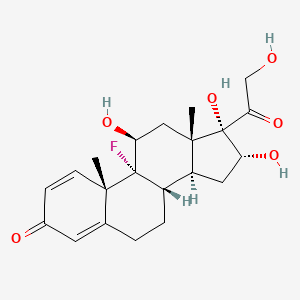
| Formula | C21H27FO6 |
|---|---|
| Molecular weight | 394.44 g/mol |
| IUPAC name | (8S,9R,10S,11S,13S,14S,16R,17S)-9-fluoro-11,16,17-trihydroxy-17-(2-hydroxyacetyl)-10,13-dimethyl-6,7,8,11,12,14,15,16-octahydrocyclopenta[a]phenanthren-3-one |
| CAS | 124-94-7 |
| PubChem CID | 31307 |
| InChIKey | GFNANZIMVAIWHM-OBYCQNJPSA-N |
| logP | 0.62 (XLogP 1.2) |
| Polar surface area | 115.06 Ų |
| H-bond acceptors / donors | 6 / 4 |
| Drug-likeness (QED) | 0.55 |
| Lipinski violations | 0 |
SMILES
C[C@]12C=CC(=O)C=C1CC[C@H]1[C@@H]3C[C@@H](O)[C@](O)(C(=O)CO)[C@@]3(C)C[C@H](O)[C@@]12FBiology & Pharmacokinetics
Pharmacokinetics predicted
| Bioavailability | 70.0% |
|---|---|
| Half-life | 2.374 h |
| Volume of distribution | 1.984 L/kg |
| Protein binding | 83.1% |
| BBB penetrant | No |
Enzyme interactions
| Enzyme | Role | Detail |
|---|---|---|
| CYP2C8 | Inhibitor | — |
| CYP3A4 | Inhibitor | IC₅₀ 49.10000000000002 µM |
| CYP3A4 | Substrate | — |
Receptor binding (top 1)
| Target | Action | Affinity |
|---|---|---|
| Glucocorticoid receptor (NR3C1) | Agonist | pIC50 7.7 |
Transporters
BCRP (Inhibitor)BSEP (Inhibitor)MRP1 (Inhibitor)OATP1B1 (Inhibitor)OATP1B1 (Inhibitor)OATP1B3 (Inhibitor)P-gp (Inhibitor)P-gp (Substrate)
Drug–drug interactions (100+, DDInter)
| Interacting drug | Severity | Management |
|---|---|---|
| Adalimumab | major | |
| Amprenavir | major | |
| Atazanavir | major | |
| Bacillus calmette-guerin substrain tice live antigen | major | |
| Baricitinib | major | |
| Bempedoic acid | major | |
| Boceprevir | major | |
| Brexucabtagene autoleucel | major | |
| Bupropion | major | |
| Ceritinib | major | |
| Certolizumab pegol | major | |
| Cinoxacin | major | |
| Ciprofloxacin | major | |
| Cladribine | major | |
| Clarithromycin | major | |
| Cobicistat | major | |
| Conivaptan | major | |
| Deferasirox | major | |
| Delafloxacin | major | |
| Delavirdine | major | |
| Desirudin | major | |
| Desmopressin | major | |
| Dinutuximab | major | |
| Enoxacin | major | |
| Etanercept | major | |
| Fingolimod | major | |
| Fosamprenavir | major | |
| Gatifloxacin | major | |
| Gemifloxacin | major | |
| Golimumab | major | |
| Grepafloxacin | major | |
| Idelalisib | major | |
| Indinavir | major | |
| Infliximab | major | |
| Iohexol | major | |
| Iopamidol | major | |
| Itraconazole | major | |
| Ketoconazole | major | |
| Leflunomide | major | |
| Levofloxacin | major |
Showing 40 of 100+.
Registered Products (3)
| Brand | Form / strength | Pack | Agent | Citizen (JOD) |
|---|---|---|---|---|
| kenacin cream | Cream 100000 IU, 0.1 %, 0.025 %, 0.25 % | 15 g tube pack varies | MIDDLE EAST PHARMA&CHEMICAL IND/JORDAN | 1.370 |
| kenacin oint | Ointment 100000 IU, 0.1 %, 0.025 %, 0.25 % | 15 g tube pack varies | MIDDLE EAST PHARMA&CHEMICAL IND/JORDAN | 1.370 |
| Kenacort A IM Inj. | Injection 40 mg/ml | 1 ml | Suleiman Tannous & Sons Co. Ltd | 2.290 |