Repaglinide
JFDA label: NovoNorm Tab
Mechanism of Action
Blocker of Sulfonylurea receptor 1, Kir6.2 — Sulfonylurea receptor 1, Kir6.2 blocker
| Target | Action | Gene / class |
|---|---|---|
| Sulfonylurea receptor 1, Kir6.2 efficacy | BLOCKER |
Indications
Approved
- Diabetes mellitus, type 2
Class profile
| mechanismClass | Meglitinide/glinide (rapid-acting secretagogue) |
|---|---|
| insulinSecretagogue | 1 |
| weightEffect | Slight gain |
| hypoglycemiaRisk | Moderate |
| renalContraindicated | 0 |
| cardioProtective | 0 |
| renalProtective | 0 |
| source | ADA-EASD2023/Maruthur2016 |
Contraindications
Source: Lexicomp
- Additional contraindications (not in US labeling): Severe hepatic impairment Absolute
- Hypersensitivity to repaglinide or any component of the formulation Absolute
- concurrent gemfibrozil therapy Absolute
- concurrent use with clopidogrel Absolute
- diabetic ketoacidosis, with or without coma Absolute
- type 1 diabetes (insulin dependent) Absolute
Adverse Reactions
Cardiac disorders (2)
Common chest pain · Ischemia
Nervous system disorders (1)
Very Common Headache
Renal and urinary disorders (1)
Common Urinary tract infection
Immune system disorders (1)
Common Hypersensitivity reaction
Metabolism and nutrition disorders (1)
Very Common Hypoglycemia
Gastrointestinal disorders (2)
Common constipation · Diarrhea
Musculoskeletal and connective tissue disorders (2)
Common arthralgia · Back pain
Respiratory, thoracic and mediastinal disorders (3)
Very Common Upper respiratory tract infection
Common bronchitis · Sinusitis
Dosing
Source: Lexicomp
Warnings & Precautions
Source: Lexicomp
Hypoglycemia
Severe hypoglycemia may occur; risk may be increased by changes in meal patterns, changes in physical activity levels, changes to coadministered medications, and concomitant use with other antidiabetic agents. Disease-related concerns:
Cardiovascular effects
Some studies suggest oral hypoglycemic drugs may be associated with increased cardiovascular events. Theoretically, repaglinide may also increase cardiovascular events, but there are no long-term studies assessing this concern. Use in combination with NPH insulin is not indicated; in two studies, reports of myocardial ischemia (6 events) in patients using repaglinide plus insulin have caused concern. Further evaluation is required to assess the safety of this combination.
Hepatic impairment
Use with caution in patients with hepatic impairment; may be more susceptible to glucose-lowering effects.
Renal impairment
Use with caution in patients with severe renal impairment; may be more susceptible to glucose-lowering effects. Concurrent drug therapy issues:
Drug-drug interactions
Potentially significant drug-drug interactions may exist, requiring dose or frequency adjustment, additional monitoring, and/or selection of alternative therapy. Consult drug interactions database for more detailed information. Other warnings/precautions:
Appropriate use
Not for use in patients with diabetic ketoacidosis or patients with type 1 diabetes mellitus (insulin-dependent).
Pregnancy & Lactation
Pregnancy
Adverse events have been observed in some animal reproduction studies. Repaglinide was shown to have a low potential to cross the placenta using an ex vivo perfusion model (Tertti 2011). Information describing the effects of repaglinide on pregnancy outcomes is limited. In women with diabetes, maternal hyperglycemia can be associated with congenital malformations as well as adverse effects in the fetus, neonate, and the mother (ACOG 2005; ADA 2018c; Kitzmiller 2008; Metzger 2007). To prevent adverse outcomes, prior to conception and throughout pregnancy maternal blood glucose and HbA1c should be kept as close to target goals as possible but without causing significant hypoglycemia (ACOG 2013; ADA 2018c; Blumer 2013; Kitzmiller 2008). Agents other than repaglinide are currently recommended to treat diabetes in pregnant women (ADA 2018c).
Lactation
It is not known if repaglinide is present in breast milk. Due to the potential for serious adverse reactions in the breastfeeding infant, the manufacturer recommends a decision be made whether to discontinue breastfeeding or to discontinue the drug, taking into account the importance of treatment to the mother.
LactMed: monitor the infant.
Monitoring
| Efficacy | HbA1c every 3 months initially, then every 6–12 months when stable; fasting and post-prandial blood glucose; patient-reported hypoglycaemia episodes |
|---|---|
| Toxicity | Hypoglycaemia symptoms; eGFR for renally-cleared agents; weight; blood pressure |
| Clinical pearl | Individualise HbA1c targets based on patient age, comorbidities, and hypoglycaemia risk. Targets of < 7% are appropriate for most patients but < 8% may be safer in frail elderly. |
| Counseling | Monitor blood glucose regularly. Know how to recognise and treat hypoglycaemia. Keep carbohydrate snacks available. |
Chemistry & Properties
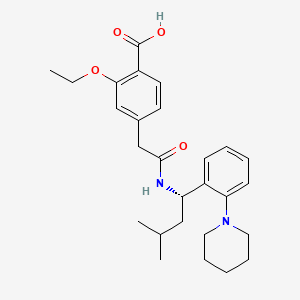
| Formula | C27H36N2O4 |
|---|---|
| Molecular weight | 452.6 g/mol |
| IUPAC name | 2-ethoxy-4-[2-[[(1S)-3-methyl-1-(2-piperidin-1-ylphenyl)butyl]amino]-2-oxoethyl]benzoic acid |
| CAS | 135062-02-1 |
| PubChem CID | 65981 |
| InChIKey | FAEKWTJYAYMJKF-QHCPKHFHSA-N |
| logP | 5.22 (XLogP 5.2) |
| Polar surface area | 78.87 Ų |
| H-bond acceptors / donors | 4 / 2 |
| Drug-likeness (QED) | 0.52 |
| Lipinski violations | 1 |
SMILES
CCOc1cc(CC(=O)N[C@@H](CC(C)C)c2ccccc2N2CCCCC2)ccc1C(=O)OBiology & Pharmacokinetics
Pharmacokinetics
| BBB penetrant | No |
|---|
Enzyme interactions
| Enzyme | Role | Detail |
|---|---|---|
| CYP2C19 | Substrate | — |
| CYP3A4 | Substrate | — |
Receptor binding (top 1)
| Target | Action | Affinity |
|---|---|---|
| ATP-binding cassette, sub-family C (CFTR/MRP), member 8 (ABCC8) | Inhibitor | pIC50 7.0 |
Transporters
BCRP (Inhibitor)BSEP (Inhibitor)BSEP (Inhibitor)MDR1 (Inhibitor)MRP1 (Inhibitor)MRP2 (Inhibitor)MRP3 (Inhibitor)MRP4 (Inhibitor)OATP1B1 (Inhibitor)OATP1B1 (Inhibitor)OATP1B3 (Inhibitor)OATP1B3 (Inhibitor)OATP2B1 (Inhibitor)OCT1 (Inhibitor)P-gp (Inhibitor)PEPT1 (Inhibitor)MDR1 (Substrate)OATP (Substrate)OATP1B1 (Substrate)P-gp (Substrate)Transporter(unspecified) (Substrate)
Drug–drug interactions (100+, DDInter)
| Interacting drug | Severity | Management |
|---|---|---|
| Cinoxacin | major | |
| Ciprofloxacin | major | |
| Clopidogrel | major | |
| Cyclosporine | major | |
| Delafloxacin | major | |
| Enoxacin | major | |
| Gatifloxacin | major | |
| Gemfibrozil | major | |
| Gemifloxacin | major | |
| Grepafloxacin | major | |
| Levofloxacin | major | |
| Lomefloxacin | major | |
| Moxifloxacin | major | |
| Nalidixic acid | major | |
| Norfloxacin | major | |
| Ofloxacin | major | |
| Sparfloxacin | major | |
| Trovafloxacin | major | |
| Abametapir (topical) | moderate | |
| Abiraterone | moderate | |
| Acebutolol | moderate | |
| Acetazolamide | moderate | |
| Acetylsalicylic acid | moderate | |
| Albiglutide | moderate | |
| Alimemazine | moderate | |
| Aloe Vera Leaf | moderate | |
| Alogliptin | moderate | |
| Alpelisib | moderate | |
| Aminoglutethimide | moderate | |
| Amiodarone | moderate | |
| Amobarbital | moderate | |
| Amprenavir | moderate | |
| Apalutamide | moderate | |
| Aprepitant | moderate | |
| Aripiprazole | moderate | |
| Armodafinil | moderate | |
| Asenapine | moderate | |
| Asparaginase Erwinia chrysanthemi | moderate | |
| Asparaginase Escherichia coli | moderate | |
| Atazanavir | moderate |
Showing 40 of 100+.
Registered Products (6)
| Brand | Form / strength | Pack | Agent | Citizen (JOD) |
|---|---|---|---|---|
| NovoNorm | Tablet 0.5 mg | 30 tab pack varies | Khoury Drug Store | 4.640 |
| NovoNorm | Tablet 1 mg | 30 tab pack varies | Khoury Drug Store | 5.190 |
| NovoNorm Tab | Tablet 2 mg | 30 tab pack varies | Khoury Drug Store | 5.610 |
| NovoNorm | Tablet 0.5 mg | 90 tab pack varies | Khoury Drug Store | 13.080 |
| NovoNorm | Tablet 1 mg | 90 tab pack varies | Khoury Drug Store | 14.640 |
| NovoNorm Tab | Tablet 2 mg | 90 tab pack varies | Khoury Drug Store | 15.790 |