Docusate
JFDA label: Mulin 10 solution
Mechanism of Action
— Surfactant laxative
Indications
Approved
- Stool softener
Off-label
- Ceruminolytic
Contraindications
Source: Lexicomp
- OTC labeling: When used for self-medication, do not use for longer than 7 days Absolute
- or concomitantly with mineral oil (oral products only) Absolute
- when abdominal pain, nausea, or vomiting is present Absolute
Adverse Reactions
Other (1)
Common Respiratory: Throat irritation (liquid)
Dosing
Source: Lexicomp
Warnings & Precautions
Source: Lexicomp
Benzyl alcohol and derivatives
Some dosage forms may contain sodium benzoate/benzoic acid; benzoic acid (benzoate) is a metabolite of benzyl alcohol; large amounts of benzyl alcohol (≥99 mg/kg/day) have been associated with a potentially fatal toxicity (“gasping syndrome”) in neonates; the “gasping syndrome” consists of metabolic acidosis, respiratory distress, gasping respirations, CNS dysfunction (including convulsions, intracranial hemorrhage), hypotension and cardiovascular collapse (AAP 1997; CDC 1982); some data suggests that benzoate displaces bilirubin.
Enema
For rectal use only; lubricate tip prior to insertion. Discontinue use and notify health care provider if rash around the anus/rectal irritation occurs or if resistance is encountered with insertion; forcing the tube may result in injury or damage to the rectum. Other warnings/precautions:
Self-medication (OTC use)
When used for self-medication (OTC), patients should be instructed to contact healthcare provider prior to use if nausea, stomach pain, or vomiting are present, or if a sudden change in bowel habits occurs and persists over 14 days. Patients should discontinue use and notify healthcare provider if rectal bleeding occurs, if a bowel movement fails to occur after use, or if use is needed >7 days.
Pregnancy & Lactation
Pregnancy
Hypomagnesemia was reported in a newborn following chronic maternal overuse of docusate sodium throughout pregnancy (Schindler 1984). Treatment of constipation in pregnant women is similar to that of nonpregnant patients and medications may be used when diet and lifestyle modifications are not effective. Agents other than docusate are preferred for initial treatment. Docusate sodium may be used if needed, but may not be as effective as other agents (ACG [Christie 2007]).
Lactation
It is not known if docusate is present in breast milk; because there is some systemic absorption, use of other agents may be preferred in breastfeeding women (Lewis 1985). Diarrhea was noted in a breastfeeding infant following maternal use of danthron and docusate sodium (Greenhalf 1973).
Monitoring
| Clinical pearl | Rectal: Periodic rectal exams are recommended in patients with impaired rectal function, especially loss of sensation. |
|---|
Chemistry & Properties
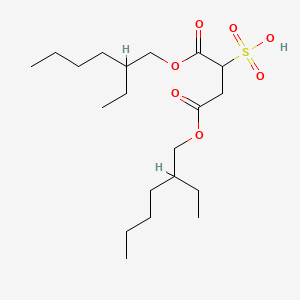
| Formula | C20H38O7S |
|---|---|
| Molecular weight | 422.58 g/mol |
| IUPAC name | 1,4-bis(2-ethylhexoxy)-1,4-dioxobutane-2-sulfonic acid |
| CAS | 10041-19-7 |
| PubChem CID | 11339 |
| InChIKey | HNSDLXPSAYFUHK-UHFFFAOYSA-N |
| logP | 4.15 (XLogP 5.1) |
| Polar surface area | 106.97 Ų |
| H-bond acceptors / donors | 6 / 1 |
| Drug-likeness (QED) | 0.29 |
| Lipinski violations | 0 |
SMILES
CCCCC(CC)COC(=O)CC(C(=O)OCC(CC)CCCC)S(=O)(=O)OBiology & Pharmacokinetics
Pharmacokinetics predicted
| Bioavailability | 70.0% |
|---|---|
| Half-life | 0.459 h |
| Volume of distribution | 0.851 L/kg |
| Protein binding | 97.3% |
| BBB penetrant | No |
Transporters
BCRP (Inhibitor)BCRP (Inhibitor)BSEP (Inhibitor)MRP1 (Inhibitor)OATP1B1 (Inhibitor)OATP1B3 (Inhibitor)P-gp (Inhibitor)P-gp (Substrate)
Drug–drug interactions (4, DDInter)
| Interacting drug | Severity | Management |
|---|---|---|
| Lactulose | moderate | |
| Mineral oil | moderate | |
| Phenolphthalein | moderate | |
| Linaclotide | minor |
Registered Products (3)
| Brand | Form / strength | Pack | Agent | Citizen (JOD) |
|---|---|---|---|---|
| Dewax ear drops | Eye/Ear Drops 0.5 % | 10 ml | Amman Pharmaceutical Indusries | 0.890 |
| Mulin 10 solution | Solution 10 mg/ml | 50 ml | THE JORDANIAN PHARMACEUTICAL MANUFACTURING COMPANY/JORDAN | 1.200 |
| Waxsol | Solution 0.5 % | 10 ml | Khoury Drug Store | 1.330 |