Micafungin
JFDA label: Mycamine 50 Vial
Mechanism of Action
Concentration-dependent inhibition of 1,3-beta-D-glucan synthase resulting in reduced formation of 1,3-beta-D-glucan, an essential polysaccharide comprising 30% to 60% of Candida cell walls (absent in mammalian cells); decreased glucan content leads to osmotic instability and cellular lysis
Indications
Approved
- Candidemia, acute disseminated candidiasis, Candida peritonitis and abscesses
- Esophageal candidiasis
- Prophylaxis of Candida infections
Off-label
- Aspergillosis, invasive (salvage therapy)
- Candidiasis empiric therapy (non-neutropenic ICU patients)
- Candidiasis, chronic disseminated (hepatosplenic)
- Candidiasis, intravascular infections
- Candidiasis, oropharyngeal (refractory disease)
- Candidiasis, osteoarticular infections
- Candidiasis, prophylaxis against invasive candidiasis (high-risk ICU patients)
- Empiric antifungal therapy (neutropenic fever)
- Primary antifungal prophylaxis in oncology patients (children/adolescents)
Antimicrobial Spectrum
Expected / intrinsic spectrum (EUCAST breakpoints & labels) — not local resistance. Source: openfda-label.
Fungi
| Organism | Activity | MIC |
|---|---|---|
| Candida albicans | Active | — |
| Candida glabrata | Active | — |
| Candida guilliermondii | Active | — |
| Candida krusei | Active | — |
| Candida meningoencephalitis | Active | — |
| Candida parapsilosis | Active | — |
| Candida tropicalis | Active | — |
Class profile
| antifungalClass | Echinocandin |
|---|---|
| targetMolecule | Beta-1,3-glucan synthase (FKS1/FKS2 subunit) |
| isFungicidal | 1 |
| spectrumCandida | S (fungicidal) |
| spectrumAspergillus | S (fungistatic) |
| spectrumCryptococcus | Intrinsically resistant |
| spectrumDermatophytes | Resistant |
| resistanceMechanisms | FKS1 hot-spot mutations,FKS2 mutations in C.glabrata |
| source | Pappas2016/Lass-Florl2011 |
Contraindications
Source: Lexicomp
- Hypersensitivity to micafungin, other echinocandins, or any component of the formulation Absolute
Adverse Reactions
Cardiac disorders (4)
Very Common Phlebitis
Common Atrial fibrillation · Cardiac arrest · tachycardia
Nervous system disorders (3)
Very Common anxiety · insomnia
Common Headache
Hepatobiliary disorders (3)
Very Common Abnormal hepatic function tests · Abnormal hepatic function tests, infusion-related reaction
Common Increased serum alkaline phosphatase
Renal and urinary disorders (2)
Very Common Decreased urine output · hematuria
Blood and lymphatic system disorders (4)
Very Common Anemia · febrile neutropenia
Common neutropenia · Thrombocytopenia
Metabolism and nutrition disorders (4)
Common abnormal aspartate transaminase · hyperkalemia · hypernatremia · Hypoglycemia
Gastrointestinal disorders (5)
Very Common diarrhea · Vomiting
Common abdominal distention · abdominal pain · Nausea
Skin and subcutaneous tissue disorders (3)
Very Common Pruritus · urticaria
Common Skin rash
Dosing
Source: Lexicomp
Warnings & Precautions
Source: Lexicomp
Hemolytic anemia/hemoglobinuria
Hemolytic anemia and hemoglobinuria have been reported.
Hepatic impairment
New-onset or worsening hepatic impairment, including hepatitis and hepatic failure, has been reported. Monitor closely and evaluate appropriateness of continued use in patients who develop abnormal liver function tests during treatment.
Hypersensitivity reactions
Severe anaphylactic reactions, including shock, have been reported.
Renal impairment
Increased BUN, serum creatinine, renal dysfunction, and/or acute renal failure has been reported; use with caution in patients that develop worsening renal function during treatment; monitor closely.
Pregnancy & Lactation
Pregnancy
Adverse events have been observed in animal reproduction studies. There are no adequate and well-controlled studies in pregnant women. Use only if benefit outweighs risk.
Lactation
It is not known if micafungin is excreted in breast milk. The manufacturer recommends that caution be exercised when administering micafungin to nursing women.
Monitoring
| Efficacy | Fungal culture and species identification; minimum inhibitory concentration (MIC) where available; clinical response (temperature, imaging for invasive fungal disease) |
|---|---|
| Toxicity | LFTs (hepatotoxicity — azoles in particular); renal function; ECG for QT prolongation (azoles); drug levels if available (itraconazole, voriconazole) |
| Clinical pearl | Voriconazole levels are highly variable due to CYP2C19 polymorphism — TDM recommended (target trough 2–5 mg/L). Check for drug interactions with CYP3A4 substrates. |
| Counseling | Report visual disturbances (voriconazole), jaundice, or rash. Take azoles with food or as directed to optimise absorption. |
Chemistry & Properties
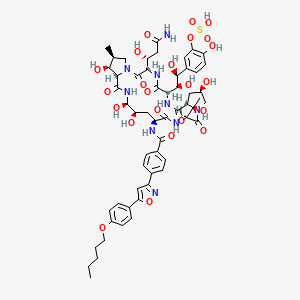
| Formula | C56H71N9O23S |
|---|---|
| Molecular weight | 1270.29 g/mol |
| IUPAC name | [5-[(1S,2S)-2-[(3S,6S,9S,11R,15S,18S,20R,21R,24S,25S,26S)-3-[(1R)-3-amino-1-hydroxy-3-oxopropyl]-11,20,21,25-tetrahydroxy-15-[(1R)-1-hydroxyethyl]-26-methyl-2,5,8,14,17,23-hexaoxo-18-[[4-[5-(4-pentoxyphenyl)-1,2-oxazol-3-yl]benzoyl]amino]-1,4,7,13,16,22-hexazatricyclo[22.3.0.09,13]heptacosan-6-yl]-1,2-dihydroxyethyl]-2-hydroxyphenyl] hydrogen sulfate |
| CAS | 235114-32-6 |
| PubChem CID | 477468 |
| InChIKey | PIEUQSKUWLMALL-YABMTYFHSA-N |
SMILES
CCCCCOc1ccc(-c2cc(-c3ccc(C(=O)N[C@H]4C[C@@H](O)[C@@H](O)NC(=O)[C@@H]5[C@@H](O)[C@@H](C)CN5C(=O)[C@H]([C@H](O)CC(N)=O)NC(=O)[C@H]([C@H](O)[C@@H](O)c5ccc(O)c(OS(=O)(=O)O)c5)NC(=O)[C@@H]5C[C@@H](O)CN5C(=O)[C@H]([C@@H](C)O)NC4=O)cc3)no2)cc1Biology & Pharmacokinetics
Pharmacokinetics predicted
| Bioavailability | 70.0% |
|---|---|
| Half-life | 3.588 h |
| Volume of distribution | 0.461 L/kg |
| Protein binding | 92.8% |
| BBB penetrant | No |
Enzyme interactions
| Enzyme | Role | Detail |
|---|---|---|
| CYP2C8 | Inhibitor | — |
Transporters
BCRP (Inhibitor)BSEP (Inhibitor)MDR1 (Inhibitor)MRP1 (Inhibitor)OATP1B1 (Inhibitor)OATP1B3 (Inhibitor)P-gp (Inhibitor)MDR1 (Substrate)OAT (Substrate)P-gp (Substrate)
Drug–drug interactions (5, DDInter)
| Interacting drug | Severity | Management |
|---|---|---|
| Amphotericin B | moderate | |
| Everolimus | moderate | |
| Nitisinone | moderate | |
| Ribociclib | moderate | |
| Sirolimus | moderate |
Registered Products (4)
| Brand | Form / strength | Pack | Agent | Citizen (JOD) |
|---|---|---|---|---|
| Megmento | Vial 100 mg | 1 vial | The Arab Pharmaceutical Manufacturing PSC/Salt | — |
| Megmento | Vial 50 mg | 1 vial | The Arab Pharmaceutical Manufacturing PSC/Salt | — |
| Mifacin 50mg/vial powder for concentrate for solution for infusion | Infusion 50 mg mg | One Vila | MS PHARMA/JORDAN | — |
| Mycamine 50 Vial | Vial 50 mg | 1 vial | Ibn Rushd Drug Store | — |