Rizatriptan
JFDA label: Orziban
Mechanism of Action
Selective agonist for serotonin (5-HT1B and 5-HT1D receptors) in cranial arteries; causes vasoconstriction and reduces sterile inflammation associated with antidromic neuronal transmission correlating with relief of migraine
Indications
Approved
- Migraine
Contraindications
Source: Lexicomp
- Additional contraindications (not in US labeling): Ophthalmoplegic migraine Absolute
- Hypersensitivity to rizatriptan or any component of the formulation Absolute
- basilar or hemiplegic migraine Absolute
- coronary artery vasospasm (including Prinzmetal angina) Absolute
- documented ischemic heart disease or other significant cardiovascular disease Absolute
- during or within 2 weeks of MAO inhibitors Absolute
- during or within 24 hours of treatment with another 5-HT1 agonist, or an ergot-containing or ergot-type medication (eg, methysergide, dihydroergotamine) Absolute
- history of stroke or transient ischemic attack Absolute
- ischemic bowel disease Absolute
- peripheral vascular disease Absolute
- severe hepatic impairment Absolute
- uncontrolled hypertension Absolute
Adverse Reactions
Cardiac disorders (3)
Common Chest pain · flushing · palpitations
Nervous system disorders (9)
Common Dizziness · drowsiness · euphoria · fatigue · feeling of heaviness · headache · hypoesthesia · pain · paresthesia
Gastrointestinal disorders (6)
Common abdominal distress · diarrhea · Nausea · sore throat · vomiting · xerostomia
Musculoskeletal and connective tissue disorders (8)
Common jaw pain · jaw pressure · jaw tightness · neck pain · neck pressure · neck tightness · tremor · Weakness
Respiratory, thoracic and mediastinal disorders (3)
Common dyspnea · Pharyngeal edema · pressure on pharynx
Dosing
Source: Lexicomp
Warnings & Precautions
Source: Lexicomp
Cardiac events
Coronary artery vasospasm, transient ischemia, myocardial infarction, ventricular tachycardia/fibrillation, cardiac arrest, and death have been reported with 5-HT1 agonist administration. Patients who experience sensations of chest pain/pressure/tightness or symptoms suggestive of angina following dosing should be evaluated for coronary artery disease or Prinzmetal's angina before receiving additional doses; if dosing is resumed and similar symptoms recur, monitor with ECG.
Cerebrovascular events
Cerebral/subarachnoid hemorrhage and stroke have been reported with 5-HT1 agonist administration. Use is contraindicated in patients with a history of stroke or transient ischemic attack
Elevated blood pressure
Significant elevation in blood pressure, including hypertensive crisis, has also been reported on rare occasions in patients with and without a history of hypertension.
Headaches
Acute migraine agents (eg, triptans, opioids, ergotamine, or a combination of the agents) used for 10 or more days per month may lead to worsening of headaches (medication overuse headache); withdrawal treatment may be necessary in the setting of overuse.
Vasospasm-related events
Peripheral vascular ischemia and colonic ischemia, gastrointestinal ischemia/infarction, splenic infarction, and Raynaud’s syndrome have been reported with 5-HT1 agonist.
Visual effects
Rarely, partial vision loss and blindness (transient and permanent) have been reported with 5-HT1 agonist. Disease-related concerns:
Coronary artery disease
Should not be given to patients who have risk factors for CAD (eg, hypertension, hypercholesterolemia, smoker, obesity, diabetes, strong family history of CAD, menopause, male >40 years of age) without adequate cardiac evaluation. Patients with suspected CAD should have cardiovascular evaluation to rule out CAD before considering use; if cardiovascular evaluation is “satisfactory,” first dose should be given in the healthcare provider's office (consider ECG monitoring). Periodic evaluation of cardiovascular status should be done in all patients.
Hepatic impairment
Use with caution in patients with hepatic impairment; drug clearance may be reduced leading to increased plasma concentrations.
Renal impairment
Use with caution in dialysis patients (systemic exposure is increased). Concurrent drug therapy issues:
Serotonin syndrome
Symptoms of agitation, confusion, hallucinations, hyper-reflexia, myoclonus, shivering, and tachycardia may occur with concomitant proserotonergic drugs (ie, SSRIs/SNRIs or triptans) or agents which reduce rizatriptan's metabolism. Concurrent use of serotonin precursors (eg, tryptophan) is not recommended. If concomitant administration with SSRIs is warranted, monitor closely, especially at initiation and with dose increases. Dosage form specific issues:
Phenylalanine
Maxalt-MLT tablets contain phenylalanine. Other warnings/precautions:
Appropriate use
Only indicated for treatment of acute migraine; not for the prevention of migraines or the treatment of cluster headache. If a patient does not respond to the first dose, the diagnosis of migraine should be reconsidered.
Pregnancy & Lactation
Pregnancy
Adverse events were observed in animal reproduction studies. Information related to rizatriptan use in pregnancy is limited (Källén 2011; Nezvalová-Henriksen 2010; Nezvalová-Henriksen 2012). A pregnancy registry has been established to monitor outcomes of women exposed to rizatriptan during pregnancy (800-986-8999). Preliminary data from the pregnancy registry (prospectively collected from 65 live births 1998-2004) does not show an increased risk of congenital malformations (Fiore 2005). Until additional information is available, other agents are preferred for the initial treatment of migraine in pregnancy (Da Silva 2012; MacGregor 2012; Williams 2012).
Lactation
It is not known if rizatriptan is excreted in breast milk. The manufacturer recommends that caution be exercised when administering rizatriptan to nursing women.
Monitoring
| Clinical pearl | Headache severity, signs/symptoms suggestive of angina; consider monitoring blood pressure, heart rate, and/or ECG with first dose in patients with likelihood of unrecognized coronary disease, such as patients with significant hypertension, hypercholesterolemia, obese patients, patients with diabetes, smokers with other risk factors or strong family history of coronary artery disease |
|---|
Chemistry & Properties
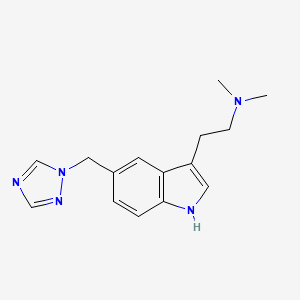
| Formula | C15H19N5 |
|---|---|
| Molecular weight | 269.35 g/mol |
| IUPAC name | N,N-dimethyl-2-[5-(1,2,4-triazol-1-ylmethyl)-1H-indol-3-yl]ethanamine |
| CAS | 144034-80-0 |
| PubChem CID | 5078 |
| InChIKey | ULFRLSNUDGIQQP-UHFFFAOYSA-N |
| logP | 1.91 (XLogP 1.7) |
| Polar surface area | 49.74 Ų |
| H-bond acceptors / donors | 4 / 1 |
| Drug-likeness (QED) | 0.77 |
| Lipinski violations | 0 |
SMILES
CN(C)CCc1c[nH]c2ccc(Cn3cncn3)cc12Biology & Pharmacokinetics
Pharmacokinetics
| BBB penetrant | Yes |
|---|
Enzyme interactions
| Enzyme | Role | Detail |
|---|---|---|
| CYP1A2 | Inhibitor | — |
| CYP1A2 | Substrate | — |
| CYP2C19 | Substrate | — |
| CYP2D6 | Inhibitor | — |
Receptor binding (top 4)
| Target | Action | Affinity |
|---|---|---|
| 5-HT1D receptor (HTR1D) | Agonist | pKi 7.9 |
| 5-HT1B receptor (HTR1B) | Agonist | pKi 6.9 |
| 5-ht1e receptor (HTR1E) | Agonist | pKi 6.8 |
| 5-HT1A receptor (HTR1A) | Agonist | pKi 6.4 |
Transporters
BCRP (Inhibitor)BSEP (Inhibitor)MRP1 (Inhibitor)OATP1B1 (Inhibitor)OATP1B3 (Inhibitor)P-gp (Inhibitor)P-gp (Substrate)
Drug–drug interactions (15, DDInter)
| Interacting drug | Severity | Management |
|---|---|---|
| Dexfenfluramine | major | |
| Dolasetron | major | |
| Fenfluramine | major | |
| Granisetron | major | |
| Lorcaserin | major | |
| Methylene blue | major | |
| Ondansetron | major | |
| Palonosetron | major | |
| Procarbazine | major | |
| Sibutramine | major | |
| Codeine | moderate | |
| Hydrocodone | moderate | |
| Morphine | moderate | |
| Morphine (liposomal) | moderate | |
| Ozanimod | moderate |
Registered Products (2)
| Brand | Form / strength | Pack | Agent | Citizen (JOD) |
|---|---|---|---|---|
| Orziban | Tablet 5 mg | 6 tab | UNITED PHARM.MFG.CO.LTD(UPM)/JORDAN | 6.420 |
| Orziban | Tablet 10 mg | 6 tab | UNITED PHARM.MFG.CO.LTD(UPM)/JORDAN | 10.530 |