Ondansetron
JFDA label: Zofran Syrup
Mechanism of Action
Antagonist of 5-hydroxytryptamine receptor 3A — Serotonin 3a (5-HT3a) receptor antagonist
| Target | Action | Gene / class |
|---|---|---|
| 5-hydroxytryptamine receptor 3A efficacy | ANTAGONIST | HTR3A |
Indications
Approved
- Cancer chemotherapy-induced nausea and vomiting
- IV
- Oral
- Postoperative nausea and/or vomiting
- Radiotherapy-associated nausea and vomiting
Off-label
- Nausea and vomiting of pregnancy (severe or refractory)
- Postoperative nausea and vomiting (treatment)
Contraindications
Source: Lexicomp
- Hypersensitivity to ondansetron or any component of the formulation Absolute
- concomitant use with apomorphine Absolute
Adverse Reactions
Cardiac disorders (1)
Uncommon QT prolongation (IV formulation — dose-dependent)
Vascular disorders (1)
Uncommon Flushing
Nervous system disorders (9)
Very Common fatigue · Headache · Headache · malaise
Common , agitation, anxiety, paresthesia, sensation of cold · Drowsiness · sedation
Uncommon Dizziness
Rare Serotonin syndrome (with serotonergic drugs)
Hepatobiliary disorders (2)
Common Increased serum ALT · increased serum AST
Renal and urinary disorders (2)
Common Gynecologic disease · urinary retention
Immune system disorders (1)
Rare Hypersensitivity / anaphylaxis (IV)
Gastrointestinal disorders (3)
Very Common Constipation
Common Constipation · Diarrhea
Skin and subcutaneous tissue disorders (2)
Common Pruritus · skin rash
General disorders and administration site conditions (2)
Common Fever · Injection site reaction
Other (1)
Not Known Percentages reported in adult patients unless otherwise specified
Respiratory, thoracic and mediastinal disorders (1)
Common Hypoxia
Dosing
Source: Lexicomp
Warnings & Precautions
Source: Lexicomp
Hypersensitivity
Hypersensitivity reactions (including anaphylaxis and bronchospasm) have been reported; discontinue if hypersensitivity occurs. Use with caution in patients allergic to other 5-HT3 receptor antagonists; cross-reactivity has been reported.
QT prolongation
ECG changes, including dose-dependent QT interval prolongation, have been observed with ondansetron use. Cases of torsade de pointes have also been reported. Selective 5-HT3 antagonists, including ondansetron, have been associated with a number of dose-dependent increases in ECG intervals (eg, PR, QRS duration, QT/QTc, JT), usually occurring 1 to 2 hours after IV administration. Single doses >16 mg ondansetron IV are no longer recommended due to the potential for an increased risk of QT prolongation. In most patients, these changes are not clinically relevant; however, when used in conjunction with other agents that prolong these intervals or in those at risk for QT prolongation, arrhythmia may occur. When used with agents that prolong the QT interval (eg, Class I and III antiarrhythmics) or in patients with cardiovascular disease, clinically relevant QT interval prolongation may occur resulting in torsades de pointes. A number of trials have shown that 5-HT3 antagonists produce QT interval prolongation to variable degrees. Avoid ondansetron use in patients with congenital long QT syndrome. Use caution and monitor ECG in patients with other risk factors for QT prolongation (eg, medications known to prolong QT interval, electrolyte abnormalities [hypokalemia or hypomagnesemia], heart failure, bradyarrhythmias, and cumulative high-dose anthracycline therapy). Reduction in heart rate may also occur with the 5-HT3 antagonists. IV formulations of 5-HT3 antagonists have more associ
Serotonin syndrome
Serotonin syndrome has been reported with 5-HT3 receptor antagonists, predominantly when used in combination with other serotonergic agents (eg, SSRIs, SNRIs, MAOIs, mirtazapine, fentanyl, lithium, tramadol, and/or methylene blue). Some of the cases have been fatal. The majority of serotonin syndrome reports due to 5-HT3 receptor antagonist have occurred in a postanesthesia setting or in an infusion center. Serotonin syndrome has also been reported following overdose of ondansetron. Monitor patients for signs of serotonin syndrome, including mental status changes (eg, agitation, hallucinations, delirium, coma); autonomic instability (eg, tachycardia, labile blood pressure, diaphoresis, dizziness, flushing, hyperthermia); neuromuscular changes (eg, tremor, rigidity, myoclonus, hyperreflexia, incoordination); gastrointestinal symptoms (eg, nausea, vomiting, diarrhea); and/or seizures. If serotonin syndrome occurs, discontinue 5-HT3 receptor antagonist treatment and begin supportive management. Disease-related concerns:
Hepatic impairment
Dose limitations are recommended for patients with severe hepatic impairment (Child-Pugh class C); use with caution in mild-moderate hepatic impairment; clearance is decreased and half-life increased in hepatic impairment. Concurrent drug therapy issues:
Drug-drug interactions
Potentially significant interactions may exist, requiring dose or frequency adjustment, additional monitoring, and/or selection of alternative therapy. Consult drug interactions database for more detailed information. Dosage form specific issues:
Benzyl alcohol and derivatives
Some dosage forms may contain sodium benzoate/benzoic acid; benzoic acid (benzoate) is a metabolite of benzyl alcohol; large amounts of benzyl alcohol (≥99 mg/kg/day) have been associated with a potentially fatal toxicity (“gasping syndrome”) in neonates; the “gasping syndrome” consists of metabolic acidosis, respiratory distress, gasping respirations, CNS dysfunction (including convulsions, intracranial hemorrhage), hypotension, and cardiovascular collapse (AAP ["Inactive" 1997]; CDC 1982); some data suggests that benzoate displaces bilirubin from protein binding sites (Ahlfors 2001); avoid or use dosage forms containing benzyl alcohol derivative with caution in neonates. See manufacturer’s labeling.
Phenylalanine
Orally-disintegrating tablets contain phenylalanine. Other warnings/precautions:
Chemotherapy-associated emesis
Antiemetics are most effective when used prophylactically (Roila 2016). If emesis occurs despite optimal antiemetic prophylaxis, re-evaluate emetic risk, disease, concurrent morbidities and medications to assure antiemetic regimen is optimized (ASCO [Hesketh 2016]).
Ileus or gastric distention
Ondansetron does not stimulate gastric or intestinal peristalsis (do not use in place of nasogastric suction). Ondansetron may mask progressive ileus and/or gastric distension; monitor for decreased bowel activity.
Pregnancy & Lactation
Pregnancy
Caution
Used for nausea/vomiting of pregnancy, hyperemesis gravidarum. Preferred after first-line antiemetics fail. Avoid high doses or IV in QT-risk patients. Use after 10 weeks where possible to reduce any T1 risk
Lactation
It is not known if ondansetron is present in breast milk. According to the manufacturer, the decision to continue or discontinue breastfeeding during therapy should take into account the risk of infant exposure, the benefits of breastfeeding to the infant, and benefits of treatment to the mother.
Monitoring
| Clinical pearl | ECG (if applicable in high-risk or elderly patients); potassium, magnesium. Monitor for signs of serotonin syndrome; monitor for decreased bowel activity. |
|---|
Chemistry & Properties
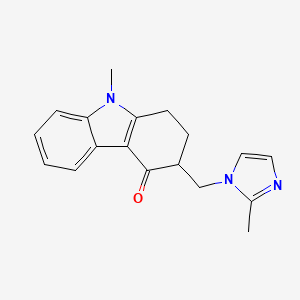
| Formula | C18H19N3O |
|---|---|
| Molecular weight | 293.37 g/mol |
| IUPAC name | 9-methyl-3-[(2-methylimidazol-1-yl)methyl]-2,3-dihydro-1H-carbazol-4-one |
| CAS | 99614-02-5 |
| PubChem CID | 4595 |
| InChIKey | FELGMEQIXOGIFQ-UHFFFAOYSA-N |
| logP | 3.13 (XLogP 2.3) |
| Polar surface area | 39.82 Ų |
| H-bond acceptors / donors | 4 / 0 |
| Drug-likeness (QED) | 0.73 |
| Lipinski violations | 0 |
SMILES
Cc1nccn1CC1CCc2c(c3ccccc3n2C)C1=OBiology & Pharmacokinetics
Pharmacokinetics
| BBB penetrant | Yes (logBB 0.28) |
|---|
Enzyme interactions
| Enzyme | Role | Detail |
|---|---|---|
| CYP1A2 | Inhibitor | — |
| CYP1A2 | Substrate | — |
| CYP2C19 | Substrate | — |
| CYP2C9 | Substrate | — |
| CYP2D6 | Inhibitor | — |
| CYP2D6 | Substrate | — |
| CYP3A4 | Inhibitor | IC₅₀ 11.000000000000007 µM |
| CYP3A4 | Substrate | — |
Receptor binding (top 2)
| Target | Action | Affinity |
|---|---|---|
| 5-HT3 (HTR3A) | Binding | pKi 8.1 |
| 5-HT3AB (HTR3A|HTR3B) | Antagonist | pKi 7.8 |
Transporters
BCRP (Inhibitor)BSEP (Inhibitor)BSEP (Inhibitor)MATE1 (Inhibitor)MATE2 (Inhibitor)MRP1 (Inhibitor)MRP2 (Inhibitor)MRP3 (Inhibitor)MRP4 (Inhibitor)OATP1B1 (Inhibitor)OATP1B1 (Inhibitor)OATP1B3 (Inhibitor)OATP1B3 (Inhibitor)OATP2B1 (Inhibitor)OCT1 (Inhibitor)OCT2 (Inhibitor)OCT3 (Inhibitor)P-gp (Inhibitor)MDR1 (Substrate)OCT1 (Substrate)P-gp (Substrate)
Drug–drug interactions (100+, DDInter)
| Interacting drug | Severity | Management |
|---|---|---|
| Alfentanil | major | |
| Almotriptan | major | |
| Amiodarone | major | |
| Amisulpride | major | |
| Amitriptyline | major | |
| Amoxapine | major | |
| Anagrelide | major | |
| Apomorphine | major | |
| Arsenic trioxide | major | |
| Bedaquiline | major | |
| Bepridil | major | |
| Bupropion | major | |
| Buspirone | major | |
| Cabozantinib | major | |
| Ceritinib | major | |
| Chloroquine | major | |
| Cisapride | major | |
| Citalopram | major | |
| Clomipramine | major | |
| Clozapine | major | |
| Crizotinib | major | |
| Desipramine | major | |
| Desvenlafaxine | major | |
| Dexfenfluramine | major | |
| Dextromethorphan | major | |
| Disopyramide | major | |
| Dofetilide | major | |
| Dolasetron | major | |
| Doxepin | major | |
| Doxepin (topical) | major | |
| Dronedarone | major | |
| Droperidol | major | |
| Duloxetine | major | |
| Efavirenz | major | |
| Eletriptan | major | |
| Escitalopram | major | |
| Fenfluramine | major | |
| Fentanyl | major | |
| Fingolimod | major | |
| Fluoxetine | major |
Showing 40 of 100+.
Registered Products (27)
| Brand | Form / strength | Pack | Agent | Citizen (JOD) |
|---|---|---|---|---|
| Onda 4m/2ml | Ampoule 4 mg/2 ml | 1 amp | Manar Drug Store | 3.190 |
| Onda 8m/4ml | Ampoule 8 mg/4 ml | 1 amp | Manar Drug Store | 3.930 |
| VOMIDO | Solution (as hydrochloride) 0.08 % | 50 ml | Amman Pharmaceutical Industries Co | 7.690 |
| CLARMON 4 mg/ 2 ml Solution for Injection | Powder for Injection 5 mg | 5 amp | Ibn Rushd Drug Store | 12.710 |
| Ondansetron Sandoz IV | Ampoule 4 mg/2 ml | 5 amp | Hussam Al Nmer Drug Store | 14.770 |
| Ondafran | Suspension 4 mg/5 ml | 100 ml | Al-Gadeed Pharmaceutical Industries/JORDAN | 15.000 |
| Onaron 4 mg Film Coated Tablets | Film-Coated Tablet 4.99 mg | 10 tab | Sukhtian Group | 16.430 |
| Xentron | Tablet 4 mg | 10 tab | Sukhtian Pharma Co. (SP) | 16.430 |
| Setron | Ampoule 2 mg/1 ml | 5 amp pack varies | Hikma Pharmaceuticals Co.Ltd/Jordan | 17.850 |
| Vomiran Solution For Inj | Injection 2 mg/1 ml | 5 vial pack varies | MS PHARMA/JORDAN | 17.850 |
| Onaron 8mg Film Coated Tablets | Film-Coated Tablet 8 mg | 10 tab | Sukhtian Group | 19.170 |
| Xentron | Tablet 8 mg | 10 tab | Sukhtian Pharma Company (SP) | 19.750 |
| Nordaset Conc.For Solution For Infusion | Infusion 8 mg/4 ml | 5 amp | ORIENT DRUG STORE CO | 19.780 |
| Zofran Inj | Injection 4 mg/2 ml | 5 amp | Nabulsi Drug Store | 19.830 |
| Onda 8mg F.C.T | Tablet 8 mg | 15 tab | Manar Drug Store | 20.280 |
| Odran | Tablet 4 mg | 10 tab | UNITED PHARM.MFG.CO.LTD(UPM)/JORDAN | 21.120 |
| Zemitron tablet | Tablet 4 mg | 10 tab | The Arab Pharmaceutical Manufacturing PSC/Salt | 21.120 |
| Odran 4mg/5ml Oral Solution | Solution 4 mg/5 ml | 50 ml | MS PHARMA/JORDAN | 21.990 |
| Zofran Tablets | Tablet 4 mg | 10 tab | Nabulsi Drug Store | 23.470 |
| Setron | Ampoule 2 mg/1 ml | 5 amp pack varies | Hikma Pharmaceuticals Co.Ltd/Jordan | 25.430 |
| Vomiran Solution For Inj | Injection 2 mg/1 ml | 5 vial pack varies | MS PHARMA/JORDAN | 25.430 |
| Zofran Syrup | Syrup 4 mg/5 ml | 50 ml | Nabulsi Drug Store | 26.000 |
| Odran | Tablet 8 mg | 10 tab | UNITED PHARM.MFG.CO.LTD(UPM)/JORDAN | 26.540 |
| Zemitron tablet | Tablet 8 mg | 10 tab | The Arab Pharmaceutical Manufacturing PSC/Salt | 26.540 |
| Zofran Inj | Injection 8 mg/4 ml | 5 amp | Nabulsi Drug Store | 28.260 |
| Zofran Tablets | Tablet 8 mg | 10 tab | Nabulsi Drug Store | 29.490 |
| Emistop Inj | Injection 2 mg/ml | 25 amp | Khoury Drug Store | 63.850 |