Tetracaine
JFDA label: Minims Tetracaine Hcl 0.5%
Mechanism of Action
Blocker of Sodium channel alpha subunit — Sodium channel alpha subunit blocker
| Target | Action | Gene / class |
|---|---|---|
| Sodium channel alpha subunit efficacy | BLOCKER |
Indications
Approved
- Hemorrhoids — hemorrhoid
- Pain — pain
- Pruritus — Pruritus
Off-label
- Carpal Tunnel Syndrome
- Cataract
- Myofascial Pain Syndromes
- Neuralgia, Postherpetic
- Shoulder Impingement Syndrome
- Skin Diseases
- Tendinopathy
- Wounds and Injuries
Contraindications
Source: openFDA
- Spinal anesthesia with tetracaine hydrochloride is contraindicated in patients with known hypersensitivity to tetracaine hydrochloride or to drugs of a similar chemical configuration (ester-type local anesthetics), or aminobenzoic acid or its derivatives; and in patients for whom spinal anesthesia as a technique is contraindicated. The decision as to whether or not spinal anesthesia should be used for an individual patient should be made by the physician after weighing the advantages with the risks and possible complications. Contraindications to spinal anesthesia as a technique can be found in standard reference texts, and usually include generalized septicemia, infection at the site of injection, certain diseases of the cerebrospinal system, uncontrolled hypotension, etc. Absolute
Adverse Reactions
Cardiac disorders (1)
Not Known Cardiac arrest
Vascular disorders (1)
Not Known Hypotension
Nervous system disorders (6)
Not Known Convulsion · Dizziness · Loss of consciousness · Paralysis · Somnolence · Tremor
Immune system disorders (2)
Not Known Anaphylactic shock · Hypersensitivity
Gastrointestinal disorders (2)
Not Known Nausea · Vomiting
Skin and subcutaneous tissue disorders (1)
Not Known Urticaria
Psychiatric disorders (1)
Not Known Agitation
Eye disorders (1)
Not Known Vision blurred
Ear and labyrinth disorders (1)
Not Known Tinnitus
General disorders and administration site conditions (14)
Not Known Arachnoiditis · Chills · Conjunctival hyperaemia · Corneal oedema · Iritis · Keratitis · Meningism · Necrosis · Nervousness · Oedema · Pain · Post lumbar puncture syndrome · Tension · Vasodilation procedure
Dosing
Source: openFDA
Warnings & Precautions
Source: openFDA
Warnings & Precautions
USED. Large doses of local anesthetics should not be used in patients with heartblock. Reactions resulting in fatality have occurred on rare occasions with the use of local anesthetics, even in the absence of a history of hypersensitivity. Methemoglobinemia Cases of methemoglobinemia have been reported in association with local anesthetic use. Although all patients are at risk for methemoglobinemia, patients with glucose-6-phosphate dehydrogenase deficiency, congenital or idiopathic methemoglobinemia, cardiac or pulmonary compromise, infants under 6 months of age, and concurrent exposure to oxidizing agents or their metabolites are more susceptible to developing clinical manifestations of the condition. If local anesthetics must be used in these patients, close monitoring for symptoms and signs of methemoglobinemia is recommended. Signs and symptoms of methemoglobinemia may occur immediately or may be delayed some hours after exposure and are characterized by a cyanotic skin discoloration and abnormal coloration of the blood. Methemoglobin levels may continue to rise; therefore, immediate treatment is required to avert more serious central nervous system and cardiovascular adverse effects, including seizures, coma, arrhythmias, and death. Discontinue tetracaine hydrochloride and any other oxidizing agents. Depending on the severity of the symptoms, patients may respond to supportive care, i.e., oxygen therapy, hydration. More severe symptoms may require treatment with methylene blue, exchange transfusion, or hyperbaric oxygen.
Pregnancy & Lactation
Pregnancy
Lactation
However, an alternate drug may be preferred, especially while nursing a newborn or preterm infant.
Chemistry & Properties
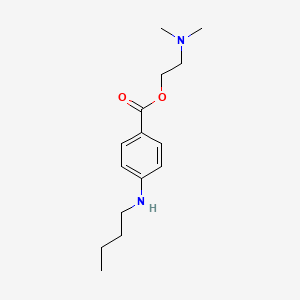
| Formula | C15H24N2O2 |
|---|---|
| Molecular weight | 264.37 g/mol |
| IUPAC name | 2-(dimethylamino)ethyl 4-(butylamino)benzoate |
| CAS | 94-24-6 |
| PubChem CID | 5411 |
| InChIKey | GKCBAIGFKIBETG-UHFFFAOYSA-N |
| logP | 2.62 (XLogP 3.7) |
| Polar surface area | 41.57 Ų |
| H-bond acceptors / donors | 4 / 1 |
| Drug-likeness (QED) | 0.58 |
| Lipinski violations | 0 |
SMILES
CCCCNc1ccc(C(=O)OCCN(C)C)cc1Biology & Pharmacokinetics
Pharmacokinetics predicted
| Bioavailability | 70.0% |
|---|---|
| Half-life | 0.782 h |
| Volume of distribution | 5.315 L/kg |
| Protein binding | 78.7% |
| BBB penetrant | Yes |
Enzyme interactions
| Enzyme | Role | Detail |
|---|---|---|
| CYP1A2 | Substrate | — |
| CYP2B6 | Inhibitor | — |
| CYP2C19 | Substrate | — |
Transporters
BCRP (Inhibitor)BSEP (Inhibitor)BSEP (Inhibitor)MDR1 (Inhibitor)MRP1 (Inhibitor)OATP1B1 (Inhibitor)OATP1B1 (Inhibitor)OATP1B3 (Inhibitor)P-gp (Inhibitor)P-gp (Substrate)
Drug–drug interactions (32, DDInter)
| Interacting drug | Severity | Management |
|---|---|---|
| Bupivacaine (liposome) | major | |
| Nitrous acid | major | |
| Alprazolam | moderate | |
| Benzocaine (topical) | moderate | |
| Chlordiazepoxide | moderate | |
| Cinchocaine (topical) | moderate | |
| Clobazam | moderate | |
| Clonazepam | moderate | |
| Clorazepic acid | moderate | |
| Cocaine (nasal) | moderate | |
| Cocaine (topical) | moderate | |
| Diazepam | moderate | |
| Estazolam | moderate | |
| Flurazepam | moderate | |
| Halazepam | moderate | |
| Lidocaine (ophthalmic) | moderate | |
| Lidocaine (topical) | moderate | |
| Lorazepam | moderate | |
| Midazolam | moderate | |
| Oxazepam | moderate | |
| Oxybuprocaine (ophthalmic) | moderate | |
| Proparacaine (ophthalmic) | moderate | |
| Quazepam | moderate | |
| Remimazolam | moderate | |
| Sulfadiazine | moderate | |
| Sulfadoxine | moderate | |
| Sulfamethoxazole | moderate | |
| Sulfasalazine | moderate | |
| Temazepam | moderate | |
| Tilmanocept | moderate | |
| Triazolam | moderate | |
| Hyaluronidase | minor |
Registered Products (3)
| Brand | Form / strength | Pack | Agent | Citizen (JOD) |
|---|---|---|---|---|
| Atracaine | Solution 0.5 % | 15 ml | Amman Pharmaceutical Indusries | — |
| Minims Tetracaine Hcl | Solution 0.5 % | 0.5 ml | Petra Drug Store | — |
| Minims TetracaineHcl 1% e/d | Ophthalmic Solution 1 % | 0.5 ml | Petra Drug Store | — |