Esketamine
JFDA label: Spravato
- SEDATION; DISSOCIATION; RESPIRATORY DEPRESSION; ABUSE AND MISUSE; and SUICIDAL THOUGHTS AND BEHAVIORS WARNING: SEDATION; DISSOCIATION; RESPIRATORY DEPRESSION; ABUSE AND MISUSE; and SUICIDAL THOUGHTS A
Mechanism of Action
Negative Allosteric Modulator of Glutamate [NMDA] receptor — Glutamate [NMDA] receptor negative allosteric modulator
| Target | Action | Gene / class |
|---|---|---|
| Glutamate [NMDA] receptor efficacy | NEGATIVE ALLOSTERIC MODULATOR |
Indications
Approved
- Depressive Disorder — depressive disorder
Off-label
- Cancer Pain
- Depressive Disorder, Treatment-Resistant
- Pain
- Shock, Septic
Contraindications
Source: openFDA
- is contraindicated in patients with: Aneurysmal vascular disease (including thoracic and abdominal aorta, intracranial, and peripheral arterial vessels) or arteriovenous malformation [see Warnings and Precautions (5.7) ] History of intracerebral hemorrhage [see Warnings and Precautions (5.7) ] Hypersensitivity to esketamine, ketamine, or any of the excipients. Aneurysmal vascular disease (including thoracic and abdominal aorta, intracranial and peripheral arterial vessels) or arteriovenous malformation. ( 4 ) Intracerebral hemorrhage. ( 4 ) Hypersensitivity to esketamine, ketamine, or any of the excipients. ( 4 ) Absolute
Adverse Reactions
Vascular disorders (1)
Uncommon Hypertension
Nervous system disorders (6)
Common Sedation
Uncommon And Sedation · And Sedation-Related Events · Dizziness · Dizziness-Related Events · Headache
Gastrointestinal disorders (2)
Uncommon Nausea · Vomiting
Psychiatric disorders (4)
Common Anxiety
Uncommon Depression · Panic Attack · Suicidal Ideation
Ear and labyrinth disorders (1)
Uncommon Vertigo
Investigations (1)
Uncommon Blood Pressure Increased
General disorders and administration site conditions (10)
Very Common Pared To Patients Treated With Placebo Plus Oral Ad · Vato Plus Oral Ad Also Demonstrated A Higher Number
Common Blood Pres · Dissociation-Related Events · Feeling Drunk · Hypoesthesia · Lethargy · Trd Dissociation
Uncommon Dissociation · Muscular Weakness
Dosing
Source: openFDA
Warnings & Precautions
Source: openFDA
Boxed Warning
SEDATION; DISSOCIATION; RESPIRATORY DEPRESSION; ABUSE AND MISUSE; and SUICIDAL THOUGHTS AND BEHAVIORS WARNING: SEDATION; DISSOCIATION; RESPIRATORY DEPRESSION; ABUSE AND MISUSE; and SUICIDAL THOUGHTS AND BEHAVIORS See full prescribing information for complete boxed warning. Risk for sedation, dissociation, and respiratory depression after administration. Monitor patients for at least two hours after administration. ( 5.1 , 5.2 , 5.3 ) Potential for abuse and misuse. Consider the risks and benefits of prescribing SPRAVATO prior to using in patients at higher risk of abuse. Monitor patients for signs and symptoms of abuse and misuse. ( 5.4 ) SPRAVATO is only available through a restricted program called the SPRAVATO REMS. ( 5.5 ) Increased risk of suicidal thoughts and behaviors in pediatric and young adult patients taking antidepressants. Closely monitor all antidepressant-treated patients for clinical worsening and emergence of suicidal thoughts and behaviors. SPRAVATO is not approved for use in pediatric patients. ( 5.6 ) Sedation Patients are at risk for sedation after administration of SPRAVATO [see Warnings and Precautions (5.1) ]. Dissociation Patients are at risk for dissociative or perceptual changes after administration of SPRAVATO [see Warnings and Precautions (5.2) ]. Respiratory Depression Respiratory depression has been observed in postmarketing experience [see Warnings and Precautions (5.3) ] . Because of the risks of sedation, dissociation, and respiratory depression, patients must be monitored for at least 2 hours at each treatment session, followed by an assessment to determine when the patient is considered clinically stable and ready to leave the healthcare setting [see Warnings and Precautions (5.1 , 5.2 , 5.3) ] . Abuse and Misuse SPRAVATO has the potential to be abused and misused. Consider the risks and benefits of prescribing SPRAVATO prior to use in patients at higher risk of abuse. Monitor patients for signs and symptoms of abuse and misuse [see Warnings and Precautions (5.4) ] . Because of the risks of serious adverse outcomes resulting from sedation, dissociation, respiratory depression, abuse and misuse, SPRAVATO is only available through a restricted program under a Risk Evaluation and Mitigation Strategy (REMS) called the SPRAVATO REMS [see Warnings and Precautions (5.5) ] . Suicidal Thoughts and Behaviors Antidepressants increased the risk of suicidal thoughts and behavior in pediatric and young adult patients in short-term st
Warnings & Precautions
Increases in Blood Pressure: Patients with cardiovascular and cerebrovascular conditions and risk factors may be at an increased risk of associated adverse effects. ( 5.7 ) Cognitive Impairment: SPRAVATO may impair attention, judgment, thinking, reaction speed and motor skills. ( 5.8 ) Impaired Ability to Drive and Operate Machinery: Do not drive or operate machinery until the next day after a restful sleep. ( 5.9 ) Embryo-fetal Toxicity: May cause fetal harm. Consider pregnancy planning and prevention in females of reproductive potential. ( 5.11 , 8.1 , 8.3 )
Sedation SPRAVATO may cause sedation or loss of consciousness
Sedation SPRAVATO may cause sedation or loss of consciousness. In some cases, patients may display diminished or less apparent breathing. In clinical trials, 48% to 61% of SPRAVATO-treated patients developed sedation based on the Modified Observer's Assessment of Alertness/Sedation scale (MOAA/S) [see Adverse Reactions (6.1) ] , and 0.3% to 0.4% of SPRAVATO-treated patients experienced loss of consciousness (MOAA/S score of 0). Because of the possibility of delayed or prolonged sedation, patients must be monitored by a healthcare provider for at least 2 hours at each treatment session, followed by an assessment to determine when the patient is considered clinically stable and ready to leave the healthcare setting [see Dosage and Administration (2.5) ] . Closely monitor for sedation with concomitant use of SPRAVATO with CNS depressants [see Drug Interactions (7.1) ] . SPRAVATO is available only through a restricted program under a REMS [see Warnings and Precautions (5.5) ] .
Dissociation The most common psychological effects of SPRAVATO were di
Dissociation The most common psychological effects of SPRAVATO were dissociative or perceptual changes (including distortion of time, space and illusions), derealization and depersonalization (61% to 84% of SPRAVATO-treated patients developed dissociative or perceptual changes based on the Clinician-Administered Dissociative States Scale) [see Adverse Reactions (6.1) ] . Given its potential to induce dissociative effects, carefully assess patients with psychosis before administering SPRAVATO; treatment should be initiated only if the benefit outweighs the risk. Because of the risks of dissociation, patients must be monitored by a healthcare provider for at least 2 hours at each treatment session, followed by an assessment to determine when the patient is considered clinically stable and ready to leave the healthcare setting [see Dosage and Administration (2.5) ] . SPRAVATO is available only through a restricted program under a REMS [see Warnings and Precautions (5.5) ] .
Respiratory Depression In post marketing experience, respiratory depre
Respiratory Depression In post marketing experience, respiratory depression was observed with the use of SPRAVATO. In addition, there were rare reports of respiratory arrest [see Adverse Reactions (6.2) ] . Because of the risks of respiratory depression, patients must be monitored for changes in respiratory status by a healthcare provider for at least 2 hours (including pulse oximetry) at each treatment session, followed by an assessment to determine when the patient is considered clinically stable and ready to leave the healthcare setting [see Dosage and Administration (2.5) ] . SPRAVATO is available only through a restricted program under a REMS [see Warnings and Precautions (5.5) ] .
Abuse and Misuse SPRAVATO contains esketamine, a Schedule III controll
Abuse and Misuse SPRAVATO contains esketamine, a Schedule III controlled substance (CIII), and may be subject to abuse and diversion. Assess each patient's risk for abuse or misuse prior to prescribing SPRAVATO and monitor all patients receiving SPRAVATO for the development of these behaviors or conditions, including drug-seeking behavior, while on therapy. Contact local state professional licensing board or state-controlled substances authority for information on how to prevent and detect abuse or diversion of SPRAVATO. Individuals with a history of drug abuse or dependence are at greater risk; therefore, use careful consideration prior to treatment of individuals with a history of substance use disorder and monitor for signs of abuse or dependence [see Drug Abuse and Dependence (9) ] . SPRAVATO is available only through a restricted program under a REMS [see Warnings and Precautions (5.5) ] .
SPRAVATO Risk Evaluation and Mitigation Strategy (REMS) SPRAVATO is av
SPRAVATO Risk Evaluation and Mitigation Strategy (REMS) SPRAVATO is available only through a restricted program under a REMS called the SPRAVATO REMS because of the risks of serious adverse outcomes from sedation, dissociation, respiratory depression, abuse and misuse [see Boxed Warning and Warnings and Precautions (5.1 , 5.2 , 5.3 , 5.4) ]. Important requirements of the SPRAVATO REMS include the following: Healthcare settings must be certified in the program and ensure that SPRAVATO is: – Only dispensed and administered in healthcare settings. – Patients treated in outpatient settings (e.g. medical offices and clinics) must be enrolled in the program. – Administered by patients under the direct observation of a healthcare provider and that patients are monitored by a healthcare provider for at least 2 hours after administration of SPRAVATO [see Dosage and Administration (2.5) ]. Pharmacies must be certified in the REMS and must only dispense SPRAVATO to healthcare settings that are certified in the program. Further information, including a list of certified pharmacies is available at www.SPRAVATOrems.com or 1-855-382-6022.
Suicidal Thoughts and Behaviors in Adolescents and Young Adults In poo
Suicidal Thoughts and Behaviors in Adolescents and Young Adults In pooled analyses of placebo-controlled trials of antidepressant drugs (SSRIs and other antidepressant classes) that included approximately 77,000 adult patients and 4,500 pediatric patients (SPRAVATO is not approved in pediatric patients), the incidence of suicidal thoughts and behaviors in patients age 24 years and younger was greater than in placebo-treated patients. There was considerable variation in risk of suicidal thoughts and behaviors among drugs, but there was an increased risk identified in young patients for most drugs studied. There were differences in absolute risk of suicidal thoughts and behaviors across the different indications, with the highest incidence in patients with major depressive disorder (MDD). The drug-placebo differences in the number of cases of suicidal thoughts and behaviors per 1000 patients treated are provided in Table 2. Table 2: Risk Differences of the Number of Patients with Suicidal Thoughts or Behaviors in the Pooled Placebo-Controlled Trials of Antidepressants in Pediatric SPRAVATO is not approved in pediatric patients. and Adult Patients Age Range (Years) Drug-Placebo Difference in Number of Patients with Suicidal Thoughts or Behaviors per 1000 Patients Treated Increases Compared to Placebo <18 14 additional patients 18–24 5 additional patients Decreases Compared to Placebo 25–64 1 fewer patient ≥65 6 fewer patients It is unknown whether the risk of suicidal thoughts and behaviors in children, adolescents, and young adults extends to longer-term use, i.e., beyond four months. However, there is substantial evidence from placebo-controlled maintenance studies in adults with MDD that antidepressants delay the recurrence of depression and that depression itself is a risk factor for suicidal thoughts and behaviors. Monitor all antidepressant-treated patients for clinical worsening and emergence of suicidal thoughts and behaviors, especially during the initial few months of drug therapy and at times of dosage changes. Counsel family members or caregivers of patients to monitor for changes in behavior and to alert the healthcare provider. Consider changing the therapeutic regimen, including possibly discontinuing SPRAVATO and/or the concomitant oral antidepressant, in patients whose depression is persistently worse, or who are experiencing emergent suicidal thoughts or behaviors.
Increase in Blood Pressure SPRAVATO causes increases in systolic and/o
Increase in Blood Pressure SPRAVATO causes increases in systolic and/or diastolic blood pressure (BP) at all recommended doses. Increases in BP peak approximately 40 minutes after SPRAVATO administration and last approximately 4 hours [see Adverse Reactions (6.1) ] . Approximately 3% to 19% of SPRAVATO-treated patients and 1% to 4% of placebo-treated patients experienced an increase of greater than or equal to 40 mmHg in systolic BP and/or 25 mmHg in diastolic BP in the first 1.5 hours after administration at least once during the first 4 weeks of treatment. A substantial increase in blood pressure could occur after any dose administered even if smaller blood pressure effects were observed with previous administrations. SPRAVATO is contraindicated in patients for whom an increase in BP or intracranial pressure poses a serious risk (e.g., aneurysmal vascular disease, arteriovenous malformation, history of intracerebral hemorrhage) [see Contraindications (4) ]. Before prescribing SPRAVATO, patients with other cardiovascular and cerebrovascular conditions should be carefully assessed to determine whether the potential benefits of SPRAVATO outweigh its risks. Assess BP prior to administration of SPRAVATO. In patients whose BP is elevated prior to SPRAVATO administration (as a general guide: >140/90 mmHg) a decision to delay SPRAVATO therapy should take into account the balance of benefit and risk in individual patients. BP should be monitored for at least 2 hours after SPRAVATO administration [see Dosage and Administration (2.1 , 2.5) ] . Measure blood pressure around 40 minutes post-dose and subsequently as clinically warranted until values decline. If BP remains high, promptly seek assistance from practitioners experienced in BP management. Refer patients experiencing symptoms of a hypertensive crisis (e.g., chest pain, shortness of breath) or hypertensive encephalopathy (e.g., sudden severe headache, visual disturbances, seizures, diminished consciousness or focal neurological deficits) immediately for emergency care. Closely monitor blood pressure with concomitant use of SPRAVATO with psychostimulants or monoamine oxidase inhibitors (MAOIs) [see Drug Interactions (7.2 , 7.3) ] . In patients with history of hypertensive encephalopathy, more intensive monitoring, including more frequent blood pressure and symptom assessment, is warranted because these patients are at increased risk for developing encephalopathy with even small increases in blood pressure.
Cognitive Impairment Short-Term Cognitive Impairment In a study in hea
Cognitive Impairment Short-Term Cognitive Impairment In a study in healthy volunteers, a single dose of SPRAVATO caused cognitive performance decline 40 minutes post-dose. Compared to placebo-treated subjects, SPRAVATO-treated subjects required a greater effort to complete cognitive tests at 40 minutes post-dose. Cognitive performance and mental effort were comparable between SPRAVATO and placebo at 2 hours post-dose. Sleepiness was comparable after 4 hours post-dose. Long-Term Cognitive Impairment Long-term cognitive and memory impairment have been reported with repeated ketamine misuse or abuse. In 1-year and 3-year, long-term, open-label clinical trials in adults, the effect of SPRAVATO on cognitive functioning remained stable over time as evaluated by the Cogstate computerized battery and Hopkins Verbal Learning Test-Revised.
Impaired Ability to Drive and Operate Machinery Two placebo-controlled
Impaired Ability to Drive and Operate Machinery Two placebo-controlled studies were conducted to assess the effects of SPRAVATO on the ability to drive [see Clinical Studies (14.3) ] . The effects of SPRAVATO 84 mg were comparable to placebo at 6 hours and 18 hours post-dose. However, two SPRAVATO-treated subjects in one of the studies discontinued the driving test at 8 hours post-dose because of SPRAVATO-related adverse reactions. Before SPRAVATO administration, instruct patients not to engage in potentially hazardous activities requiring complete mental alertness and motor coordination, such as driving a motor vehicle or operating machinery, until the next day following a restful sleep. Patients will need to arrange transportation home following treatment with SPRAVATO.
Ulcerative or Interstitial Cystitis Cases of ulcerative or interstitia
Ulcerative or Interstitial Cystitis Cases of ulcerative or interstitial cystitis have been reported in individuals with long-term off-label use or misuse/abuse of ketamine. In clinical studies with SPRAVATO nasal spray, there was a higher rate of lower urinary tract symptoms (pollakiuria, dysuria, micturition urgency, nocturia, and cystitis) in SPRAVATO-treated patients than in placebo-treated patients [see Adverse Reactions (6) ] . No cases of esketamine-related interstitial cystitis were observed in any of the studies, which included treatment for up to a year. Monitor for urinary tract and bladder symptoms during the course of treatment with SPRAVATO, and refer to an appropriate healthcare provider as clinically warranted.
Embryo-fetal Toxicity Based on published findings from pregnant animal
Embryo-fetal Toxicity Based on published findings from pregnant animals treated with ketamine, the racemic mixture of arketamine and esketamine, SPRAVATO may cause fetal harm when administered to pregnant women. Advise pregnant women of the potential risk to an infant exposed to SPRAVATO in utero . Advise women of reproductive potential to consider pregnancy planning and prevention [see Use in Specific Populations (8.1 , 8.3) ].
Pregnancy & Lactation
Lactation
Until more data are available, repeated doses esketamine nasal spray should probably be avoided during breastfeeding.
Chemistry & Properties
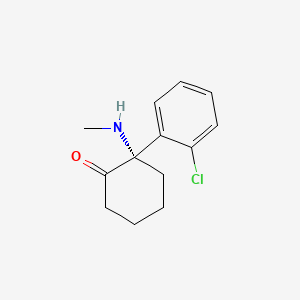
| Formula | C13H16ClNO |
|---|---|
| Molecular weight | 237.73 g/mol |
| IUPAC name | (2S)-2-(2-chlorophenyl)-2-(methylamino)cyclohexan-1-one |
| CAS | 33643-46-8 |
| PubChem CID | 182137 |
| InChIKey | YQEZLKZALYSWHR-ZDUSSCGKSA-N |
| logP | 2.9 (XLogP 2.2) |
| Polar surface area | 29.1 Ų |
| H-bond acceptors / donors | 2 / 1 |
| Drug-likeness (QED) | 0.86 |
| Lipinski violations | 0 |
SMILES
CN[C@]1(c2ccccc2Cl)CCCCC1=OBiology & Pharmacokinetics
Pharmacokinetics
| BBB penetrant | Yes |
|---|
Enzyme interactions
| Enzyme | Role | Detail |
|---|---|---|
| CYP1A2 | Substrate | — |
| CYP2B6 | Inhibitor | — |
| CYP2B6 | Substrate | — |
| CYP2C19 | Inhibitor | — |
| CYP2C19 | Substrate | — |
| CYP2C9 | Substrate | — |
| CYP2D6 | Substrate | — |
| CYP3A4 | Substrate | — |
Transporters
BCRP (Inhibitor)BSEP (Inhibitor)MRP1 (Inhibitor)OATP1B1 (Inhibitor)OATP1B3 (Inhibitor)P-gp (Inhibitor)P-gp (Substrate)
Drug–drug interactions (70, DDInter)
| Interacting drug | Severity | Management |
|---|---|---|
| Caffeine | major | |
| Diethylpropion | major | |
| Doxapram | major | |
| Fenfluramine | major | |
| Mazindol | major | |
| Methylene blue | major | |
| Phentermine | major | |
| Acrivastine | moderate | |
| Aldesleukin | moderate | |
| Alimemazine | moderate | |
| Azatadine | moderate | |
| Azelastine (nasal) | moderate | |
| Beclomethasone dipropionate (nasal) | moderate | |
| Brimonidine (ophthalmic) | moderate | |
| Brimonidine (topical) | moderate | |
| Brompheniramine | moderate | |
| Budesonide (nasal) | moderate | |
| Carbinoxamine | moderate | |
| Cetirizine | moderate | |
| Chlorcyclizine | moderate | |
| Chlorphenesin | moderate | |
| Chlorpheniramine | moderate | |
| Ciclesonide (nasal) | moderate | |
| Clemastine | moderate | |
| Clofedanol | moderate | |
| Codeine | moderate | |
| Cyclizine | moderate | |
| Cyproheptadine | moderate | |
| Dexamethasone (nasal) | moderate | |
| Dexbrompheniramine | moderate | |
| Dextromethorphan | moderate | |
| Difenoxin | moderate | |
| Diphenhydramine | moderate | |
| Diphenoxylate | moderate | |
| Doxepin | moderate | |
| Doxepin (topical) | moderate | |
| Doxylamine | moderate | |
| Dronabinol | moderate | |
| Ephedrine (nasal) | moderate | |
| Ethanol | moderate |
Showing 40 of 70.
Registered Products (3)
| Brand | Form / strength | Pack | Agent | Citizen (JOD) |
|---|---|---|---|---|
| Spravato | Nasal Spray 28 mg/200mcl | 1 Nasal spray pack varies | Adatco Drug Store | — |
| Spravato | Nasal Spray 28 mg/200mcl | 2 Nasal spray pack varies | Adatco Drug Store | — |
| Spravato | Nasal Spray 28 mg/200mcl | 3 Nasal spray pack varies | Adatco Drug Store | — |