Clemastine
JFDA label: TAVEGYL Amp
Mechanism of Action
Competes with histamine for H1-receptor sites on effector cells in the gastrointestinal tract, blood vessels, and respiratory tract; anticholinergic and sedative effects are also seen.
Indications
Approved
- Allergic rhinitis
- OTC Labeling
- Urticaria/angioedema
Contraindications
Source: Lexicomp
- Hypersensitivity clemastine, any component of the formulation, or to other antihistamines of similar chemical structure Absolute
- breast-feeding women Absolute
- lower respiratory tract symptoms (eg, asthma) Absolute
- newborn or premature infants Absolute
- use with monoamine oxidase inhibitors Absolute
Adverse Reactions
Cardiac disorders (3)
Not Known Hypotension · palpitations · tachycardia
Nervous system disorders (11)
Not Known Ataxia · confusion · dizziness · drowsiness (slight to moderate) · fatigue · headache · insomnia · irritability · nervousness · restlessness · sedation
Renal and urinary disorders (3)
Not Known Difficulty in micturition · urinary frequency · urinary retention
Blood and lymphatic system disorders (3)
Not Known Agranulocytosis · hemolytic anemia · thrombocytopenia
Immune system disorders (1)
Not Known Anaphylaxis
Gastrointestinal disorders (6)
Not Known Constipation · diarrhea · epigastric distress · nausea · vomiting · xerostomia
Skin and subcutaneous tissue disorders (2)
Not Known Skin photosensitivity · skin rash
Eye disorders (1)
Not Known Blurred vision
Ear and labyrinth disorders (1)
Not Known Tinnitus
Respiratory, thoracic and mediastinal disorders (1)
Not Known Thickening of bronchial secretions
Dosing
Source: Lexicomp
Warnings & Precautions
Source: Lexicomp
CNS depression
May cause CNS depression, which may impair physical or mental abilities; patients must be cautioned about performing tasks which require mental alertness (eg, operating machinery or driving). Disease-related concerns:
Asthma
Use with caution in patients with a history of asthma. Antihistamines should not be used to treat lower respiratory symptoms (including asthma).
Cardiovascular disease
Use with caution in patients with cardiovascular disease (including hypertension and ischemic heart disease).
Increased intraocular pressure
Use with caution in patients with increased intraocular pressure or angle-closure (narrow angle) glaucoma.
Prostatic hyperplasia/urinary obstruction
Use with caution in patients with prostatic hyperplasia, bladder neck obstruction, and/or GU obstruction.
Pyloroduodenal obstruction
Use with caution in patients with pyloroduodenal obstruction (including stenotic peptic ulcer).
Thyroid dysfunction
Use with caution in patients with thyroid dysfunction. Concurrent drug therapy issues:
Drug-drug interactions
Potentially significant interactions may exist, requiring dose or frequency adjustment, additional monitoring, and/or selection of alternative therapy. Consult drug interactions database for more detailed information.
Pregnancy & Lactation
Pregnancy
Maternal clemastine use has generally not resulted in an increased risk of birth defects. Antihistamines are recommended for the treatment of rhinitis, urticaria, and pruritus with rash in pregnant women (although second generation antihistamines may be preferred). Antihistamines are not recommended for treatment of pruritus associated with intrahepatic cholestasis in pregnancy.
Lactation
Small amounts of clemastine may be excreted in breast milk. Premature infants and newborns have a higher risk of intolerance to antihistamines. Adverse events were observed in single case report of a nursing infant. Use while breast-feeding is contraindicated by the manufacturer. Antihistamines may decrease maternal serum prolactin concentrations when administered prior to the establishment of nursing.
Monitoring
| Clinical pearl | Monitor therapeutic response (eg, reduction of rhinitis, urticaria, eczema, pruritus, or other allergic symptoms) |
|---|
Chemistry & Properties
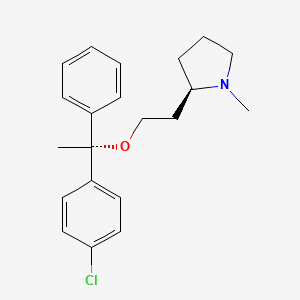
| Formula | C21H26ClNO |
|---|---|
| Molecular weight | 343.9 g/mol |
| IUPAC name | (2R)-2-[2-[(1R)-1-(4-chlorophenyl)-1-phenylethoxy]ethyl]-1-methylpyrrolidine |
| CAS | 15686-51-8 |
| PubChem CID | 26987 |
| InChIKey | YNNUSGIPVFPVBX-NHCUHLMSSA-N |
| logP | 5.1 (XLogP 5.0) |
| Polar surface area | 12.47 Ų |
| H-bond acceptors / donors | 2 / 0 |
| Drug-likeness (QED) | 0.72 |
| Lipinski violations | 1 |
SMILES
CN1CCC[C@@H]1CCO[C@](C)(c1ccccc1)c1ccc(Cl)cc1Biology & Pharmacokinetics
Pharmacokinetics
| BBB penetrant | Yes |
|---|
Enzyme interactions
| Enzyme | Role | Detail |
|---|---|---|
| CYP2B6 | Inhibitor | — |
| CYP2C19 | Inhibitor | IC₅₀ 0.5999999999999996 µM |
| CYP2C19 | Substrate | — |
| CYP2D6 | Inhibitor | IC₅₀ 3.0000000000000013 µM |
| CYP3A4 | Substrate | — |
Receptor binding (top 1)
| Target | Action | Affinity |
|---|---|---|
| H1 receptor (HRH1) | Antagonist | pKi 10.3 |
Transporters
BCRP (Inhibitor)BSEP (Inhibitor)MRP1 (Inhibitor)OATP1B1 (Inhibitor)OATP1B3 (Inhibitor)OCT1 (Inhibitor)P-gp (Inhibitor)MDR1 (Substrate)P-gp (Substrate)
Drug–drug interactions (100+, DDInter)
| Interacting drug | Severity | Management |
|---|---|---|
| Dextropropoxyphene | major | |
| Potassium chloride | major | |
| Potassium citrate | major | |
| Sodium oxybate | major | |
| Topiramate | major | |
| Zonisamide | major | |
| Acetylcholine | moderate | |
| Aclidinium | moderate | |
| Acrivastine | moderate | |
| Alfentanil | moderate | |
| Alimemazine | moderate | |
| Alprazolam | moderate | |
| Amantadine | moderate | |
| Amitriptyline | moderate | |
| Amobarbital | moderate | |
| Amoxapine | moderate | |
| Apomorphine | moderate | |
| Apraclonidine | moderate | |
| Aripiprazole | moderate | |
| Asenapine | moderate | |
| Atropine | moderate | |
| Azatadine | moderate | |
| Azelastine (nasal) | moderate | |
| Baclofen | moderate | |
| Belladonna | moderate | |
| Benzatropine | moderate | |
| Benzhydrocodone | moderate | |
| Biperiden | moderate | |
| Botulinum Toxin Type B | moderate | |
| Botulinum toxin type A | moderate | |
| Brexanolone | moderate | |
| Brexpiprazole | moderate | |
| Brimonidine (ophthalmic) | moderate | |
| Brimonidine (topical) | moderate | |
| Brivaracetam | moderate | |
| Bromocriptine | moderate | |
| Brompheniramine | moderate | |
| Buprenorphine | moderate | |
| Buspirone | moderate | |
| Butabarbital | moderate |
Showing 40 of 100+.
Registered Products (2)
| Brand | Form / strength | Pack | Agent | Citizen (JOD) |
|---|---|---|---|---|
| TAVEGYL Tab | Tablet 1 mg | 20 tab | Nabulsi Drug Store | 4.530 |
| TAVEGYL Amp | Ampoule 2 mg/2 ml | 2 ml | Nabulsi Drug Store | 4.750 |