Doxorubicin
JFDA label: ADRIBLASTINA Vial
- Cardiomyopathy:
- Extravasation:
- Secondary malignancy:
- Myelosuppression:
Mechanism of Action
Doxorubicin inhibits DNA and RNA synthesis by intercalation between DNA base pairs by inhibition of topoisomerase II and by steric obstruction. Doxorubicin intercalates at points of local uncoiling of the double helix. Although the exact mechanism is unclear, it appears that direct binding to DNA (intercalation) and inhibition of DNA repair (topoisomerase II inhibition) result in blockade of DNA and RNA synthesis and fragmentation of DNA. Doxorubicin is also a powerful iron chelator; the iron-doxorubicin complex can bind DNA and cell membranes and produce free radicals that immediately cleave the DNA and cell membranes.
Indications
Approved
- Breast cancer
- Metastatic cancers or disseminated neoplastic conditions
Off-label
- Endometrial carcinoma
- Hepatocellular carcinoma (metastatic)
- Multiple myeloma
- Renal carcinoma
- Salivary gland cancers (advanced)
- Thymomas and thymic malignancies
- Uterine sarcoma
- Waldenström macroglobulinemia
Contraindications
Source: Lexicomp
- Hypersensitivity (including anaphylaxis) to doxorubicin, any component of the formulation, or to other anthracyclines or anthracenediones Absolute
- previous therapy with maximum cumulative doses of doxorubicin, daunorubicin, idarubicin, or other anthracycline and anthracenediones Absolute
- recent MI (within past 4 to 6 weeks), severe myocardial insufficiency, severe arrhythmia Absolute
- severe hepatic impairment (Child-Pugh class C or bilirubin >5 mg/dL) Absolute
- severe persistent drug-induced myelosuppression or baseline neutrophil count 3 Absolute
Adverse Reactions
Nervous system disorders (1)
Not Known Malaise
Renal and urinary disorders (2)
Not Known infertility (may be temporary) · Urine discoloration
Blood and lymphatic system disorders (4)
Not Known anemia · Leukopenia · neutropenia · thrombocytopenia
Metabolism and nutrition disorders (3)
Not Known Amenorrhea · dehydration · hyperuricemia
Gastrointestinal disorders (8)
Not Known Abdominal pain · anorexia · diarrhea · discoloration of saliva · gastrointestinal ulcer · mucositis · nausea · vomiting
Skin and subcutaneous tissue disorders (5)
Not Known Alopecia · discoloration of sweat · pruritus · skin photosensitivity · skin rash; urticaria
Musculoskeletal and connective tissue disorders (1)
Not Known Weakness
Eye disorders (1)
Not Known Discoloration of tears
General disorders and administration site conditions (3)
Not Known Necrosis (colon) · Post-injection flare · radiation recall phenomenon
Other (14)
Not Known Atrioventricular block · bradycardia · bundle branch block · Cardiac failure (manifestations include ascites, cardiomegaly, dyspnea, edema, gallop rhythm, hepatomegaly, oliguria, pleural effusion, pulmonary edema, tachycardia) · decreased left ventricular ejection fraction · ECG abnormality · extrasystoles (atrial or ventricular) · myocarditis · nonspecific ST or T wave changes on ECG · pericarditis · sinus tachycardia · supraventricular tachycardia · tachyarrhythmia · ventricular tachycardia
Dosing
Source: Lexicomp
Warnings & Precautions
Source: Lexicomp
Bone marrow suppression
Severe myelosuppression resulting in serious infection, septic shock, transfusion requirements, hospitalization, and death may occur. Myelosuppression may be dose-limiting and primarily manifests as leukopenia and neutropenia; anemia and thrombocytopenia may also occur. The nadir typically occurs 10 to 14 days after administration with cell count recovery by day 21. Monitor blood counts at baseline and regularly during therapy.
Cardiomyopathy
Myocardial damage, including acute left ventricular failure can occur with doxorubicin. The risk of cardiomyopathy is proportional to the cumulative exposure with incidences from 1% to 20% for cumulative doses from 300 mg/m2 to 500 mg/m2 when doxorubicin is administered every 3 weeks. The risk of cardiomyopathy is further increased with concomitant cardiotoxic therapy. Assess left ventricular ejection fraction (LVEF) before and regularly during and after doxorubicin treatment. Assess LVEF by MUGA or echocardiogram; use the same assessment method at all time points; increase the frequency of assessments as the cumulative dose exceeds 300 mg/m2. Discontinue doxorubicin in patients who develop signs/symptoms of cardiomyopathy during treatment. Delayed cardiotoxicity may occur late in treatment or within months to years after completion of therapy, and is typically manifested by decreased LVEF and/or signs/symptoms of heart failure. The total cumulative doxorubicin dose should take into account prior treatment with other anthracyclines or anthracenediones. The risk for delayed cardiotoxicity is estimated to range from 1% to 2% at cumulative lifetime doses of 300 mg/m2 to 6% to 20% at cumulative lifetime doses of 500 mg/m2 administered every 3 weeks. The risk of cardiomyopathy is increased in patients who have received radiotherapy to the mediastinum or concomitant therapy with other known cardiotoxic agents such as cyclophosphamide and trastuzumab. Pericarditis and myocarditis ha
Extravasation
Vesicant; extravasation may result in severe local tissue injury and necrosis requiring wide excision of the affected area and skin grafting. Immediately terminate infusion and apply ice to the affected area. For IV administration only; do not administer by intramuscular (IM) or subcutaneous routes. Ensure proper needle or catheter placement prior to and during infusion. Avoid extravasation.
Fertility impairment
In men, doxorubicin may damage spermatozoa and testicular tissue, resulting in possible genetic fetal abnormalities; may also result in oligospermia, azoospermia, and permanent loss of fertility (sperm counts have been reported to return to normal levels in some men, occurring several years after the end of therapy). In females of reproductive potential, doxorubicin may cause infertility and result in amenorrhea; premature menopause can occur.
Gastrointestinal toxicity
Doxorubicin is associated with a moderate or high emetic potential (depending on dose or regimen); antiemetics are recommended to prevent nausea and vomiting (Dupuis 2011; Hesketh 2017; Roila 2016).
Secondary malignancy
[US Boxed Warnings]: Secondary acute myelogenous leukemia (AML) and myelodysplastic syndromes (MDS) occur at a higher incidence in patients treated with anthracyclines, including doxorubicin. AML and MDS typically occur within 1 to 3 years of treatment; risk factors for development of secondary AML or MDS include treatment with anthracyclines in combination with DNA-damaging antineoplastics (eg, alkylating agents) and/or radiation therapy, heavily pretreated patients, and escalated anthracycline doses.
Tumor lysis syndrome
May cause tumor lysis syndrome and hyperuricemia (in patients with rapidly growing tumors). Urinary alkalinization and prophylaxis with an antihyperuricemic agent may be necessary. Monitor electrolytes, renal function, and hydration status. Disease-related concerns:
Hepatic impairment
Dose reduction is recommended in patients with bilirubin levels of 1.2 to 5 mg/dL; toxicities may be increased in patients with hepatic impairment. Use is contraindicated in patients with severe impairment (Child-Pugh class C or bilirubin >5 mg/dL). Monitor hepatic function tests (ALT, AST, alkaline phosphatase, and bilirubin) at baseline and during treatment. Concurrent drug therapy issues:
Drug-drug interactions
Potentially significant interactions may exist, requiring dose or frequency adjustment, additional monitoring, and/or selection of alternative therapy. Consult drug interactions database for more detailed information. Special populations:
Pediatric
Children are at increased risk for developing delayed cardiotoxicity; long-term periodic cardiac function monitoring is recommended. Doxorubicin may contribute to prepubertal growth failure in children; may also contribute to gonadal impairment (usually temporary). Radiation recall pneumonitis has been reported in children receiving concomitant dactinomycin and doxorubicin.
Radiation recipients
Use with caution in patients who have received radiation therapy; radiation recall may occur. May increase radiation-induced toxicity to the myocardium, mucosa, skin, and liver. Dosage form specific issues:
Formulations (conventional vs liposomal)
Use caution when selecting product for preparation and dispensing; indications, dosages and adverse event profiles differ between conventional doxorubicin hydrochloride solution and doxorubicin liposomal. Both formulations are the same concentration. As a result, serious errors have occurred. Other warnings/precautions:
Vaccines
Administration of live vaccines to immunosuppressed patients may be hazardous.
Pregnancy & Lactation
Pregnancy
Adverse events have been observed in animal reproduction studies. Based on the mechanism of action, doxorubicin may cause fetal harm if administered during pregnancy (according to the manufacturer’s labeling). Advise patients (females of reproductive potential and males with female partners of reproductive potential) to use effective nonhormonal contraception during and for 6 months following therapy. Limited information is available from a retrospective study of women who received doxorubicin (in combination with cyclophosphamide) during the second or third (prior to week 35) trimester for the treatment of pregnancy-associated breast cancer (Ring 2005). Some pharmacokinetic properties of doxorubicin may be altered in pregnant women (van Hasselt 2014). The European Society for Medical Oncology (ESMO) has published guidelines for diagnosis, treatment, and follow-up of cancer during pregnancy (Peccatori 2013); the guidelines recommend referral to a facility with expertise in cancer durin
Lactation
Doxorubicin and its metabolites are present in breast milk. Due to the potential for serious adverse reactions in the breastfed infant, the manufacturer recommends a decision be made whether to discontinue breastfeeding or to discontinue the drug, taking into account the importance of treatment to the mother.
Monitoring
| Clinical pearl | CBC with differential and platelet count; liver function tests (bilirubin, ALT/AST, alkaline phosphatase); serum uric acid, calcium, potassium, phosphate and creatinine; hydration status; cardiac function (baseline, periodic, and followup): ECG, left ventricular ejection fraction (echocardiography [ECHO] or multigated radionuclide angiography [MUGA]); monitor infusion site. Cardiovascular monitoring (Armenian 2017): Comprehensive assessment prior to treatment including a history and physical examination, screening for cardiovascular disease risk factors such as hypertension, diabetes, dyslipidemia, obesity, and smoking. Echocardiogram (prior to treatment). In patients who develop signs/symptoms of cardiac dysfunction during therapy, an echocardiogram is recommended for diagnostic workup; if echocardiogram is not available or feasible, a cardiac MRI (preferred) or MUGA scan may be utilized; obtain serum cardiac biomarkers. |
|---|
Chemistry & Properties
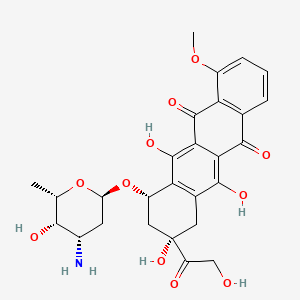
| Formula | C27H29NO11 |
|---|---|
| Molecular weight | 543.53 g/mol |
| IUPAC name | (7S,9S)-7-[(2R,4S,5S,6S)-4-amino-5-hydroxy-6-methyloxan-2-yl]oxy-6,9,11-trihydroxy-9-(2-hydroxyacetyl)-4-methoxy-8,10-dihydro-7H-tetracene-5,12-dione |
| CAS | 23214-92-8 |
| PubChem CID | 31703 |
| InChIKey | AOJJSUZBOXZQNB-TZSSRYMLSA-N |
| logP | 0.0 (XLogP 1.3) |
| Polar surface area | 206.07 Ų |
| H-bond acceptors / donors | 12 / 6 |
| Drug-likeness (QED) | 0.24 |
| Lipinski violations | 3 |
SMILES
COc1cccc2c1C(=O)c1c(O)c3c(c(O)c1C2=O)C[C@@](O)(C(=O)CO)C[C@@H]3O[C@H]1C[C@H](N)[C@H](O)[C@H](C)O1Biology & Pharmacokinetics
Pharmacokinetics
| BBB penetrant | Yes (logBB -0.83) |
|---|
Enzyme interactions
| Enzyme | Role | Detail |
|---|---|---|
| CYP2B6 | Inhibitor | — |
Receptor binding (top 1)
| Target | Action | Affinity |
|---|---|---|
| DNA topoisomerase II alpha (TOP2A) | Inhibitor | pIC50 6.0 |
Transporters
ASBT (Inhibitor)BCRP (Inhibitor)BCRP (Inhibitor)BSEP (Inhibitor)BSEP (Inhibitor)MATE1 (Inhibitor)MDR1 (Inhibitor)MRP (Inhibitor)MRP1 (Inhibitor)MRP1 (Inhibitor)MRP2 (Inhibitor)MRP3 (Inhibitor)MRP7 (Inhibitor)OATP1B1 (Inhibitor)OATP1B1 (Inhibitor)OATP1B3 (Inhibitor)OATP1B3 (Inhibitor)OATP2B1 (Inhibitor)OCT3 (Inhibitor)OCTN1 (Inhibitor)P-gp (Inhibitor)BCRP (Substrate)BSEP (Substrate)MDR1 (Substrate)MRP (Substrate)MRP1 (Substrate)MRP2 (Substrate)MRP3 (Substrate)P-gp (Substrate)Transporter(unspecified) (Substrate)
Drug–drug interactions (100+, DDInter)
| Interacting drug | Severity | Management |
|---|---|---|
| Adalimumab | major | |
| Amiodarone | major | |
| Amisulpride | major | |
| Anagrelide | major | |
| Arsenic trioxide | major | |
| Bacillus calmette-guerin substrain tice live antigen | major | |
| Baricitinib | major | |
| Bedaquiline | major | |
| Bepridil | major | |
| Cabozantinib | major | |
| Ceritinib | major | |
| Certolizumab pegol | major | |
| Chloroquine | major | |
| Cisapride | major | |
| Citalopram | major | |
| Cladribine | major | |
| Clozapine | major | |
| Crizotinib | major | |
| Dalfopristin | major | |
| Deferiprone | major | |
| Disopyramide | major | |
| Dofetilide | major | |
| Dolasetron | major | |
| Dronedarone | major | |
| Droperidol | major | |
| Efavirenz | major | |
| Escitalopram | major | |
| Etanercept | major | |
| Fingolimod | major | |
| Gatifloxacin | major | |
| Golimumab | major | |
| Grepafloxacin | major | |
| Halofantrine | major | |
| Haloperidol | major | |
| Hydroxychloroquine | major | |
| Ibutilide | major | |
| Iloperidone | major | |
| Infliximab | major | |
| Ivabradine | major | |
| Ivosidenib | major |
Showing 40 of 100+.
Registered Products (17)
| Brand | Form / strength | Pack | Agent | Citizen (JOD) |
|---|---|---|---|---|
| A.D. Mycin | Vial 50 mg | 25 ml | Ibn Rushd Drug Store | — |
| A.D. Mycin 10 mg/ | Vial 10 mg | 5 ml | Ibn Rushd Drug Store | — |
| ADRIBLASTINA Vial | Vial 50 mg | 1 vial | Petra Drug Store | — |
| Adriamycin | Vial 2 mg/1 ml | 1 vial | Petra Drug Store | — |
| Adrim Injection | Injection 50 mg/25 ml | 25 ml | Sun Set Drug Store | — |
| Adrim Injection | Injection 10 mg/5 ml | 5 ml | Sun Set Drug Store | — |
| Caelyx | Vial 2 mg/ml | 1 vial | Khoury Drug Store | — |
| Cytodox | Solution 50 mg/25 ml | 25 ml | Greenland Drug Store | — |
| D-Rubicin Powder for Injection | Powder for Injection 50 mg | One Vial | Khuson Drug Store | — |
| DOXORUBICIN EBEWE VIALS | Vial 50 mg/25 ml | 1 vial | Sabbagh Drug Store | — |
| DOXORUBICIN EBEWE VIALS | Vial 10 mg/5 ml | 5 ml | Sabbagh Drug Store | — |
| DOXORUBIN powder for inj | Powder for Injection 50 mg | 1 vial | International Progness Drug Store | — |
| DOXORUBIN powder for inj | Powder for Injection 10 mg | 1 vial | International Progness Drug Store | — |
| Doxotil | Vial 50 mg/25 ml | 1 vial | Orient Montreal Drug Store | — |
| Doxotil | Vial 10 mg/5 ml | 1 vial | Orient Montreal Drug Store | — |
| Doxtu 50mg /25 ml | Injection Doxorubicin Hcl 2 mg/ml | 1 vial | Ibn Rushd Drug Store | — |
| Zuvidox-50 | Vial 50 mg | 1 vial | ٠ستÙدع أدÙÙØ© اÙÙÙÙÙÙÙ | — |