Triptorelin
JFDA label: Decapeptyl L.P
Mechanism of Action
Triptorelin is an agonist analog of gonadotropin releasing hormone (GnRH) and causes suppression of ovarian and testicular steroidogenesis due to decreased levels of LH and FSH with subsequent decrease in testosterone (male) and estrogen (female) levels. After chronic and continuous administration, usually 2 to 4 weeks after initiation, a sustained decrease in LH and FSH secretion occurs. When used for ART, prevents premature LH surge in women undergoing controlled ovarian hyperstimulation.
Indications
Approved
- Assisted reproductive technologies
- Central precocious puberty
- Prostate cancer (advanced)
Off-label
- Endometrial stromal sarcoma
- Endometriosis
- In vitro fertilization
- Paraphilia/hypersexuality
Contraindications
Source: Lexicomp
- Additional contraindications (not in the US labeling): Breastfeeding women Absolute
- Known hypersensitivity to triptorelin or any component of the formulation, other GnRH agonists or GnRH Absolute
Adverse Reactions
Cardiac disorders (6)
Common chest pain · dependent edema · Flushing · hypertension · Lower extremity edema · peripheral edema
Nervous system disorders (7)
Common dizziness · emotional lability · fatigue · Headache · insomnia · malaise · pain
Hepatobiliary disorders (3)
Very Common Increased serum alkaline phosphatase · increased serum ALT · increased serum AST
Renal and urinary disorders (11)
Very Common Increased blood urea nitrogen · Vaginal hemorrhage
Common dysuria · Erectile dysfunction · gynecological pain · impotence · leukorrhea · Pelvic pain · testicular atrophy · urinary retention · urinary tract infection
Blood and lymphatic system disorders (3)
Very Common Decreased hemoglobin · decreased red blood cells
Common Anemia
Metabolism and nutrition disorders (9)
Very Common Hot flash · increased serum glucose · increased testosterone (peak: days 2-4; decline to low levels by weeks 3-4)
Common Decreased libido · dysmenorrhea · gynecomastia · ovarian cyst · ovarian hyperstimulation syndrome · Spontaneous abortion
Gastrointestinal disorders (9)
Common abdominal distension · abdominal pain · anorexia · constipation · diarrhea · dyspepsia · mastalgia · Nausea · vomiting
Skin and subcutaneous tissue disorders (2)
Common pruritus · Skin rash
Musculoskeletal and connective tissue disorders (8)
Very Common Musculoskeletal pain
Common arthralgia · back pain · leg cramps · Leg pain · myalgia · Postoperative pain · weakness
Eye disorders (2)
Common Conjunctivitis · eye pain
General disorders and administration site conditions (4)
Very Common Inflammation at injection site
Common bruising at injection site · injection site reaction · Pain at injection site
Other (31)
Not Known Anaphylactic shock · anaphylaxis · angioedema · As reported with all strengths; frequency of effect may vary by strength: · bladder outflow obstruction · blurred vision · cerebrovascular accident · circulatory shock · deep vein thrombosis · dyspareunia · exacerbation of depression · hematuria · hypersensitivity reaction · increased appetite · limb pain · myocardial infarction · neuropathy · ostealgia · pituitary apoplexy · prolonged Q-T interval on ECG · pulmonary embolism · renal insufficiency · seizure · sleep disorder · spinal cord compression · thrombophlebitis · tissue necrosis at injection site · transient ischemic attacks · tumor flare · urethral obstruction · vaginal dryness
Respiratory, thoracic and mediastinal disorders (6)
Common Cough · dyspnea · flu-like symptoms · pharyngitis · rhinitis · Upper respiratory tract infection
Dosing
Source: Lexicomp
Warnings & Precautions
Source: Lexicomp
Cardiovascular effects
Androgen-deprivation therapy (ADT) may increase the risk for cardiovascular disease (Levine 2010). Myocardial infarction, sudden cardiac death and stroke have been reported in men receiving GnRH agonists. ADT may prolong the QT/QTc interval; consider the benefits of ADT versus the risk for QT prolongation in patients with a history of QTc prolongation, congenital long QT syndrome, heart failure, frequent electrolyte abnormalities, and in patients with medications known to prolong the QT interval. Consider periodic monitoring of electrocardiograms and electrolytes in at-risk patients.
Decreased bone density
Use with caution in patients with risk factors for decreased bone mineral density; GnRH agonist therapy may increase risk for osteoporosis and bone fractures particularly with prolonged use.
Hyperglycemia
Hyperglycemia and an increased risk of developing diabetes has been reported with therapy and may manifest as diabetes or worsening of glycemic control in patients with diabetes. Monitor blood glucose and/or glycosylated hemoglobin (HbA1c) as clinically necessary.
Hypersensitivity reactions
Angioedema and anaphylactic shock have occurred; discontinue use if severe reaction occurs.
Ovarian hyperstimulation syndrome
Decapeptyl [Canadian product]: Ovarian hyperstimulation syndrome (OHSS) is a rare exaggerated response to ovulation induction therapy (Corbett 2014; Fiedler 2012). This syndrome may begin within 24 hours of treatment but may become most severe 7 to 10 days after therapy (Corbett 2014). Symptoms of mild/moderate OHSS may include abdominal distention/discomfort, diarrhea, nausea, and/or vomiting. Severe OHSS symptoms may include severe abdominal pain, anuria/oliguria, ascites, severe dyspnea, hypotension, or nausea/vomiting (intractable). Decreased creatinine clearance, hemoconcentration, hypoproteinemia, elevated liver enzymes, elevated WBC, and electrolyte imbalances may also be present (ASRM 2016; Corbett 2014; Fiedler 2012). Treatment is primarily symptomatic and includes fluid and electrolyte management, analgesics, and prevention of thromboembolic complications (ASRM 2016; SOGC-CFAS 2011). Therapy with gonadotropins should be stopped.
Pituitary apoplexy
Rare cases of pituitary apoplexy (frequently secondary to pituitary adenoma) have been observed with GnRH agonist administration (onset from 1 hour to usually • Psychiatric effects: Symptoms of emotional lability (eg, crying, irritability, anger, aggression, impatience) have been reported with GnRH agonists, including triptorelin; monitor for the development or worsening of psychiatric symptoms.
Seizures
Seizures have been reported with GnRH agonists, including triptorelin in patients with or without a history of seizures or other conditions or concurrent medications associated with seizures.
Spinal cord compression
Cases of spinal cord compression, which may contribute to weakness or paralysis (possible fatal complications), have been reported; observe patients with metastatic vertebral lesions closely during the first few weeks of treatment.
Symptom flare
Transient initial increases in gonadotropins and sex steroids leading to a worsening of symptoms may be observed during the first few weeks of therapy or after subsequent doses. Patients with prostate cancer may experience new or increased bone pain, neuropathy, hematuria, or urethral or bladder outlet obstruction. Female patients with central precocious puberty may experience transient vaginal bleeding. Disease-related concerns:
Urinary tract obstruction
Observe patients with urinary tract obstruction closely during the first few weeks of treatment. Concurrent drug therapy issues:
Drug-drug interactions
Potentially significant interactions may exist, requiring dose or frequency adjustment, additional monitoring, and/or selection of alternative therapy. Consult drug interactions database for more detailed information. Dosage form specific issues:
Polysorbate 80
Some dosage forms may contain polysorbate 80 (also known as Tweens). Hypersensitivity reactions, usually a delayed reaction, have been reported following exposure to pharmaceutical products containing polysorbate 80 in certain individuals (Isaksson 2002; Lucente 2000; Shelley 1995). Thrombocytopenia, ascites, pulmonary deterioration, and renal and hepatic failure have been reported in premature neonates after receiving parenteral products containing polysorbate 80 (Alade 1986; CDC 1984). See manufacturer's labeling.
Pregnancy & Lactation
Pregnancy
Use is contraindicated in pregnant women. When used for ART, pregnancy must be ruled out prior to therapy and nonhormonal contraception should be used until menses occurs. Due to the short half-life of triptorelin (formulations used for ART), it is not expected to be present in the maternal serum at the time of embryo transfer. In case reports, spontaneous abortion, congenital anomalies, and other adverse events have been reported following triptorelin (Decapeptyl [Canadian product]) exposure during pregnancy.
Lactation
It is not known if triptorelin is present in breast milk.
Monitoring
| Clinical pearl | Glucose and HbA1c (periodically), signs and symptoms of emerging cardiovascular disease; consider periodic monitoring of electrocardiograms and electrolytes in at-risk patients; development/worsening of psychiatric symptoms. Additional monitoring (per indication): Treatment of precocious puberty: Monitor response to therapy with LH levels after a GnRH or GnRH agonist stimulation test, basal LH, or serum sex steroid levels beginning 1 to 2 months after initiation of therapy, during therapy, and with each subsequent dose; height every 3 to 6 months; bone age (periodically) Prostate cancer: Serum testosterone levels, prostate-specific antigen; bone density. Assisted reproductive technologies: Decapeptyl [Canadian product]: Negative pregnancy test prior to initiation of therapy; signs/symptoms of allergic reaction for 30 minutes after administration; ultrasound and/or estradiol levels to assess follicle development; ultrasound to assess number and size of follicles OHSS: Monitoring of hospitalized patients should include abdominal circumference, albumin, cardiorespiratory status, electrolytes, fluid balance, hematocrit, hemoglobin, serum creatinine, urine output, urine specific gravity, vital signs, weight (daily or as necessary) and liver enzymes (weekly) (SOGC-CFAS 2011). Treatment of paraphilia/hypersexuality (off-label use): The following monitoring has been recommended for other GnRH agonists: CBC (baseline, monthly for 4 months then every 6 months); serum testos |
|---|
Chemistry & Properties
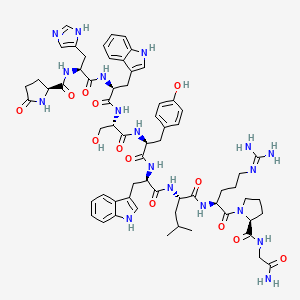
| Formula | C64H82N18O13 |
|---|---|
| Molecular weight | 1311.47 g/mol |
| IUPAC name | (2S)-N-[(2S)-1-[[(2S)-1-[[(2S)-1-[[(2S)-1-[[(2R)-1-[[(2S)-1-[[(2S)-1-[(2S)-2-[(2-amino-2-oxoethyl)carbamoyl]pyrrolidin-1-yl]-5-(diaminomethylideneamino)-1-oxopentan-2-yl]amino]-4-methyl-1-oxopentan-2-yl]amino]-3-(1H-indol-3-yl)-1-oxopropan-2-yl]amino]-3-(4-hydroxyphenyl)-1-oxopropan-2-yl]amino]-3-hydroxy-1-oxopropan-2-yl]amino]-3-(1H-indol-3-yl)-1-oxopropan-2-yl]amino]-3-(1H-imidazol-5-yl)-1-oxopropan-2-yl]-5-oxopyrrolidine-2-carboxamide |
| CAS | 57773-63-4 |
| PubChem CID | 25074470 |
| InChIKey | VXKHXGOKWPXYNA-PGBVPBMZSA-N |
SMILES
CC(C)C[C@H](NC(=O)[C@@H](Cc1c[nH]c2ccccc12)NC(=O)[C@H](Cc1ccc(O)cc1)NC(=O)[C@H](CO)NC(=O)[C@H](Cc1c[nH]c2ccccc12)NC(=O)[C@H](Cc1c[nH]cn1)NC(=O)[C@@H]1CCC(=O)N1)C(=O)N[C@@H](CCCNC(=N)N)C(=O)N1CCC[C@H]1C(=O)NCC(N)=OBiology & Pharmacokinetics
Pharmacokinetics predicted
| Bioavailability | 70.0% |
|---|---|
| Half-life | 1.267 h |
| Volume of distribution | 0.317 L/kg |
| Protein binding | 65.3% |
| BBB penetrant | No |
Transporters
BCRP (Inhibitor)BSEP (Inhibitor)MRP1 (Inhibitor)OATP1B1 (Inhibitor)OATP1B3 (Inhibitor)P-gp (Inhibitor)P-gp (Substrate)
Drug–drug interactions (100+, DDInter)
| Interacting drug | Severity | Management |
|---|---|---|
| Amiodarone | major | |
| Amisulpride | major | |
| Anagrelide | major | |
| Arsenic trioxide | major | |
| Bedaquiline | major | |
| Bepridil | major | |
| Cabozantinib | major | |
| Ceritinib | major | |
| Cisapride | major | |
| Citalopram | major | |
| Clozapine | major | |
| Crizotinib | major | |
| Disopyramide | major | |
| Dofetilide | major | |
| Dolasetron | major | |
| Dronedarone | major | |
| Droperidol | major | |
| Efavirenz | major | |
| Escitalopram | major | |
| Fingolimod | major | |
| Gatifloxacin | major | |
| Grepafloxacin | major | |
| Halofantrine | major | |
| Haloperidol | major | |
| Ibutilide | major | |
| Iloperidone | major | |
| Ivabradine | major | |
| Ivosidenib | major | |
| Lefamulin | major | |
| Levacetylmethadol | major | |
| Lumefantrine | major | |
| Macimorelin | major | |
| Mesoridazine | major | |
| Methadone | major | |
| Mifepristone | major | |
| Moxifloxacin | major | |
| Nilotinib | major | |
| Osimertinib | major | |
| Ozanimod | major | |
| Panobinostat | major |
Showing 40 of 100+.
Registered Products (6)
| Brand | Form / strength | Pack | Agent | Citizen (JOD) |
|---|---|---|---|---|
| Decapeptyl | Ampoule 0.1 mg | 7 amp | Petra Drug Store | 27.820 |
| Gonapeptyl | Pre-filled Syringe 0.1 mg/1 ml | 1 ml | Petra Drug Store | 45.000 |
| Decapeptyl Prolonged Release | Tablet 3.75 mg | 1 vial | Petra Drug Store | 106.610 |
| Gonapeptyl CR | Capsule 3.75 mg | 1 syringe | Petra Drug Store | 117.050 |
| Decapeptyl S.R 22.5mg Powder and solvent for sustained release suspension for injection | Suspension 22.5 mg | 1 amp | Petra Drug Store | — |
| Decapeptyl L.P | Ampoule 11.25 mg | 1 syringe | Petra Drug Store | — |