Flumazenil
JFDA label: Flunexate IV Amp
- Seizures:
Mechanism of Action
Allosteric Antagonist of GABA-A receptor; anion channel — GABA-A receptor; anion channel allosteric antagonist
| Target | Action | Gene / class |
|---|---|---|
| GABA-A receptor; anion channel efficacy | ALLOSTERIC ANTAGONIST |
Indications
Approved
- Benzodiazepine reversal when used in conscious sedation or general anesthesia
- Management of benzodiazepine overdose
Contraindications
Source: Lexicomp
- Hypersensitivity to flumazenil, benzodiazepines, or any component of the formulation Absolute
- patients given benzodiazepines for control of potentially life-threatening conditions (eg, control of intracranial pressure or status epilepticus) Absolute
- patients who may have ingested or are showing signs of cyclic-antidepressant overdosage Absolute
Adverse Reactions
Cardiac disorders (4)
Common flushing · Palpitation · thrombophlebitis · vasodilatation
Nervous system disorders (18)
Common agitation · anxiety · Ataxia · depersonalization · depression · dizziness · dysphoria · emotional lability · euphoria · fatigue · headache · hypoesthesia · insomnia · malaise · nervousness · paranoia · paresthesia · vertigo
Metabolism and nutrition disorders (1)
Common Hot flash
Gastrointestinal disorders (2)
Common nausea · Xerostomia
Skin and subcutaneous tissue disorders (3)
Common Dermatological disease · diaphoresis · skin rash
Musculoskeletal and connective tissue disorders (2)
Common tremor · Weakness
Eye disorders (3)
Common Blurred vision · lacrimation · visual disturbance
General disorders and administration site conditions (2)
Common injection site reaction · Pain at injection site
Other (1)
Very Common Gastrointestinal: Vomiting
Respiratory, thoracic and mediastinal disorders (2)
Common Dyspnea · hyperventilation
Dosing
Source: Lexicomp
Warnings & Precautions
Source: Lexicomp
Amnesia
Does not consistently reverse amnesia; patient may not recall verbal instructions after procedure.
CNS depression
May cause CNS depression, which may impair physical or mental abilities; patients must be cautioned about performing tasks which require mental alertness (eg, operating machinery or driving) for 24 hours after discharge.
Resedation
Occurs more frequently in patients where a large single dose or cumulative dose of a benzodiazepine has been administered along with a neuromuscular-blocking agent and multiple anesthetic agents.
Respiratory depression
Should not rely upon to reverse respiratory depression/hypoventilation. Flumazenil is not a substitute for evaluation of oxygenation. Establishing an airway and assisting ventilation, as necessary, is always the initial step in overdose management.
Seizures
Benzodiazepine reversal may result in seizures; seizures may occur more frequently in patients on benzodiazepines for long-term sedation or following tricyclic antidepressant overdose. Dose should be individualized and practitioners should be prepared to manage seizures. Seizures may also develop in patients with concurrent major sedative-hypnotic drug withdrawal, recent therapy with repeated doses of parenteral benzodiazepines, myoclonic jerking or seizure activity prior to flumazenil administration. Use with caution in patients relying on a benzodiazepine for seizure control. Disease-related concerns:
Head injury
Use with caution in patients with a head injury; may alter cerebral blood flow or precipitate convulsions in patients receiving benzodiazepines.
Hepatic impairment
Use with caution in patients with hepatic dysfunction; repeated doses of the drug should be reduced in frequency or amount.
Panic disorder
Use with caution in patients with a history of panic disorder; may provoke panic attacks. Special populations:
Drug/alcohol dependence
Use caution in drug and ethanol-dependent patients; these patients may also be dependent on benzodiazepines.
Intensive care patients
Should be used with caution in the intensive care unit because of increased risk of unrecognized benzodiazepine dependence in such settings. Other warnings/precautions:
Appropriate use
Should not be used to diagnose benzodiazepine-induced sedation. Reverse neuromuscular blockade before considering use. Flumazenil does not antagonize the CNS effects of other GABA agonists (such as ethanol, barbiturates, or general anesthetics); nor does it reverse opioids. Not recommended for treatment of benzodiazepine dependence.
Overdose use
Use with caution in patients with mixed drug overdoses; toxic effects of other drugs taken may emerge once benzodiazepine effects are reversed.
Pregnancy & Lactation
Pregnancy
Teratogenic effects were not seen in animal reproduction studies. Embryocidal effects were seen at large doses. Use during labor and delivery is not recommended. In general, medications used as antidotes should take into consideration the health and prognosis of the mother; antidotes should be administered to pregnant women if there is a clear indication for use and should not be withheld because of fears of teratogenicity (Bailey 2003).
Lactation
It is not known if flumazenil is excreted in breast milk. The manufacturer recommends that caution be used if administering to breast-feeding women.
Monitoring
| Clinical pearl | Monitor for return of sedation, respiratory depression, benzodiazepine withdrawal, and other residual effects of benzodiazepines for at least 2 hours and until the patient is stable and resedation is unlikely. |
|---|
Chemistry & Properties
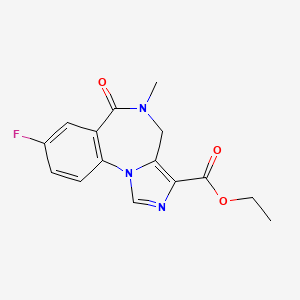
| Formula | C15H14FN3O3 |
|---|---|
| Molecular weight | 303.29 g/mol |
| IUPAC name | ethyl 8-fluoro-5-methyl-6-oxo-4H-imidazo[1,5-a][1,4]benzodiazepine-3-carboxylate |
| CAS | 78755-81-4 |
| PubChem CID | 3373 |
| InChIKey | OFBIFZUFASYYRE-UHFFFAOYSA-N |
| logP | 1.77 (XLogP 1.0) |
| Polar surface area | 64.43 Ų |
| H-bond acceptors / donors | 5 / 0 |
| Drug-likeness (QED) | 0.79 |
| Lipinski violations | 0 |
SMILES
CCOC(=O)c1ncn2c1CN(C)C(=O)c1cc(F)ccc1-2Biology & Pharmacokinetics
Pharmacokinetics
| BBB penetrant | Yes (logBB -0.3) |
|---|
Receptor binding (top 5)
| Target | Action | Affinity |
|---|---|---|
| GABAA receptor α5 subunit (GABRA5) | Allosteric modulator | pKi 9.2 |
| GABAA receptor α1 subunit (GABRA1) | Allosteric modulator | pKi 9.1 |
| GABAA receptor α2 subunit (GABRA2) | Allosteric modulator | pKi 9.1 |
| GABAA receptor α3 subunit (GABRA3) | Allosteric modulator | pKi 9.0 |
| GABAA receptor α6 subunit (GABRA6) | Allosteric modulator | pKi 6.8 |
Transporters
BCRP (Inhibitor)BSEP (Inhibitor)BSEP (Inhibitor)MDR1 (Inhibitor)MRP1 (Inhibitor)MRP2 (Inhibitor)MRP3 (Inhibitor)MRP4 (Inhibitor)OATP1B1 (Inhibitor)OATP1B3 (Inhibitor)P-gp (Inhibitor)MDR1 (Substrate)P-gp (Substrate)
Drug–drug interactions (29, DDInter)
| Interacting drug | Severity | Management |
|---|---|---|
| Amitriptyline | major | |
| Amoxapine | major | |
| Clomipramine | major | |
| Desipramine | major | |
| Doxepin | major | |
| Doxepin (topical) | major | |
| Imipramine | major | |
| Maprotiline | major | |
| Nortriptyline | major | |
| Protriptyline | major | |
| Trimipramine | major | |
| Alprazolam | moderate | |
| Chlordiazepoxide | moderate | |
| Clobazam | moderate | |
| Clonazepam | moderate | |
| Clorazepic acid | moderate | |
| Diazepam | moderate | |
| Estazolam | moderate | |
| Flurazepam | moderate | |
| Halazepam | moderate | |
| Lorazepam | moderate | |
| Midazolam | moderate | |
| Oxazepam | moderate | |
| Quazepam | moderate | |
| Temazepam | moderate | |
| Triazolam | moderate | |
| Baclofen | minor | |
| Nalmefene | minor | |
| Zolpidem | minor |
Registered Products (2)
| Brand | Form / strength | Pack | Agent | Citizen (JOD) |
|---|---|---|---|---|
| Exitine 0.5mg/5ml Solution For Inj | Injection 0.1 mg/ml | 5 vial | MS PHARMA/JORDAN | — |
| Flunexate IV Amp | Ampoule 0.5 mg/5 ml | 5 amp | Hikma Pharmaceuticals Co.Ltd/Jordan | — |