Zolpidem
JFDA label: Stilnox Tab
Mechanism of Action
Zolpidem, an imidazopyridine hypnotic that is structurally dissimilar to benzodiazepines, enhances the activity of the inhibitory neurotransmitter, γ-aminobutyric acid (GABA), via selective agonism at the benzodiazepine-1 (BZ1) receptor; the result is increased chloride conductance, neuronal hyperpolarization, inhibition of the action potential, and a decrease in neuronal excitability leading to sedative and hypnotic effects. Because of its selectivity for the BZ1 receptor site over the BZ2 receptor site, zolpidem exhibits minimal anxiolytic, myorelaxant, and anticonvulsant properties (effects largely attributed to agonism at the BZ2 receptor site).
Indications
Approved
- Extended release tablet
- Immediate release and sublingual tablets (Edluar only) and oral spray
- Insomnia
- Sublingual tablet (Intermezzo only)
- Sublingual tablet (Sublinox only [Canadian product])
Contraindications
Source: Lexicomp
- Additional contraindications (not in U.S. labeling): Significant obstructive sleep apnea syndrome and acute and/or severe impairment of respiratory function Absolute
- Hypersensitivity to zolpidem or any component of the formulation Absolute
- myasthenia gravis Absolute
- personal or family history of sleepwalking Absolute
- severe hepatic impairment Absolute
Adverse Reactions
Cardiac disorders (9)
Common chest discomfort · chest pain · edema · hypertension · increased blood pressure · orthostatic hypotension · Palpitations · syncope · tachycardia
Nervous system disorders (44)
Very Common Somnolence (next-day residual)
Common abnormal dreams · agitation · amnesia · Anterograde amnesia · Anxiety · apathy · ataxia · cerebrovascular disease · cognitive dysfunction · confusion · depersonalization · depression · disinhibition · disorientation · Dizziness · drugged feeling · dysarthria · eating disorder · emotional lability · equilibrium disturbance · euphoria · falling · fatigue · hallucination · Headache · hypoesthesia · illusion · increased body temperature · insomnia · lack of concentration · lethargy · malaise · memory impairment · migraine · nervousness · paresthesia · psychomotor retardation · sleep disorder · speech disturbance · stress · stupor · vertigo
Uncommon Parasomnia (sleepwalking, sleep eating, sleep driving)
Hepatobiliary disorders (2)
Common Abnormal hepatic function tests · increased serum ALT
Renal and urinary disorders (5)
Common cystitis · dysuria · urinary incontinence · Urinary tract infection · vaginitis
Blood and lymphatic system disorders (1)
Common Bruise
Immune system disorders (1)
Common Hypersensitivity reaction
Metabolism and nutrition disorders (4)
Common hyperglycemia · Hypermenorrhea · increased thirst · menstrual disease
Gastrointestinal disorders (16)
Common abdominal distress · abdominal tenderness · anorexia · change in appetite · constipation · diarrhea · dysgeusia · dyspepsia · flatulence · frequent bowel movements · gastroenteritis · gastroesophageal reflux disease · hiccups · Nausea · vomiting · xerostomia
Skin and subcutaneous tissue disorders (6)
Common diaphoresis · pallor · pruritus · Skin rash · urticaria · wrinkling of skin
Musculoskeletal and connective tissue disorders (8)
Common arthralgia · arthritis · back pain · leg cramps · Myalgia · neck pain · tremor · weakness
Psychiatric disorders (2)
Common Physical dependence · Rebound insomnia on withdrawal
Eye disorders (8)
Common asthenopia · blurred vision · diplopia · eye irritation · eye pain · eye redness · scleritis · Visual disturbance
Ear and labyrinth disorders (2)
Common Labyrinthitis · tinnitus
Infections and infestations (2)
Common infection · Influenza
General disorders and administration site conditions (2)
Common Fever · trauma
Injury, poisoning and procedural complications (1)
Common Falls / fractures (elderly)
Other (3)
Very Common Central nervous system: Headache · dizziness · drowsiness
Respiratory, thoracic and mediastinal disorders (10)
Common bronchitis · cough · dyspnea · flu-like symptoms · lower respiratory tract infection · pharyngitis · rhinitis · Sinusitis · throat irritation · upper respiratory tract infection
Dosing
Source: Lexicomp
Warnings & Precautions
Source: Lexicomp
Abnormal thinking/behavioral changes
Hypnotics/sedatives have been associated with abnormal thinking and behavior changes including decreased inhibition (eg, aggressiveness and extroversion that seemed out of character), bizarre behavior, agitation, visual and auditory hallucinations, and depersonalization. These changes may occur unpredictably and may indicate previously unrecognized psychiatric disorders; evaluate appropriately.
CNS depression
May cause CNS depression impairing physical and mental capabilities; patients must be cautioned about performing tasks which require mental alertness (operating machinery or driving). An increased risk of next-day psychomotor impairment is increased if patient is unable to stay in bed for a full night of sleep (7 to 8 hours); if coadministered with other CNS depressants and/or taken with other drugs that increase blood levels of zolpidem; or if a higher than recommended dose is taken. Dose adjustment may be necessary if taking concomitant CNS depressants; use with alcohol is not recommended.
Hypersensitivity reactions
Hypersensitivity reactions, including anaphylaxis as well as angioedema, have been reported after taking the first or subsequent doses. Do not rechallenge patient if such reactions occur.
Sleep-related activities
An increased risk for hazardous sleep-related activities such as sleep-driving, preparing and eating food, making phone calls, or having sex while asleep have also been noted; amnesia, anxiety, and other neuropsychiatric symptoms may also occur. Patients usually do not remember these events. The use of alcohol, other CNS depressants, and exceeding the recommended maximum dose may increase the risk of these activities. Discontinue treatment in patients who report any sleep-driving episodes. Disease-related concerns:
Depression
Use with caution in patients with depression; worsening of depression, including suicide or suicidal ideation has been reported with the use of hypnotics. Intentional overdose may be an issue in this population. The minimum dose that will effectively treat the individual patient should be used. Prescriptions should be written for the smallest quantity consistent with good patient care.
Drug abuse
Use with caution in patients with a history of drug dependence. Risk of abuse is increased in patients with a history or family history of alcohol or drug abuse or mental illness.
Hepatic impairment
GABA agonists, including zolpidem, have been associated with precipitation of hepatic encephalopathy in patients with hepatic impairment. Patients with hepatic impairment do not clear zolpidem as rapidly as patients with normal hepatic function. Use with caution in patients with mild to moderate hepatic impairment; dose adjustment recommended. Avoid use of immediate and extended-release tablets in patients with severe hepatic impairment; may result in encephalopathy.
Myasthenia gravis
Use with caution in patients with myasthenia gravis.
Respiratory disease
Use with caution in patients with respiratory compromise, COPD, or sleep apnea. Concurrent drug therapy issues:
Drug-drug interactions
Potentially significant interactions may exist, requiring dose or frequency adjustment, additional monitoring, and/or selection of alternative therapy. Consult drug interactions database for more detailed information. Special populations:
Debilitated
Use with caution in debilitated patients; potential for oversedation, impaired coordination, and confusion with use; dosage adjustment recommended.
Elderly
Use with caution in elderly patients; dose adjustment recommended. Monitor for impaired cognitive and/or motor performance, confusion, and potential for falling.
Females
Dosage adjustment is recommended for females; pharmacokinetic studies involving zolpidem showed a significant increase in maximum concentration and exposure in females compared to males at the same dose.
Pediatric
When studied for the unapproved use of insomnia associated with ADHD in children, a higher incidence (~7%) of hallucinations was reported. In addition, sleep latency did not decrease compared to placebo. Dosage form specific issues:
Polysorbate 80
Some dosage forms may contain polysorbate 80 (also known as Tweens). Hypersensitivity reactions, usually a delayed reaction, have been reported following exposure to pharmaceutical products containing polysorbate 80 in certain individuals (Isaksson 2002; Lucente 2000; Shelley 1995). Thrombocytopenia, ascites, pulmonary deterioration, and renal and hepatic failure have been reported in premature neonates after receiving parenteral products containing polysorbate 80 (Alade 1986; CDC 1984). See manufacturer’s labeling. Other warnings/precautions:
Appropriate use
Symptomatic treatment of insomnia should be initiated only after careful evaluation of potential causes of sleep disturbance. Failure of sleep disturbance to resolve after 7 to 10 days may indicate the need for psychiatric and/or medical illness reevaluation.
Rapid onset
Because of the rapid onset of action, administer Intermezzo immediately prior to bedtime, after the patient has gone to bed and is having difficulty falling asleep, or during the middle of the night when at least 4 hours are left before waking.
Withdrawal
Abrupt discontinuance or rapid dose decrease may lead to withdrawal symptoms.
Pregnancy & Lactation
Pregnancy
Adverse events were observed in some animal reproduction studies. Zolpidem crosses the placenta (Juric, 2009). Severe neonatal respiratory depression has been reported when zolpidem was used at the end of pregnancy, especially when used concurrently with other CNS depressants. Children born of mothers taking sedative/hypnotics may be at risk for withdrawal; neonatal flaccidity has been reported in infants following maternal use of sedative/hypnotics during pregnancy. Additional adverse effects to the fetus/newborn have been noted in some studies (Wang, 2010; Wikner, 2011).
Lactation
Zolpidem is present in breast milk (Pons 1989). A single oral dose of immediate release zolpidem 20 mg was administered to 5 breastfeeding women; the amount of zolpidem recovered in milk samples 3 hours postadministration ranged from 0.76 to 3.88 mcg (0.004% to 0.019% of the administered maternal dose). Zolpidem was undetectable at 13 and 16 hours postadministration in all women (Pons 1989). The manufacturer recommends that caution be exercised when administering zolpidem to breastfeeding wo
LactMed: monitor the infant.
Monitoring
| Clinical pearl | Daytime alertness; fall risk, respiratory rate (patients with compromised respiration); behavior profile; tolerance, abuse, and dependence; reevaluate if insomnia persists after 7 to 10 days of use. |
|---|
Chemistry & Properties
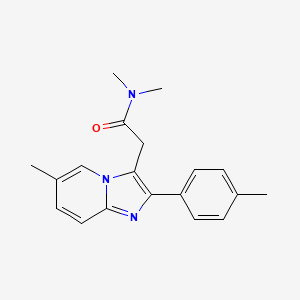
| Formula | C19H21N3O |
|---|---|
| Molecular weight | 307.4 g/mol |
| IUPAC name | N,N-dimethyl-2-[6-methyl-2-(4-methylphenyl)imidazo[1,2-a]pyridin-3-yl]acetamide |
| CAS | 82626-48-0 |
| PubChem CID | 5732 |
| InChIKey | ZAFYATHCZYHLPB-UHFFFAOYSA-N |
| logP | 3.25 (XLogP 2.5) |
| Polar surface area | 37.61 Ų |
| H-bond acceptors / donors | 3 / 0 |
| Drug-likeness (QED) | 0.74 |
| Lipinski violations | 0 |
SMILES
Cc1ccc(-c2nc3ccc(C)cn3c2CC(=O)N(C)C)cc1Biology & Pharmacokinetics
Pharmacokinetics
| BBB penetrant | Yes (logBB -0.48) |
|---|
Enzyme interactions
| Enzyme | Role | Detail |
|---|---|---|
| CYP1A2 | Substrate | — |
| CYP2C19 | Substrate | — |
| CYP2C9 | Substrate | — |
| CYP2D6 | Substrate | — |
| CYP3A4 | Substrate | — |
Receptor binding (top 9)
| Target | Action | Affinity |
|---|---|---|
| GABA A alpha1 | Binding | pKi 7.6 |
| GABA A Alpha1Beta3Gamma2 | Binding | pKi 7.5 |
| GABA A Alpha1Beta1Gamma2 | Binding | pKi 7.0 |
| GABA A alpha2 | Binding | pKi 6.8 |
| GABA A alpha3 | Binding | pKi 6.4 |
| GABAA receptor α2 subunit (GABRA2) | Allosteric modulator | pKi 6.1 |
| GABA A Alpha2Beta1Gamma2 | Binding | pKi 6.1 |
| GABAA receptor α3 subunit (GABRA3) | Allosteric modulator | pKi 5.7 |
| GABA A Alpha3Beta1Gamma2 | Binding | pKi 5.7 |
Transporters
BCRP (Inhibitor)BSEP (Inhibitor)BSEP (Inhibitor)MDR1 (Inhibitor)MRP1 (Inhibitor)MRP2 (Inhibitor)MRP4 (Inhibitor)OATP1B1 (Inhibitor)OATP1B3 (Inhibitor)OATP1B3 (Inhibitor)OCT2 (Inhibitor)P-gp (Inhibitor)MDR1 (Substrate)P-gp (Substrate)
Drug–drug interactions (92, DDInter)
| Interacting drug | Severity | Management |
|---|---|---|
| Codeine | major | |
| Hydrocodone | major | |
| Morphine | major | |
| Morphine (liposomal) | major | |
| Aldesleukin | moderate | |
| Alimemazine | moderate | |
| Alpelisib | moderate | |
| Aminoglutethimide | moderate | |
| Amyl Nitrite | moderate | |
| Anagrelide | moderate | |
| Apalutamide | moderate | |
| Aprepitant | moderate | |
| Azatadine | moderate | |
| Bexarotene | moderate | |
| Brigatinib | moderate | |
| Brimonidine (ophthalmic) | moderate | |
| Brimonidine (topical) | moderate | |
| Brompheniramine | moderate | |
| Bupropion | moderate | |
| Carbinoxamine | moderate | |
| Ceritinib | moderate | |
| Cetirizine | moderate | |
| Chlorphenesin | moderate | |
| Chlorpheniramine | moderate | |
| Cimetidine | moderate | |
| Clarithromycin | moderate | |
| Clemastine | moderate | |
| Clofedanol | moderate | |
| Clotrimazole | moderate | |
| Cobicistat | moderate | |
| Cyclizine | moderate | |
| Cyproheptadine | moderate | |
| Dabrafenib | moderate | |
| Dasatinib | moderate | |
| Deferasirox | moderate | |
| Dexamethasone | moderate | |
| Dexbrompheniramine | moderate | |
| Dextromethorphan | moderate | |
| Diazoxide | moderate | |
| Diphenhydramine | moderate |
Showing 40 of 92.
Registered Products (4)
| Brand | Form / strength | Pack | Agent | Citizen (JOD) |
|---|---|---|---|---|
| Stilnox Tab | Tablet 10 mg | 14 tab pack varies | Ulfa Pharma Co. | 1.720 |
| Inso-N | Tablet 10 mg | 20 tab | Hikma Pharmaceuticals Co.Ltd/Jordan | 2.300 |
| Inso-N | Tablet 5 mg | 20 tab | Hikma Pharmaceuticals Co.Ltd/Jordan | 2.300 |
| Stilnox Tab | Tablet 10 mg | 20 tab pack varies | Ulfa Pharma Co. | 2.460 |