Orlistat
JFDA label: Unical
Mechanism of Action
Inhibitor of Gastric triacylglycerol lipase — Gastric lipase inhibitor; Inhibitor of Pancreatic triacylglycerol lipase — Pancreatic lipase inhibitor
| Target | Action | Gene / class |
|---|---|---|
| Gastric triacylglycerol lipase efficacy | INHIBITOR | LIPF |
| Pancreatic triacylglycerol lipase efficacy | INHIBITOR | PNLIP |
Indications
Approved
- OTC
- Obesity management
- Rx
Contraindications
Source: Lexicomp
- Hypersensitivity to orlistat or to any component of the formulation Absolute
- cholestasis Absolute
- chronic malabsorption syndrome Absolute
Adverse Reactions
Cardiac disorders (1)
Not Known Pedal edema
Nervous system disorders (4)
Not Known anxiety · fatigue · Headache · sleep disorder
Renal and urinary disorders (2)
Not Known Urinary tract infection · vaginitis
Metabolism and nutrition disorders (2)
Not Known hypoglycemia (in patients with diabetes) · Menstrual disease
Gastrointestinal disorders (15)
Not Known abdominal distension (in patients with diabetes) · abdominal distress · abdominal pain · bowel urgency · cholelithiasis · fecal incontinence · flatulence with discharge · frequent bowel movements · gingival disease · infectious diarrhea · nausea · oily evacuation · Oily rectal leakage · rectal pain · steatorrhea
Skin and subcutaneous tissue disorders (1)
Not Known Xeroderma
Musculoskeletal and connective tissue disorders (3)
Not Known Back pain · leg pain · myalgia
Ear and labyrinth disorders (1)
Not Known Otitis
Infections and infestations (1)
Not Known Influenza
Respiratory, thoracic and mediastinal disorders (2)
Not Known lower respiratory tract infection · Upper respiratory tract infection
Dosing
Source: Lexicomp
Warnings & Precautions
Source: Lexicomp
Cholelithiasis
Substantial weight loss may increase the risk of cholelithiasis.
Hepatotoxicity
Cases of severe liver injury (some fatal) with hepatocellular necrosis or acute hepatic failure have been reported; liver transplantation has been required in some patients. Patients should be instructed to report any symptoms of hepatic impairment (eg, anorexia, pruritus, jaundice, dark urine, light colored stools, right upper quadrant pain); discontinue therapy immediately and obtain liver function tests if symptoms occur.
Increased urinary oxalate
Increased levels of urinary oxalate following treatment may occur in some patients; cases of oxalate nephrolithiasis and oxalate nephropathy with renal failure have been reported. Monitor renal function in patients at risk for renal impairment; use with caution in patients with a history of hyperoxaluria or calcium oxalate nephrolithiasis. Disease-related concerns:
Diabetes
Monitor patients with diabetes closely; weight loss may affect glycemic control. Dosage adjustments of antidiabetic medications may be necessary. Concurrent drug therapy issues:
Drug-drug interactions
Potentially significant interactions may exist, requiring dose or frequency adjustment, additional monitoring, and/or selection of alternative therapy. Consult drug interactions database for more detailed information. Special populations:
Pediatric
When used in adolescents, weight related to growth is accounted for in BMI, therefore, reduction in BMI is a better indicator of weight loss. Other warnings/precautions:
Appropriate use
Prior to use, other causes for obesity (eg, hypothyroidism) should be ruled out. According to Endocrine Society practice guidelines, weight loss medication should be discontinued and alternative treatment considered if weight loss is • Dietary guidelines: Patients should be advised to adhere to dietary guidelines; if taken with a diet high in fat (>30% total daily calories from fat), gastrointestinal adverse events may increase. Distribute daily fat intake over 3 main meals. If taken with any 1 meal very high in fat, the possibility of gastrointestinal effects increases. Counsel patients to take a multivitamin supplement that contains fat-soluble vitamins ≥2 hours before or after orlistat administration to ensure adequate nutrition; orlistat has been shown to reduce the absorption of some fat-soluble vitamins and beta-carotene.
Potential for misuse
The potential exists for misuse in inappropriate patient populations (eg, patients with anorexia nervosa or bulimia) similar to any weight loss agent.
Self-medication (OTC use)
Prior to use, patients should contact their healthcare provider if they have ever had kidney stones, gall bladder disease, or pancreatitis. Patients taking medications for diabetes or thyroid disease, seizures, anticoagulants, or other weight-loss products should consult their healthcare provider or pharmacist before use. Patients who have had an organ transplant should not use orlistat. If severe and/or continuous abdominal pain, itching, yellowing of the eyes or skin, dark urine, loss of appetite occurs, or seizures worsen, use should be discontinued and healthcare provider consulted.
Pregnancy & Lactation
Pregnancy
Adverse events have not been observed in animal reproduction studies. Although orlistat is minimally absorbed, weight-loss therapy is not recommended for pregnant women. Obese and overweight women should be encouraged to participate in weight reduction programs prior to attempting pregnancy; weight gain during pregnancy should be determined by their prepregnancy BMI and current guidelines (ADA, 2009; IOM, 2009). Use of orlistat is contraindicated in pregnant women.
Lactation
It is not known if orlistat is excreted in breast milk. Weight-loss therapy is generally not recommended for lactating women. Weight-loss programs which include physical activity and nutrition components should be discussed at the 6-week postpartum visit (ADA, 2009; IOM, 2009).
Monitoring
| Clinical pearl | BMI; diet (calorie and fat intake); serum glucose in patients with diabetes; thyroid function in patient with thyroid disease; liver function tests in patients exhibiting symptoms of hepatic impairment; renal function in patients at risk for renal impairment. |
|---|
Chemistry & Properties
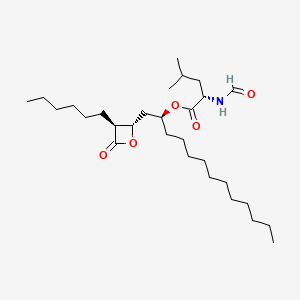
| Formula | C29H53NO5 |
|---|---|
| Molecular weight | 495.75 g/mol |
| IUPAC name | [(2S)-1-[(2S,3S)-3-hexyl-4-oxooxetan-2-yl]tridecan-2-yl] (2S)-2-formamido-4-methylpentanoate |
| CAS | 96829-58-2 |
| PubChem CID | 3034010 |
| InChIKey | AHLBNYSZXLDEJQ-FWEHEUNISA-N |
| logP | 6.88 (XLogP 10.0) |
| Polar surface area | 81.7 Ų |
| H-bond acceptors / donors | 5 / 1 |
| Drug-likeness (QED) | 0.09 |
| Lipinski violations | 1 |
SMILES
CCCCCCCCCCC[C@@H](C[C@@H]1OC(=O)[C@H]1CCCCCC)OC(=O)[C@H](CC(C)C)NC=OBiology & Pharmacokinetics
Pharmacokinetics predicted
| Bioavailability | 70.0% |
|---|---|
| Half-life | 1.179 h |
| Volume of distribution | 16.579 L/kg |
| Protein binding | 99.6% |
| BBB penetrant | No |
Enzyme interactions
| Enzyme | Role | Detail |
|---|---|---|
| CYP2B6 | Inhibitor | — |
| CYP2C19 | Inhibitor | — |
| CYP2C8 | Inhibitor | — |
| CYP2C9 | Inhibitor | — |
| CYP2C9 | Substrate | — |
| CYP3A4 | Inhibitor | — |
Receptor binding (top 6)
| Target | Action | Affinity |
|---|---|---|
| pancreatic lipase (PNLIP) | Inhibitor | pIC50 8.9 |
| diacylglycerol lipase α (DAGLA) | Inhibitor | pIC50 7.2 |
| αβ-Hydrolase 12 (ABHD12) | Inhibitor | pIC50 7.1 |
| diacylglycerol lipase β (DAGLB) | Inhibitor | pIC50 7.0 |
| fatty acid synthase (FASN) | Inhibitor | pKi 6.6 |
| fatty acid synthase (FASN) | Inhibitor | pIC50 5.9 |
Transporters
BCRP (Inhibitor)BSEP (Inhibitor)BSEP (Inhibitor)MDR1 (Inhibitor)MRP1 (Inhibitor)MRP2 (Inhibitor)MRP3 (Inhibitor)MRP4 (Inhibitor)OATP1B1 (Inhibitor)OATP1B3 (Inhibitor)OATP1B3 (Inhibitor)P-gp (Inhibitor)P-gp (Substrate)
Drug–drug interactions (100+, DDInter)
| Interacting drug | Severity | Management |
|---|---|---|
| Cyclosporine | major | |
| Leflunomide | major | |
| Lomitapide | major | |
| Mipomersen | major | |
| Pexidartinib | major | |
| Teriflunomide | major | |
| Triheptanoin | major | |
| Abacavir | moderate | |
| Acarbose | moderate | |
| Acetohexamide | moderate | |
| Albiglutide | moderate | |
| Alogliptin | moderate | |
| Amiodarone | moderate | |
| Amprenavir | moderate | |
| Anisindione | moderate | |
| Asparaginase Erwinia chrysanthemi | moderate | |
| Asparaginase Escherichia coli | moderate | |
| Atazanavir | moderate | |
| Bedaquiline | moderate | |
| Boceprevir | moderate | |
| Brentuximab vedotin | moderate | |
| Calaspargase pegol | moderate | |
| Canagliflozin | moderate | |
| Cannabidiol | moderate | |
| Chlorpropamide | moderate | |
| Clofarabine | moderate | |
| Dapagliflozin | moderate | |
| Darunavir | moderate | |
| Dicoumarol | moderate | |
| Didanosine | moderate | |
| Dolutegravir | moderate | |
| Dulaglutide | moderate | |
| Efavirenz | moderate | |
| Elvitegravir | moderate | |
| Empagliflozin | moderate | |
| Emtricitabine | moderate | |
| Entecavir | moderate | |
| Epirubicin | moderate | |
| Ertugliflozin | moderate | |
| Etravirine | moderate |
Showing 40 of 100+.
Registered Products (6)
| Brand | Form / strength | Pack | Agent | Citizen (JOD) |
|---|---|---|---|---|
| Unical | Tablet 120 mg | 30 tab | UNITED PHARM.MFG.CO.LTD(UPM)/JORDAN | 11.220 |
| Onlefit | Capsule 120 mg | 40 cap | Hikma Pharmaceuticals Co.Ltd/Jordan | 14.960 |
| Otrim | Tablet 120 mg | 40 tab | Hayat Pharmaceutical Industries CO.PLC/JORDAN | 14.960 |
| Refit | Capsule 120 mg | 40 cap | Pharma International Company/ Jordan | 14.960 |
| Alli | Capsule 60 mg | 60 cap pack varies | Sukhtian Group | 18.240 |
| Alli | Capsule 60 mg | 120 cap pack varies | Sukhtian Group | 36.460 |