Calcitriol
JFDA label: ROCALTROL CAP
Mechanism of Action
Agonist of Vitamin D3 receptor — Vitamin D receptor agonist
| Target | Action | Gene / class |
|---|---|---|
| Vitamin D3 receptor efficacy | AGONIST | VDR |
Indications
Approved
- Hypocalcemia — Hypocalcemia
- Hypoparathyroidism — hypoparathyroidism
- Kidney Failure, Chronic — chronic kidney disease
- Psoriasis — psoriasis
Off-label
- Acute Kidney Injury
- Adenomatous Polyposis Coli
- Breast Neoplasms
- Carcinoma, Basal Cell
- Cholangiocarcinoma
- Chronic Kidney Disease-Mineral and Bone Disorder
- Diabetes Mellitus, Type 1
- Diabetic Nephropathies
- Fibroma
- Hyperparathyroidism, Secondary
- Hypertension
- Klinefelter Syndrome
- Lupus Erythematosus, Systemic
- Myelodysplastic Syndromes
- Osteopetrosis
- Osteoporosis
- Pancreatic Neoplasms
- Prostatic Neoplasms
- Prostatic Neoplasms, Castration-Resistant
- Sepsis
- Severe Acute Respiratory Syndrome
Contraindications
Source: openFDA
- Calcitriol Oral Solution should not be given to patients with hypercalcemia or evidence of vitamin D toxicity. Use of Calcitriol Oral Solution in patients with known hypersensitivity to Calcitriol Oral Solution (or drugs of the same class) or any of the inactive ingredients is contraindicated. Absolute
Adverse Reactions
Nervous system disorders (2)
Not Known Headache · Somnolence
Metabolism and nutrition disorders (1)
Not Known Weight Loss
Gastrointestinal disorders (8)
Not Known Abdominal Pain Or Stomach Ache Late Polyuria · And Anorexia · Anorexia · Constipation · Dry Mouth · Nausea · Pancreatitis · Vomiting
Skin and subcutaneous tissue disorders (1)
Not Known Pruritus
Musculoskeletal and connective tissue disorders (1)
Not Known Bone Pain
Eye disorders (2)
Not Known Conjunctivitis Calcific · Photophobia
General disorders and administration site conditions (5)
Not Known Metallic Taste · Muscle Pain · Nocturia · Polydipsia · Weakness
Respiratory, thoracic and mediastinal disorders (1)
Not Known Rhinorrhea
Dosing
Source: openFDA
Warnings & Precautions
Source: openFDA
Warnings & Precautions
Overdosage of any form of vitamin D is dangerous (see OVERDOSAGE ). Progressive hypercalcemia due to overdosage of vitamin D and its metabolites may be so severe as to require emergency attention. Chronic hypercalcemia can lead to generalized vascular calcification, nephrocalcinosis and other soft-tissue calcification. The serum calcium times phosphate (Ca x P) product should not be allowed to exceed 70 mg 2 /dL 2 . Radiographic evaluation of suspect anatomical regions may be useful in the early detection of this condition. Calcitriol Oral Solution is the most potent metabolite of vitamin D available. The administration of Calcitriol Oral Solution to patients in excess of their daily requirements can cause hypercalcemia, hypercalciuria, and hyperphosphatemia. Therefore, pharmacologic doses of vitamin D and its derivatives should be withheld during Calcitriol Oral Solution treatment to avoid possible additive effects and hypercalcemia. If treatment is switched from ergocalciferol (vitamin D 2 ) to calcitriol, it may take several months for the ergocalciferol level in the blood to return to the baseline value (see OVERDOSAGE ). Calcitriol increases inorganic phosphate levels in serum. While this is desirable in patients with hypophosphatemia, caution is called for in patients with renal failure because of the danger of ectopic calcification. A nonaluminum phosphate-binding compound and a low-phosphate diet should be used to control serum phosphorus levels in patients undergoing dialysis. Magnesium-containing preparations (eg, antacids) and Calcitriol Oral Solution should not be used concomitantly in patients on chronic renal dialysis because such use may lead to the development of hypermagnesemia. Studies in dogs and rats given calcitriol for up to 26 weeks have shown that small increases of calcitriol above endogenous levels can lead to abnormalities of calcium metabolism with the potential for calcification of many tissues in the body.
Pregnancy & Lactation
Pregnancy
Lactation
If the mother requires calcitriol, it is not a reason to discontinue breastfeeding.
Chemistry & Properties
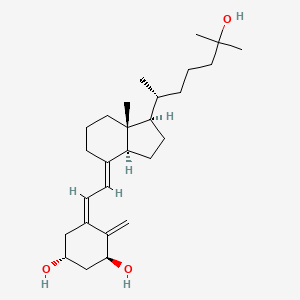
| Formula | C27H44O3 |
|---|---|
| Molecular weight | 416.65 g/mol |
| IUPAC name | trans-(1R,3S,5Z)-5-[(2E)-2-[(1R,3aS,7aR)-1-[(2R)-6-hydroxy-6-methylheptan-2-yl]-7a-methyl-2,3,3a,5,6,7-hexahydro-1H-inden-4-ylidene]ethylidene]-4-methylidenecyclohexane-1,3-diol |
| CAS | 32222-06-3 |
| PubChem CID | 5280453 |
| InChIKey | GMRQFYUYWCNGIN-NKMMMXOESA-N |
| logP | 5.7 (XLogP 5.1) |
| Polar surface area | 60.69 Ų |
| H-bond acceptors / donors | 3 / 3 |
| Drug-likeness (QED) | 0.52 |
| Lipinski violations | 1 |
SMILES
C=C1/C(=C\C=C2/CCC[C@]3(C)[C@@H]([C@H](C)CCCC(C)(C)O)CC[C@@H]23)C[C@@H](O)C[C@@H]1OBiology & Pharmacokinetics
Pharmacokinetics
| BBB penetrant | No |
|---|
Enzyme interactions
| Enzyme | Role | Detail |
|---|---|---|
| CYP2B6 | Inhibitor | — |
| CYP2C8 | Inhibitor | — |
| CYP3A4 | Substrate | — |
Transporters
BCRP (Inhibitor)BSEP (Inhibitor)BSEP (Inhibitor)MRP1 (Inhibitor)MRP2 (Inhibitor)MRP3 (Inhibitor)OATP1B1 (Inhibitor)OATP1B3 (Inhibitor)OATP2B1 (Inhibitor)P-gp (Inhibitor)P-gp (Substrate)
Drug–drug interactions (55, DDInter)
| Interacting drug | Severity | Management |
|---|---|---|
| Burosumab | major | |
| Calcifediol | major | |
| Cholecalciferol | major | |
| Dihydrotachysterol | major | |
| Doxercalciferol | major | |
| Erdafitinib | major | |
| Ergocalciferol | major | |
| Paricalcitol | major | |
| Aluminum hydroxide | moderate | |
| Amobarbital | moderate | |
| Bendroflumethiazide | moderate | |
| Benzthiazide | moderate | |
| Butabarbital | moderate | |
| Butalbital | moderate | |
| Calcipotriol (topical) | moderate | |
| Carbamazepine | moderate | |
| Chlorothiazide | moderate | |
| Chlorthalidone | moderate | |
| Cholestyramine | moderate | |
| Colesevelam | moderate | |
| Colestipol | moderate | |
| Digitoxin | moderate | |
| Digoxin | moderate | |
| Felbamate | moderate | |
| Fosphenytoin | moderate | |
| Hydrochlorothiazide | moderate | |
| Hydroflumethiazide | moderate | |
| Indapamide | moderate | |
| Isoniazid | moderate | |
| Magnesium carbonate | moderate | |
| Magnesium chloride | moderate | |
| Magnesium citrate | moderate | |
| Magnesium gluconate | moderate | |
| Magnesium glycinate | moderate | |
| Magnesium hydroxide | moderate | |
| Magnesium oxide | moderate | |
| Magnesium sulfate | moderate | |
| Methylphenobarbital | moderate | |
| Metolazone | moderate | |
| Mineral oil | moderate |
Showing 40 of 55.
Registered Products (1)
| Brand | Form / strength | Pack | Agent | Citizen (JOD) |
|---|---|---|---|---|
| ROCALTROL CAP | Capsule 0.25 mcg | 100 cap | Shawi & Rushedat Drug Store | 17.960 |