Indapamide
JFDA label: Natrilix SR Tab
Mechanism of Action
Inhibitor of Solute carrier family 12 member 3 — Thiazide-sensitive sodium-chloride cotransporter inhibitor
| Target | Action | Gene / class |
|---|---|---|
| Solute carrier family 12 member 3 efficacy | INHIBITOR | SLC12A3 |
Indications
Approved
- Chronic kidney disease (CKD) and hypertension
- Coronary artery disease (CAD) and hypertension
- Diabetes and hypertension
- Heart failure
- Hypertension
Off-label
- Calcium nephrolithiasis
Contraindications
Source: Lexicomp
- Additional contraindications (not in U.S. labeling): Severe renal failure (CrCl Absolute
- Hypersensitivity to indapamide or any component of the formulation or sulfonamide-derived drugs Absolute
- anuria Note: Although the FDA approved product labeling states this medication is contraindicated with other sulfonamide-containing drug classes, the scientific basis of this statement has been challenged. See “Warnings/Precautions” for more detail Absolute
Adverse Reactions
Nervous system disorders (17)
Common Agitation · anxiety · Depression · dizziness · drowsiness · fatigue · headache · hypertonia · insomnia · irritability · lethargy · malaise · nervousness (dose-dependent) · pain · paresthesia · tension · vertigo
Renal and urinary disorders (4)
Common Increased blood urea nitrogen · increased serum creatinine · Nocturia · polyuria
Metabolism and nutrition disorders (8)
Common Decreased libido · glycosuria · hyperglycemia · hyperuricemia · hypochloremia · Hypokalemia (Infection: Infection · hyponatremia · weight loss
Gastrointestinal disorders (10)
Common Abdominal cramps · abdominal pain · anorexia · constipation · diarrhea · dyspepsia · gastric irritation · nausea · vomiting · xerostomia
Skin and subcutaneous tissue disorders (3)
Common Pruritus · skin rash · urticaria
Musculoskeletal and connective tissue disorders (4)
Common Back pain · muscle cramps · muscle spasm · weakness
Eye disorders (2)
Common Blurred vision · conjunctivitis
Respiratory, thoracic and mediastinal disorders (6)
Common Cough · flu-like symptoms · pharyngitis · Rhinitis · rhinorrhea · sinusitis
Other (8)
Common Cardiac arrhythmia · chest pain · flushing · orthostatic hypotension · palpitations · peripheral edema · vasculitis · ventricular premature contractions
Dosing
Source: Lexicomp
Warnings & Precautions
Source: Lexicomp
Electrolyte disturbances
Severe hyponatremia with hypokalemia has been reported at recommended doses (particularly in elderly women); risk may be dose dependent, therefore, use lowest dose possible. Hypochloremic alkalosis, hypomagnesemia, or hypercalcemia can also occur; monitor electrolytes periodically during therapy.
Photosensitivity
Photosensitization may occur.
Sulfonamide (“sulfa”) allergy
The FDA-approved product labeling for many medications containing a sulfonamide chemical group includes a broad contraindication in patients with a prior allergic reaction to sulfonamides. There is a potential for cross-reactivity between members of a specific class (eg, two antibiotic sulfonamides). However, concerns for cross-reactivity have previously extended to all compounds containing the sulfonamide structure (SO2NH2). An expanded understanding of allergic mechanisms indicates cross-reactivity between antibiotic sulfonamides and nonantibiotic sulfonamides may not occur or at the very least this potential is extremely low (Brackett 2004; Johnson 2005; Slatore 2004; Tornero 2004). In particular, mechanisms of cross-reaction due to antibody production (anaphylaxis) are unlikely to occur with nonantibiotic sulfonamides. T-cell-mediated (type IV) reactions (eg, maculopapular rash) are less well understood and it is not possible to completely exclude this potential based on current insights. In cases where prior reactions were severe (Stevens-Johnson syndrome/TEN), some clinicians choose to avoid exposure to these classes. Disease-related concerns:
Adrenal insufficiency
Avoid use of diuretics for treatment of elevated blood pressure in patients with primary adrenal insufficiency (Addison disease). Adjustment of glucocorticoid/mineralocorticoid therapy and/or use of other antihypertensive agents is preferred to treat hypertension (Bornstein 2016; Inder 2015).
Diabetes
Use with caution in patients with prediabetes or diabetes mellitus; may see a change in glucose control.
Gout
In certain patients with a history of gout, a familial predisposition to gout, or chronic renal failure, gout can be precipitated.
Hepatic impairment
Use with caution in patients with severe hepatic dysfunction; in cirrhosis, avoid electrolyte and acid/base imbalances that might lead to hepatic encephalopathy.
Hypercholesterolemia
Use with caution in patients with moderate or high cholesterol concentrations; thiazide diuretics have been shown to increase cholesterol concentrations; however, indapamide (a thiazide-like diuretic) has not been shown to adversely affected lipids.
Hypokalemia
Use with caution in patients with hypokalemia; correct before initiating therapy.
Renal impairment
Use with caution in severe renal disease.
Systemic lupus erythematosus (SLE)
Can cause SLE exacerbation or activation. Dosage forms specific issues:
Lactose
Formulation may contain lactose.
Pregnancy & Lactation
Pregnancy
Adverse events were not observed in animal reproduction studies. Diuretics cross the placenta and are found in cord blood. Maternal use may cause may cause fetal or neonatal jaundice, thrombocytopenia, or other adverse events observed in adults. Use of diuretics during normal pregnancies is not appropriate; use may be considered when edema is due to pathologic causes (as in the nonpregnant patient); monitor.
Lactation
It is not known if indapamide is excreted in breast milk. If therapy is needed, the manufacturer recommends that nursing be discontinued.
Monitoring
| Clinical pearl | Blood pressure (both standing and sitting/supine); serum electrolytes, hepatic function, renal function, uric acid; assess weight, I & O reports daily to determine fluid loss |
|---|
Chemistry & Properties
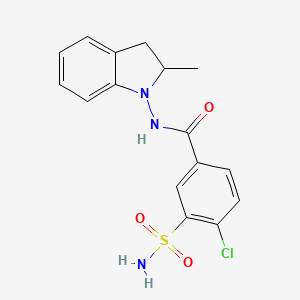
| Formula | C16H16ClN3O3S |
|---|---|
| Molecular weight | 365.84 g/mol |
| IUPAC name | 4-chloro-N-(2-methyl-2,3-dihydroindol-1-yl)-3-sulfamoylbenzamide |
| CAS | 26807-65-8 |
| PubChem CID | 3702 |
| InChIKey | NDDAHWYSQHTHNT-UHFFFAOYSA-N |
| logP | 2.08 (XLogP 2.9) |
| Polar surface area | 92.5 Ų |
| H-bond acceptors / donors | 4 / 2 |
| Drug-likeness (QED) | 0.87 |
| Lipinski violations | 0 |
SMILES
CC1Cc2ccccc2N1NC(=O)c1ccc(Cl)c(S(N)(=O)=O)c1Biology & Pharmacokinetics
Pharmacokinetics
| BBB penetrant | No |
|---|
Enzyme interactions
| Enzyme | Role | Detail |
|---|---|---|
| CYP2C8 | Inhibitor | — |
Receptor binding (top 1)
| Target | Action | Affinity |
|---|---|---|
| N-Acylphosphatidylethanolamine-phospholipase D (NAPEPLD) | Allosteric modulator | pKd 6.2 |
Transporters
ASBT (Inhibitor)BCRP (Inhibitor)BSEP (Inhibitor)BSEP (Inhibitor)MRP1 (Inhibitor)MRP2 (Inhibitor)MRP3 (Inhibitor)MRP4 (Inhibitor)OAT3 (Inhibitor)OATP1B1 (Inhibitor)OATP1B1 (Inhibitor)OATP1B3 (Inhibitor)OATP1B3 (Inhibitor)P-gp (Inhibitor)P-gp (Substrate)
Drug–drug interactions (100+, DDInter)
| Interacting drug | Severity | Management |
|---|---|---|
| Aminolevulinic acid | major | |
| Arsenic trioxide | major | |
| Cisapride | major | |
| Dolasetron | major | |
| Acarbose | moderate | |
| Acetohexamide | moderate | |
| Albiglutide | moderate | |
| Aldesleukin | moderate | |
| Alimemazine | moderate | |
| Alogliptin | moderate | |
| Amifostine | moderate | |
| Aminolevulinic acid (topical) | moderate | |
| Amphotericin B | moderate | |
| Amphotericin B (cholesteryl sulfate) | moderate | |
| Amphotericin B (lipid complex) | moderate | |
| Amphotericin B (liposomal) | moderate | |
| Beclomethasone dipropionate | moderate | |
| Betamethasone | moderate | |
| Bisacodyl | moderate | |
| Brimonidine (ophthalmic) | moderate | |
| Brimonidine (topical) | moderate | |
| Bupropion | moderate | |
| Calcifediol | moderate | |
| Calcipotriol (topical) | moderate | |
| Calcitriol | moderate | |
| Calcitriol (topical) | moderate | |
| Calcium Phosphate | moderate | |
| Calcium acetate | moderate | |
| Calcium carbonate | moderate | |
| Calcium chloride | moderate | |
| Calcium citrate | moderate | |
| Calcium glubionate anhydrous | moderate | |
| Calcium glucoheptonate | moderate | |
| Calcium gluconate | moderate | |
| Calcium lactate | moderate | |
| Canagliflozin | moderate | |
| Capecitabine | moderate | |
| Castor oil | moderate | |
| Celecoxib | moderate | |
| Chlorpropamide | moderate |
Showing 40 of 100+.
Registered Products (13)
| Brand | Form / strength | Pack | Agent | Citizen (JOD) |
|---|---|---|---|---|
| Dapamix S.R | Tablet 1.5 mg | 30 tab pack varies | Al-Taqqadom Pharmaceutical Industries | 3.550 |
| Inzide | Tablet 1.5 mg | 30 tab | United Pharmaceutical | 3.550 |
| Pharmalix SR | Tablet 1.5 mg | 30 tab | Pharma International Company/ Jordan | 3.550 |
| Bi-Preterax Arginine | Tablet 1.25 mg, 5 mg | 30 tab | The Jordan Drugstore Co | 3.930 |
| Natrilix SR Tab | Tablet 1.5 mg | 30 tab | The Jordan Drugstore Co | 3.980 |
| Bi-Preterax Arginine 10mg/2.5mg | Tablet 2.5 mg, 10 mg | 30 tab | The Jordan Drugstore Co | 6.450 |
| Triplixam 5mg/1.25mg/5mg | Tablet 1.25 mg, 5 mg, 5 mg | 30 tab | The Jordan Drugstore Co | 7.030 |
| Triplixam 5mg /1.25mg /10 mg | Film-Coated Tablet 1.25 mg, 10 mg, 5 mg | 30 Film | The Jordan Drugstore Co | 7.100 |
| Natrixam 1.5mg/10mg | Tablet 1.5 mg, 10 mg | 30 tab | The Jordan Drugstore Co | 7.990 |
| Natrixam 1.5mg/5mg | Tablet 1.5 mg, 5 mg | 30 tab | The Jordan Drugstore Co | 7.990 |
| Triplixam 10mg/2.5mg/10mg | Tablet 2.5 mg, 10 mg, 10 mg | 30 tab | The Jordan Drugstore Co | 13.930 |
| Triplixam 10mg/2.5mg/5mg | Tablet 2.5 mg, 5 mg, 10 mg | 30 tab | The Jordan Drugstore Co | 13.930 |
| Dapamix S.R | Tablet 1.5 mg | 1000 tab pack varies | Al-Taqqadom Pharmaceutical Industries | 100.580 |