Prasugrel
Active form: R-138727.
JFDA label: Lexar 10 mg
- Bleeding risk:
Mechanism of Action
Prasugrel, an inhibitor of platelet activation and aggregation, is a prodrug that is metabolized to both active (R-138727) and inactive metabolites. The active metabolite irreversibly blocks the P2Y12 component of ADP receptors on the platelet, which prevents activation of the GPIIb/IIIa receptor complex, thereby reducing platelet activation and aggregation
Indications
Approved
- Acute coronary syndrome to be managed with percutaneous coronary intervention (PCI)
Contraindications
Source: Lexicomp
- Hypersensitivity (eg, anaphylaxis) to prasugrel or any component of the formulation Absolute
- active pathological bleeding (eg, peptic ulcer, intracranial hemorrhage) Absolute
- prior TIA or stroke Absolute
Adverse Reactions
Cardiac disorders (5)
Common atrial fibrillation · bradycardia · Hypertension · hypotension · peripheral edema
Nervous system disorders (4)
Common dizziness · fatigue · Headache · noncardiac chest pain
Blood and lymphatic system disorders (5)
Common anemia · Leukopenia · major hemmorhage · major hemorrhage · minor hemorrhage
Metabolism and nutrition disorders (2)
Common Hypercholesterolemia · hyperlipidemia
Gastrointestinal disorders (3)
Common diarrhea · gastrointestinal hemorrhage · Nausea
Skin and subcutaneous tissue disorders (1)
Common Skin rash
Musculoskeletal and connective tissue disorders (2)
Common Back pain · limb pain
General disorders and administration site conditions (1)
Common Fever
Respiratory, thoracic and mediastinal disorders (3)
Common cough · dyspnea · Epistaxis
Dosing
Source: Lexicomp
Warnings & Precautions
Source: Lexicomp
Bleeding
May cause significant, sometimes fatal, bleeding. Do not use prasugrel in patients with active pathological bleeding or a history of TIA or stroke. Additional risk factors for bleeding include body weight Management of bleeding episodes includes the use of PRBCs and platelet transfusion.
Hypersensitivity
Hypersensitivity, including angioedema, has been reported, including in patients with a previous history of thienopyridine hypersensitivity. Because of structural similarities, cross-reactivity is possible among the thienopyridines (clopidogrel, prasugrel, and ticlopidine); use with caution or avoid in patients with previous history of thienopyridine hypersensitivity. Use of prasugrel is contraindicated in patients with hypersensitivity (eg, anaphylaxis) to prasugrel.
Thrombotic thrombocytopenic purpura (TTP)
Cases of TTP (usually occurring within the first 2 weeks of therapy), resulting in some fatalities, have been reported with prasugrel; urgent plasmapheresis is required. Disease-related concerns:
GI disease
Use with caution in patients with recent or recurrent GI bleeding or active peptic ulcer disease (patients are generally at higher risk of bleeding).
Hepatic impairment
Use with caution in patients with severe hepatic impairment (patients are generally at higher risk of bleeding).
Renal impairment
Use with caution in patients with moderate to severe renal impairment (patients are generally at higher risk of bleeding). Concurrent drug therapy issues:
Drug-drug interactions
Potentially significant interactions may exist, requiring dose or frequency adjustment, additional monitoring, and/or selection of alternative therapy. Consult drug interactions database for more detailed information. Special populations:
Elderly
In patients ≥75 years, use is generally not recommended due to increased risk of fatal and intracranial bleeding and uncertain benefit, except in high-risk situations (patients with diabetes or a history of MI) in which its effect appears to be greater and its use may be considered.
Lower GI bleed patients
An individualized and multidisciplinary approach should be utilized to determine therapy discontinuation and management in patients with acute lower GI bleed (LGIB) who are on antiplatelet medications; risk of ongoing bleeding should be weighed with risk of thromboembolic events. In patients receiving dual antiplatelet therapy (aspirin plus P2Y12 receptor blocker [eg, clopidogrel, prasugrel, ticagrelor, ticlopidine]) or thienopyridine monotherapy, the thienopyridine should generally be resumed as soon as possible and at least within 7 days, taking into account control of bleeding and cardiovascular risk (aspirin should not be discontinued); however, dual antiplatelet therapy should not be discontinued in the 90 days post-acute coronary syndrome or 30 days post-coronary stenting (Strate 2016).
Low-weight patients
In patients weighing • Surgical patients: [US Boxed Warning]: Do not initiate therapy in patients likely to undergo urgent CABG surgery; when possible, discontinue ≥7 days prior to any surgery; increased risk of bleeding. The American College of Chest Physicians (ACCP) recommends discontinuing prasugrel 5 days before surgery (Guyatt 2012). When urgent CABG is necessary, the ACCF/AHA suggests that it may be reasonable to perform surgery within 7 days of discontinuing prasugrel especially if the benefits of prompt revascularization outweigh the risks of bleeding (ACCF/AHA [Hillis 2011]; ACCF/AHA [O’Gara 2013]). Elective noncardiac surgery should not be performed in patients in whom dual antiplatelet therapy (DAPT) will need to be discontinued perioperatively within 30 days following bare metal stent (BMS) placement or within 12 months after drug-eluting stent (DES) placement. In patients undergoing urgent noncardiac surgery during the first 4 to 6 weeks after BMS or DES placement, continue DAPT. In patients with stents undergoing surgery that requires discontinuation of the P2Y12 inhibitor (eg, clopidogrel), continue aspirin and re-start the P2Y12 inhibitor as soon as possible after surgery (ACC/AHA [Fleisher 2014]). Other warnings/precautions:
Drug discontinuation
Discontinue therapy for active bleeding, elective surgery, stroke, or TIA; reinitiate therapy as soon as possible unless patient suffers stroke or TIA where subsequent use is contraindicated; if possible, manage bleeding without discontinuing therapy since premature discontinuation of treatment may cause increased risk for cardiac adverse events; lapses in treatment should be avoided.
Pregnancy & Lactation
Pregnancy
Adverse events have not been observed in animal reproduction studies. Information related to use during pregnancy is limited (Tello-Montoliu, 2012).
Lactation
It is not known if prasugrel is excreted in breast milk. According to the manufacturer, the decision to continue or discontinue breast-feeding during therapy should take into account the risk of infant exposure, the benefits of breast-feeding to the infant, and benefits of treatment to the mother.
LactMed: monitor the infant.
Monitoring
| Clinical pearl | Hemoglobin and hematocrit periodically. |
|---|
Chemistry & Properties
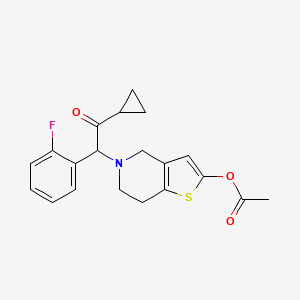
| Formula | C20H20FNO3S |
|---|---|
| Molecular weight | 373.45 g/mol |
| IUPAC name | [5-[2-cyclopropyl-1-(2-fluorophenyl)-2-oxoethyl]-6,7-dihydro-4H-thieno[3,2-c]pyridin-2-yl] acetate |
| CAS | 150322-43-3 |
| PubChem CID | 6918456 |
| InChIKey | DTGLZDAWLRGWQN-UHFFFAOYSA-N |
| logP | 3.89 (XLogP 3.6) |
| Polar surface area | 46.61 Ų |
| H-bond acceptors / donors | 5 / 0 |
| Drug-likeness (QED) | 0.75 |
| Lipinski violations | 0 |
SMILES
CC(=O)Oc1cc2c(s1)CCN(C(C(=O)C1CC1)c1ccccc1F)C2Biology & Pharmacokinetics
Pharmacokinetics
| BBB penetrant | No |
|---|
Enzyme interactions
| Enzyme | Role | Detail |
|---|---|---|
| CYP | Substrate | — |
| CYP1A2 | Substrate | — |
| CYP2B6 | Substrate | — |
| CYP2C19 | Inhibitor | — |
| CYP2C19 | Substrate | — |
| CYP2C8 | Inhibitor | — |
| CYP2C9 | Inhibitor | — |
| CYP2C9 | Substrate | — |
| CYP2D6 | Substrate | — |
| CYP3A4 | Inhibitor | — |
| CYP3A4 | Substrate | — |
| ESTERASE | Substrate | — |
Transporters
BCRP (Inhibitor)BSEP (Inhibitor)MDR1 (Inhibitor)MRP1 (Inhibitor)OATP1B1 (Inhibitor)OATP1B3 (Inhibitor)OATP2B1 (Inhibitor)P-gp (Inhibitor)P-gp (Substrate)
Drug–drug interactions (100+, DDInter)
| Interacting drug | Severity | Management |
|---|---|---|
| Abciximab | major | |
| Acalabrutinib | major | |
| Alteplase | major | |
| Anagrelide | major | |
| Anisindione | major | |
| Anistreplase | major | |
| Antithrombin Alfa | major | |
| Antithrombin III human | major | |
| Apixaban | major | |
| Ardeparin | major | |
| Argatroban | major | |
| Avapritinib | major | |
| Betrixaban | major | |
| Bivalirudin | major | |
| Bromfenac | major | |
| Cabozantinib | major | |
| Cangrelor | major | |
| Caplacizumab | major | |
| Clopidogrel | major | |
| Dalteparin | major | |
| Danaparoid | major | |
| Dasatinib | major | |
| Deferasirox | major | |
| Defibrotide | major | |
| Desirudin | major | |
| Dextran (-1) | major | |
| Dextran (high molecular weight) | major | |
| Dextran (low molecular weight) | major | |
| Diclofenac | major | |
| Dicoumarol | major | |
| Diflunisal | major | |
| Dipyridamole | major | |
| Drotrecogin alfa | major | |
| Edoxaban | major | |
| Enoxaparin | major | |
| Eptifibatide | major | |
| Etodolac | major | |
| Fedratinib | major | |
| Fenoprofen | major | |
| Flurbiprofen | major |
Showing 40 of 100+.
Registered Products (2)
| Brand | Form / strength | Pack | Agent | Citizen (JOD) |
|---|---|---|---|---|
| Lexar | Tablet as HCL 5 mg | 30 tab | UNITED PHARM.MFG.CO.LTD(UPM)/JORDAN | 38.510 |
| Lexar | Tablet as HCL 10 mg | 30 tab | UNITED PHARM.MFG.CO.LTD(UPM)/JORDAN | 42.320 |